
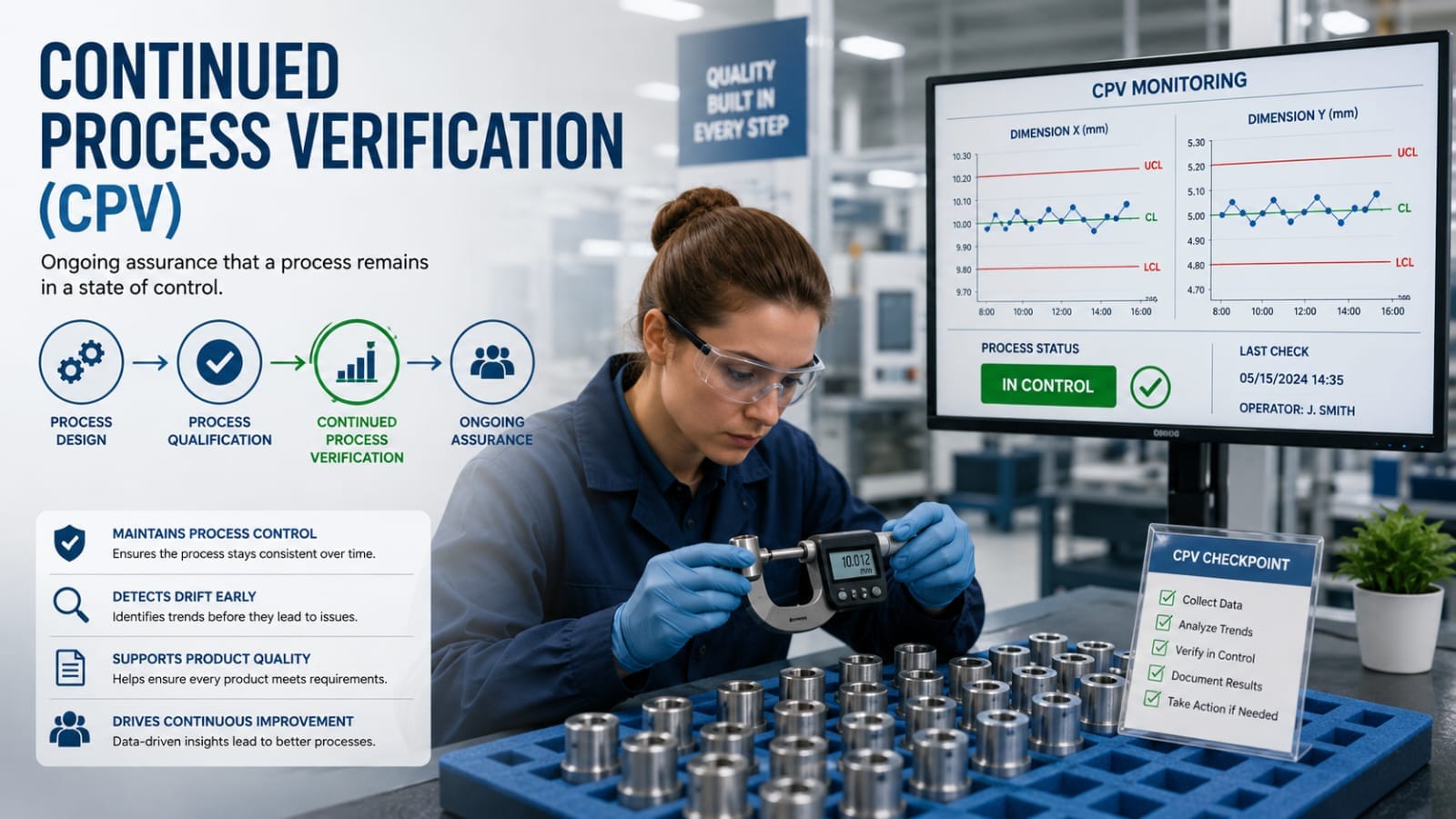
Continued Process Verification (CPV) in Pharmaceuticals – Complete Regulatory Guide
The pharmaceutical industry has evolved significantly from traditional process validation approaches toward a lifecycle-based validation philosophy. One of the most important elements of this lifecycle approach is Continued Process Verification (CPV), which ensures that manufacturing processes remain in a continuous state of control throughout the commercial lifecycle of a product.
Unlike traditional validation, where three successful validation batches were often considered sufficient, modern regulatory agencies expect manufacturers to continuously monitor process performance using scientific data, statistical tools, and risk-based decision-making. CPV enables pharmaceutical companies to identify trends before they become deviations, thereby improving product quality, patient safety, regulatory compliance, and operational efficiency.
This article provides a comprehensive understanding of Continued Process Verification, including regulatory expectations, implementation strategy, statistical techniques, key performance indicators, challenges, and industry best practices.
What is Continued Process Verification (CPV)?
Continued Process Verification (CPV) is the ongoing collection, analysis, and evaluation of manufacturing process data during routine commercial production to confirm that the process consistently produces products meeting predetermined quality attributes.
CPV represents Stage 3 of the FDA Process Validation Lifecycle and is intended to demonstrate that the process remains capable and under statistical control after commercial manufacturing begins.
Rather than validating a process once and assuming it will remain stable indefinitely, CPV continuously verifies process performance throughout the product lifecycle.
The FDA Process Validation Lifecycle
According to the FDA’s 2011 Process Validation Guidance, process validation consists of three interconnected stages:
- Stage 1 – Process Design
Developing a thorough understanding of the manufacturing process based on development studies and scientific knowledge. - Stage 2 – Process Performance Qualification (PPQ)
Demonstrating that the designed process performs reproducibly under commercial manufacturing conditions. - Stage 3 – Continued Process Verification (CPV)
Ongoing assurance that the process remains in a validated state throughout routine production.
CPV is therefore not an optional activity but an essential component of lifecycle process validation.
Objectives of Continued Process Verification
The primary objectives of CPV include:
- Ensure consistent product quality
- Detect process drift early
- Monitor critical quality attributes (CQAs)
- Monitor critical process parameters (CPPs)
- Identify adverse trends before failures occur
- Support continual process improvement
- Reduce batch failures and deviations
- Strengthen regulatory compliance
- Enhance patient safety
- Improve manufacturing efficiency
Regulatory Expectations for CPV
Several global regulatory authorities emphasize lifecycle process validation and ongoing process monitoring.
US FDA
The FDA Process Validation Guidance (2011) clearly states that manufacturers must establish systems for detecting unplanned departures from the process as well as continuously evaluate process performance using statistical methodologies where appropriate.
European Medicines Agency (EMA)
EMA Annex 15 requires ongoing process verification as part of continued assurance that manufacturing processes remain in control during commercial production.
ICH Q8, Q9, Q10 and Q12
ICH guidelines encourage science-based process understanding, quality risk management, pharmaceutical quality systems, and lifecycle management, all of which support implementation of effective CPV programs.
Why Continued Process Verification is Important
Manufacturing processes naturally experience variation over time due to equipment wear, raw material variability, environmental conditions, operator differences, and maintenance activities.
Without continuous monitoring, these variations may gradually affect product quality before traditional quality control testing detects any issue.
CPV enables manufacturers to:
- Detect subtle process changes
- Prevent recurring deviations
- Reduce Out-of-Specification (OOS) results
- Minimize recalls
- Improve process capability
- Support annual product quality reviews
- Generate data for continuous improvement initiatives
Elements of an Effective CPV Program
A successful Continued Process Verification program generally includes the following components:
1. Critical Quality Attributes (CQAs)
CQAs are measurable product characteristics that directly affect product safety, efficacy, purity, identity, and quality.
Examples include:
- Assay
- Dissolution
- Impurity profile
- Content uniformity
- Moisture content
- Sterility
2. Critical Process Parameters (CPPs)
CPPs are process variables that significantly influence CQAs.
Examples include:
- Granulation endpoint
- Mixing time
- Compression force
- Drying temperature
- Coating spray rate
- Pan speed
- Fluid bed airflow
3. Critical Material Attributes (CMAs)
Raw material variability also affects process performance.
Manufacturers should monitor:
- Particle size
- Moisture content
- Bulk density
- Flow properties
- API polymorphic form
Together, CQAs, CPPs, and CMAs form the foundation of an effective CPV strategy.
To be continued in Part 2…
Regulatory Disclaimer: This article is intended solely for educational and informational purposes. It summarizes industry practices and publicly available regulatory concepts related to Continued Process Verification (CPV). Readers should always refer to the latest applicable regulations, guidance documents, pharmacopeial requirements, and internal quality procedures before implementing any regulatory or manufacturing decisions.

About the Author
Mahummed Asif is a pharmaceutical QA professional with sound knowledge in GMP, Product Life Cycle Management, QMS, Product Complaint Management, Change control, risk management, and USFDA audit preparation.
2 thoughts on “Continued Process Verification (CPV) in Pharma”