DSCSA in Pharma – Complete Guide to the Drug Supply Chain Security Act (2026)
Counterfeit medicines, diverted products, stolen drugs, and illegitimate pharmaceuticals pose serious risks to patient safety worldwide. To strengthen the integrity of the pharmaceutical supply chain in the United States, the U.S. Food and Drug Administration (FDA) implemented the Drug Supply Chain Security Act (DSCSA).
The DSCSA establishes a nationwide electronic system for identifying and tracing prescription drugs throughout the supply chain. It requires manufacturers, wholesale distributors, dispensers, repackagers, and third-party logistics providers (3PLs) to exchange product information electronically and verify product authenticity before distribution.
This comprehensive guide explains the DSCSA requirements, implementation process, serialization, verification, electronic interoperability, compliance expectations, and best practices for pharmaceutical companies.
Table of Contents
- What is DSCSA?
- Objectives of DSCSA
- History of DSCSA
- Who Must Comply?
- Key Requirements
- Serialization Requirements
- Product Identifier
- Authorized Trading Partners
- Electronic Traceability
- Verification Requirements
- Implementation Challenges
- Best Practices
- Frequently Asked Questions
What is DSCSA?
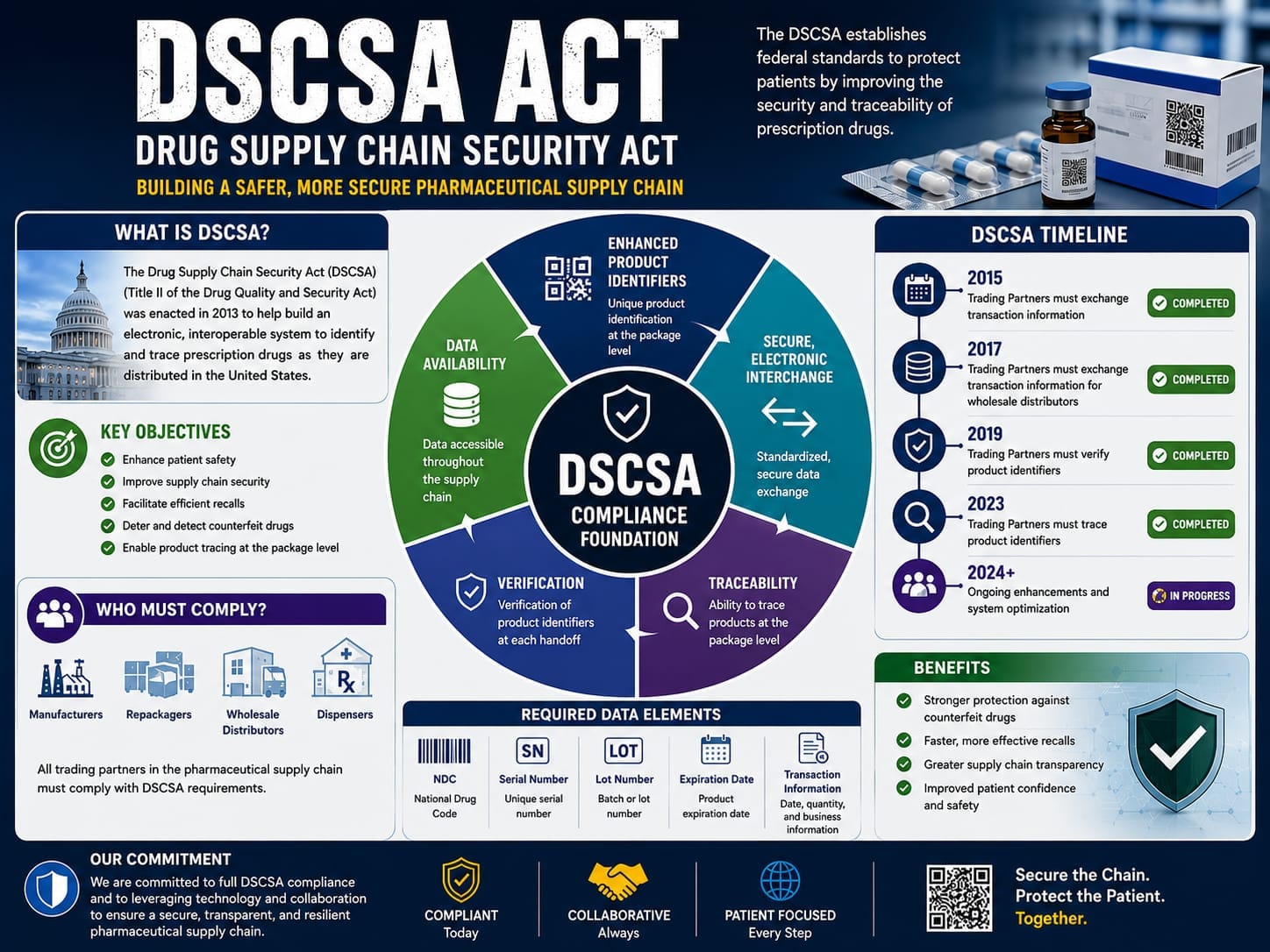
The Drug Supply Chain Security Act (DSCSA) is Title II of the Drug Quality and Security Act (DQSA), signed into law in November 2013. It establishes requirements to build an interoperable system capable of tracing prescription drugs as they move through the U.S. pharmaceutical supply chain.
The primary objective is to prevent counterfeit, stolen, contaminated, or otherwise illegitimate drugs from reaching patients while improving the ability to rapidly detect and remove suspect products from distribution.
The legislation applies to nearly every participant involved in handling prescription drug products distributed in the United States.
Why Was DSCSA Introduced?
Before DSCSA, pharmaceutical supply chains often relied on paper documentation, making it difficult to track product movement accurately. This created opportunities for counterfeit medicines, product diversion, theft, and unauthorized distribution.
Several high-profile incidents involving counterfeit oncology drugs and falsified medicines highlighted weaknesses in supply chain visibility, prompting regulatory authorities to strengthen traceability requirements.
DSCSA addresses these concerns by requiring unique product identification, electronic transaction records, verification capabilities, and enhanced collaboration among trading partners.
Objectives of DSCSA
- Improve patient safety.
- Prevent counterfeit medicines.
- Increase supply chain transparency.
- Enable rapid product recalls.
- Detect suspect and illegitimate products.
- Strengthen pharmaceutical security.
- Support electronic interoperability.
- Improve regulatory oversight.
- Enhance product verification.
- Reduce diversion and theft.
Who Must Comply with DSCSA?
DSCSA requirements apply to multiple entities across the pharmaceutical supply chain.
1. Manufacturers
- Serialize products.
- Generate product identifiers.
- Maintain transaction data.
- Investigate suspect products.
2. Repackagers
- Assign new product identifiers after repackaging.
- Maintain complete transaction history.
- Verify serialized products.
3. Wholesale Distributors
- Accept products only from authorized trading partners.
- Verify suspect products.
- Maintain electronic transaction records.
4. Dispensers
- Receive serialized products.
- Investigate suspect products.
- Maintain transaction documentation.
5. Third-Party Logistics Providers (3PLs)
- Meet FDA licensing requirements.
- Maintain supply chain security.
- Support product traceability.
Major Components of DSCSA
The law is built around several critical compliance pillars:
- Product Identification
- Product Tracing
- Product Verification
- Authorized Trading Partners
- Detection of Illegitimate Products
- Notification Requirements
- Electronic Interoperability
Serialization Under DSCSA
Serialization assigns a unique identifier to every saleable unit of prescription medicine. This unique identifier allows supply chain partners to authenticate products throughout their lifecycle.
Each serialized package contains a machine-readable 2D Data Matrix barcode that includes essential product information for verification and traceability.
The Product Identifier Typically Includes:
- National Drug Code (NDC)
- Unique Serial Number
- Lot Number
- Expiration Date
Every saleable package must have its own unique serial number, ensuring no two packages share the same identifier.
Benefits of DSCSA Compliance
- Enhanced patient safety.
- Reduced counterfeit drug risk.
- Improved inventory visibility.
- Better recall management.
- Greater supply chain transparency.
- Improved regulatory compliance.
- Faster product verification.
- Reduced financial losses from diversion.
- Strengthened consumer confidence.
- Improved operational efficiency.
Product Verification Requirements
Product verification is one of the most critical requirements under the Drug Supply Chain Security Act (DSCSA). Every trading partner must be capable of verifying the authenticity of serialized prescription drug products before they are further distributed within the pharmaceutical supply chain.
Verification helps identify counterfeit, stolen, diverted, recalled, expired, or otherwise illegitimate products before they reach patients.
Verification Activities Include:
- Scanning the 2D Data Matrix barcode.
- Verifying the Product Identifier (PI).
- Confirming serial number authenticity.
- Checking lot number and expiration date.
- Responding to verification requests from trading partners.
- Investigating suspect products.
- Quarantining potentially illegitimate products.
- Maintaining verification records.
Product Tracing Requirements
DSCSA requires prescription drugs to be traceable throughout the U.S. supply chain. Every ownership transfer must be documented electronically to enable rapid product investigations and recalls.
Historically, product tracing relied on Transaction Information (TI), Transaction History (TH), and Transaction Statements (TS). As the industry transitions to enhanced electronic interoperability, trading partners are expected to exchange standardized electronic tracing data.
Traceability Provides:
- Complete supply chain visibility.
- Rapid identification of affected batches.
- Efficient product recalls.
- Reduced diversion.
- Enhanced regulatory oversight.
- Improved patient protection.
Authorized Trading Partners (ATP)
Only Authorized Trading Partners (ATPs) are permitted to engage in transactions involving prescription drug products under DSCSA.
Trading partners must verify that the organizations they transact with are appropriately licensed and registered, as applicable.
Authorized Trading Partners Include:
- Drug Manufacturers
- Wholesale Distributors
- Repackagers
- Dispensers (Pharmacies and Healthcare Providers)
- Third-Party Logistics Providers (3PLs)
Conducting business with unauthorized entities may result in regulatory action and increased supply chain risk.
Electronic Interoperability
A major milestone of DSCSA is the implementation of an interoperable electronic system that enables seamless exchange of serialized product data across the pharmaceutical supply chain.
Instead of relying on paper documentation, manufacturers, wholesalers, dispensers, and other trading partners exchange standardized electronic information to improve product traceability and verification.
Benefits of Electronic Interoperability
- Real-time information exchange.
- Faster verification requests.
- Improved recall management.
- Reduced manual documentation.
- Greater supply chain transparency.
- Improved data accuracy.
EPCIS – The Global Standard for Data Exchange
The Electronic Product Code Information Services (EPCIS) standard developed by GS1 is widely adopted for exchanging serialized pharmaceutical data under DSCSA.
EPCIS enables trading partners to communicate critical information about serialized products using a standardized electronic format.
EPCIS Data May Include:
- Serialized Product Identifier
- Shipment Information
- Receiving Information
- Aggregation Data
- Commissioning Events
- Packing Events
- Shipping Events
- Receiving Events
- Decommissioning Events
The use of EPCIS significantly improves interoperability between different serialization systems.
Suspect Product Investigations
Trading partners must promptly investigate products believed to be counterfeit, diverted, stolen, intentionally adulterated, or otherwise unfit for distribution.
Common Reasons for Investigation
- Packaging abnormalities.
- Missing serialization information.
- Product appearance differences.
- Unknown suppliers.
- Unexpected serial number responses.
- Customer complaints.
- Recall notifications.
- Tampered packaging.
Investigation Process
- Identify the suspect product.
- Quarantine the affected units.
- Verify the product identifier.
- Contact the manufacturer if necessary.
- Document the investigation.
- Determine product disposition.
- Notify FDA and trading partners if the product is determined to be illegitimate.
Handling Illegitimate Products
If a product is confirmed to be illegitimate, organizations must take immediate action to prevent further distribution.
Required Actions Include:
- Stop product distribution.
- Quarantine affected inventory.
- Conduct a documented investigation.
- Notify immediate trading partners.
- Notify FDA as required.
- Maintain investigation records.
- Implement corrective and preventive actions (CAPA).
FDA Inspection Expectations
During inspections, FDA investigators may evaluate whether organizations have established effective procedures to comply with DSCSA requirements.
Inspectors May Review:
- Serialization procedures.
- Verification processes.
- Trading partner qualification records.
- Product investigation reports.
- EPCIS data exchange capability.
- Recall procedures.
- Employee training records.
- Quality management system documentation.
- CAPA records related to DSCSA events.
Common DSCSA Compliance Challenges
- Integration of multiple IT systems.
- Large volumes of serialization data.
- Supplier readiness.
- Data quality issues.
- EPCIS implementation complexity.
- Employee training.
- Managing verification requests.
- Global supply chain coordination.
- Legacy system limitations.
- Maintaining data accuracy.
DSCSA Compliance Best Practices
Achieving and maintaining DSCSA compliance requires a combination of robust quality systems, reliable technology, and effective collaboration across the pharmaceutical supply chain. Organizations should establish documented procedures and regularly review their compliance programs to ensure continued adherence to FDA requirements.
- Implement validated serialization and traceability systems.
- Adopt GS1 standards for product identification and data exchange.
- Qualify and periodically assess all trading partners.
- Maintain accurate and secure electronic transaction records.
- Conduct routine internal audits of DSCSA processes.
- Train employees on serialization, verification, and investigation procedures.
- Develop written SOPs for suspect and illegitimate product handling.
- Perform periodic mock recall exercises.
- Monitor regulatory updates and FDA guidance documents.
- Integrate DSCSA compliance into the Quality Management System (QMS).
DSCSA Implementation Roadmap
- Perform a gap assessment against current DSCSA requirements.
- Identify affected products, facilities, and business processes.
- Select compliant serialization and traceability software.
- Implement product serialization and aggregation where applicable.
- Establish EPCIS-based electronic data exchange with trading partners.
- Update Standard Operating Procedures (SOPs).
- Train employees and relevant stakeholders.
- Validate computerized systems and interfaces.
- Conduct pilot testing and end-to-end verification.
- Continuously monitor compliance and improve processes.
Benefits of Full DSCSA Compliance
- Enhanced patient safety and public health protection.
- Reduced risk of counterfeit and diverted medicines.
- Improved visibility across the pharmaceutical supply chain.
- Faster and more efficient product recalls.
- Greater confidence among healthcare providers and patients.
- Improved regulatory compliance and inspection readiness.
- Better inventory accuracy and operational efficiency.
- Strengthened brand reputation and product integrity.
Frequently Asked Questions (FAQs)
1. What does DSCSA stand for?
DSCSA stands for Drug Supply Chain Security Act, a U.S. law that establishes requirements for tracing prescription drugs throughout the supply chain.
2. Who must comply with DSCSA?
Manufacturers, repackagers, wholesale distributors, dispensers, and third-party logistics providers (3PLs) involved in the U.S. prescription drug supply chain.
3. What is pharmaceutical serialization?
Serialization is the process of assigning a unique product identifier to each saleable package of prescription medicine, enabling traceability and verification.
4. What is a Product Identifier (PI)?
A Product Identifier typically consists of the National Drug Code (NDC), a unique serial number, lot number, and expiration date encoded in a 2D Data Matrix barcode.
5. What is EPCIS?
EPCIS (Electronic Product Code Information Services) is a GS1 standard used to exchange serialized product data electronically between trading partners.
6. What is an Authorized Trading Partner (ATP)?
An Authorized Trading Partner is an appropriately licensed and registered entity permitted to engage in transactions involving prescription drug products under DSCSA.
7. Why is DSCSA important?
DSCSA improves drug traceability, helps prevent counterfeit medicines, strengthens supply chain security, and enhances patient safety.
Conclusion
The Drug Supply Chain Security Act (DSCSA) represents one of the most significant advancements in pharmaceutical supply chain security. By requiring serialization, electronic traceability, product verification, and collaboration among authorized trading partners, the law creates a more transparent and secure system for distributing prescription medicines in the United States.
Organizations that proactively invest in compliant technologies, robust quality systems, employee training, and continuous improvement will not only meet regulatory expectations but also enhance operational efficiency and protect patients from the risks associated with counterfeit and illegitimate medicines.
As the pharmaceutical industry continues to embrace digital transformation, DSCSA compliance will remain a cornerstone of supply chain integrity and regulatory excellence.
Regulatory Disclaimer
This article is intended for educational and informational purposes only. While every effort has been made to ensure the accuracy of the information presented, readers should always refer to the latest U.S. FDA regulations, official guidance documents, the Drug Supply Chain Security Act (DSCSA), and applicable industry standards for current regulatory requirements. This content should not be interpreted as legal or regulatory advice.

About the Author
Mahummed Asif is a pharmaceutical QA professional with 16 years experience having sound knowledge in GMP, Product Life Cycle Management, Regulatory filing, QMS, Product Complaint Management, Change control, risk management, and USFDA audit preparation.