
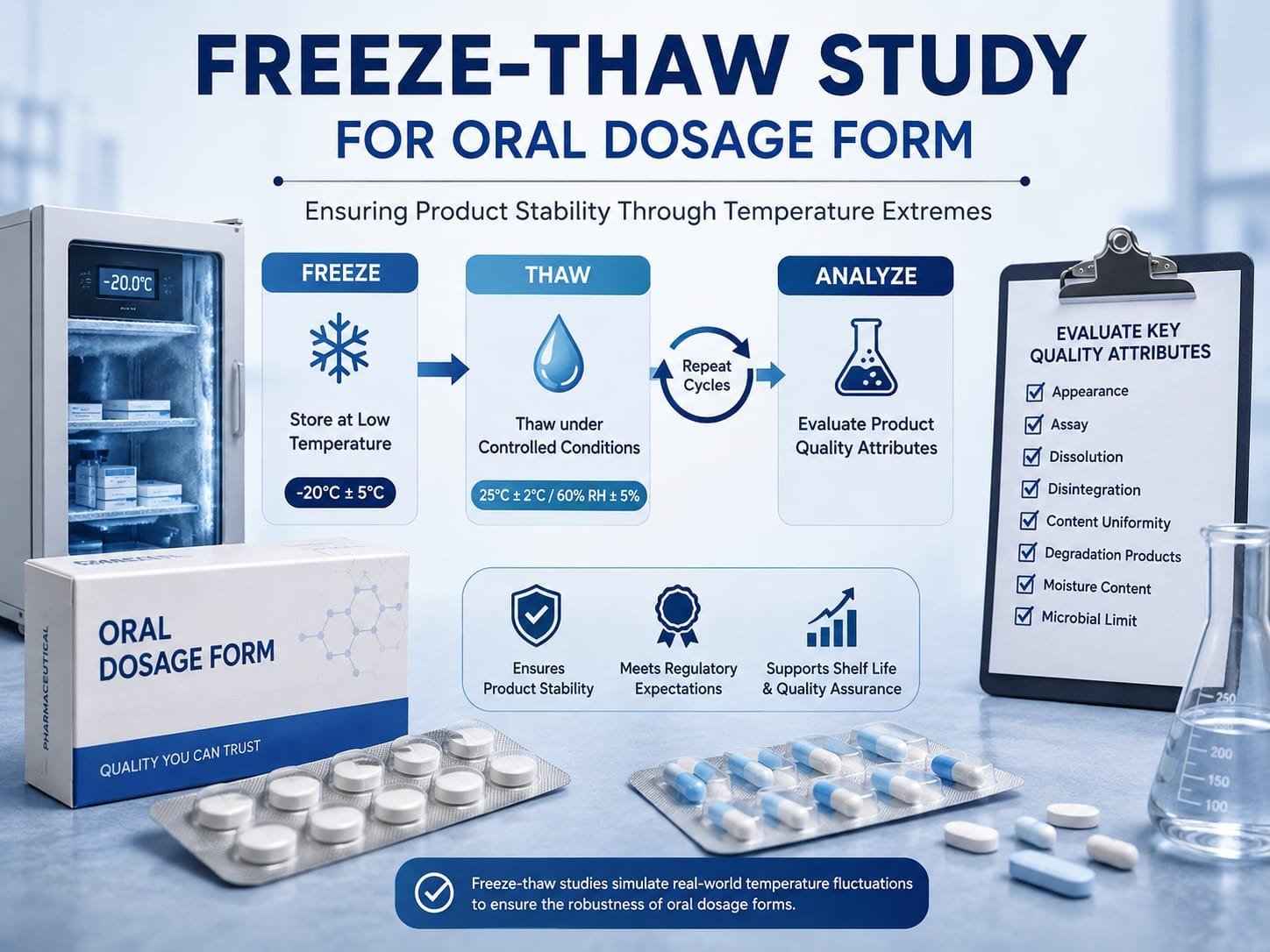
Freeze-Thaw Study for Oral Dosage Forms in Pharma: GMP Guide 2026
We all know freeze-thaw studies are critical for biologics. But what about Tablets, Capsules, Syrups and Suspensions?
Yes, oral dosage forms can also fail during winter shipping, cold storage, or if a patient keeps syrup in the freezer. A Freeze-Thaw Study for Oral Dosage Forms proves your product remains safe, effective, and elegant after temperature excursions.
1. Why Do Oral Dosage Forms Need Freeze-Thaw Studies?
Unlike biologics, most tablets are stored at room temp. But issues happen during:
- Shipping: Trucks in North India winter can reach -5°C to 5°C
- Warehousing: Power failure in AC warehouse
- Patient Use: Cough syrups kept in freezer by mistake
- Regulatory Expectation: ICH Q1A + WHO ask for stress testing data
Main Goal: To justify storage statement, shipping limits, and “Do not freeze” or “Store below 25°C” on label.
2. Regulatory References for Oral Products
| Guideline | Key Point for Oral Dosage Forms |
|---|---|
| ICH Q1A(R2) | Stress testing should include effect of temperature. Freeze-thaw is part of it |
| WHO TRS 1010 Annex 10 | Stability studies must cover conditions during distribution |
| USFDA Stability Guidance | For liquids/suspensions, evaluate effect of freezing on physical stability |
| Schedule Y, India | Stability data required for registration including stress conditions |
3. Dosage Forms Most at Risk
- Oral Liquids & Syrups: Risk of precipitation, crystallization, phase separation
- Oral Suspensions: Risk of caking, settling, change in viscosity
- Emulsions: Risk of creaming and breaking of emulsion
- Soft Gelatin Capsules: Risk of shell cracking, leakage
- Coated Tablets: Risk of film cracking, color change due to moisture
- Orally Dispersible Tablets: Risk of moisture uptake and hardness change
Plain dry tablets are least affected, but coating and packaging can still fail.
4. How to Design a Freeze-Thaw Study for Oral Dosage Forms
Step 1: Define Cycles & Conditions
Standard Cycle: Freeze at -20°C ±5°C for 24 hours → Thaw at 25°C ±2°C / 60% RH for 24 hours
No. of Cycles: 3 cycles minimum. 5 cycles for high-risk liquids.
Rationale: Covers worst-case winter transport + patient misuse.
Step 2: Packaging
Test in final market pack: Alu-Alu, Bottle, PET Jar. Include desiccant if used. For liquids, test upright and inverted.
Step 3: Test Parameters / CQAs by Dosage Form
| Dosage Form | Key Tests After Each Cycle |
|---|---|
| Tablets | Appearance, Hardness, Friability, Disintegration, Assay, Dissolution |
| Capsules | Appearance, Shell integrity, Content uniformity, Dissolution |
| Oral Liquids/Syrups | Appearance, pH, Viscosity, Assay, Preservative efficacy, Microbial limit |
| Suspensions | Appearance, Sedimentation volume, Redispersibility, Particle size, Assay |
Step 4: Acceptance Criteria
Product must comply with release specification after 3 cycles. No new impurities >0.1%. For liquids: No precipitation that cannot be redispersed by shaking.
5. Interpreting Results & Label Impact
If Product Passes
Label: “Store below 30°C. Protect from moisture.” No “Do not freeze” needed.
If Product Fails
Label: “DO NOT FREEZE”. Add “Shake well before use” for suspensions. Add carton to protect from cold during distribution.
6. Common Failures Seen in Freeze-Thaw of Oral Products
- Syrups: Sugar crystallization, color darkening
- Suspensions: Irreversible caking at bottom, cannot redisperse
- Film-coated tablets: Cracking and peeling due to moisture expansion
- Softgels: Shell becomes brittle and leaks
- Effervescent tablets: Premature reaction due to moisture from condensation during thaw
7. Freeze-Thaw vs Accelerated vs Shipping Study
Freeze-Thaw: Lab stress study to check product robustness
Accelerated 40°C/75%RH: Chemical stability
Shipping Validation: Real truck route with data logger
All 3 are needed for a complete stability package for oral products.
8. Best Practices from Industry
- Start Early: Do freeze-thaw during product development, not after filing
- Use Worst Case: Minimum fill bottle, highest headspace
- Document Rationale: Why 3 cycles? Why -20°C? Link to climatic zone IVb
- Train Warehouse: If “Do not freeze” is on label, add temp indicators in winter shipments
Conclusion
Freeze-Thaw study is not only for injectables. For oral dosage forms it protects against real-world cold exposure and prevents market complaints like “syrup crystallized” or “tablet coating cracked”.
As per GMP: “Test it in lab first, so it doesn’t fail in patient’s hand later.”
For QA and R&D teams, this small study saves big money in recalls and brand reputation.

About the Author
Mahummed Asif is a experienced pharmaceutical QA professional and publisher of Pharmashare. He has sound knowledge in GMP, Product Life Cycle Management, Regulatory filing, QMS, Product Complaint Management, Change control, risk management, and global audit preparation.