
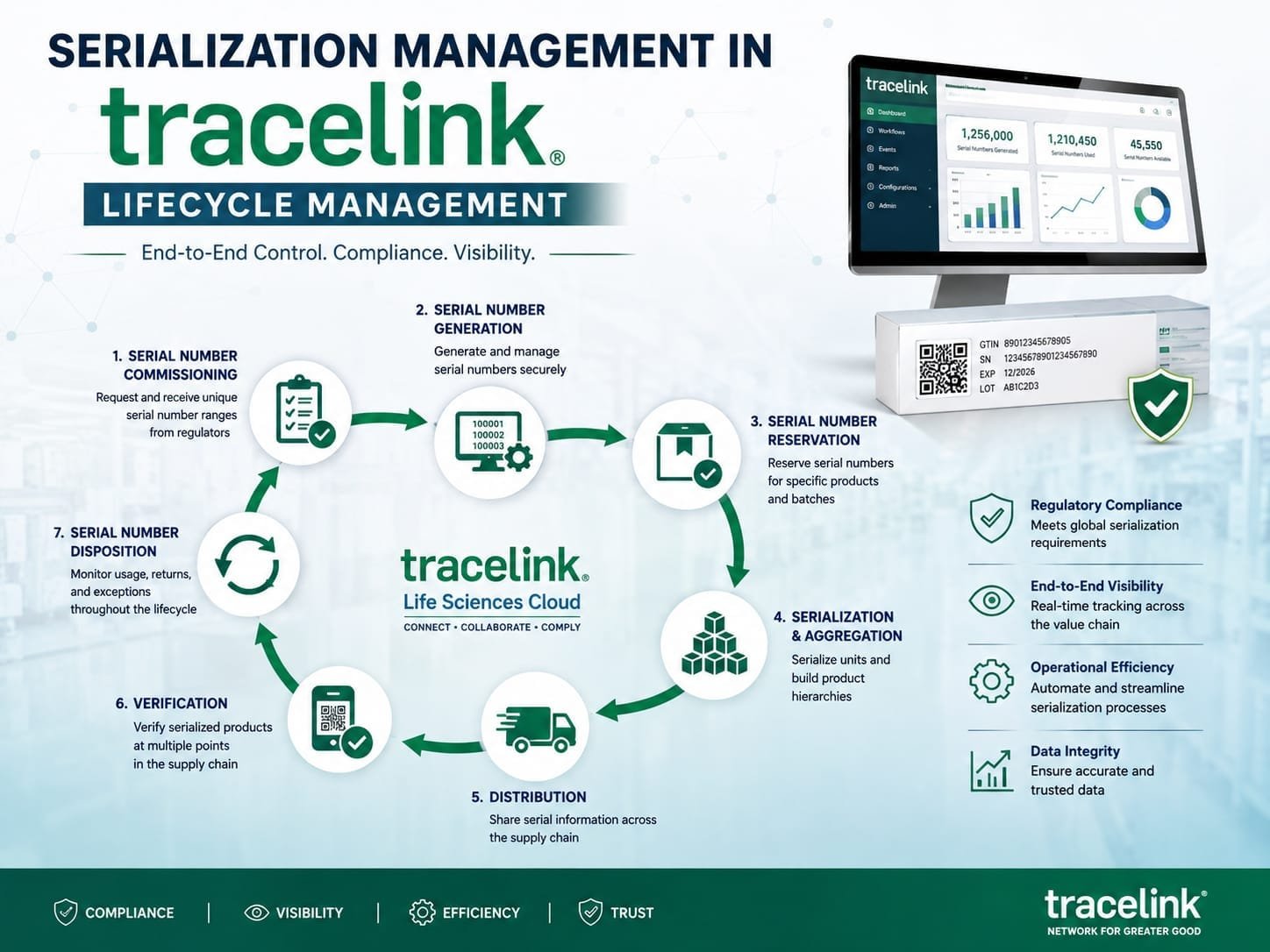
Serialization Management in TraceLink: Complete Guide to Serial Number Commissioning and Lifecycle Management
Serialization management is a critical component of pharmaceutical supply-chain operations. As pharmaceutical companies manage serialization requirements across manufacturing sites, packaging lines, contract manufacturing organizations, wholesalers, and regulatory ecosystems, effective control of individual serial numbers becomes essential.
TraceLink is widely used by pharmaceutical organizations and supply-chain partners to support serialization and product traceability activities. Within a serialization environment, one of the most important operational activities is the management of the serial number lifecycle—from generation and commissioning through packaging, aggregation, distribution, exception handling, decommissioning, and retirement.
For serialization professionals, understanding how serial numbers move through different lifecycle states is essential for preventing data inconsistencies, resolving serialization exceptions, maintaining accurate parent-child relationships, and supporting regulatory compliance.
This article provides an SEO-focused practical guide to serialization management in TraceLink, with particular emphasis on serial number commissioning and lifecycle management.
Table of Contents
- What Is Pharmaceutical Serialization?
- What Is TraceLink Serialization Management?
- What Is a Serial Number?
- What Is Serial Number Commissioning?
- Serial Number Lifecycle Management
- Common Serial Number Lifecycle States
- Serial Number Generation
- Serial Number Commissioning Process
- Commissioning During Packaging
- Relationship Between Commissioning and Aggregation
- Serial Number Decommissioning
- Serial Numbers in Reserve Status
- Serialization Exceptions
- Serial Number Reconciliation
- Serial Numbers During Rework
- Rejected and Damaged Serialized Units
- Traceability and Data Integrity
- Roles and Responsibilities
- Monitoring and Trending
- Investigation of Serial Number Issues
- Best Practices
- Common Serialization Errors
- Audit and Inspection Readiness
- Practical Example
- Frequently Asked Questions
- Conclusion
1. What Is Pharmaceutical Serialization?
Pharmaceutical serialization is the process of assigning a unique identifier to individual saleable units of a medicinal product so that each unit can be distinguished and tracked throughout the pharmaceutical supply chain.
Unlike traditional lot-level identification, serialization provides identification at the individual package level.
A serialized pharmaceutical package may contain information such as:
- Product identifier
- National Drug Code or equivalent product identifier
- Serial number
- Lot or batch number
- Expiration date
- Other market-specific data elements
The combination of these data elements creates the basis for product traceability and verification.
2. What Is TraceLink Serialization Management?
TraceLink provides a digital platform for connecting pharmaceutical companies and supply-chain partners to exchange and manage information associated with serialized products.
In a typical serialization environment, the platform may interact with:
- Enterprise Resource Planning systems
- Manufacturing Execution Systems
- Packaging line serialization systems
- Level 1–5 serialization architecture
- Warehouse systems
- Contract manufacturing organizations
- Contract packaging organizations
- Wholesalers and distributors
- Regulatory reporting ecosystems
The exact configuration and workflows depend on the company’s TraceLink applications, market requirements, system architecture, and business processes.
Key point:
TraceLink should not be viewed merely as a database of serial numbers. Effective serialization management requires controlled lifecycle management, accurate event reporting, exception handling, reconciliation, and reliable communication between connected systems.
3. What Is a Serial Number?
A serial number is a unique identifier assigned to an individual saleable unit of a pharmaceutical product.
For example, a product may have:
| Data Element | Example |
|---|---|
| Product | ABC 500 mg Tablet |
| Lot | LOT20260801 |
| Expiry | 08/2030 |
| Serial Number | SN000123456 |
The serial number must be managed carefully because incorrect serial number status or incorrect relationships can affect downstream verification, returns, recalls, investigations, and regulatory reporting.
4. What Is Serial Number Commissioning?
Serial number commissioning is the process by which a previously generated serial number becomes associated with a physical product unit and is placed into an active state for use in the serialized supply chain.
The distinction between serial number generation and commissioning is important.
- Generation: Creation or allocation of serial numbers.
- Commissioning: Associating a serial number with the intended product and physical package during the manufacturing or packaging process.
A serial number may therefore exist in the serialization system before it is physically used on a product.
5. Serial Number Lifecycle Management
Serial number lifecycle management involves controlling the status and use of each serialized identifier throughout its existence.
A simplified lifecycle may look like:
The actual terminology and available status values can vary according to the configured TraceLink application, business process, and applicable market requirements.
6. Common Serial Number Lifecycle States
Serialization teams commonly encounter different states associated with serial numbers.
| Status / State | General Meaning | Operational Consideration |
|---|---|---|
| Available | Serial number is available for use. | Should not be confused with a serial number already associated with a physical unit. |
| Reserved | Serial number has been set aside for a specific purpose or process. | Investigate stale reservations or inappropriate use. |
| Commissioned | Serial number has been associated with a physical product. | Must correspond to actual packaging activity. |
| Aggregated | Serialized item has been associated with a higher-level parent. | Parent-child relationships must remain accurate. |
| Decommissioned | Serial number has been removed from active use according to an approved process. | Reason and supporting event should be traceable. |
| Destroyed | Physical serialized unit has been destroyed or otherwise rendered unavailable according to the applicable process. | Physical and electronic records should reconcile. |
Important: Organizations should use the exact status definitions and workflows configured in their validated TraceLink environment and applicable procedures.
7. Serial Number Generation
Before commissioning, serial numbers must be generated or otherwise made available to the packaging process.
Serial number generation should be governed by controlled procedures covering:
- Uniqueness
- Randomization or sequential rules where applicable
- Serial number pool management
- Product association
- Market assignment
- Quantity requested
- Security controls
- Access authorization
- Reconciliation
The serialization system should prevent unintended reuse or duplication of serial numbers.
8. Serial Number Commissioning Process in TraceLink
A typical commissioning workflow may involve several connected systems.
Step 1: Define the product and packaging configuration
The correct product, market, packaging level, and production information must be available before serialized production begins.
Step 2: Obtain or generate serial numbers
The required serial number quantity is generated or allocated according to the approved process.
Step 3: Send serial numbers to the packaging environment
The relevant serial number information may be communicated to the packaging line or manufacturing serialization system.
Step 4: Print or encode the identifier
The serial number may be printed or encoded in the applicable machine-readable and human-readable format.
Step 5: Verify the serialized package
The packaging line verifies whether the printed or encoded information matches the expected product data.
Step 6: Commission the serial number
The serial number is associated with the physical package and recorded as an active serialized unit.
Step 7: Perform reconciliation
The quantity of generated, used, commissioned, rejected, and unused serial numbers should be reconciled according to the site’s approved procedure.
9. Commissioning During Packaging Operations
Serialization commissioning is closely connected with packaging-line operations.
During packaging, the system may need to confirm:
- Correct product
- Correct batch
- Correct expiration date
- Correct serial number
- Correct barcode or data matrix
- Correct packaging level
- Correct aggregation relationship
If any of these checks fail, the unit may be rejected or routed for appropriate investigation and disposition.
10. Relationship Between Commissioning and Aggregation
Commissioning and aggregation are related but different activities.
Commissioning identifies the individual unit. Aggregation establishes the relationship between that unit and a higher packaging level.
For example:
The serialization system should maintain accurate parent-child relationships.
If a carton is commissioned but incorrectly aggregated to a case, downstream scanning and verification may produce incorrect results.
11. Serial Number Decommissioning
Decommissioning is an important component of the serial number lifecycle.
A serial number may require decommissioning or another appropriate terminal state when the associated physical product:
- Is rejected during packaging
- Is damaged
- Is destroyed
- Is removed from saleable inventory
- Is returned and disposed of
- Is subject to an approved operational disposition
The exact event and status should be based on the applicable business process and regulatory requirements.
Critical control:
A serial number should not simply be changed to an inactive status to resolve a system discrepancy without understanding the underlying physical and electronic events. Incorrect lifecycle updates can create traceability gaps.
12. Serial Numbers in Reserve Status
One practical serialization issue encountered by pharmaceutical organizations is the presence of serial numbers in a reserve or similar non-active state.
A reserved serial number may represent a number that has been allocated but not yet successfully commissioned.
Possible causes include:
- Packaging line interruption
- Communication failure
- Serialization software failure
- Batch termination
- Manual intervention
- Network connectivity problems
- Incomplete commissioning transactions
- Rejected packages
- Incorrect production order configuration
Before changing the status of such serial numbers, the serialization team should reconcile the electronic record with the physical product and approved batch documentation.
13. Serialization Exceptions
Serialization exceptions occur when expected events do not match actual system or physical events.
Examples include:
- Duplicate serial number
- Invalid serial number
- Unknown serial number
- Incorrect product association
- Incorrect lot association
- Incorrect expiration date
- Commissioning failure
- Aggregation mismatch
- Parent-child relationship error
- Unexpected serial number status
- Missing serialization event
- Communication failure between systems
14. Serial Number Reconciliation
Reconciliation is one of the most important controls in serialization management.
The objective is to ensure that the electronic serialization records correspond to actual physical production and packaging activity.
A typical reconciliation may compare:
| Category | Expected Control |
|---|---|
| Serial numbers requested | Should match approved production requirements. |
| Serial numbers received | Should reconcile with the relevant system transaction. |
| Serial numbers commissioned | Should correspond to physical saleable units. |
| Serial numbers rejected | Should correspond to documented rejected units. |
| Serial numbers unused | Should be appropriately accounted for. |
| Aggregated serial numbers | Should reconcile with packaging hierarchy. |
15. Serial Numbers During Rework
Rework can introduce additional complexity into serialization management.
For example, a serialized package may require removal, relabeling, repackaging, or replacement of a component.
The rework process should clearly define:
- Whether the original serial number remains valid
- Whether the serial number must be decommissioned
- Whether a new serial number is required
- How aggregation relationships are affected
- How the change is documented
- How electronic events are reconciled
Rework should always be managed through approved procedures and validated system workflows.
16. Rejected and Damaged Serialized Units
During packaging, units may fail vision inspection, barcode verification, weight checks, printing checks, or other quality controls.
The corresponding serial number must be handled consistently with the physical disposition.
For example, if a serialized unit is physically destroyed, the electronic record should reflect the appropriate event according to the site’s procedure and regulatory requirements.
The key principle is physical-to-electronic reconciliation.
17. Traceability and Data Integrity
Serialization data is subject to the same fundamental data-integrity principles applicable to other GMP-relevant computerized systems.
Serialization professionals should ensure that data is:
- Attributable
- Legible
- Contemporaneous
- Original
- Accurate
- Complete
- Consistent
- Enduring
- Available
User access should be controlled according to roles and responsibilities.
Critical changes to serial number lifecycle information should be traceable through appropriate system audit trails and supporting documentation.
18. Roles and Responsibilities
| Function | Typical Responsibility |
|---|---|
| Packaging | Execution of serialized packaging activities and physical reconciliation. |
| Serialization/IT | System configuration, interfaces, troubleshooting, and technical support. |
| QA | Oversight of procedures, deviations, investigations, data integrity, and compliance. |
| Supply Chain | Coordination of serialized product movement and partner requirements. |
| Engineering | Support for packaging equipment, scanners, printers, and line systems. |
| Regulatory | Assessment of applicable serialization and reporting requirements. |
19. Monitoring and Trending
Serialization performance should be monitored through appropriate metrics and periodic review.
Useful metrics may include:
- Commissioning success rate
- Serialization exception rate
- Aggregation failure rate
- Rejected serial number quantity
- Reserved serial number quantity
- Unreconciled serial numbers
- Interface failures
- Data transmission failures
- Repeat serialization deviations
- Time required to resolve exceptions
Trending can help identify recurring issues and opportunities for system or process improvement.
20. Investigation of Serial Number Issues
A robust investigation should determine both the immediate cause and the underlying systemic cause.
The investigation may review:
- Packaging batch records
- Serialization system logs
- TraceLink transaction history
- Line-controller information
- Scanner and printer records
- ERP transactions
- MES transactions
- Aggregation records
- Operator actions
- System audit trails
- Previous similar incidents
A strong investigation should answer three fundamental questions:
1. What happened?
Identify the actual serialization event or failure.
2. Why did it happen?
Determine the technical, procedural, human, or systemic root cause.
3. What prevents recurrence?
Define appropriate CAPA or process improvements.
21. Best Practices for Serialization Management in TraceLink
1. Establish clear SOPs
Define procedures for serial number generation, commissioning, aggregation, exception handling, reconciliation, decommissioning, and disposition.
2. Control user access
Only authorized users should be able to perform or approve critical serialization activities.
3. Maintain system-to-system reconciliation
Ensure that ERP, MES, packaging systems, and serialization platforms remain synchronized.
4. Investigate abnormal serial number statuses
Do not allow unexplained serial numbers to accumulate in reserve, commissioned, or other unexpected states.
5. Maintain accurate aggregation
Verify parent-child relationships before products leave the packaging operation.
6. Monitor interface failures
Interface interruptions can create incomplete or duplicated transactions and should be monitored proactively.
7. Train personnel
Packaging, QA, IT, engineering, and serialization personnel should understand the impact of lifecycle transactions on downstream traceability.
8. Perform periodic reconciliation
Reconciliation should be performed according to approved procedures and applicable regulatory requirements.
9. Trend recurring issues
Repeated serialization exceptions should trigger structured investigation and continuous improvement.
22. Common Serial Number Management Errors
- Incorrect serial number status
- Failure to reconcile unused serial numbers
- Incorrect parent-child relationship
- Duplicate serial numbers
- Manual modification without adequate controls
- Failure to investigate recurring exceptions
- Incomplete batch reconciliation
- Incorrect product association
- Incorrect lot or expiration information
- Uncontrolled handling of reserved serial numbers
- Failure to document physical destruction
- Communication failures between connected systems
23. Audit and Inspection Readiness
Serialization systems may become an important area of regulatory or customer scrutiny because they support pharmaceutical traceability and supply-chain controls.
An inspection-ready serialization program should be able to demonstrate:
- Validated systems
- Controlled procedures
- Appropriate user access
- Audit-trail controls
- Data integrity
- Serial number reconciliation
- Exception investigation
- Deviation management
- CAPA effectiveness
- Training records
- System change control
- Business continuity and disaster recovery controls
The organization should be able to explain the complete lifecycle of a serialized unit from creation through its final disposition.
24. Practical Example: Serial Number Commissioning Failure
Consider a packaging line where 100,000 serial numbers are allocated for a batch.
During packaging:
- 98,500 units are successfully commissioned.
- 800 units are rejected because of packaging defects.
- 500 units are rejected because of serialization verification failures.
- 200 units remain unused.
The serialization team should not simply close the batch based on the commissioned quantity.
The organization should reconcile all categories and confirm the appropriate lifecycle status of the remaining serial numbers.
Key lesson:
The objective of reconciliation is not merely to make the numbers add up. It is to demonstrate that every serial number is appropriately accounted for and that the electronic serialization history reflects the physical disposition of the associated product.
25. Serialization Lifecycle: Simplified Workflow
26. Frequently Asked Questions
What is serial number commissioning in TraceLink?
Serial number commissioning is the process of associating a generated serial number with an actual physical pharmaceutical product unit and recording the relevant serialized event in the connected serialization environment.
What is the difference between serial number generation and commissioning?
Generation creates or allocates the identifier, while commissioning associates that identifier with a physical product unit during the packaging process.
Why is serial number lifecycle management important?
It ensures that every serial number is appropriately controlled from creation through final disposition and that electronic records remain consistent with physical product activity.
What causes serial numbers to remain in reserve status?
Potential causes include interrupted packaging operations, communication failures, incomplete transactions, rejected units, batch termination, or system issues. The actual cause should be established through investigation and reconciliation.
What is the relationship between commissioning and aggregation?
Commissioning identifies an individual serialized unit, while aggregation establishes its relationship with a higher packaging level such as a case or pallet.
How should serialization exceptions be handled?
Exceptions should be managed through approved procedures, with investigation of the physical and electronic records, appropriate correction or disposition, reconciliation, and CAPA where required.
Is TraceLink itself responsible for the entire serialization process?
Not necessarily. TraceLink may form an important component of an organization’s serialization ecosystem, but the complete process normally involves packaging equipment, line systems, MES/ERP systems, serialization applications, trading partners, procedures, and personnel.
Why is reconciliation important in serialization?
Reconciliation provides evidence that serial numbers generated and processed electronically correspond to actual physical units and their documented disposition.
27. Conclusion
Serialization management in TraceLink is more than simply generating and storing serial numbers. Effective serialization requires disciplined management of the complete serial number lifecycle.
For pharmaceutical serialization professionals, serial number commissioning is a critical control point because it establishes the relationship between the digital identifier and the physical product.
From commissioning and aggregation to exception management, reconciliation, decommissioning, and final disposition, every lifecycle transaction should be accurately controlled and traceable.
Organizations can strengthen their serialization programs by combining a properly configured TraceLink environment with validated interfaces, robust SOPs, trained personnel, effective reconciliation, strong data-integrity controls, and risk-based investigation of serialization exceptions.
Final takeaway: A mature serialization program should allow an organization to answer a simple but critical question for every serial number:
Where was this serial number created, what happened to it, where is it now, and what is its current lifecycle status?
Key Takeaways for Pharma Serialization Professionals
- Serial number generation and commissioning are different activities.
- Commissioning establishes the link between the serial number and physical product.
- Serial number lifecycle management is essential for traceability.
- Reserve or unexpected serial number statuses require appropriate reconciliation.
- Aggregation establishes parent-child relationships between packaging levels.
- Rejected and damaged serialized units require controlled disposition.
- Physical and electronic records must remain synchronized.
- Serialization exceptions should be investigated using a structured approach.
- Audit trails and access controls are important data-integrity controls.
- Periodic reconciliation and trending can identify systemic serialization issues.
- TraceLink should operate as part of a controlled and validated serialization ecosystem.
- Procedures should reflect the organization’s actual TraceLink configuration and applicable market requirements.
Regulatory and Product Disclaimer:
This article is intended for educational and professional information purposes. TraceLink functionality, terminology, workflows, status values, interfaces, and configuration can vary by implementation, application version, market, and customer environment. The examples in this article are illustrative and should not be treated as a substitute for approved company procedures, validated system documentation, regulatory requirements, or TraceLink product documentation.

About the Author
Mahummed Asif is a experienced pharmaceutical QA professional and publisher of Pharmashare. He has sound knowledge in GMP, Product Life Cycle Management, Regulatory filing, QMS, Product Complaint Management, Change control, risk management, and global audit preparation.