Role of Serialization and Aggregation Systems in Pharmaceutical Product Recall
Pharmaceutical product recalls are among the most critical quality and supply-chain activities performed by pharmaceutical companies. When a product defect, contamination, labeling error, stability issue, data integrity concern, or other quality defect is identified, the company must quickly determine which products are affected and ensure that those products are effectively removed or controlled throughout the supply chain.
Traditional lot-level traceability can identify products associated with a particular batch, but modern pharmaceutical supply chains increasingly require more granular visibility. Serialization and aggregation systems provide important capabilities for identifying individual saleable units, tracking packaging hierarchies, supporting targeted recalls, and reconciling recalled quantities.
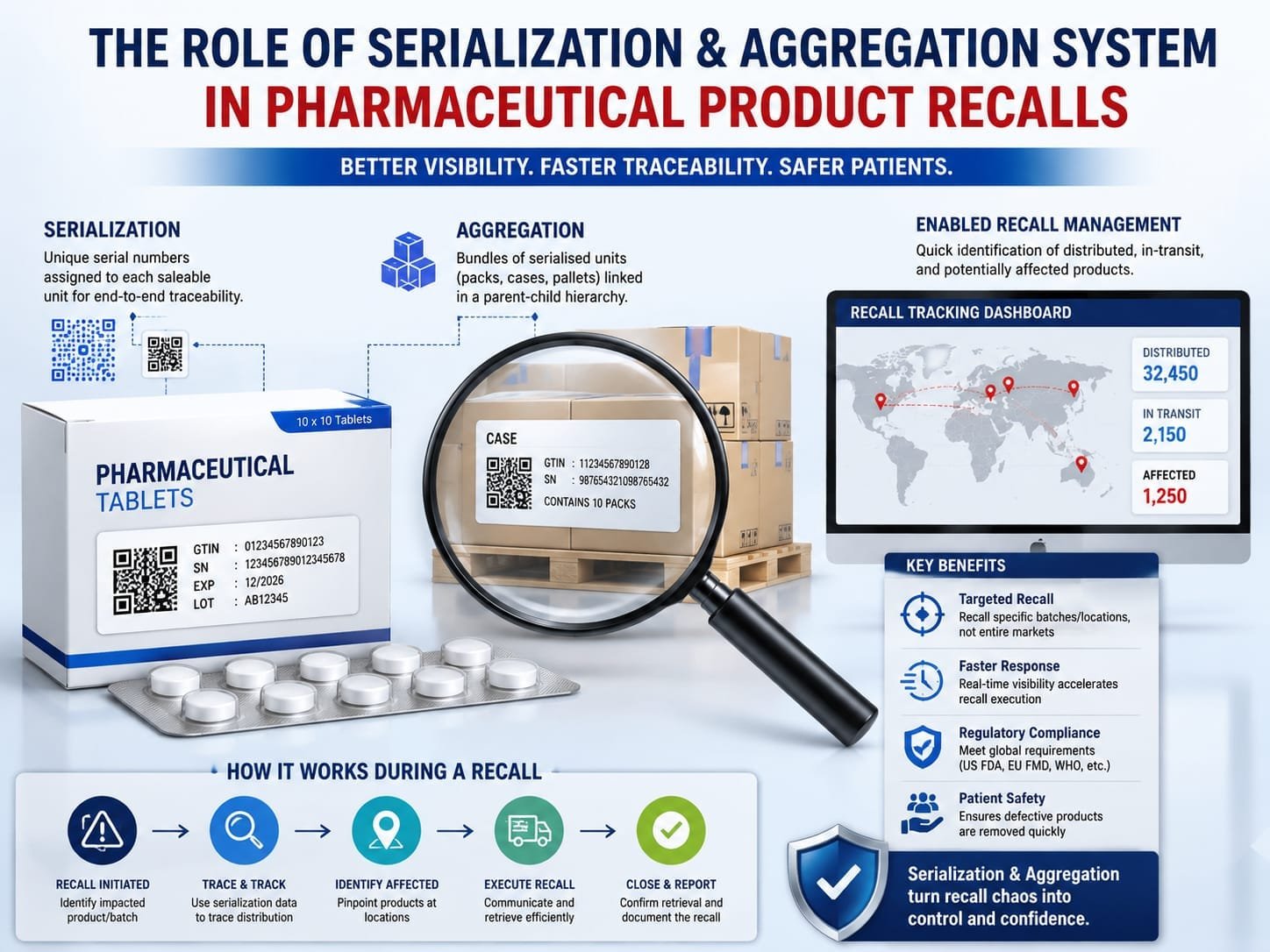
Serialization identifies an individual pharmaceutical package using a unique serial number, while aggregation establishes relationships between individual units and higher packaging levels such as cases and pallets. Together, these capabilities can significantly improve the speed, accuracy, and effectiveness of pharmaceutical product recalls.
This article explains the role of serialization and aggregation systems in pharmaceutical product recall, including recall identification, serial-number-level traceability, aggregation, distribution visibility, recall execution, reconciliation, effectiveness checks, investigations, and common challenges.
Table of Contents
- What Is a Pharmaceutical Product Recall?
- What Is Pharmaceutical Serialization?
- What Is Pharmaceutical Aggregation?
- Why Are Serialization and Aggregation Important During Recall?
- Traditional Lot-Level Recall vs. Serialized Recall
- Role of Serialization in Product Traceability
- Serial Number-Level Recall Identification
- Role of Aggregation During Recall
- Tracking Product Distribution
- Serialization-Supported Recall Process
- Recall Initiation
- Identification of Affected Products
- Identifying Downstream Trading Partners
- Recall Notification
- Quarantine and Product Withdrawal
- Recall Reconciliation
- Recall Effectiveness Checks
- Returned Product and Serial Number Verification
- Role in Recall Investigation
- Data Integrity Considerations
- Systems Involved in Serialized Recall
- Practical Recall Example
- Key Benefits
- Challenges and Limitations
- Best Practices
- Audit and Regulatory Inspection Readiness
- Frequently Asked Questions
- Conclusion
1. What Is a Pharmaceutical Product Recall?
A pharmaceutical product recall is an action taken to remove or correct a medicinal product that has been identified as defective, potentially harmful, non-compliant, or otherwise unsuitable for continued distribution or use.
A recall may be initiated because of issues such as:
- Incorrect labeling
- Incorrect strength or composition
- Contamination
- Microbiological concerns
- Stability failures
- Out-of-specification results
- Manufacturing deviations
- Packaging defects
- Incorrect serialization data
- Mix-up of products or batches
- Counterfeit or suspected falsified product concerns
- Adverse events or safety concerns
- Regulatory non-compliance
The recall process requires rapid identification of affected inventory and effective communication with the relevant supply-chain partners and, where applicable, regulatory authorities.
2. What Is Pharmaceutical Serialization?
Pharmaceutical serialization is the process of assigning a unique identifier to an individual saleable package of a medicinal product.
Depending on the market and applicable regulatory framework, serialized product information may include:
- Product identifier
- Serial number
- Lot or batch number
- Expiration date
- Other applicable product or transaction information
Serialization provides identification at the individual package level rather than relying exclusively on batch-level identification.
Example:
If a batch contains 100,000 serialized packages, each package can have its own unique serial number. During a recall, this can provide the ability to identify individual packages or defined groups of packages rather than automatically treating the entire batch as a single undifferentiated population.
3. What Is Pharmaceutical Aggregation?
Aggregation is the process of establishing a parent-child relationship between different packaging levels.
For example:
The aggregation relationship allows the serialization system to understand which individual units are physically contained within a particular case or pallet.
This relationship becomes extremely valuable during recall operations because a recalled pallet or case can potentially be traced to the serialized units contained within it.
4. Why Are Serialization and Aggregation Important During Recall?
A recall is fundamentally a traceability exercise.
The organization needs to determine:
- What product is affected?
- Which batches are affected?
- Which individual serial numbers are affected?
- Where was the product manufactured?
- Where was it shipped?
- Which distributors received it?
- Which customers or markets may have received it?
- How much product remains in inventory?
- How much product has already been distributed?
- How much has been returned?
- How much has been destroyed?
- How much remains unaccounted for?
Serialization and aggregation can provide data needed to answer these questions more efficiently.
5. Traditional Lot-Level Recall vs. Serialized Recall
| Aspect | Traditional Lot-Level Approach | Serialization and Aggregation Approach |
|---|---|---|
| Identification | Primarily batch/lot based | Individual package and batch based |
| Traceability | May require extensive manual reconciliation | Can provide granular electronic traceability |
| Distribution visibility | Often dependent on inventory and shipping records | Can be supported by serialized event and aggregation data |
| Recall targeting | May involve broader inventory | Potential for more targeted identification where supported |
| Reconciliation | Often quantity-based | Can include serial-level reconciliation |
| Investigation | Requires extensive document review | Electronic serialization records can accelerate investigation |
Serialization does not eliminate the need for traditional batch records, distribution records, quality investigations, and reconciliation. Instead, it provides an additional layer of granular traceability.
6. Role of Serialization in Product Traceability
One of the greatest benefits of serialization during a recall is improved product traceability.
A serialized product can potentially be followed through different stages of the supply chain, depending on the systems, market requirements, data availability, and trading-partner connectivity.
A simplified traceability path may look like:
The level of visibility available at each stage depends on the organization’s serialization architecture and the applicable market’s traceability requirements.
7. Serial Number-Level Recall Identification
A major advantage of serialization is the ability to identify individual serialized units associated with a potentially affected product population.
For example, suppose a quality investigation identifies that a specific manufacturing or packaging condition affected only a defined portion of a batch.
Without serialized identification, the organization may need to recall a larger population while determining the actual scope.
With reliable serialization data, the organization may be able to identify a more specific population based on:
- Serial number range or population
- Packaging event
- Production date
- Packaging line
- Batch
- Market
- Distribution event
- Aggregation relationship
Any narrowing of recall scope must, however, be scientifically and quality-system justified. Serialization data should support the recall decision rather than replace the underlying quality risk assessment.
8. Role of Aggregation During Recall
Aggregation can substantially simplify the physical identification of recalled products.
Consider a pallet containing multiple serialized cases. Each case contains multiple serialized saleable units.
If the pallet serial number and aggregation hierarchy are accurate, the organization may be able to determine the serialized contents without manually scanning every individual package.
Aggregation principle:
A reliable parent-child relationship allows the organization to move from a higher packaging level to the individual serialized units associated with that packaging hierarchy.
This can support faster warehouse quarantine, inventory identification, return processing, and recall reconciliation.
9. Tracking Product Distribution
Recall effectiveness depends heavily on knowing where affected product has been distributed.
Serialization systems can work together with ERP, warehouse management, enterprise traceability, and partner systems to provide distribution visibility.
Relevant information may include:
- Shipment date
- Shipment quantity
- Product identifier
- Batch number
- Serialized units
- Case identifiers
- Pallet identifiers
- Receiving organization
- Market or country
- Distribution status
This information can help the recall team prioritize affected trading partners and locations.
10. Serialization-Supported Pharmaceutical Recall Process
A simplified serialization-supported recall process can be represented as follows:
11. Recall Initiation
The recall process normally begins with a quality signal.
Potential signals may originate from:
- Product complaints
- OOS or OOT results
- Deviation investigations
- Stability failures
- Adverse event information
- Manufacturing investigations
- Supplier issues
- Regulatory inspection findings
- Market surveillance
- Serialization or traceability anomalies
Once a potential product defect is identified, the quality organization assesses the risk and determines the appropriate action.
12. Identification of Affected Products
The recall team must establish the scope of affected product using scientifically justified criteria.
Serialization data can assist in determining:
- Affected product codes
- Affected batches
- Affected packaging events
- Affected serial numbers
- Affected cases
- Affected pallets
- Affected markets
- Affected distribution locations
The quality investigation should determine whether the defect affects all units of a batch or only a defined population.
13. Identifying Downstream Trading Partners
Once the affected serialized population has been identified, the next question is:
Where did these products go?
Serialization and aggregation data can assist the recall team in connecting affected products with downstream trading partners.
This may allow recall communications to be more targeted and reduce unnecessary disruption to unaffected inventory.
14. Recall Notification
Recall communication should be performed according to the company’s approved recall procedure and applicable regulatory requirements.
The recall notification may identify:
- Product name
- Strength and dosage form
- Batch or lot information
- Serial number information where applicable
- Reason for recall
- Required action
- Return instructions
- Quarantine instructions
- Contact information
- Regulatory reporting requirements
Accurate serialization data can help ensure that the appropriate product population is communicated to the relevant stakeholders.
15. Quarantine and Product Withdrawal
Once the recall is initiated, affected inventory should be placed under appropriate control.
At manufacturing and warehouse locations, serialization and aggregation information can support physical identification of affected cases, pallets, and individual units.
For example, if an affected case is identified by its serialized identifier, the aggregation relationship may allow the organization to determine which saleable units are contained within that case.
The actual quarantine process should always follow approved site procedures.
16. Recall Reconciliation
Recall reconciliation is critical for determining whether all reasonable efforts have been made to identify and recover or control affected product.
A reconciliation may include:
| Category | Example Information |
|---|---|
| Total manufactured | Total quantity produced for the affected population |
| Total serialized | Number of units assigned serialized identifiers |
| Released | Quantity released for distribution |
| Distributed | Quantity shipped to downstream partners |
| Inventory | Quantity remaining within company-controlled locations |
| Returned | Quantity recovered through recall |
| Destroyed | Quantity destroyed following approved disposition |
| Unaccounted | Quantity requiring further investigation |
Where appropriate, serial-level reconciliation can provide a much more granular picture than simple quantity reconciliation.
17. Recall Effectiveness Checks
A recall is not complete merely because recall letters have been issued.
The organization must evaluate whether the recall was effective.
Effectiveness checks may consider:
- Response rate from affected customers
- Quantity identified by downstream partners
- Quantity returned
- Quantity quarantined
- Quantity remaining in distribution
- Quantity destroyed
- Outstanding responses
- Unaccounted serialized units
- Repeat distribution of recalled product
Serialization data can provide supporting evidence for these effectiveness assessments.
18. Returned Product and Serial Number Verification
When recalled products are returned, serialization information can help confirm whether a returned package belongs to the affected population.
Depending on the system and market, verification may involve:
- Serial number
- Product identifier
- Lot number
- Expiration date
- Packaging hierarchy
- Distribution history
This can help reduce the risk of incorrectly processing unrelated products during a recall.
19. Role of Serialization in Recall Investigation
Serialization data can be extremely useful during root-cause investigations.
For example, if complaints are concentrated among products packaged during a particular period, serialization records may help investigators examine:
- Packaging line
- Production date and time
- Equipment
- Packaging campaign
- Serialization events
- Aggregation events
- Operator or system events
- Interface transactions
The serialization data should be combined with batch manufacturing records, packaging records, deviation investigations, laboratory results, complaint data, and other relevant evidence.
20. Data Integrity Considerations
Because serialization information can influence product traceability and recall decisions, data integrity is critical.
Organizations should establish appropriate controls for:
- User access
- Role-based permissions
- Audit trails
- Data changes
- System interfaces
- Data transmission
- Backup and recovery
- System validation
- Electronic records
- Manual interventions
Any manual correction of serialization information should be governed by approved procedures and appropriate review.
21. Systems Involved in a Serialized Recall
Serialization-based recall management generally involves multiple interconnected systems rather than a single application.
| System | Potential Role |
|---|---|
| ERP | Product, batch, inventory, and distribution information |
| MES | Manufacturing and production information |
| Packaging Line Serialization System | Commissioning and packaging-level serialization events |
| Aggregation System | Parent-child relationships |
| Enterprise Serialization Repository | Centralized serialization information |
| Warehouse Management System | Inventory and warehouse movements |
| Partner Systems | Downstream transaction and traceability information |
| Recall/QMS System | Recall management, investigation, CAPA, and documentation |
22. Practical Example of Serialization-Supported Recall
Consider a pharmaceutical manufacturer that discovers a packaging defect affecting a defined group of serialized units from a batch.
The recall team determines that the issue relates to packages produced during a particular packaging operation.
Using available serialization information, the team identifies:
- The affected product
- The affected batch
- The relevant packaging event
- The potentially affected serial numbers
- The cases containing those units
- The pallets containing those cases
- The downstream distribution locations
The company can then initiate appropriate quarantine and recall activities.
As products are returned, the serial numbers can be reconciled against the affected population.
Result:
The combination of serialization and aggregation can reduce manual searching, improve recall traceability, support faster identification of affected inventory, and strengthen the evidence available for recall reconciliation and effectiveness assessment.
23. Key Benefits of Serialization and Aggregation in Product Recall
1. Faster identification
Serialized data can help identify affected products more quickly.
2. Improved traceability
Individual packages can be distinguished within a batch or product population.
3. Targeted recall
Where scientifically justified and supported by reliable data, recall activities can potentially be focused on the affected population rather than unnecessarily broad product groups.
4. Better distribution visibility
Serialization data can help identify where affected products were shipped.
5. Improved aggregation visibility
Parent-child relationships can help identify the contents of cases and pallets.
6. Improved reconciliation
Returned, quarantined, distributed, and remaining inventory can be compared against the affected serialized population.
7. Better recall effectiveness monitoring
Serialization data can provide additional evidence when assessing recall response and recovery.
8. Stronger investigation capability
Historical serialization events can provide useful information during quality investigations.
24. Challenges and Limitations
Serialization does not automatically guarantee perfect recall traceability.
Organizations may encounter challenges such as:
- Incomplete serialization data
- Incorrect aggregation
- Interface failures
- Data synchronization issues
- Incorrect serial number status
- Manual interventions
- Trading partner data gaps
- System downtime
- Incorrect product master data
- Inadequate user training
- Data migration issues
- Different regulatory requirements across markets
Therefore, serialization should be supported by robust procedures, validated systems, trained personnel, effective governance, and periodic reconciliation.
25. Best Practices for Using Serialization During Product Recall
1. Maintain accurate master data
Product identifiers, packaging configurations, markets, and other master data should be maintained under appropriate change control.
2. Validate serialization interfaces
Interfaces between ERP, MES, packaging systems, serialization platforms, and other systems should be appropriately qualified and monitored.
3. Maintain accurate aggregation
Incorrect aggregation can compromise recall efficiency. Parent-child relationships should therefore be controlled and reconciled.
4. Perform periodic reconciliation
Do not wait until a recall occurs to discover discrepancies in serialization data.
5. Trend serialization exceptions
Repeated exceptions may indicate systemic weaknesses requiring CAPA or process improvement.
6. Integrate recall and serialization procedures
Recall procedures should clearly define how serialization information will be retrieved, assessed, and reconciled.
7. Conduct mock recalls
Mock recalls can test whether the organization can quickly identify and reconcile affected serialized products.
8. Train cross-functional teams
QA, supply chain, serialization, IT, warehouse, packaging, regulatory, and customer-service teams should understand their respective roles.
9. Protect data integrity
Serialization records should remain accurate, complete, traceable, and appropriately controlled.
10. Establish business continuity
Organizations should have appropriate contingency procedures for serialization and traceability activities during system outages or other disruptions.
26. Audit and Regulatory Inspection Readiness
During regulatory inspections or customer audits, pharmaceutical companies may need to demonstrate that their serialization and traceability systems are appropriately controlled.
An inspection-ready program should be able to demonstrate:
- Validated serialization systems
- Approved SOPs
- System access controls
- Audit-trail controls
- Accurate serialization data
- Aggregation controls
- Exception management
- Reconciliation records
- Recall records
- Mock recall results
- Deviation investigations
- CAPA records
- Training records
- Change-control documentation
The organization should be able to explain how serialization data supports the identification, quarantine, withdrawal, reconciliation, and final disposition of recalled products.
27. Serialization and Recall: Key Relationship
| Recall Requirement | Serialization Contribution | Aggregation Contribution |
|---|---|---|
| Identify affected products | Individual serial number identification | Identifies units within packaging hierarchy |
| Locate inventory | Serialized inventory information | Case/pallet relationship |
| Trace distribution | Serialized event information | Movement through packaging levels |
| Quarantine | Identify affected serialized units | Identify affected cases/pallets |
| Return | Verify recalled units | Verify packaging hierarchy where applicable |
| Reconciliation | Serial-level accounting | Packaging-level reconciliation |
| Effectiveness check | Track affected serial population | Support physical identification and reconciliation |
28. Frequently Asked Questions
What is the role of serialization in pharmaceutical recall?
Serialization provides unique identification of individual pharmaceutical packages. During a recall, this information can help identify affected products, support traceability, assist distribution investigations, and improve reconciliation.
What is the role of aggregation during product recall?
Aggregation establishes relationships between individual serialized units and higher packaging levels such as cases and pallets. This can help organizations identify the contents of recalled packaging levels more efficiently.
Can serialization reduce the scope of a pharmaceutical recall?
Potentially, where the affected population can be scientifically and reliably defined using serialization and other supporting data. The final recall scope must be determined through the applicable quality risk assessment and regulatory requirements.
Can serialization identify where a recalled product was shipped?
It can support distribution traceability when the relevant serialized transaction and supply-chain data are available and properly connected across the applicable systems and trading partners.
Does aggregation help with pallet-level recall?
Yes. When accurate aggregation relationships exist, a pallet or case identifier can be linked to the serialized units contained within that packaging hierarchy.
Why is reconciliation important during a recall?
Reconciliation demonstrates how the affected product population has been accounted for, including product manufactured, distributed, remaining in inventory, returned, quarantined, destroyed, or otherwise dispositioned.
Can serialization replace the pharmaceutical recall procedure?
No. Serialization is a technological and traceability capability. It supports the recall process but does not replace the quality system, risk assessment, regulatory evaluation, communication process, effectiveness checks, or approved recall procedures.
What are the major challenges in using serialization for recall?
Common challenges include inaccurate aggregation, incomplete data, system-interface failures, incorrect serial-number status, master-data errors, trading-partner data gaps, and inadequate reconciliation.
29. Conclusion
Serialization and aggregation systems have become important components of modern pharmaceutical product traceability and recall management.
Serialization provides the ability to identify individual pharmaceutical packages, while aggregation establishes the relationships between saleable units, cases, and pallets. Together, they can provide valuable information throughout the recall lifecycle.
During a recall, serialization can help organizations identify affected products, determine distribution populations, support quarantine, verify returned products, perform detailed reconciliation, and evaluate recall effectiveness.
Aggregation can further simplify the physical identification of products by linking individual units to cases and pallets.
However, technology alone does not guarantee an effective recall. The reliability of serialization-supported recall activities depends on accurate master data, validated systems, correct aggregation, robust interfaces, appropriate procedures, trained personnel, data integrity controls, and regular reconciliation.
Final takeaway:
An effective pharmaceutical recall system should connect quality risk assessment + serialization + aggregation + distribution traceability + recall execution + reconciliation + effectiveness checks.
When these elements work together, pharmaceutical organizations can improve the speed, accuracy, and control of product recalls while strengthening overall supply-chain traceability.
Key Takeaways for Pharmaceutical Professionals
- Serialization identifies individual pharmaceutical packages.
- Aggregation connects individual units to cases and pallets.
- Serialization improves the granularity of recall traceability.
- Aggregation can accelerate identification of affected packaging hierarchies.
- Serialized data can support distribution investigations.
- Serialization can assist targeted recall activities when the affected population is scientifically established.
- Serial-number reconciliation strengthens recall accountability.
- Serialization data can support recall effectiveness checks.
- Accurate aggregation is essential for reliable traceability.
- Data integrity is critical because incorrect serialization information can compromise recall decisions.
- Mock recalls are useful for testing serialization-supported recall readiness.
- Serialization supports—but does not replace—the pharmaceutical quality system and recall procedure.
Regulatory Disclaimer:
This article is intended for educational and professional information purposes only. Pharmaceutical serialization, aggregation, traceability, and recall requirements vary by jurisdiction, product, supply-chain model, and applicable regulatory framework. Organizations should evaluate current applicable regulations, regulatory guidance, approved procedures, validated systems, and market-specific requirements before implementing or relying on serialization data during a product recall.

About the Author
Mahummed Asif is a experienced pharmaceutical QA professional and publisher of Pharmashare. He has sound knowledge in GMP, Product Life Cycle Management, Regulatory filing, QMS, Product Complaint Management, Change control, risk management, and global audit preparation.