Role of OCR in Pharmaceutical Packaging: Ensuring 100% Accuracy & Compliance
In pharmaceutical packaging, one wrong character can lead to a product recall, regulatory action, or patient harm.
That’s why OCR – Optical Character Recognition is no longer optional. It’s a GMP requirement.
From reading batch numbers to verifying artwork, OCR acts as the “digital proofreader” on your packaging line.
1. What is OCR in Pharma Packaging?
OCR = Optical Character Recognition
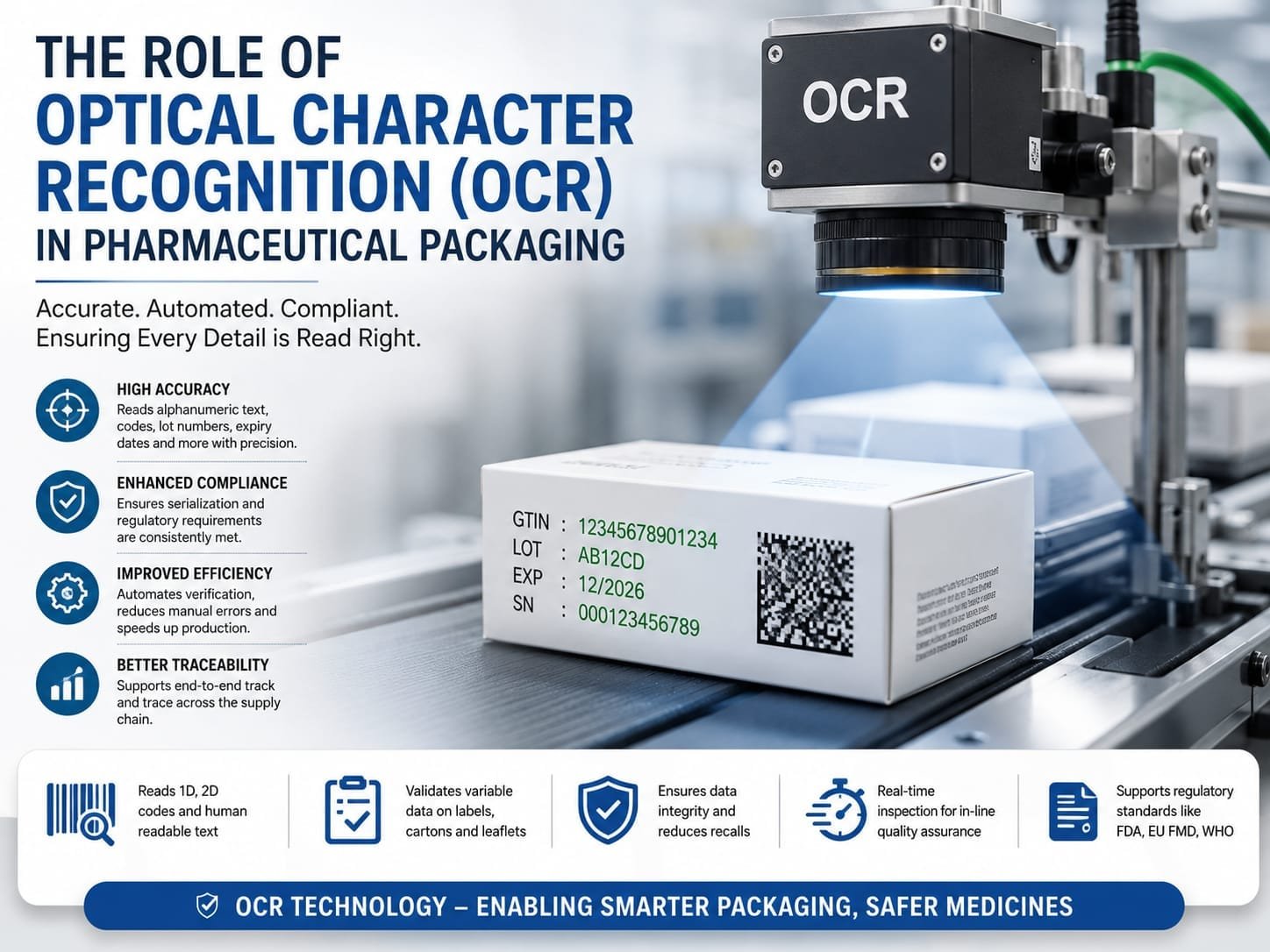
It’s a vision technology that reads printed text on labels, leaflets, cartons, and foils, and converts it into machine-readable data.
Unlike a barcode scanner that reads only codes, OCR reads human-readable text like:
- Product Name
- Strength
- Batch No / Lot No
- Manufacturing & Expiry Date
- MRP
- Manufacturing Site Address
Core Purpose: Verify that the text printed on the pack matches the approved artwork and batch record.
2. Where is OCR Used on the Packaging Line?
| Station | What OCR Checks | Why It Matters |
|---|---|---|
| Labeling Machine | Product name, strength, batch, Mfg/Exp date | Prevents wrong label on wrong product |
| Leaflet Inserter | Verify correct leaflet version & language | EU FMD & US FDA require correct PIL |
| Cartoner | Batch, Exp date, GTIN printed on carton | Aggregation data must match |
| Case Packer | Case label with SSCC, Batch, Exp | Warehouse traceability |
| Post-Serialization | Human readable text below 2D DataMatrix | DSCSA/EU FMD mandate |
OCR is usually placed before serialization printing. So bad packs never get a serial number.
3. How Does OCR Function? 5 Step Process
- Image Capture
A high-resolution telecentric camera with LED lighting captures the image of the text area at 400-600 ppm. Backlighting is used for blister and foil. - Pre-processing
The software removes noise, corrects skew, adjusts contrast. Critical for curved vials and reflective foils. - Character Recognition
AI-based OCR engine compares each character to a trained font library. Deep Learning OCR can read embossed, dot-matrix, and laser-etched text. - Verification
The read text is compared with the “Golden Template” from L3/L4.
Golden Template Batch: B25081
OCR Read Batch: B25081→ PASS
OCR Read Batch: B25018→ FAIL + Reject - Action & Data Storage
Pass → Allow serialization print
Fail → Reject pack + Save image + Send reason to SCADA + Create audit trail for 21 CFR Part 11
4. 6 Critical Benefits of OCR in Pharma Packing
- Prevents Mix-ups
Catches wrong strength label. Example: “Paracetamol 500mg” vs “Paracetamol 650mg”. Cost of 1 mix-up = crores in recall. - Ensures Regulatory Compliance
FDA 21 CFR 211.130: 100% examination of labels. EU Annex 1: Verification of printed information. OCR provides objective proof. - Supports Serialization & Aggregation
OCR reads Batch/Exp and cross-checks with data sent to L4. Prevents “Batch mismatch” errors. - Reduces Manual QA Checks
No need for 2nd person visual check. OCR logs every pack. Reduces manpower by 60%. - Provides Audit Trail
Every PASS/FAIL image stored with SN, time, and operator ID. Audit proof in 30 seconds. - Enables Real-time Feedback
If OCR sees 5 “Date smudge” fails, it alerts maintenance. Predictive quality.
5. OCR vs OCV: What’s the Difference?
| Feature | OCR – Optical Character Recognition | OCV – Optical Character Verification |
|---|---|---|
| Function | Reads and converts text to data | Verifies if printed text matches template |
| Use Case | Reading variable data like Batch, Date | Checking fixed text like Product Name, Logo |
| In Pharma | Used for Batch/Exp/MRP | Used for Brand name, artwork elements |
Modern pharma systems use OCR + OCV together for 100% coverage.
6. Validation Requirements: IQ, OQ, PQ
Per GMP, your OCR system must be validated.
- IQ: Camera resolution, lighting, font library, network to L3 verified
- OQ: Test with min/max speed, different fonts, tilted text, low contrast. Acceptance: >99.9% accuracy
- PQ: Run 10,000 packs with 50 known defects. Acceptance: 100% detection, <0.5% false reject
Challenge Set must include: Faint print, missing character, wrong font, date format change DD/MM/YYYY vs MM/DD/YYYY
7. Common Challenges & Solutions
- Reflective Foil/Blister
Solution: Use polarizing filters + diffuse dome lighting - Curved Surface on Vials
Solution: 360° camera + image stitching software - Variable Fonts
Solution: Train OCR with all fonts used in artwork. Update library for every artwork change - Inkjet Smudging
Solution: OCR flags it → Triggers printer maintenance alarm
8. Integration with Pharma 4.0
Modern OCR doesn’t work alone. It talks to:
- L3: Gets approved artwork + batch details
- Serialization Printer: “Print SN only if OCR = PASS”
- L4: Uploads image of rejects for deviation investigation
- SCADA: Shows OEE dashboard “Top 3 OCR fails this shift”
9. FAQs
Q1: Is OCR mandatory for US FDA?
Not by name. But 21 CFR 211.130 requires 100% label examination. OCR is the only way to prove it at high speed.
Q2: Can OCR read handwritten text?
No. Pharma lines use only printed text. Handwriting is not GMP compliant.
Q3: What is accuracy expectation?
>99.95% for Batch/Exp. <0.1% false rejects to avoid product waste.
10. Conclusion
In pharma packaging, “Seeing is not believing. Reading and Verifying is believing.”
Barcode tells you WHAT the pack is. OCR tells you IF the pack is correct.
With regulators demanding data integrity and patients demanding safety, OCR is the bridge between packaging and compliance.
If your line is still relying on manual label checks in 2026, you are taking a regulatory and business risk.
Remember: 1 missed character = 1 potential recall. Let OCR be your second pair of eyes that never blinks.
This article is for educational purposes only. Always refer to latest US FDA, EU GMP Annex 1 and your approved company SOPs.

About the Author
Mahummed Asif is a experienced pharmaceutical QA professional and publisher of Pharmashare. He has sound knowledge in GMP, Product Life Cycle Management, Regulatory filing, QMS, Product Complaint Management, Change control, risk management, and global audit preparation.