
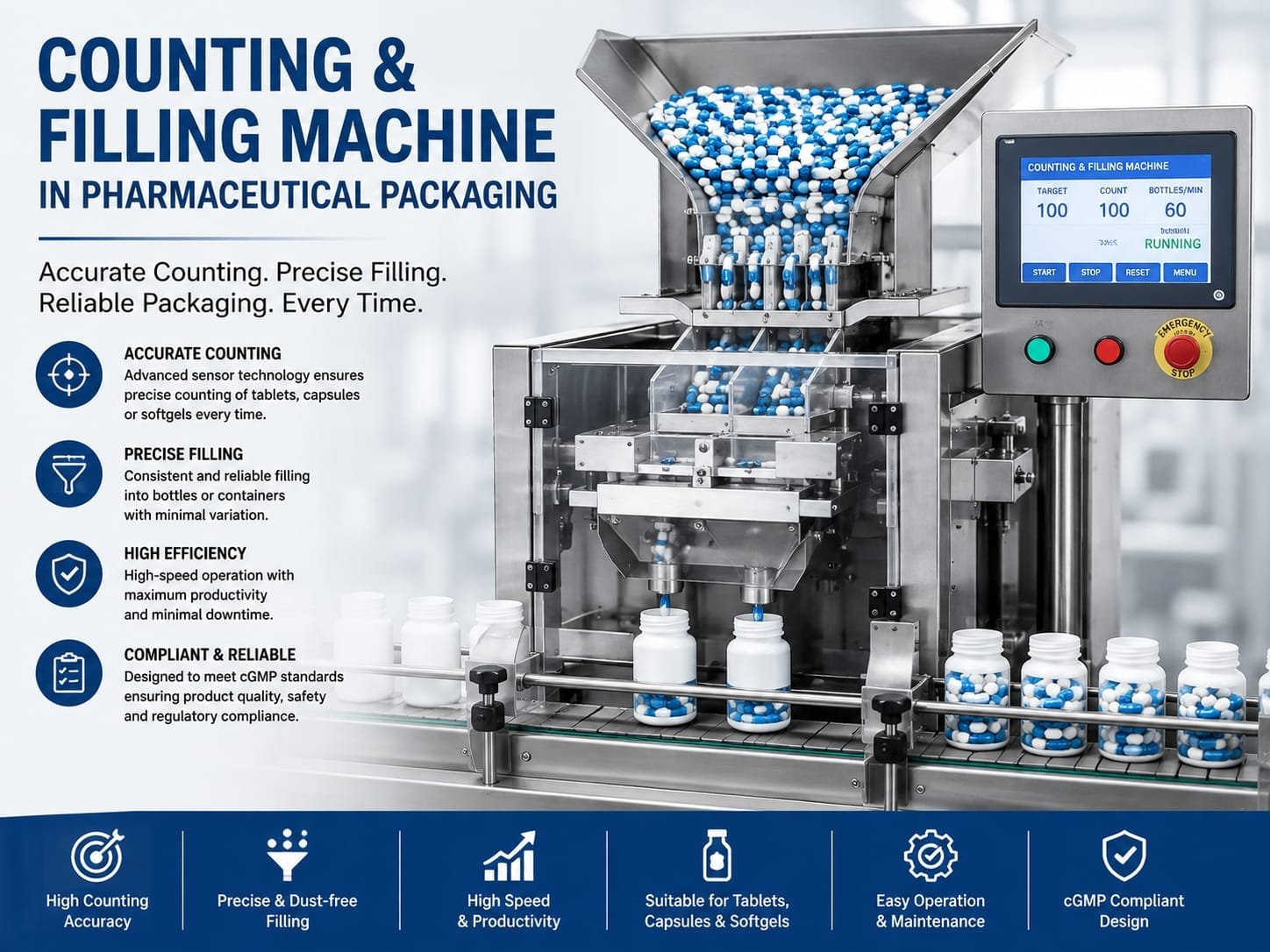
Counting and Filling Machine in Pharmaceutical Packaging: Working, Types & GMP Compliance
Every tablet, capsule, or softgel in a bottle must be the exact count mentioned on the label. No more, no less.
This is where the Automatic Counting and Filling Machine becomes the heart of solid dosage packaging.
In 2026, with track & trace and zero-defect mandates, these machines do more than just count. They ensure accuracy, speed, and compliance.
Counting = Right Quantity
Filling = Right Container
GMP = Proof of Both
1. What is a Counting and Filling Machine?
A Counting and Filling Machine is an automatic packaging equipment used in pharma to count a specific number of solid dosage forms like tablets, capsules, and softgels and fill them into bottles or containers.
It replaces manual counting which is slow, error-prone, and not 21 CFR 211 compliant.
2. Types of Counting and Filling Machines in Pharma
Type 1: Electronic Counting and Filling Machine
Working Principle: Uses sensors and photoelectric counters. Products pass through a chute and each piece breaks the light beam. Counter adds +1.
Speed: 60 to 300 BPM
Best For: Coated tablets, capsules of uniform size
Pros: Low cost, easy to changeover
Cons: Accuracy drops with dust or broken tablets
Type 2: Vibratory Bowl Counting and Filling Machine
Working Principle: Products are fed into a vibratory bowl. Vibration arranges them in single file. They pass through counting sensors into the bottle.
Speed: 100 to 500 BPM
Best For: Small tablets, softgels
Pros: Gentle handling, high speed
Type 3: Vision-Based AI Counting and Filling Machine
Working Principle: High-speed camera + AI counts each tablet in real time. Can detect broken, chipped, or double tablets and reject them.
Speed: 300 to 800 BPM
Best For: High-value products, export batches
Pros: 99.99% accuracy, data logging for L4
Type 4: Weight-Based Filling Machine
Working Principle: Instead of counting pieces, it fills by target weight. Used for powders and granules.
Example: 500g of vitamin powder per bottle
3. How Does a Counting and Filling Machine Work? 7 Step Process
- Product Feeding
Bulk tablets/capsules are loaded into the hopper. Dust extraction system removes fines. - Singulation
Vibratory bowl or conveyor arranges products in a single line. Prevents jamming. - Counting
As products pass the sensor, the electronic counter counts. AI vision systems also check for defects at this stage. - Bottle Feeding
Empty bottles are fed from a bottle unscrambler in sync with the counter. - Filling
Once the set count is reached, a diverter gate opens and drops the counted products into the bottle. - Weight Check & Verification
Inline checkweigher verifies fill weight. Vision system verifies bottle fill level. - Reject & Data Logging
Underfilled or overfilled bottles are rejected. Count data is sent to L3/L4 for batch records.
4. 6 Critical GMP & Compliance Features Required in 2026
- 21 CFR Part 11 Compliance
Audit trail, user access levels, electronic signature for count changes. - 100% Accuracy Verification
Dual counting system: Primary sensor + Secondary weight check. Prevents “short fills”. - Data Integrity
Every bottle count, batch number, and reject data must be logged and backed up. Direct link to L3. - Product Contact Parts
SS 316L contact parts. Tool-less dismantling for cleaning. No dead spots. - Reject Management
Separate locked bin for rejects. Shift-wise reconciliation by QA. - Integration with Serialization
Machine sends “Bottle filled with 100 tablets” signal to serialization printer before label printing.
5. Key Benefits of Automatic Counting & Filling
| Parameter | Manual Counting | Auto Counting Machine |
|---|---|---|
| Speed | 20-30 BPM | 200-800 BPM |
| Accuracy | 95-97% | 99.9-99.99% |
| Data Logging | No | Yes, with timestamp |
| Contamination Risk | High | Low, closed system |
6. Validation Approach: IQ, OQ, PQ
- IQ: Installation, utility, material of construction, software version verified
- OQ: Run at min, normal, max speed. Check accuracy with 10 different tablet sizes. Acceptance: ±0.5% of set count
- PQ: Run 3 consecutive batches. Challenge with broken tablets and dust. Acceptance: 100% count accuracy, <0.1% rejects
7. Common Problems and Troubleshooting
- Problem: Short Fills
Cause: Sensor blocked by dust
Solution: Daily cleaning + inline air blow - Problem: Tablet Chipping
Cause: High vibration in bowl
Solution: Reduce amplitude, add soft coating in bowl - Problem: Count Mismatch with L4
Cause: Network lag
Solution: Local buffer memory + auto sync
8. Integration with Downstream Equipment
A modern counting machine is never standalone. The flow is:
Counting & Filling → Cotton Placer → Induction Sealing → Capping → Labeling → 360° Inspection → Serialization
This ensures every bottle has the right count before it gets a serial number.
9. FAQs
Q1: What is the accuracy requirement as per GMP?
There is no fixed % in guidelines. But expectation is zero short fills. Industry standard: 99.9% accuracy.
Q2: Can one machine count both tablets and capsules?
Yes, with quick changeover kits and recipe change in HMI. 15-20 min changeover time.
Q3: How is accuracy verified during production?
By periodic manual check of 20 bottles per hour and by inline checkweigher data.
10. Conclusion
The Counting and Filling Machine is not just a packaging machine. It is a quality and compliance machine.
It ensures:
- Patient Safety: Right dose, right count
- Regulatory Compliance: Data, audit trail, accuracy
- Business Efficiency: Speed, less waste, less manpower
In the era of serialization and AI, choosing the right counting technology is choosing to avoid recalls.
Remember: You can label a bottle in 1 second. But you can’t fix a wrong count after it leaves the plant.
This article is for educational purposes only. Always refer to latest US FDA, EU GMP and your approved company SOPs.

About the Author
Mahummed Asif is a experienced pharmaceutical QA professional and publisher of Pharmashare. He has sound knowledge in GMP, Product Life Cycle Management, Regulatory filing, QMS, Product Complaint Management, Change control, risk management, and global audit preparation.
2 thoughts on “Counting and Filling Machine in Pharmaceutical Packaging”