
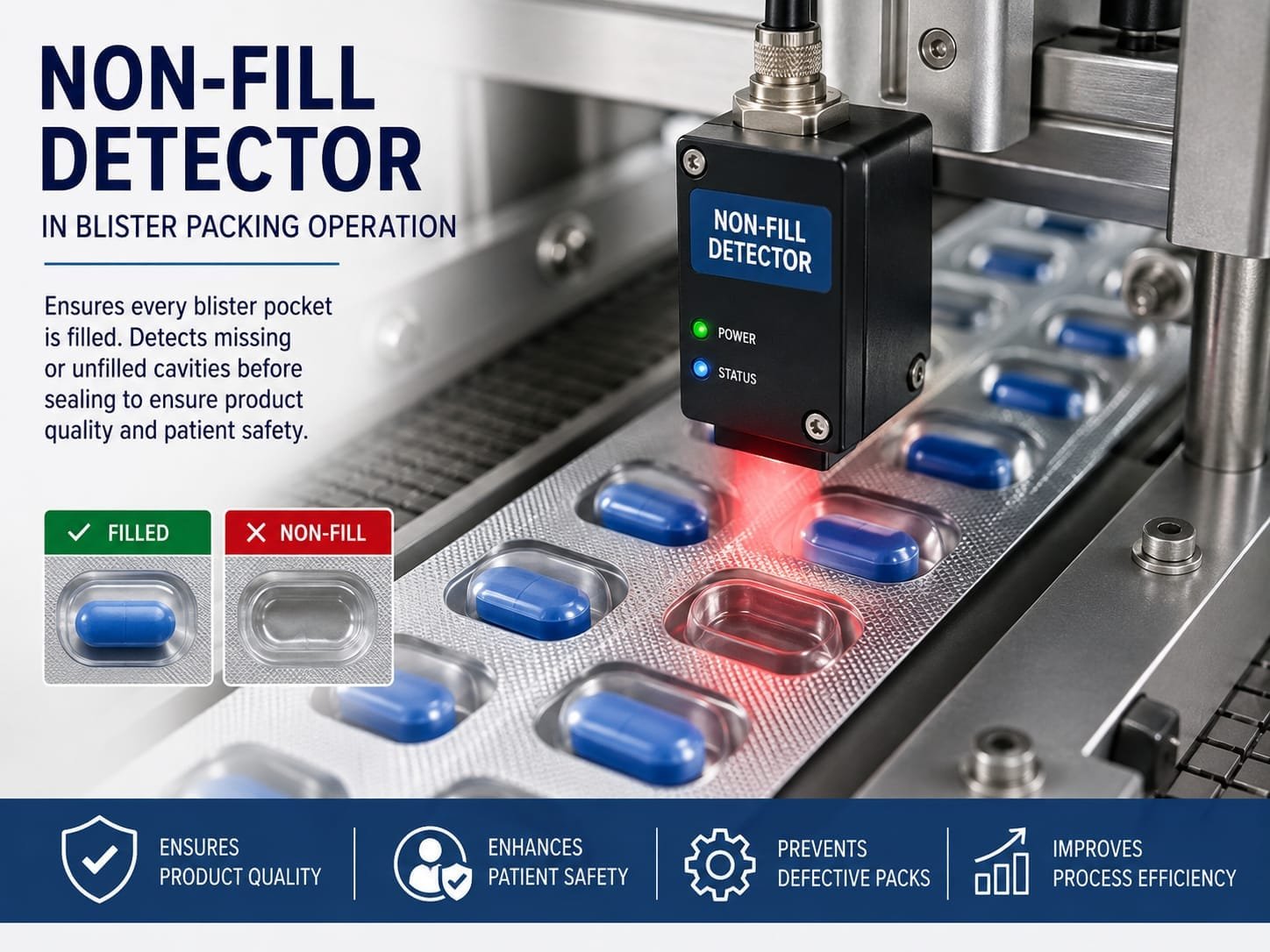
Non-Fill Detector in Blister Packing Operation: Working, Validation & GMP Guide
By PharmaShare | OSDF Packing Series | August 2026
1. What is a Non-Fill Detector?
Non-Fill Detector is an automated inspection system installed on a blister packing machine to detect and reject blisters with empty cavities (no tablet/capsule).
It is installed just after the filling station and before the sealing station.
GMP Mandate: As per EU GMP Annex 8 & 21 CFR 211.110 – 100% inspection for critical defects is expected. Empty pocket is a Critical Defect (AQL 0.010). Manual checking is not acceptable anymore.
2. Why is it Critical? The Risk of Empty Pocket
- Patient Safety: Patient misses a dose – especially critical for cardiac, anti-epileptic drugs
- Compliance Risk: Top reason for market complaints in OSDF
- Regulatory: USFDA asks for 100% empty pocket detection validation during audit
- Brand Damage: One empty blister photo on social media = huge damage
3. Types of Non-Fill Detection Technologies
| Technology | How it Works | Best For |
|---|---|---|
| 1. Vision / Camera Based | High-resolution camera + AI compares empty vs filled cavity by color, shape, contrast | All tablets/capsules, 99.9% accurate. Industry standard in 2026 |
| 2. Infrared (IR) Sensor | IR beam across pocket – if tablet present, beam breaks | Low cost, but fails for small / light colored tablets |
| 3. Mechanical / Brush Sensor | Old type – mechanical feeler checks pocket depth | Obsolete – Not recommended for GMP |
2026 Industry Standard: 95% of new Uhlmann, IMA, Romaco, ACG machines use Color Vision + AI based Non-Fill Detection (Laetus, Cognex, Sensum, ACG Inspect).
4. Working Principle – Step by Step
- Image Capture: Camera captures image of each blister format (e.g., 1×10) at 300+ blisters/min speed
- AI Analysis: System has taught image of “Good – Filled” vs “Bad – Empty”. It checks for presence, color, shape, broken piece
- Decision: Within 20-30 milliseconds – PASS or FAIL
- Rejection: If empty detected, PLC gives signal to pneumatic reject station after sealing. Blister goes to locked RED reject bin
- Alarm & Count: HMI shows reject count, reason (Empty), and batch trend
5. Qualification & Validation – What Auditors Expect
A. Challenge Test (Daily – Before Batch Start)
Most important GMP check. Must be documented in BPR.
- Create 3 test blisters: 1 Empty Pocket, 1 Half Broken, 1 Double Tablet
- Run them on machine at production speed
- System must detect and reject all 3
- Result: PASS/FAIL signed by Operator + QA
B. Validation Protocol (IQ/OQ/PQ)
| Test | Acceptance |
|---|---|
| False Reject Test | False reject < 0.5% |
| Detection Sensitivity | 100% empty detection for 3 consecutive runs of 100 blisters with 1 empty each |
| Product Specificity | Validation for EACH product, color, and size – White vs Yellow tablet needs separate teaching |
| Speed Challenge | Validate at low, normal, and high machine speed |
6. Common Issues & Troubleshooting
| Problem | Root Cause | CAPA |
|---|---|---|
| Too many false rejects | Dust on camera lens, wrong lighting, product teaching poor | Clean lens every 2 hrs, re-teach product, check light intensity |
| Missed empty detection | Camera delay, white tablet in white background, speed too high | Use color camera, reduce speed, increase contrast setting |
| System not rejecting | Pneumatic valve fail, PLC communication fail | Check reject verification sensor – must alarm if reject fails |
7. GMP Checklist for Non-Fill Detector
- Is challenge test done and documented with 3 blisters daily?
- Is reject verification sensor present? (Ensures rejected blister actually went to reject bin)
- Is there audit trail for teaching / product change?
- Is the reject bin locked and labeled RED?
- Is product-wise validation available?
- Is camera cleaning part of batch to batch cleaning checklist?
- Is alarm defined if >5 consecutive empty rejects?
Conclusion
Non-Fill Detector is not an accessory – it is a Critical GMP System.
In 2026, no auditor will accept manual checking of empty pockets. Your blister machine must have a validated vision-based system with challenge test and reject verification.
Remember: 1 empty blister reaching market = 1 complaint. 10 complaints = CAPA + Regulatory scrutiny. Prevention is cheaper than investigation.
Tip: Link your non-fill detector data to your SCADA – trend empty pockets by feeder, shift, and product. You’ll predict feeder wear before it fails.
Related: Counting & Filling Machine | Blister Packing in Pharma – Complete Guide | Handling of Rejects During Packing

About the Author
Mahummed Asif is a experienced pharmaceutical QA professional and publisher of Pharmashare. He has sound knowledge in GMP, Product Life Cycle Management, Regulatory filing, QMS, Product Complaint Management, Change control, risk management, and global audit preparation.