
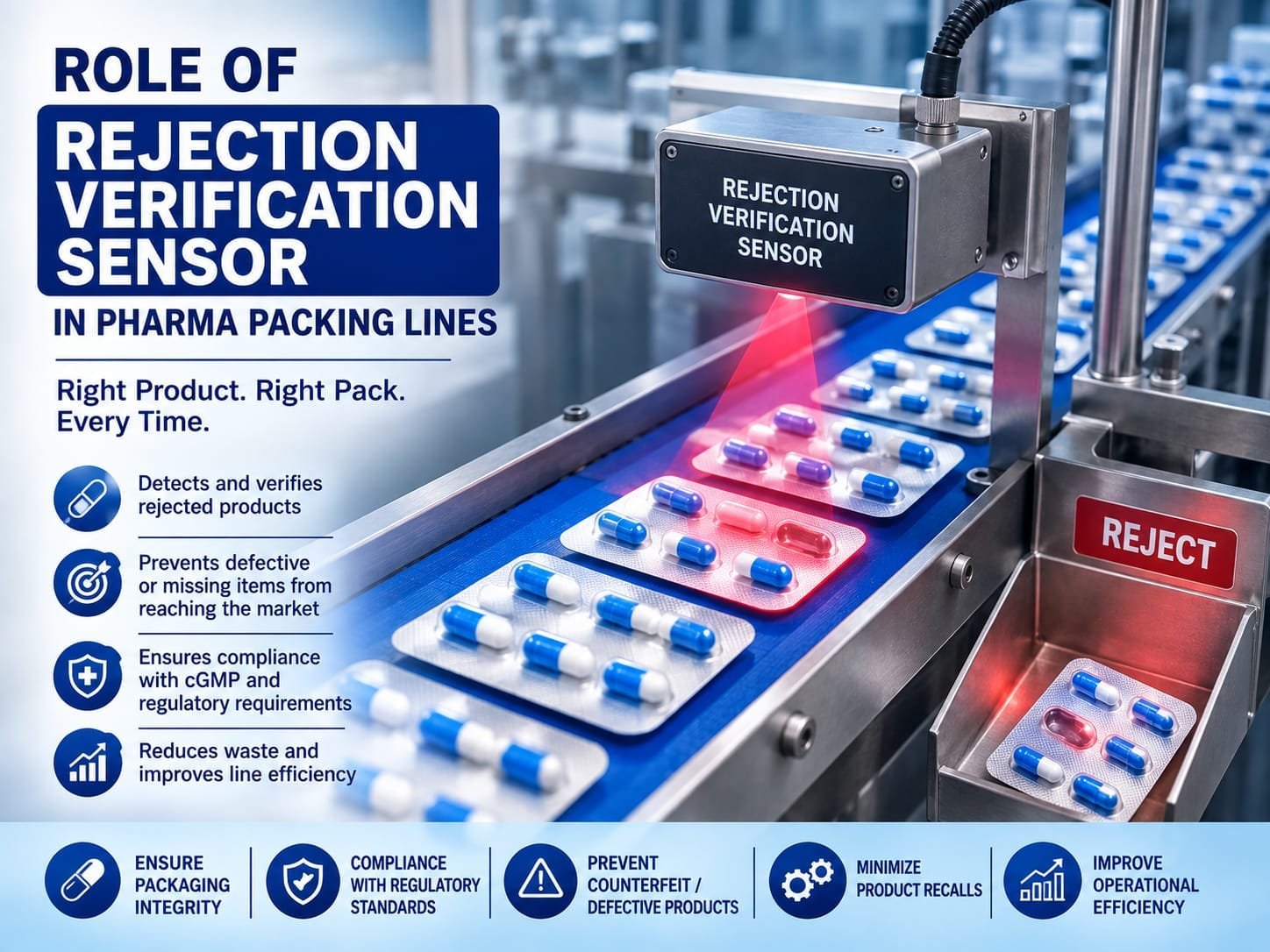
Role of Rejection Verification Sensor in Pharma Packing Lines: Why Your Auto-Reject is Useless Without It
By PharmaShare Editorial Team | Pharma Packaging Technology | August 2026
1. What is Rejection Verification Sensor?
In every pharma packing line, we have detectors:
- Vision system detects empty pocket
- Checkweigher detects low fill weight
- Metal detector detects metal contamination
- OCR detects wrong print
But how do you know the defective pack was actually rejected into the reject bin?
That’s the job of Rejection Verification Sensor.
Simple Definition: It is a second sensor (usually photoelectric / proximity sensor) installed at the reject chute/bin that gives feedback to PLC – “Yes, the rejected pack has reached the reject bin”.
If the rejected pack does NOT reach the bin within defined time (e.g., 500 ms), the machine stops and gives alarm: “REJECTION FAILED”.
2. Why is it Mandatory? Regulatory Expectations
This is not a good-to-have. This is expected by all major regulators.
| Regulation | What it Says |
|---|---|
| EU GMP Annex 8 | Rejection systems should be checked to ensure they are operating correctly |
| 21 CFR 211.110 | Control procedures must be established to monitor output and validate performance of manufacturing processes that may cause variation |
| USFDA Guidance – Checkweigher | Rejection verification is expected. System must stop if reject fails |
| EU GMP Annex 15 | Qualification of automated inspection systems must include reject verification |
3. How It Works – Logic Diagram
STEP 2: PLC Counts – e.g., 5 packs later → Pusher / Flap activates
STEP 3: Defective pack falls into reject chute
STEP 4: Verification Sensor at Chute Detects Pack → Signal OK
STEP 5: If NO signal within 500ms → MACHINE STOPS + ALARM “REJECT VERIFICATION FAILED”
Fail-Safe Design: The line must stop if verification fails. It should NOT continue running. This is a critical GMP principle – Fail Safe.
4. Where is it Required on a Packing Line?
Everywhere there is an auto-rejection, you need verification:
- Blister Line: After non-fill detector / vision inspection
- Bottle Line: After counting / checkweigher (for under/over count)
- Cartoning Line: After OCR/OCV, leaflet presence, flap check
- Serialization Line: After vision for aggregation fail
- Metal Detector: After metal detection – CRITICAL for compliance
- Labeling Line: After label presence check
Best Practice in 2026: Uhlmann, IMA, Marchesini now give dual sensor verification – Sensor 1 confirms pusher moved, Sensor 2 confirms pack reached bin. This is called Closed-Loop Rejection.
5. Qualification & Validation – How to Validate It
A. Daily Challenge Test (Must in BPR)
- Create 1 defective pack (e.g., empty blister)
- Run it – System must reject it
- Verification sensor must show OK in HMI
- Now block the reject chute with your hand intentionally
- System must STOP with alarm “Rejection Verification Failed”
This 2-part challenge proves: Detection + Verification + Fail-Safe.
B. Validation Protocol (3 Runs)
| Test | Acceptance |
|---|---|
| 100% Rejection verification | 100% packs detected as defective must be verified at chute |
| Fail-safe test | Machine must stop within 1 sec if chute blocked |
| Audit trail | Every verification failure must be logged with time, batch, user in audit trail |
6. Common Mistakes That Lead to Audit Observations
- ❌ Vision system present but no verification sensor – “Open loop rejection”
- ❌ Verification sensor present but machine does NOT stop on failure – only warning
- ❌ No challenge test for verification – only for detection
- ❌ Rejected packs kept in open bin – can be taken back by operator
- ❌ No trend of verification failures in MBR
7. How to Retrofit on Old Machines
If you have old blister / bottle line without verification:
- Install SICK / Omron photoelectric sensor at reject chute – Cost ~ $200
- Wire it to PLC – Add timer logic – 500ms window
- Add HMI alarm – “REJECTION FAILED – LINE STOPPED”
- Integrate audit trail to SCADA
- Re-validate with 3 runs
ROI: Less than 1 day to implement, saves you from a major FDA 483.
Conclusion
Detection without verification is half compliance.
Your packing line may have the best camera in the world, but if the rejected product can still go into a shipper, you are not GMP compliant.
Rejection Verification Sensor closes the loop – Detect → Reject → Verify → Stop if Fail.
If you are QA Head, go today to your packing floor and ask: “Show me the rejection verification alarm for checkweigher and vision.” If they can’t, you have a gap.
⚠️ Regulatory Disclaimer
For Information Purposes Only: The content provided on PharmaShare.in, including this article on rejection verification sensors, is for educational and informational purposes only. It is not intended as legal, regulatory, or compliance advice.
No Regulatory Authority: PharmaShare is not affiliated with USFDA, EMA, MHRA, CDSCO, WHO, or any other regulatory agency. References to 21 CFR Part 211, EU GMP Annexes, and other guidelines are based on publicly available information as of August 2026 and are subject to change.
Professional Validation Required: Readers must validate and verify all information, designs, validation protocols, and procedures with their own Quality Assurance, Engineering, and Regulatory Affairs departments before implementation. Site-specific risk assessment and change control must be performed.
No Liability: PharmaShare, its authors and contributors do not assume any responsibility or liability for any errors, omissions, or outcomes resulting from the use of this information. Implementation of any system should be done under qualified supervision and as per approved SOPs.
Trademarks: All trademarks, logos, and brand names mentioned (e.g., Uhlmann, IMA, Marchesini, SICK, Omron, Cognex, Laetus) are property of their respective owners. Use here is for identification only.
Related Articles: Counting & Filling Machine | Non-Fill Detector in Blister Packing | Handling of Rejects During Packing

About the Author
Mahummed Asif is a experienced pharmaceutical QA professional and publisher of Pharmashare. He has sound knowledge in GMP, Product Life Cycle Management, Regulatory filing, QMS, Product Complaint Management, Change control, risk management, and global audit preparation.