What is Orange Book & How to Read It? Complete Guide for Generic Pharma
By PharmaShare Regulatory Team | US FDA Regulatory | August 2026
1. What is Orange Book? Official Name
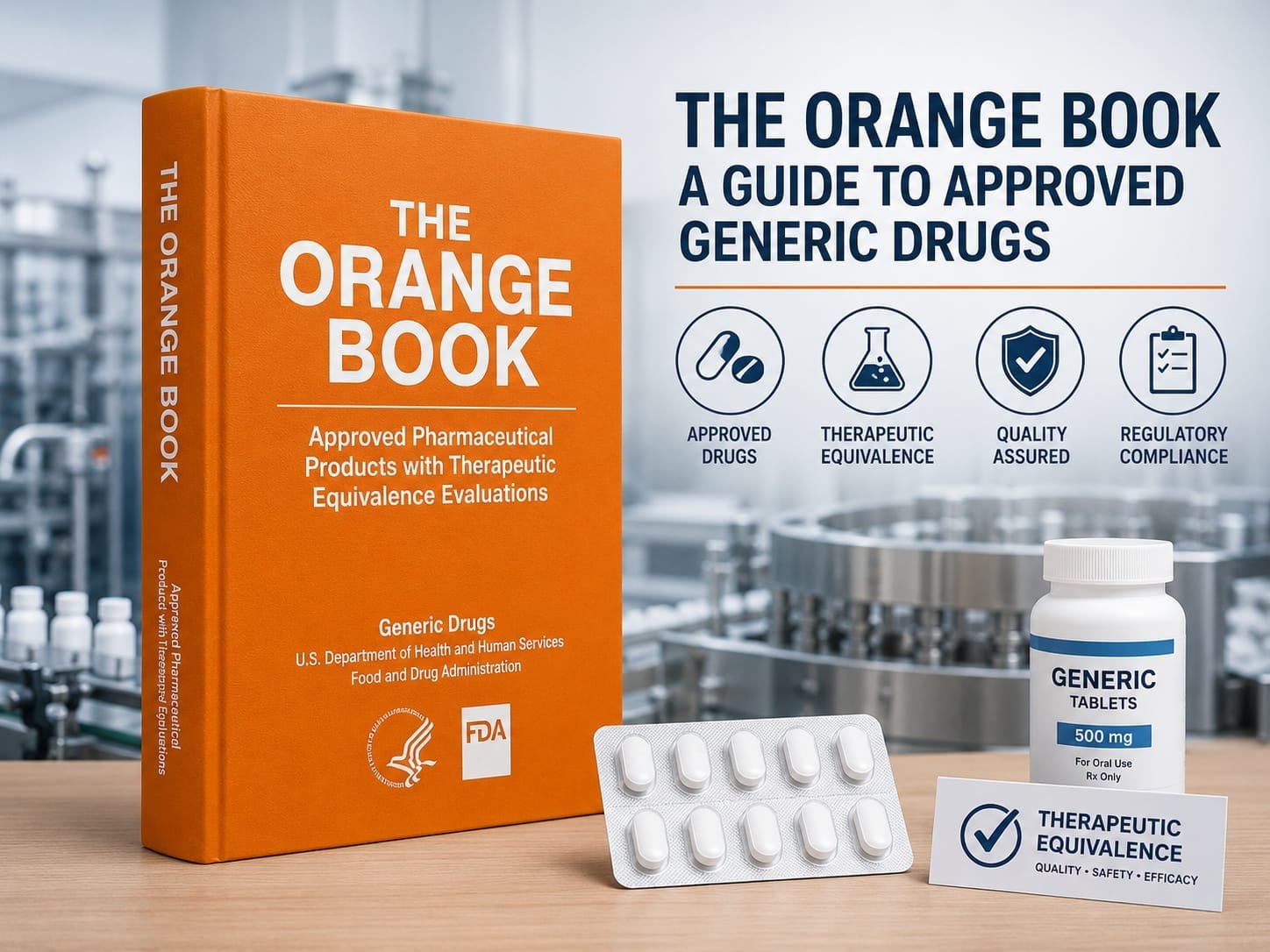
Official name: Approved Drug Products with Therapeutic Equivalence Evaluations.
Everyone calls it Orange Book because its cover was Orange in print edition in 1980. Now it’s fully online.
Website: https://www.accessdata.fda.gov/scripts/cder/ob/index.cfm
Maintained by: USFDA – CDER
Updated: Daily
What it contains?
- All USFDA approved drugs (NDA + ANDA)
- Reference Listed Drug (RLD) identification
- Patent details for each NDA
- Exclusivity details (NCE, ODE, PED etc.)
- Therapeutic Equivalence (TE) Code – AB, BX etc.
- Generic approval status
2. Why Orange Book is Bible for Generic Pharma?
To select RLD for ANDA filing + Check patents + Para I-IV strategy
To see approved strengths, dosage forms, and which products are AB rated
To track patent expiry, challenge opportunities, 180-day exclusivity
To find products with no generic, orphan drugs, and market size
3. How to Search Orange Book – Step by Step (2026 Method)
Let’s search for Atorvastatin (Lipitor) as example:
- Go to Orange Book Search: https://www.accessdata.fda.gov/scripts/cder/ob/index.cfm
- Click “Search by Proprietary Name / Active Ingredient / NDA Number”
- Type “Atorvastatin Calcium” → Search
- You will see list of all NDAs and ANDAs
- Click on any NDA number – e.g., N020702 (Lipitor)
Result page shows 5 sections:
| Section | What You See | Why Important |
|---|---|---|
| 1. Product Info | Ingredient, Strength, Dosage Form, Route, Applicant (Pfizer) | This is your RLD details. Must match your ANDA |
| 2. TE Code | AB, AB1, AB2, BX, etc. | AB = Bioequivalent, can be substituted at pharmacy |
| 3. RLD Column | Yes / No – Identifies Reference Listed Drug | You must file ANDA against RLD = Yes product |
| 4. Patent & Exclusivity | Patent No., Expiry Date, Drug Substance / Product / Method of Use | Decides Para I, II, III, IV filing |
| 5. RS – Reference Standard | Identifies which product to use for BE study | FDA expects BE against RS, not always RLD |
4. How to Read TE Codes – The Most Confusing Part
| Code | Meaning | Example |
|---|---|---|
| A | No known or suspected bioequivalence problems | All good generics are A-rated |
| AB | Meets bioequivalence, therapeutically equivalent, can be substituted | Most tablets/capsules – You want AB rating |
| AB1, AB2 | Same as AB but multiple RS for same strength – meets BE to its own RS | Common for old drugs |
| BX | Data insufficient to prove bioequivalence – NOT substitutable | Some extended-release, injectables – Avoid |
| B* | Actual or potential BE problems, needs further investigation | Not preferred |
Rule: For ANDA to be commercially viable, you need AB rating. BX products won’t get market share.
5. How to Read Patent & Exclusivity Section
Patent Info shows:
- Patent No.: e.g., US 5,273,995
- Expiry Date: e.g., Dec 28, 2028 + 6 months PED if applicable
- Drug Substance (DS): Covers API
- Drug Product (DP): Covers formulation
- Method of Use (U-XXXX): Covers specific indication – You can carve this out via Section viii
Exclusivity Info shows:
| Code | Meaning | Blocks ANDA? |
|---|---|---|
| NCE | New Chemical Entity – 5 years | Yes, cannot even submit ANDA for 5 years |
| ODE | Orphan Drug – 7 years | Yes |
| I-XXX | New Indication – 3 years | No, but you must carve out that indication from label |
| PED | Pediatric – +6 months extra | Extends all patents & exclusivity by 6 months |
6. RLD vs RS – Most People Get This Wrong
RLD (Reference Listed Drug): The brand drug on whose safety/efficacy data you rely for your ANDA labeling. You file Para certification against RLD’s patents.
RS (Reference Standard): The actual physical product FDA wants you to use for your Bioequivalence study. RS is usually RLD, but sometimes FDA selects a generic as RS if RLD discontinued.
Rule in 2026: Always buy RS listed in Orange Book at time of BE study, not any generic from market. FDA checks RS lot number in your BE report.
7. Live Example – Reading Orange Book for a Drug
Let’s take: Sitagliptin 100mg Tablets (Januvia) – N021995
– RLD: Yes (Januvia 100mg – Merck)
– RS: Yes (Januvia 100mg)
– TE Code for ANDA: AB (all generics are AB rated)
– Patent: US RE… – Expiry July 2026, Method of Use U-…
– Exclusivity: Expired
→ Decision: You can file ANDA as Para II if patent expired, or Para IV if you want to launch before expiry by challenging.
8. Pro Tips to Use Orange Book Like an Expert
- Check Daily: New patents are listed daily. If you filed Para II yesterday and new patent lists today, FDA will ask you to amend to Para IV. Set daily alert.
- Download Patent List: Use Orange Book Patent List PDF – Share with IP team weekly.
- Check Discontinued List: Sometimes RLD is discontinued but RS is still available – You can still file ANDA.
- Use Orange Book + Purple Book: For biologics, check Purple Book. For small molecules, Orange Book only.
- 180-Day Exclusivity: Orange Book also shows which ANDA has 180-day exclusivity – Look for “180-day Decision” section.
Conclusion
Orange Book is not just a list. It’s your business intelligence tool.
If you read it correctly, you can know:
- Which product to develop next (no generic + patent expiring soon)
- When to file (Para II vs Para IV)
- What BE study to do (RS selection)
- Whether your generic will be substitutable (AB rating)
Master Orange Book = Master US Generic Business.
⚠️ Regulatory Disclaimer
This article is for educational purposes only. Orange Book is maintained by USFDA and information changes daily. Always verify from official FDA Orange Book website before making any regulatory or business decision. PharmaShare is not affiliated with USFDA. Consult qualified regulatory professional for ANDA filing strategy. Last Updated: Aug 21, 2026.
Related: https://pharmashare.in/types-of-anda-filing-in-the-us/

About the Author
Mahummed Asif is a experienced pharmaceutical Quality Assurance professional and publisher of Pharmashare. He has worked with leading Pharmaceutical organizations and has developed extensive expertise in Quality Assurance, deviation management, investigations, CAPA, QMS, Product Life Cycle Management, change control, risk management, validation, product complaints, product recalls, and regulatory compliance. He is passionate about sharing practical pharmaceutical knowledge with professionals, students, and quality practitioners across the industry.