
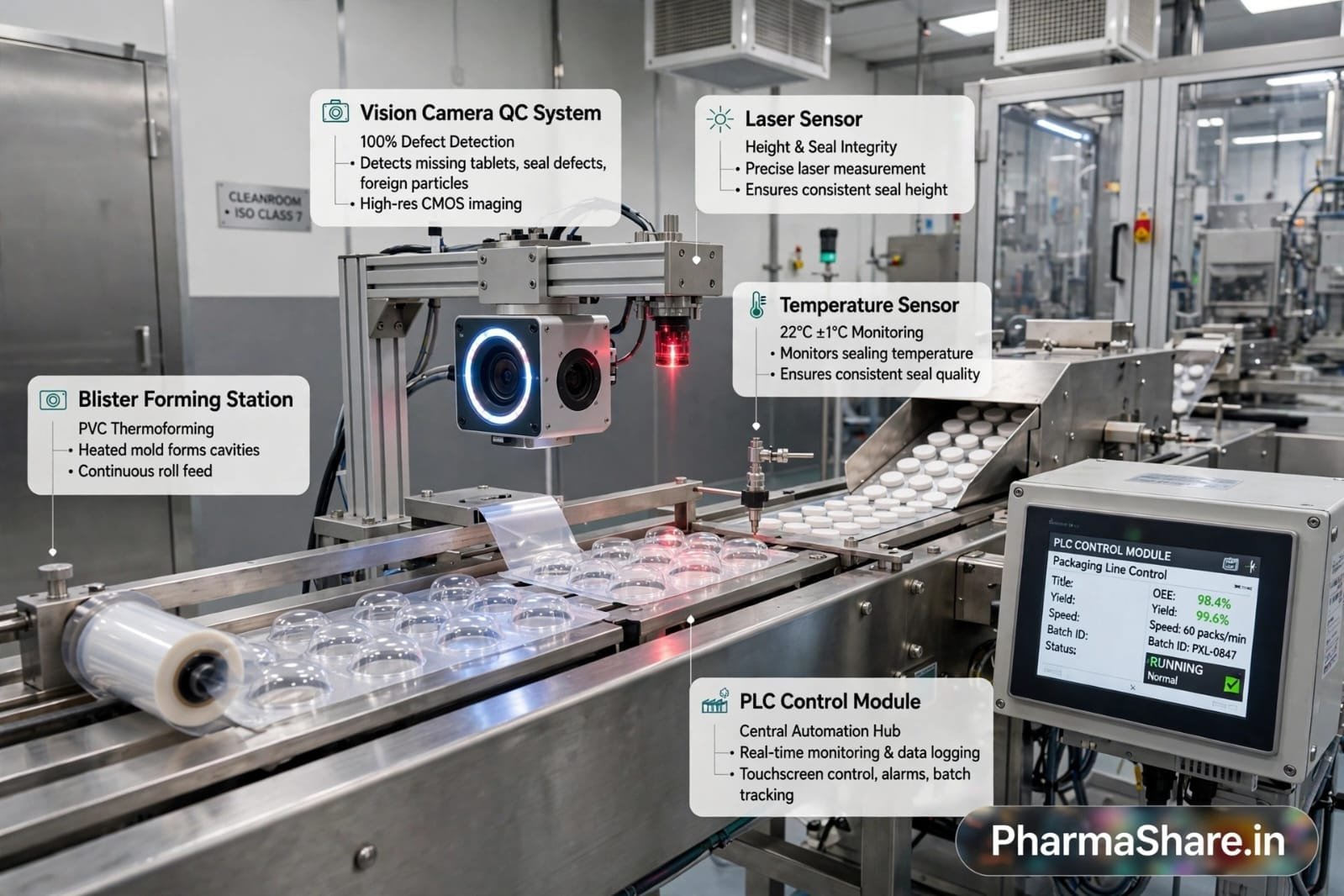
Types of Sensors Used in Pharmaceutical Packaging and Their Functions
In pharmaceutical manufacturing, packaging is not just about protection and presentation — it is a critical control point for patient safety, regulatory compliance, and product integrity. A single packaging error can lead to a product recall, FDA warning letter, or risk to the patient.
This is where sensors play a vital role. Modern blister lines, bottle filling lines, cartoning and case packing lines are equipped with a network of smart sensors that work 24/7 to detect, reject, and document every anomaly.
1. Vision Sensors & Machine Vision Systems
Function: The eye of the packaging line.
- Checking presence and count of tablets in blisters
- Detecting broken, chipped, or discolored tablets
- Verifying print quality, expiry date, batch number on cartons
- Reading 2D barcodes and serialization codes for Track & Trace
2. Proximity and Photoelectric Sensors
Function: Product presence and positioning. These sensors detect whether a product, foil, carton, or leaflet is present at a specific station. If a carton is missing, the line will not dispense the blister, preventing product loss and mix-ups.
3. Color & Color Mark Sensors
Function: Accurate color-based detection. Used to detect color registration marks on printed foils and cartons, ensuring blister foil is cut and sealed at the exact right position.
4. Temperature Sensors (RTD, Thermocouples, IR)
Function: Seal integrity. They continuously monitor sealing temperature of blister forming, lidding, and pouch sealing. A deviation of even 2-3°C can cause weak sealing or leakage.
5. Pressure Sensors
Function: Ensuring leak-proof packaging. Monitors forming pressure, sealing pressure, and vacuum integrity in blister and strip packs. Essential for nitrogen flushing in MAP packaging.
6. Leak Detection & Vacuum Decay Sensors
Function: Container Closure Integrity Testing (CCIT). Critical for bottles, vials, and BFS. Detects micro-leaks using vacuum decay or High-Voltage Leak Detection (HVLD).
7. Checkweighers / Load Cell Sensors
Function: Weight-based QC. After filling, load cells weigh each pack. Under-filled, over-filled, or empty bottles with missing tablets are auto-rejected. This is a critical GMP requirement.
8. Metal Detectors & X-Ray Inspection Sensors
Function: Product safety. Installed after packaging, they detect metallic particles from punches or glass shards inside sealed bottles and cartons.
9. Serialization and RFID Sensors
Function: Track and Trace compliance. As per DSCSA (US), FMD (EU), and DGFT (India), these scanners read and verify unique serial numbers and aggregation codes.
10. Humidity and Gas Sensors
Function: Stability protection. Monitors RH% and oxygen levels inside packaging areas and bulk shippers. Vital for effervescent and moisture-sensitive products.
11. Ultrasonic Sensors
Function: Non-contact inspection. Checks fill level in bottles without contact and inspects quality of tube sealing in ointment/cream lines.
12. Torque and Cap Inspection Sensors
Function: Proper closure. Measures applied torque while capping. Under-torqued caps cause leakage, over-torqued caps cause difficulty for patients.
Why Sensor Integration Matters for FDA & EU Compliance
- Data Integrity: All modern sensors are connected to SCADA/MES and record every parameter with timestamp as per 21 CFR Part 11.
- Zero Defect Philosophy: Enables 100% online inspection instead of random sampling.
- Reduced Recalls: Prevents labelling and packaging mix-ups at source.
- OEE Improvement: Auto-rejection prevents line stoppage and reduces human intervention.
Conclusion
From a simple photoelectric sensor that detects a carton to an advanced AI-based vision system that reads 1000 cartons per minute, sensors are the silent guardians of pharmaceutical packaging quality.
For any pharma company preparing for a USFDA, MHRA, or EU GMP audit, validation and calibration of these sensors is not optional – it is a direct indicator of your Quality Culture.
Investing in smart sensor technology is not an expense; it is insurance for patient safety and regulatory peace of mind.
© PharmaShare.in – Simplifying Pharma Knowledge
The information provided on this page is for educational and informational purposes only. It is not intended to provide regulatory, legal, or compliance advice.
Pharmaceutical regulations including FDA 21 CFR, EU GMP Annexes, ICH Guidelines, EDQM, WHO, and CDSCO requirements are subject to frequent updates and interpretation by regulatory authorities.
Readers are responsible for ensuring compliance with current applicable laws and regulations in their jurisdiction. PharmaShare does not guarantee the accuracy, completeness, or currentness of this content.
This content does not create a consultant-client relationship. For product-specific regulatory strategy, dossier preparation, or inspection readiness, please consult qualified regulatory professionals or contact us directly.

About the Author
Mahummed Asif is a experienced pharmaceutical Quality Assurance professional and publisher of Pharmashare. He has worked with leading Pharmaceutical organizations and has developed extensive expertise in Quality Assurance, deviation management, investigations, CAPA, QMS, Product Life Cycle Management, change control, risk management, validation, product complaints, product recalls, and regulatory compliance. He is passionate about sharing practical pharmaceutical knowledge with professionals, students, and quality practitioners across the industry.