
Tablet compression tooling is one of the most important parts of
pharmaceutical tablet manufacturing. The quality, shape, size,
thickness and appearance of a tablet depend partly on the condition
and design of the punches and dies used during compression.
Proper tooling selection, inspection, cleaning, maintenance and
storage help pharmaceutical manufacturers maintain consistent
tablet quality, reduce machine downtime and prevent tooling-related
defects.
1. Introduction to Tablet Compression Tooling
Tablet compression is a major step in the manufacturing of
pharmaceutical tablets. During this operation, a suitable quantity
of granules or powder is compressed inside a die cavity using
upper and lower punches.
The punches apply the compression force, while the die holds the
material and helps define the tablet’s diameter or overall shape.
The punch tips determine the tablet’s face design, including its
shape, embossing and score lines, where applicable.
Punches and dies must be compatible with the tablet compression
machine. The correct tooling should be selected according to the
product specification, tablet design, machine configuration and
approved tooling drawings.
2. What Is Tablet Compression Tooling?
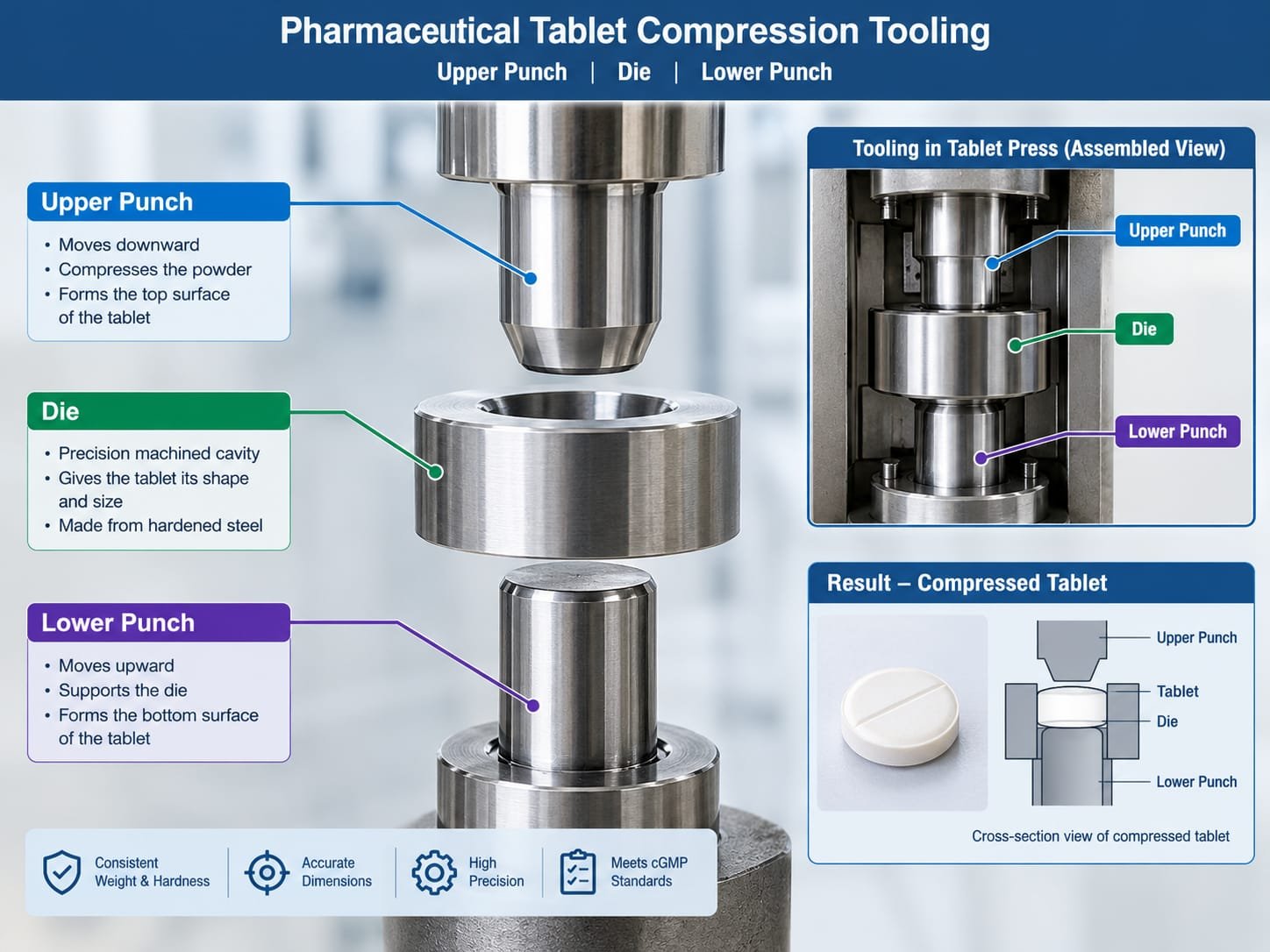
Tablet compression tooling refers to the punches and dies installed
in a tablet press to convert powder or granules into tablets.
In a rotary tablet press, multiple tooling stations operate as
the turret rotates.
The main tooling components are:
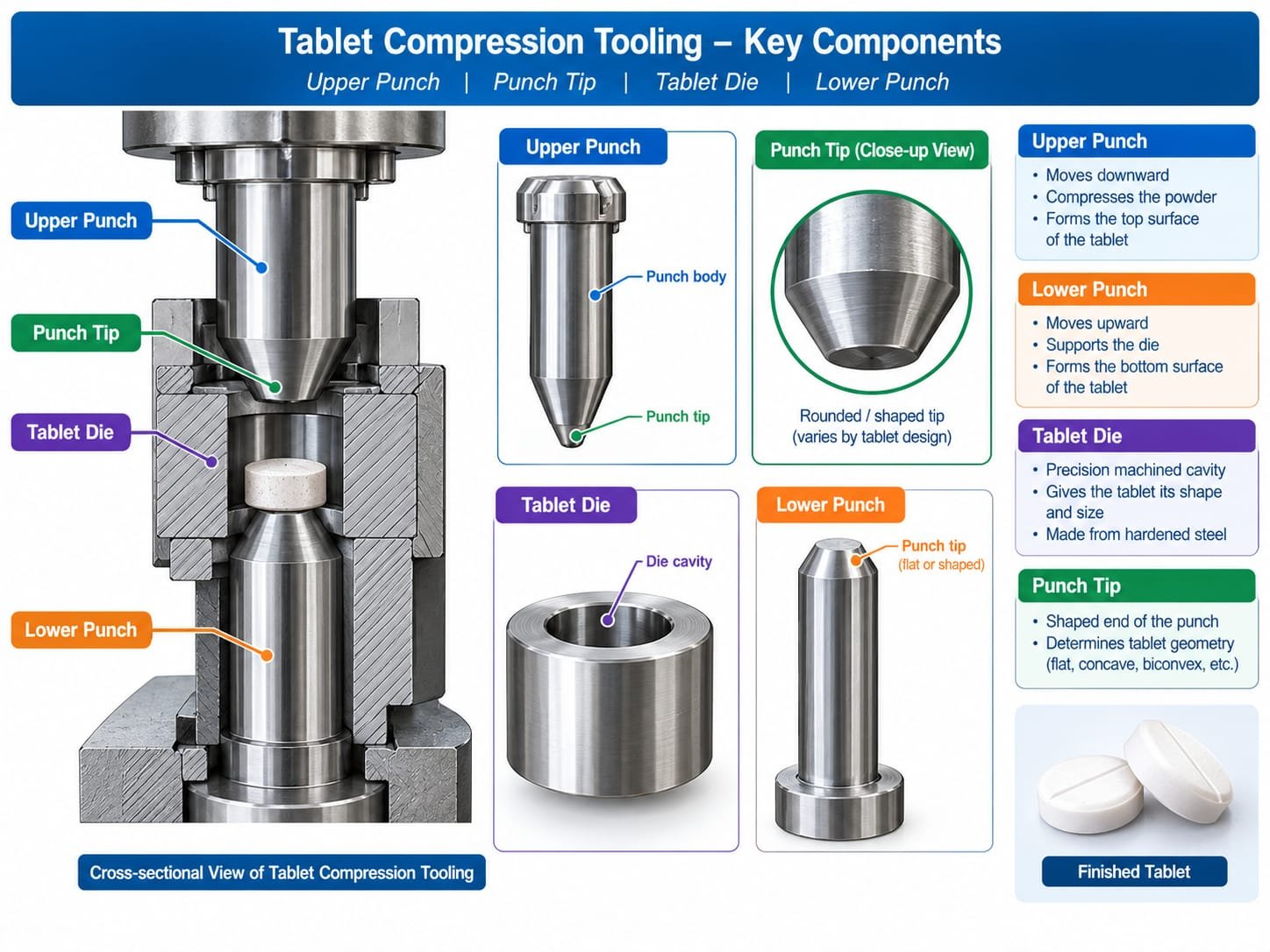
- Upper punch: Enters the die from the top and participates in compression.
- Lower punch: Supports the powder in the die, helps control the fill volume and ejects the finished tablet.
- Die: Provides the cavity in which the tablet is formed.
Tooling is available in different sizes, shapes, standards and
designs. The selected tooling must match the press and the approved
tablet design.
Important: Tooling dimensions are not universal.
Always confirm compatibility against the applicable tooling
standard, machine manufacturer’s requirements and approved drawings.
3. Main Components of Tablet Tooling
3.1 Upper Punch
The upper punch moves downward during the compression cycle.
Its tip face contacts the powder bed and helps form the upper
surface of the tablet. The punch head interacts with the press
rollers and cam tracks according to the machine design.
The upper punch must have the correct working length, tip profile,
head configuration and surface finish. Damage to the tip or
head can affect tablet quality and machine performance.
3.2 Lower Punch
The lower punch moves inside the die bore. It establishes the
powder fill depth, supports the material during compression
and rises to eject the tablet after compression.
The lower punch working length and movement must be within
specification to achieve the intended tablet weight, thickness
and compression conditions.
3.3 Die
The die is a precision component with a central opening called
the die bore. The upper and lower punches move into this opening
during compression.
The die bore helps determine the tablet’s diameter or cross-sectional
shape. The die’s outside dimensions must also match the die pocket
in the tablet press.
| Component | Main Function | Important Checks |
|---|---|---|
| Upper punch | Applies compression from the upper side | Tip condition, working length, head wear and surface finish |
| Lower punch | Supports powder, helps control fill depth and ejects the tablet | Tip condition, working length, free movement and head wear |
| Die | Provides the cavity for tablet formation | Die bore, outside diameter, height, wear and corrosion |
4. Types of Tablet Compression Tooling
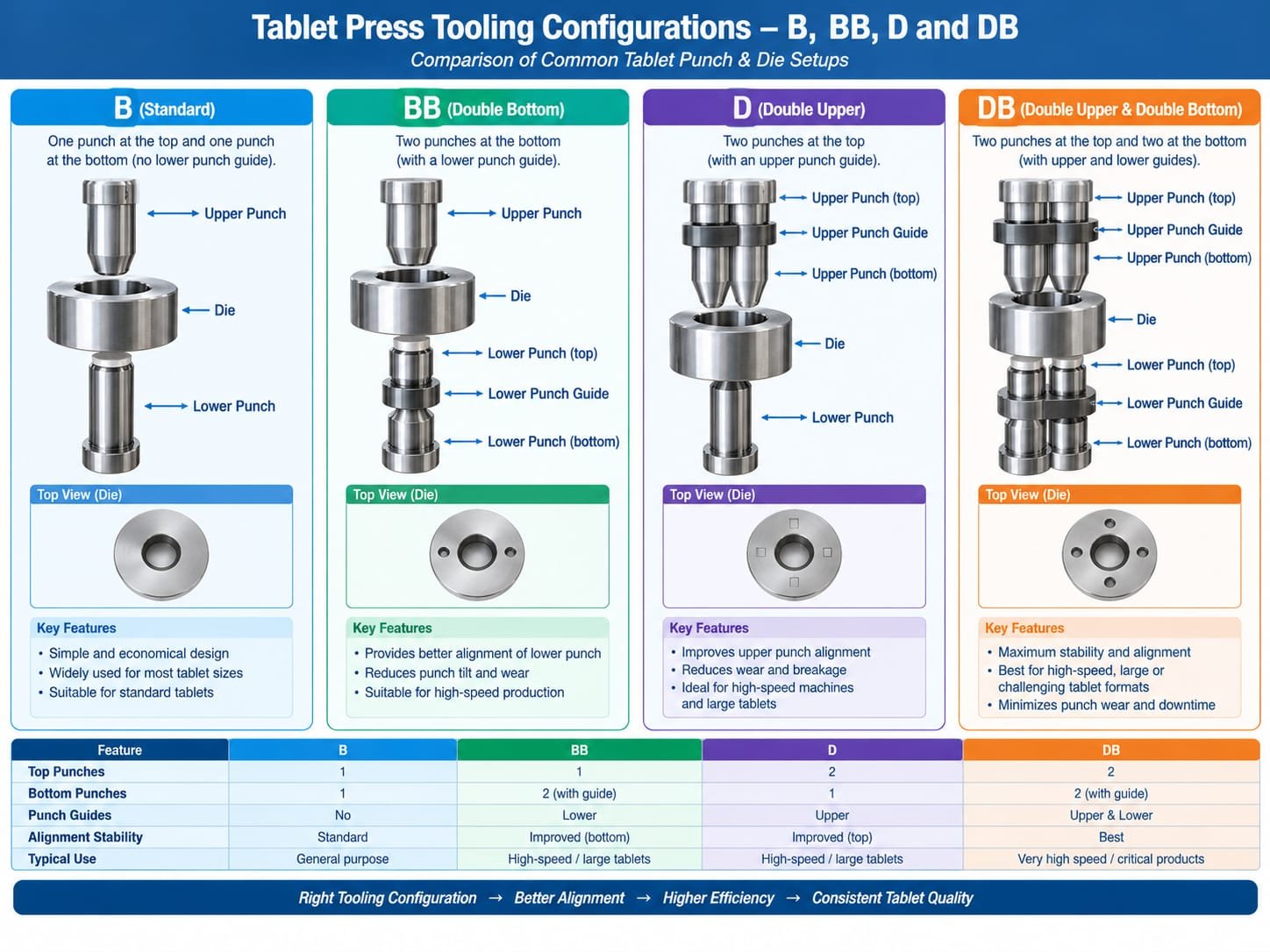
B and D tooling are widely used configurations in tablet compression.
BB and DB are additional designations used for particular tooling
dimensions. Tooling selection depends on the press specification
and the tablet requirements.
4.1 B Tooling
B tooling is commonly used for many standard tablet applications.
It has its own specified punch and die dimensions and is suitable
for products whose tablet design and required production capacity
can be accommodated by the tooling.
4.2 D Tooling
D tooling generally has larger punch and die dimensions than
B tooling. It may be selected for larger tablets or applications
requiring the capacity offered by that tooling configuration.
Suitability depends on the press, formulation and tablet design.
4.3 BB Tooling
BB tooling is a related configuration with dimensions different
from standard B tooling. In common TSM-style nomenclature, BB
uses the same nominal punch barrel diameter as B tooling but
has a different specified lower-punch length. Confirm the
exact configuration from the tooling drawing and standard.
4.4 DB Tooling
DB tooling generally refers to a combination that uses D-type
punch dimensions with a B-type die configuration, subject to
the applicable tooling standard and machine design. It is
important not to assume that similarly named configurations
are interchangeable.
| Tooling Type | General Description | Selection Consideration |
|---|---|---|
| B | Common tooling configuration | Press compatibility and tablet dimensions |
| D | Generally larger tooling configuration | Required tablet size and press capability |
| BB | B-related configuration with different specified dimensions | Exact punch and die specifications |
| DB | Combination tooling designation under applicable specifications | Verified compatibility of punches, dies and press |
Note: B, BB, D and DB descriptions can depend
on the tooling standard. TSM and European Euronorm specifications
are similar in concept but are not automatically interchangeable.
Check the exact specifications before ordering or installing tooling.
5. Types of Punches Used in Tablet Compression
Punches are selected according to the shape and appearance of
the required tablet. The punch tip may be flat, concave, deeply
concave or designed with a special profile.
5.1 Flat-Faced Punch
A flat-faced punch produces a tablet with a relatively flat face.
Edge details and other design features depend on the tip geometry.
5.2 Standard Concave Punch
A concave punch produces a tablet with a curved face. The depth
of concavity is selected according to the tablet design.
5.3 Deep-Concave Punch
Deep-concave punches produce tablets with a more pronounced curved
face. These designs require suitable formulation properties and
process settings to avoid defects such as capping or lamination.
5.4 Embossed Punch
Embossed punches contain raised or recessed lettering, numbers,
symbols or logos on the tip face. They are used to identify a
product or provide an approved marking on the tablet.
5.5 Scored Punch
A scored punch forms a groove or score line on the tablet.
The presence of a score line does not automatically mean that
a tablet can be divided into equal doses. That claim must be
supported by the product’s approved specifications and applicable
evidence.
5.6 Special-Profile Punch
Special-profile punches may be used for oval, capsule-shaped,
oblong or other non-round tablets. Custom shapes require suitable
punch and die design and a compatible press setup.
| Punch Type | Typical Application | Key Consideration |
|---|---|---|
| Flat-faced | Tablets with a flat face design | Flatness and edge condition |
| Concave | Tablets with a curved face | Concavity depth and formulation performance |
| Deep-concave | Tablets with a deeper curved face | Tablet strength and defect control |
| Embossed | Tablets with approved identification markings | Legibility and cleanliness of engraving |
| Scored | Tablets designed with a score line | Score geometry and approved product design |
| Special profile | Oval, oblong, capsule-shaped or custom tablets | Tooling drawing and press compatibility |
6. Types of Dies Used in Tablet Compression
6.1 Standard Die
A standard die contains a bore of the specified shape and size.
It is selected according to the tablet design and the compatible
punch configuration.
6.2 Tapered Die
A tapered die has a designed taper in the bore. Depending on
the application, the taper may help tablet release or support
a particular compression process. The taper must match the
approved tooling design.
6.3 Special-Bore Die
Special-bore dies are manufactured for non-standard tablet
shapes or specific product requirements. Their dimensions
and finish must meet the approved tooling drawing.
6.4 Die with Wear-Resistant Insert
Some dies use a wear-resistant insert to improve performance
in suitable applications. The insert material and design depend
on the tooling supplier’s specification and the product’s
abrasive characteristics.
The die bore must be checked for scoring, wear, corrosion,
deformation and residue. A damaged die may affect tablet
dimensions, ejection behaviour and tooling life.
7. Important Tooling Dimensions and Terminology
Understanding punch and die terminology helps production,
engineering and quality assurance personnel communicate
clearly during tooling selection, troubleshooting and inspection.
| Term | Meaning | Why It Matters |
|---|---|---|
| Punch head | Upper end of the punch that interacts with machine rollers and cams | Affects machine interaction and wear |
| Head flat | Flat region on the punch head | Important for roller contact and tooling condition |
| Head angle | Angled transition on the punch head | Affects cam and roller interaction |
| Neck | Reduced section between the head and barrel | Provides clearance for machine components |
| Barrel | Main cylindrical body of the punch | Guides punch movement in the turret |
| Stem | Transition region near the punch tip | Important for correct tooling geometry |
| Punch tip | End of the punch that enters the die bore | Defines the tablet face profile |
| Tip face | Surface that forms the tablet face | Influences appearance and sticking or picking risk |
| Working length | Specified functional length of the punch, measured using the applicable tooling convention | Affects punch penetration and tablet formation |
| Overall length | Total punch length according to the drawing’s measurement convention | Supports dimensional verification |
| Die bore | Internal opening of the die | Defines the tablet’s cross-sectional dimensions |
| Die outside diameter | External diameter of the die | Must fit the machine’s die pocket |
| Die height | Overall height of the die | Must meet tooling and press requirements |
| Die chamfer | Designed edge or entry transition at the die bore | Affects the die entry and tooling geometry |
| Key or orientation feature | Feature used to orient a punch in the press where applicable | Helps maintain correct alignment of shaped or embossed tooling |
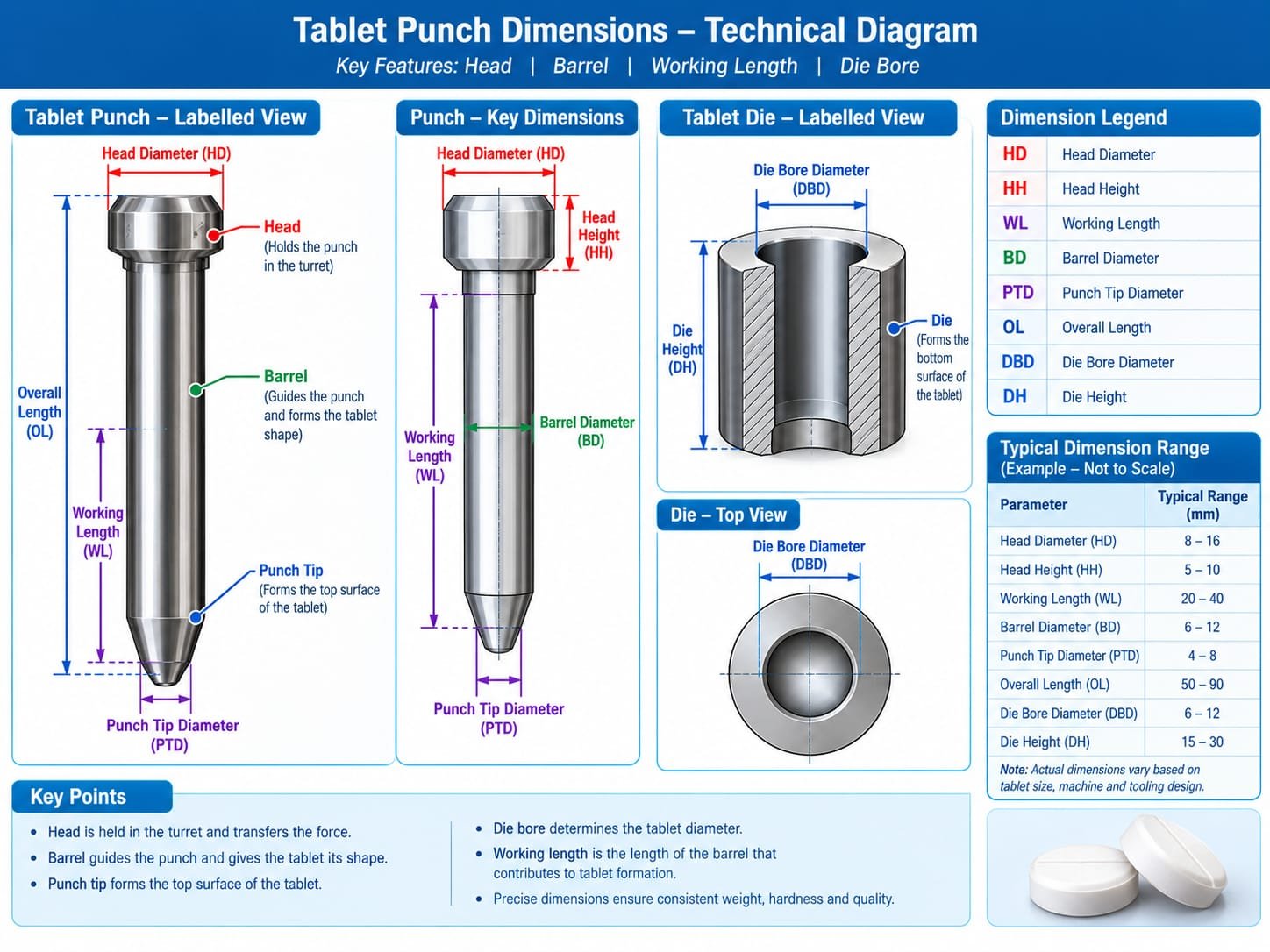
Note: Working length, overall length and other
dimensions must be measured using the definition and method
specified in the applicable tooling standard or drawing.
Do not use generic dimensions as acceptance limits.
8. Working Principle of Punches and Dies
In a rotary tablet press, the tooling stations move through
a sequence of filling, metering, compression and ejection.
The exact sequence depends on the machine design.
-
Die filling: The lower punch moves to the
required fill position, allowing powder or granules to enter
the die cavity. -
Weight adjustment or metering: The fill
position and excess powder removal are controlled by the
press setup to achieve the target tablet weight. -
Pre-compression, where provided: The tooling
may apply an initial compression force to help remove trapped
air and prepare the powder bed. -
Main compression: The upper and lower punches
compress the material to form a tablet. -
Decompression: The compression force is
released as the punches move away from the main compression zone. -
Tablet ejection: The lower punch rises to
bring the tablet to the ejection level, where it is removed
from the die.
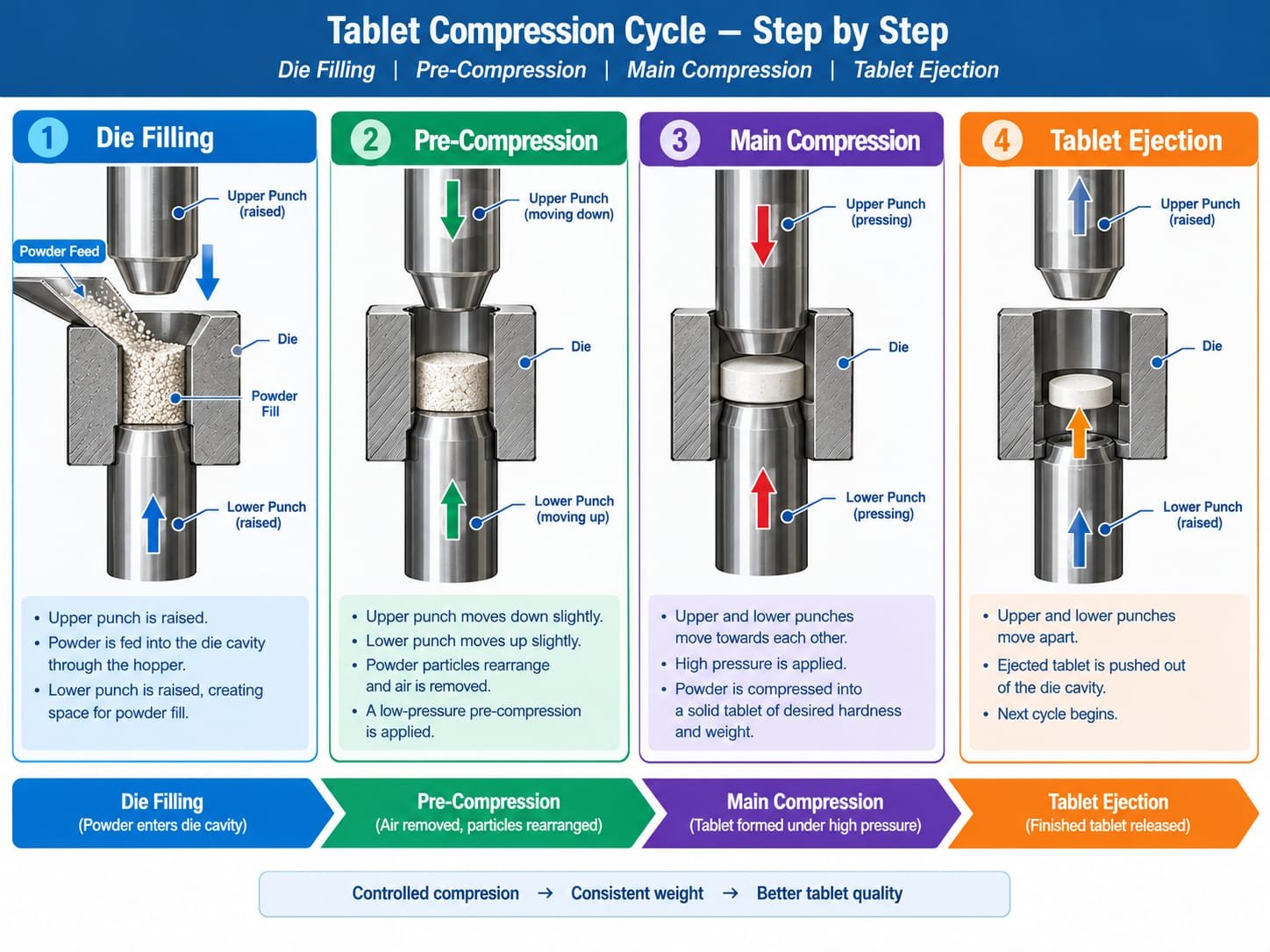
Correct tooling dimensions and movement help the press operate
consistently. However, tablet quality also depends on the
formulation, granule properties, lubrication, press settings
and environmental conditions.
9. Materials Used for Tablet Compression Tooling
Punches and dies are manufactured from suitable engineering
materials selected for strength, wear resistance, corrosion
resistance and the intended application.
| Material or Treatment | General Purpose | Selection Consideration |
|---|---|---|
| Tool steel | Provides strength and wear resistance | Steel grade, hardness and application |
| High-carbon, high-chromium steel | Used in tooling designs requiring suitable wear resistance | Product abrasiveness and supplier specifications |
| Corrosion-resistant materials | Used where corrosion resistance is important | Product chemistry, cleaning and maintenance requirements |
| Surface coatings or treatments | May improve surface performance for selected applications | Compatibility, coating integrity and approved repair methods |
| Wear-resistant die inserts | May improve die-bore durability in suitable applications | Design compatibility and supplier recommendations |
The correct tooling material should be selected in consultation
with the tooling supplier and based on the product’s properties,
cleaning process, expected wear and operating conditions.
Hardness values and material grades should be verified from
approved technical specifications rather than assumed.
10. How to Select the Correct Tablet Compression Tooling
Tooling selection should be completed before installation
or production. The following factors should be evaluated:
- Machine compatibility: Confirm that the tooling standard and dimensions match the tablet press.
- Tablet design: Verify tablet shape, dimensions, concavity, embossing and score-line requirements.
- Product characteristics: Consider the formulation’s tendency to stick, pick, abrade or cause corrosion.
- Tooling material: Select the material and surface treatment suitable for the application.
- Compression requirements: Confirm that the tooling is suitable for the approved process and operating range.
- Drawing and identification: Match tooling IDs, drawings, revisions and supplier documentation.
- Inspection status: Verify that tooling has been inspected and released for use according to site procedures.
Never select a punch or die based only on appearance or a
similar product name. Verify the actual dimensions, tooling
standard and approved design.
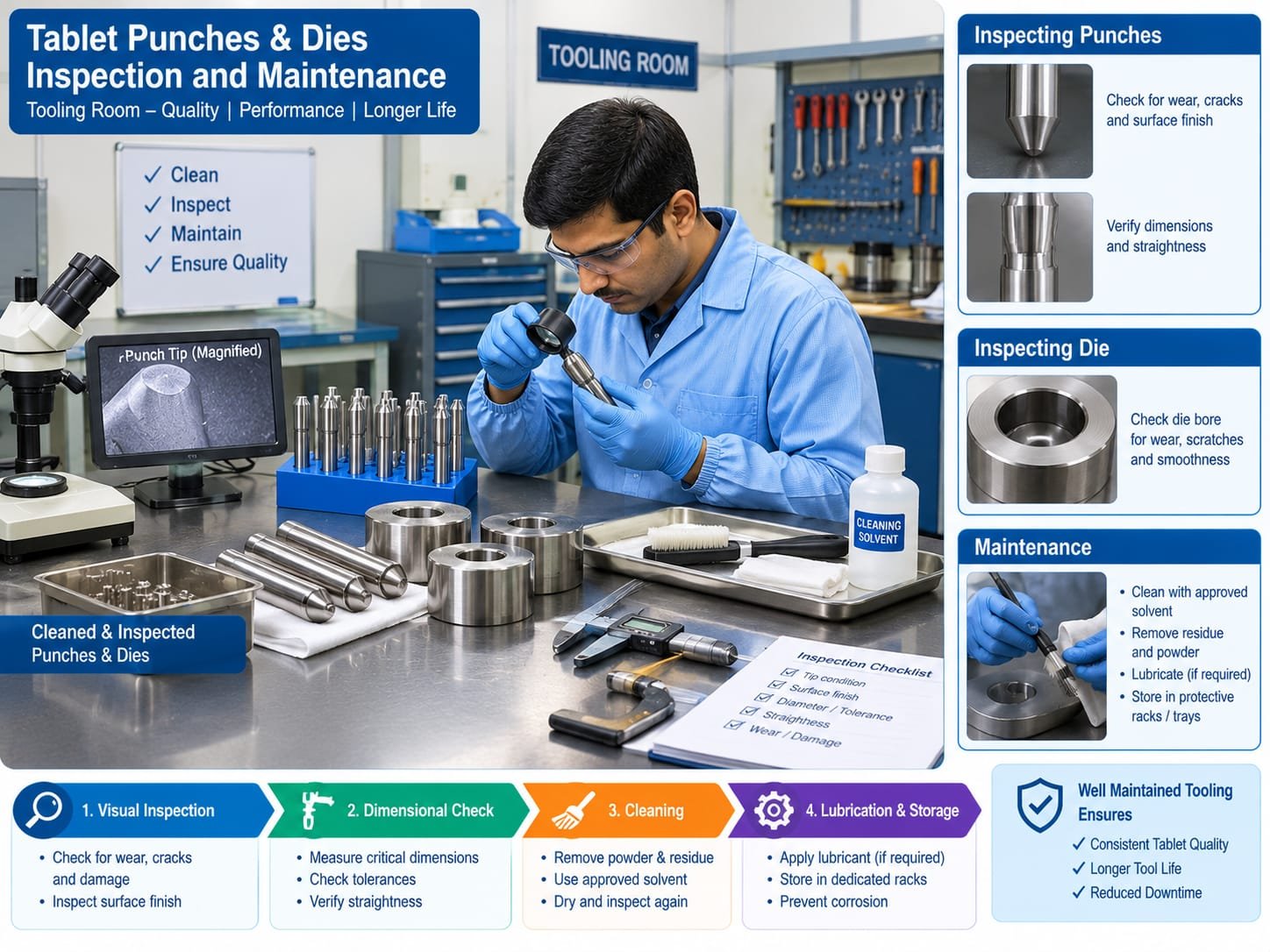
11. Tooling Inspection and Maintenance
Routine tooling inspection helps identify damage before it
affects tablet quality or causes unplanned production stoppages.
Inspection should be performed at defined stages, such as
before use, after use, during scheduled maintenance and after
a tooling-related investigation, as specified by the site’s
approved procedures.
11.1 Visual Inspection
- Check punch tips for scratches, dents, chips and wear.
- Inspect embossed characters and logos for damage or loss of definition.
- Check punch barrels and heads for scoring, deformation and excessive wear.
- Inspect die bores for scoring, corrosion, residue and abnormal wear.
- Check for corrosion, contamination and evidence of improper handling.
11.2 Dimensional Inspection
Measure critical dimensions using suitable calibrated or
verified measuring equipment and the approved method.
Depending on the tooling design, checks may include working
length, tip dimensions, barrel dimensions, die bore, die
outside diameter and die height.
11.3 Cleaning
Remove product residue and cleaning-agent residues according
to the approved cleaning procedure. Pay particular attention
to engraved areas, punch tips, keyways and other difficult-to-clean
locations. Dry the tooling thoroughly and prevent corrosion.
11.4 Repair and Polishing
Tooling repair should be performed only by trained and authorized
personnel. Uncontrolled polishing may change critical dimensions,
damage embossing or remove a protective coating. Measure and
inspect tooling after repair as required by the approved procedure.
11.5 Lubrication and Storage
Apply only the approved protective lubricant when required.
Store clean, dry tooling in designated, identified storage
systems that protect punch tips and other precision surfaces
from damage and corrosion.
| Maintenance Step | Purpose | Expected Outcome |
|---|---|---|
| Clean | Remove product residue and contaminants | Reduced contamination and sticking risk |
| Inspect | Identify damage, wear and corrosion | Early detection of tooling problems |
| Measure | Verify critical dimensions | Evidence of dimensional conformity |
| Repair, if permitted | Restore serviceability within approved limits | Controlled tooling condition |
| Reinspect | Verify tooling after maintenance | Documented suitability for use |
| Protect and store | Prevent corrosion and physical damage | Improved tooling preservation |
12. Common Tooling-Related Tablet Defects
Defects observed during compression may be related to tooling,
formulation properties, machine settings or a combination
of these factors. Tooling should be examined as part of a
structured investigation rather than assuming it is always
the root cause.
| Observed Defect | Possible Tooling Contribution | Recommended Investigation |
|---|---|---|
| Sticking | Residue or unsuitable tip-surface condition | Inspect punch faces, cleaning status, formulation and lubrication |
| Picking | Material adhering to engraved or damaged punch areas | Inspect embossing, punch-face condition and product properties |
| Capping | Tooling geometry or condition may contribute | Check punch condition, compression settings, air entrapment and granule properties |
| Lamination | Tooling or compression behaviour may contribute | Review tooling, formulation, compression profile and decompression behaviour |
| Chipped tablet edges | Damaged punch tips or die edges may contribute | Inspect edges and tooling alignment; review ejection and handling |
| Poor embossing | Worn or damaged engraved punch face | Inspect engraving and confirm the correct punch design |
| Tablet dimension variation | Worn or incorrect tooling dimensions | Measure tooling and review press setup and product characteristics |
| Unusual noise or punch movement | Wear, damage or an unsuitable tooling fit | Stop and assess the equipment and tooling according to site procedures |
When a defect occurs, document the observation, identify the
affected tooling stations where possible, preserve relevant
evidence and investigate the probable root cause. Replace
or repair tooling only through the approved process.
13. GMP Requirements for Tablet Compression Tooling
In pharmaceutical manufacturing, tooling management should
form part of the site’s pharmaceutical quality system. Tooling
must be suitable for its intended use, properly identified
and controlled to prevent mix-ups, contamination and use
of damaged components.
13.1 Identification and Traceability
- Maintain unique tooling identification where required.
- Record tooling type, dimensions, product or set association, and status as applicable.
- Maintain traceable inspection, maintenance and repair records.
- Prevent mix-ups between similar-looking tooling sets.
13.2 Status Control
- Separate serviceable, under-maintenance and rejected tooling.
- Do not issue damaged or unapproved tooling for production.
- Ensure the correct tooling is issued against the approved product requirements.
- Document and investigate defects or abnormal wear according to site procedures.
13.3 Documentation
Depending on the site’s procedures, tooling records may include
receipt and identification, inspection results, cleaning status,
maintenance and repair history, dimensional measurements,
issue and return records, and final disposition.
Where tooling damage could affect product quality, the event
should be assessed under the applicable deviation, investigation
and CAPA procedures. Evaluate affected batches based on documented
evidence and the site’s quality risk management process.
14. Pre-Use Tooling Checklist
The following checklist can support routine verification.
It is a general reference and should be adapted to the
approved site SOP, equipment requirements and tooling drawings.
| Check | Acceptance Consideration |
|---|---|
| Tooling identity | Matches the approved tooling specification and product requirement |
| Tooling standard | Verified as compatible with the press |
| Cleanliness | Clean and free from visible residue according to the applicable procedure |
| Punch tips | No unacceptable damage, wear or contamination |
| Punch heads and barrels | Condition and dimensions meet applicable requirements |
| Die bore and exterior | No unacceptable wear, scoring, corrosion or damage |
| Dimensional checks | Required dimensions are within approved tolerances |
| Maintenance status | Required maintenance and inspection are complete |
| Records and release | Required documentation and authorization are complete |
15. Conclusion
Tablet compression tooling plays an essential role in
pharmaceutical tablet manufacturing. The upper punch,
lower punch and die work together to form tablets with
the required dimensions and appearance.
Understanding B, D, BB and DB tooling configurations,
punch profiles, die designs and critical dimensions helps
production, engineering and quality assurance teams select
the correct tools and identify potential problems.
Regular inspection, controlled cleaning, approved maintenance,
dimensional verification and proper storage help preserve
tooling condition and support consistent tablet quality.
Correct tooling management should always follow approved
procedures, machine requirements and applicable quality
system controls.
At Pharmashare.in, we aim to share practical pharmaceutical
manufacturing and quality assurance knowledge that supports
professionals in their daily work.
16. Frequently Asked Questions (FAQs)
1. What is tooling in tablet compression?
Tooling refers mainly to the upper punches, lower punches
and dies used in a tablet press to form tablets from powder
or granules.
2. What are the main types of tablet compression tooling?
B and D are common tooling configurations. BB and DB are
additional designations used for specific dimensional
configurations. The exact tooling standard must be verified.
3. What is the difference between B tooling and D tooling?
D tooling generally has larger punch and die dimensions
than B tooling. The suitable configuration depends on the
tablet design and the compatible press.
4. What is the function of a punch in tablet compression?
The upper and lower punches apply force to compress the
powder inside the die. Punch-tip geometry also determines
the tablet-face design.
5. What is the function of a die?
The die contains the cavity in which the tablet is formed.
Its bore helps determine the tablet’s diameter or
cross-sectional shape.
6. What is punch working length?
Working length is a defined functional punch dimension
measured according to the applicable tooling standard
or drawing. It is important for correct punch movement
and tablet formation.
7. How often should punches and dies be inspected?
Inspection frequency should be defined in the approved
site SOP and maintenance programme. Checks may be required
before use, after use, during scheduled maintenance and
following a tooling-related event.
8. Can damaged punches be polished and reused?
Only if repair is permitted by the approved procedure and
is performed by qualified personnel. Critical dimensions,
tip geometry, embossing and any protective coating must
remain acceptable. Some damage requires replacement.
9. Can tooling cause tablet sticking or picking?
Yes. Residue, surface damage and unsuitable punch-face
conditions can contribute to sticking or picking. Formulation,
lubrication and process conditions must also be investigated.
10. Why is tooling traceability important?
Traceability helps ensure that the correct tooling is used,
supports inspection and maintenance history, prevents
mix-ups and provides evidence during investigations
and quality audits.
The information provided on this page is for educational and informational purposes only. It is not intended to provide regulatory, legal, or compliance advice.
Pharmaceutical regulations including FDA 21 CFR, EU GMP Annexes, ICH Guidelines, EDQM, WHO, and CDSCO requirements are subject to frequent updates and interpretation by regulatory authorities.
Readers are responsible for ensuring compliance with current applicable laws and regulations in their jurisdiction. PharmaShare does not guarantee the accuracy, completeness, or currentness of this content.
This content does not create a consultant-client relationship. For product-specific regulatory strategy, dossier preparation, or inspection readiness, please consult qualified regulatory professionals or contact us directly.

About the Author
Mahummed Asif is a experienced pharmaceutical Quality Assurance professional and publisher of Pharmashare. He has worked with leading Pharmaceutical organizations and has developed extensive expertise in Quality Assurance, deviation management, investigations, CAPA, QMS, Product Life Cycle Management, change control, risk management, validation, product complaints, product recalls, and regulatory compliance. He is passionate about sharing practical pharmaceutical knowledge with professionals, students, and quality practitioners across the industry.