
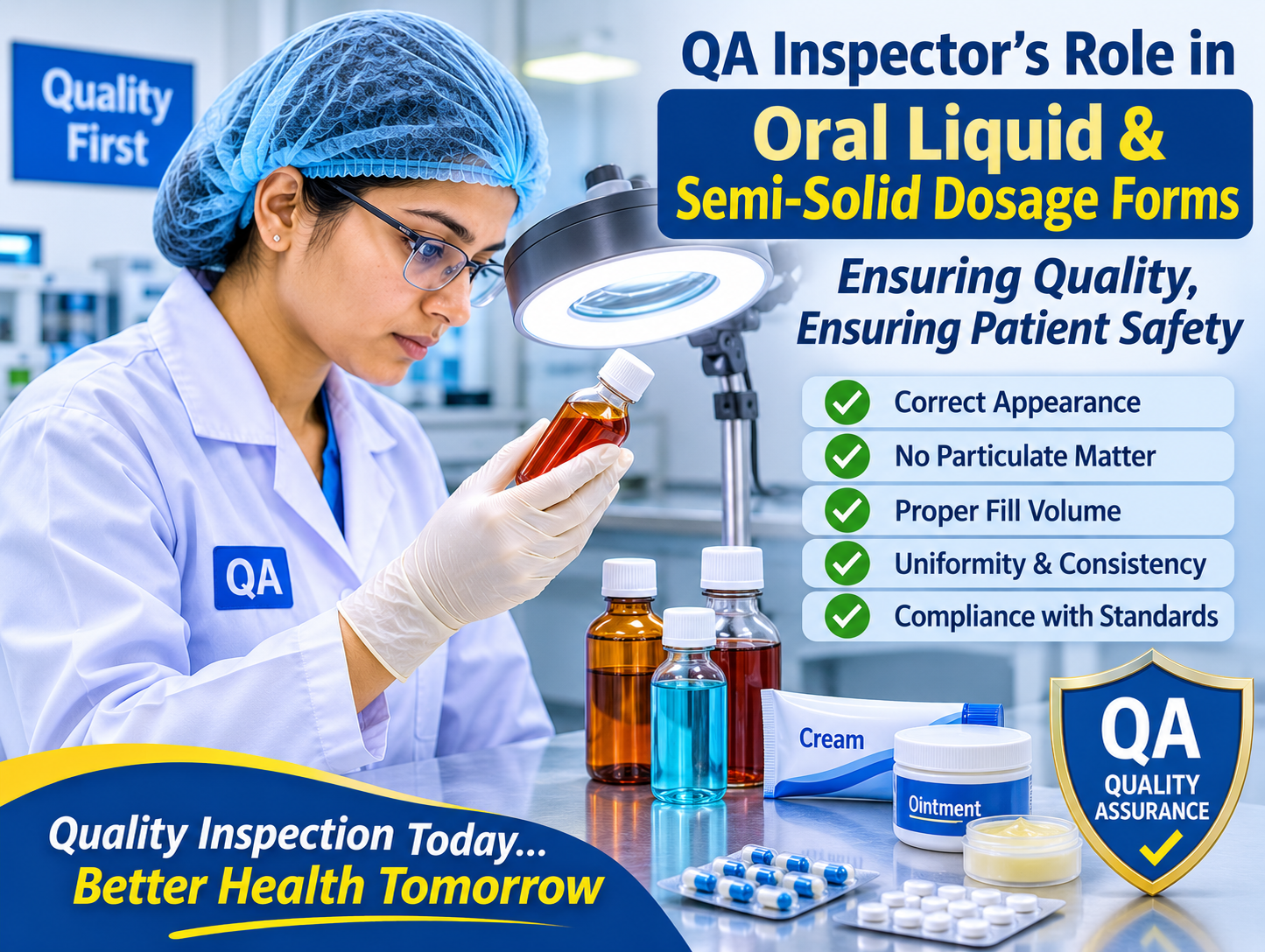
Visual Inspectors Qualification in Oral Liquid & Semi-Solid Dosage Forms: Complete GMP Guide
In Oral Solid Dosage Forms, a defect is on the surface – you can see a chip or crack. But in Oral Liquids & Semi-Solids, the defect is inside the product.
A black particle floating in a syrup, a separated cream, a leaking ointment tube, a wrong colour suspension – these are defects a patient will see first, before they even taste the medicine. If your inspector misses it, it becomes a complaint, a recall, or an FDA 483.
In this blog, we cover the complete, audit-proof process for Visual Inspector Qualification in Oral Liquids (Syrups, Suspensions, Emulsions, Drops) & Semi-Solids (Creams, Gels, Ointments, Pastes, Lotions), as per EU GMP, USFDA 21 CFR 211, WHO TRS, and PDA TR 79 principles.
1. What is Visual Inspector Qualification for Liquids & Semi-Solids?
It is a documented process to prove that an inspector has the visual ability, product knowledge, and practical skill to consistently detect defects in liquid and semi-solid products under defined inspection conditions.
It includes:
- Eye Fitness: Visual Acuity + Colour Vision
- Knowledge: Defect types specific to liquids/semi-solids, AQL, GMP rules
- Skill: Practical ability to detect defects in a seeded test set (Knapp Test adapted)
- Consistency: Ability to repeat performance over time without fatigue bias
2. Why Liquids & Semi-Solids Need a Different Approach Than Tablets
| Parameter | Tablets / Capsules | Liquids & Semi-Solids |
|---|---|---|
| Where is defect? | On surface | Inside product + container + closure |
| Inspection Method | Static – rotate in hand | Dynamic – invert, swirl, shake gently, check against light |
| Critical Challenge | Chip, crack | Particles, phase separation, air bubbles vs contamination, leakage |
| Container | Blister / Bottle | PET/HDPE bottle, Glass bottle, Tube, Jar, Sachet |
3. Regulatory Expectations
- USFDA 21 CFR 211.100, 211.134, 211.204: Written procedures for inspection, container/closure integrity, fill level check.
- EU GMP Chapter 1 & 6: Personnel must be qualified, inspection under suitable conditions.
- WHO TRS 986: Visual inspection by trained personnel with adequate eyesight and lighting.
- PDA TR 79 / USP <1790>: Reference for visual inspection – defect classification, test sets, Knapp methodology – adapted for liquids/semi-solids.
- ISO 2859-1: AQL Sampling for inspection.
4. The 6-Step Qualification Process
Step 1: Prerequisites & Medical Fitness – Eye Test
Before any training, inspector must clear:
- Visual Acuity: Near vision – Jaeger J1 or 20/20 (with or without glasses). Far vision – Snellen 20/20. Tested by Occupational Health / Ophthalmologist.
- Colour Vision: Ishihara Test (38 plates). Critical for liquids – to detect colour change, discolouration, turbidity, wrong product.
- Frequency: Annually. If inspector wears glasses, qualification must be done WITH glasses. Record must be attached to qualification file.
Common Audit Finding: Eye test done after qualification, or no record for colour blindness.
Step 2: GMP & Theoretical Training
- Types of defects in liquids & semi-solids and their classification
- AQL Sampling – ISO 2859-1, Defect levels (Critical / Major / Minor)
- Inspection conditions – Light, background, distance, time, swirling technique
- Handling – How to hold bottle/tube without damaging label, how to segregate rejected units
- Documentation – How to record defects, reconciliation
- Hygiene, gowning, cross-contamination control
Step 3: Defect Library Training – The Heart of Qualification
Create a physical Defect Library / Defect Kit for each product family. This is what USFDA auditors ask to see first.
| Defect Category | Oral Liquids – Syrup / Suspension / Drops | Semi-Solids – Cream / Gel / Ointment |
|---|---|---|
| Critical | Foreign particle / Glass / Metal / Hair, Wrong product / Mix-up, Microbial growth / Fungus, Leaking / No seal, Empty bottle | Foreign particle, Wrong product / Mix-up, Contamination, Leaking tube, Microbial growth, No seal / Tamper-evident broken |
| Major | Black spots / Fibre, Phase separation, Caking / Sedimentation not redispersible, Colour change, Turbidity in clear syrup, Underfill / Overfill, Cracked bottle, Loose cap, Damaged induction seal | Phase separation / Oil separation, Gritty particles, Air bubbles (excess), Colour change, Underfill / Overfill, Cracked / Dented tube, Loose cap, Crimp defect |
| Minor | Slight colour variation, Minor label defect, Slight scratch on bottle, Minor air bubbles | Slight colour variation, Minor label / print defect, Slight dent, Slight inconsistency in texture |
How to Prepare Defect Library: Use real rejected units from production. Label each with defect name, photo, and category. For liquids, keep a sealed retention sample. For semi-solids, check expiry every 3 months – creams can dry out and change appearance. Replace if faded.
Key Training Point: Teach difference between Normal vs Defect – e.g., Air bubbles in gel are normal to some extent, but excessive bubbles = defect. Sediment in suspension is normal if it redisperses on shaking, but caking is defect.
Step 4: Practical Training – Supervised Inspection
Inspector performs visual inspection on real batches under supervision of qualified trainer for minimum 3-5 days or 10 batches.
Standardized Inspection Conditions:
- Light: 2000 – 3750 Lux at inspection surface (measured with calibrated lux meter). For clear syrups, use light box / Tyndall beam to detect particles.
- Background: Black AND White background – Black for light particles, White for dark particles.
- Distance: 25-30 cm from eye.
- Technique – Liquids: Hold bottle against light, invert slowly 3 times, swirl gently, check for particles, separation, colour. Do NOT shake vigorously (creates bubbles).
- Technique – Semi-Solids: Check tube for dents, crimp, leakage at crimp & cap, squeeze gently to check consistency, check seal. For jars, check surface for separation, fungus, colour.
- Time: Max 20-30 min continuous inspection, then 5 min eye break. Max 2 hours per shift rotation to prevent fatigue.
- Speed: Define units per minute in SOP – e.g., 15-25 bottles/min for liquids, 20-30 tubes/min for semi-solids – validated by time study.
Step 5: Qualification Test – Knapp Test Adapted for Liquids & Semi-Solids
Test Set Preparation: Prepare 100 units – 70 Good units + 30 Defective units (10 Critical, 10 Major, 10 Minor) – Defects seeded by QA, not known to inspector. For liquids, use clear bottles where possible, or same container as product.
Inspection: Inspector inspects under same conditions as routine, within defined time. QA observes but does not help.
Acceptance Criteria (Example – Define in Protocol):
– Critical Defects: Must detect 100%
– Major Defects: Must detect ≥ 90%
– Minor Defects: Must detect ≥ 70%
– False Rejection (Good as Bad): ≤ 5%
Result: If inspector fails, retraining + re-test after 7 days. Max 2 attempts, then disqualify.
Pro Tips:
- Always prepare Set A and Set B to prevent memorization.
- For suspensions, include a “hard to detect” set – e.g., small black fibre in brown suspension – this tests real skill.
- For creams, include a tube with slight oil separation vs normal – tests judgment.
Step 6: Certification & Authorization
After passing all steps, QA issues Visual Inspector Qualification Certificate with:
- Inspector Name, ID, Department
- Product types qualified for (e.g., Syrups, Suspensions, Creams, Gels, Ointments)
- Eye test report reference
- Knapp Test result (%)
- Qualified By / Approved By (QA Head)
- Valid Until Date (1 Year)
Maintain a Qualified Inspectors List – Only those on the list can perform inspection. Auditors check this list against batch records.
5. Requalification & Ongoing Monitoring
- Annual Requalification: Eye test + Knapp Test + Defect Library review
- After Long Leave: >30 days leave = Requalification required
- After Product Change: New colour, new viscosity, new container (e.g., amber to clear bottle) = New defect library training
- After Failure / Complaint: If inspector misses a defect that leads to complaint, immediate requalification + CAPA
- Periodic Performance Monitoring: QA to re-inspect 200 units from inspector’s accepted lot and compare rejection rate. Track trend per inspector.
- Container Change: If you change from glass to PET bottle, light transmission changes – requalify.
6. Common Audit Findings & How to Avoid Them
- Finding: No defect library for liquids, only for tablets. Fix: Separate library for liquids & semi-solids.
- Finding: Inspector qualified for syrups but inspecting ointments. Fix: Product / dosage-form specific qualification.
- Finding: No lux meter calibration, light not measured. Fix: Calibrate lux meter, record daily light intensity.
- Finding: No differentiation between normal sediment vs caking. Fix: Add photo standard for “Acceptable vs Reject” for suspensions.
- Finding: Defect kit samples expired / cream dried. Fix: Review defect library every 3 months for semi-solids.
- Finding: No eye break defined, inspector fatigued. Fix: SOP must define break schedule & rotation.
7. Best Practices from Industry
- Use photo standards + physical samples together – photo for training, physical for testing.
- For clear liquids, use black/white inspection booth with Tyndall light – increases particle detection by 40%.
- Rotate inspectors every 2 hours – reduces fatigue and bias.
- Use blind test sets – inspector should not know defect count.
- Link qualification to Quality Metrics – track false rejection, missed defects, complaint trend per inspector (for training, not punishment).
- For semi-solids, always check leak test – keep tube inverted for 30 min on tissue paper to detect slow leakage.
Conclusion
Visual Inspector Qualification in Oral Liquids & Semi-Solids is not a one-time training. It is a continuous system of Eye Fitness + Product Knowledge + Skill + Monitoring.
Liquids and creams hide their defects. A qualified inspector does not just look – he observes, swirls, inverts, and judges.
If you qualify your inspectors correctly, you protect the patient, you protect the batch, and you protect yourself in an audit.
Remember: A qualified inspector does not just see defects. He prevents recalls.
The information provided on this page is for educational and informational purposes only. It is not intended to provide regulatory, legal, or compliance advice.
Pharmaceutical regulations including FDA 21 CFR, EU GMP Annexes, ICH Guidelines, EDQM, WHO, and CDSCO requirements are subject to frequent updates and interpretation by regulatory authorities.
Readers are responsible for ensuring compliance with current applicable laws and regulations in their jurisdiction. PharmaShare does not guarantee the accuracy, completeness, or currentness of this content.
This content does not create a consultant-client relationship. For product-specific regulatory strategy, dossier preparation, or inspection readiness, please consult qualified regulatory professionals or contact us directly.

About the Author
Mahummed Asif is a experienced pharmaceutical Quality Assurance professional and publisher of Pharmashare. He has worked with leading Pharmaceutical organizations and has developed extensive expertise in Quality Assurance, deviation management, investigations, CAPA, QMS, Product Life Cycle Management, change control, risk management, validation, product complaints, product recalls, and regulatory compliance. He is passionate about sharing practical pharmaceutical knowledge with professionals, students, and quality practitioners across the industry.