505(b)(2) vs ANDA: Which Filing Should You Choose? Complete Comparison 2026
By PharmaShare Regulatory Team | US FDA Pathways | August 2026
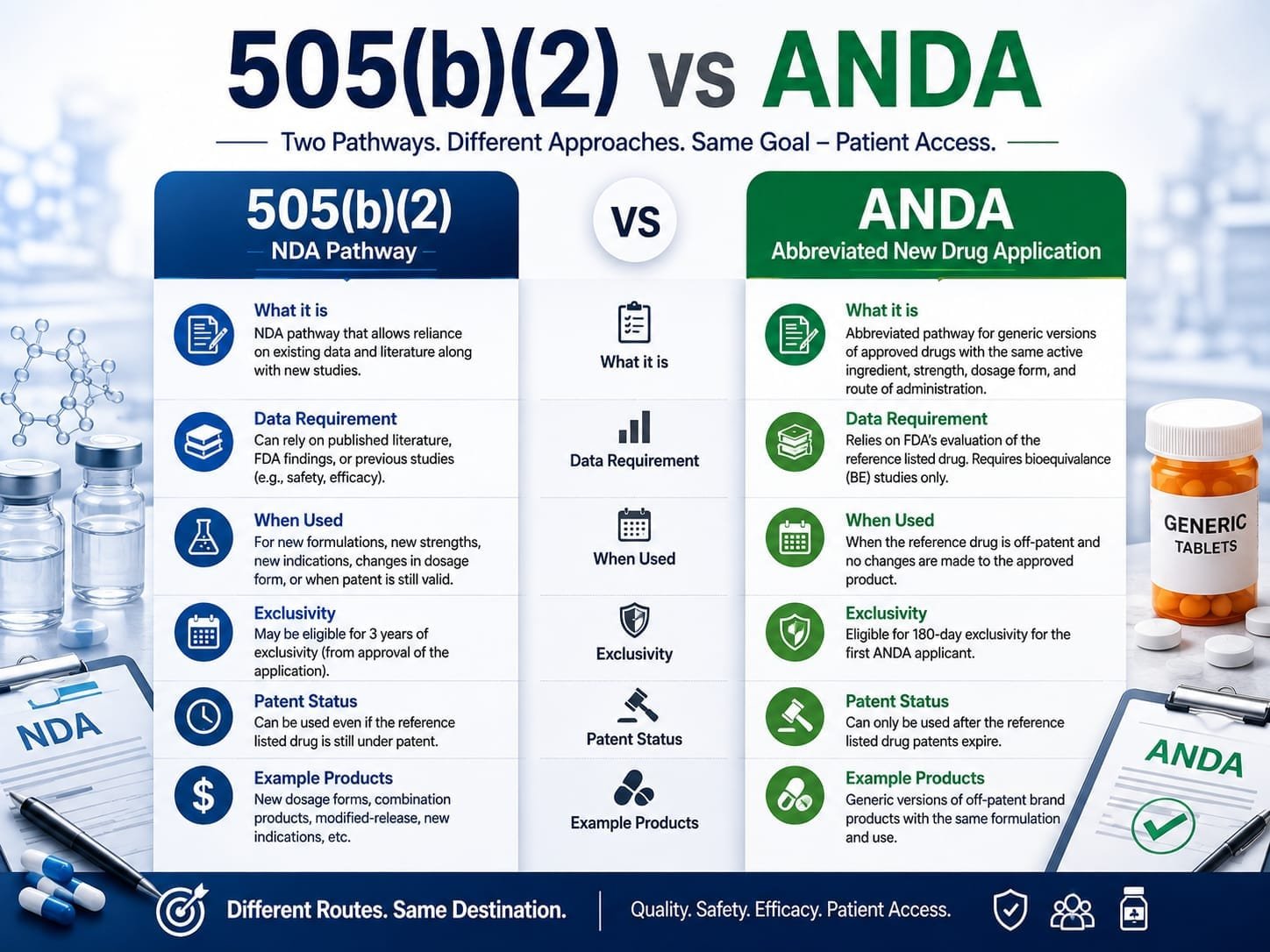
1. What are Both Pathways?
| ANDA – 505(j) | 505(b)(2) NDA |
|---|---|
| Abbreviated NDA for Generics. You rely 100% on FDA’s previous finding of safety & efficacy for RLD. No new clinical studies except BE. | Hybrid NDA. You rely partly on FDA’s finding for RLD + partly on your own new studies. You have some innovation. |
| Law: 21 CFR 314.92, 314.94 | Law: 21 CFR 314.54 – FD&C Act 505(b)(2) |
2. Key Difference in One Line
ANDA = SAME as brand
505(b)(2) = DIFFERENT from brand but based on brand
If you change anything – strength, dosage form, route, indication, formulation – you cannot file ANDA. You must file 505(b)(2).
3. Detailed Comparison Table – This is What FDA Reviewers See
| Parameter | ANDA – 505(j) | 505(b)(2) NDA |
|---|---|---|
| Product | Duplicate – Must be pharmaceutical equivalent | Modified – Can be different strength, form, route, indication, combination |
| Examples | Metformin 500mg tablet generic of Glucophage | Metformin 500mg Extended-Release, Metformin Oral Solution, Metformin + new indication, IV to Oral switch |
| Clinical Studies | Only BE study (Fasting + Fed). No Phase I/II/III | Needs bridging studies – PK, PD, maybe Phase I/II, sometimes Phase III if new indication. BE alone not enough |
| Patent Certification | Para I, II, III, IV mandatory for each patent | Same Para I-IV required if you rely on listed drug |
| Exclusivity You Get | 180-day if FTF Para IV (only against other ANDAs) | 3-year New Clinical Investigation Exclusivity (if new studies essential). Can block ANDA & other 505(b)(2) |
| Exclusivity Blocks You? | Blocked by 5-yr NCE, 3-yr, ODE etc. | Blocked by same + if someone else has 3-yr for your condition of use |
| TE Rating | Gets AB rating – Auto-substitutable at pharmacy | NO TE rating – NOT auto-substitutable. Needs marketing |
| Labeling | Must be same as RLD (except differences allowed by FDA) | Can have different labeling – new indication, dosing |
| Cost & Time | $2-5M, 24-36 months to approval | $10-50M, 36-60 months (due to clinical) |
| Market Price | 10-20% of brand price (commodity, high competition) | 50-80% of brand price (differentiated, less competition) |
| GDUFA vs PDUFA Fee | GDUFA – ~$240K in FY26 + Facility Fee | PDUFA – ~$2.2M if clinical data, ~$1.1M without clinical (FY26) |
4. When to File ANDA vs 505(b)(2) – Decision Tree
– Same Active, Same Strength, Same Dosage Form, Same Route → File ANDA
Question 2: Are you changing ANYTHING?
➡️ Different Strength (RLD 100mg, you want 50mg) → Suitability Petition ANDA OR 505(b)(2) – If petition denied, must file 505(b)(2)
➡️ New Dosage Form (Tablet to Capsule, IR to ER, Tablet to Oral Solution) → 505(b)(2)
➡️ New Route (IV to Oral, Oral to Topical) → 505(b)(2)
➡️ New Indication (RLD for hypertension, you want for heart failure) → 505(b)(2)
➡️ New Combination (RLD single drug, you want FDC with 2nd drug) → 505(b)(2)
➡️ Change in inactive ingredient that affects safety/efficacy → 505(b)(2)
➡️ Rx to OTC Switch → 505(b)(2)
5. Real World Examples to Understand Clearly
| Brand (RLD) | Generic Version | Pathway & Why |
|---|---|---|
| Lipitor 20mg Tablet | Atorvastatin 20mg Tablet | ANDA – Same everything |
| Lipitor 20mg Tablet | Atorvastatin 20mg Oral Suspension | 505(b)(2) – Dosage form change Tablet → Suspension |
| Neurontin 300mg Capsule | Gabapentin 300mg Capsule | ANDA – Duplicate |
| Neurontin 300mg Capsule | Gabapentin Once-Daily 300mg GR Tablet (Gralise) | 505(b)(2) – New ER formulation + new indication (PHN) |
| Desferal Injection | Deferasirox Oral Tablet (Jadenu) | 505(b)(2) – Route change Injection → Oral, big innovation |
6. Business Strategy: Which Makes More Money?
Choose ANDA If:
- You want low investment, low risk
- Product has huge volume (Metformin, Atorvastatin)
- You can be in first 3 generics
- You have cost advantage in manufacturing
- You want AB rating for auto-substitution
Profit: High volume x Low margin
Choose 505(b)(2) If:
- RLD has problems – bad taste, injection pain, frequent dosing
- You have novel formulation tech (nanotech, ODT, depot)
- You want to avoid crowded ANDA competition (10+ generics)
- You want 3-year exclusivity & better pricing
- You want to extend lifecycle of your own brand
Profit: Low volume x High margin
7. Can You Convert ANDA to 505(b)(2) or Vice Versa?
ANDA to 505(b)(2): Yes. FDA may refuse to file your ANDA if your product is NOT duplicate. They will issue Refuse-to-Receive (RTR) and ask you to refile as 505(b)(2). Common for products with different inactive ingredients that affect bioequivalence.
505(b)(2) to ANDA: No. Once you file 505(b)(2), you cannot downgrade to ANDA. But you can file new ANDA separately.
Suitability Petition Trick: If you want to file ANDA for different strength, you first file suitability petition. If FDA approves petition, you can file ANDA (cheaper). If denied, you must file 505(b)(2). In 2026, FDA denies ~60% of petitions.
8. FDA Review Timeline
- ANDA: GDUFA III – 10 months Standard, 8 months Priority (if drug shortage / first generic)
- 505(b)(2): PDUFA VII – 10 months Standard, 6 months Priority (if significant improvement)
But practically ANDA has 3-4 review cycles due to deficiencies. 505(b)(2) also has similar cycles if clinical data weak.
Conclusion
ANDA = Me-too. Fast, cheap, but price war.
505(b)(2) = Me-better. Slow, expensive, but differentiated and higher price + 3-year exclusivity.
In 2026, smart mid-size pharma companies are moving from pure ANDA to 505(b)(2) because ANDA competition is brutal – 15-20 generics on day 1 for many molecules. 505(b)(2) with improved formulation (e.g., ready-to-use IV bag vs lyophilized powder) gives you niche and better margin.
Rule of Thumb: If you can answer YES to “Does my product offer any benefit to patient/doctor/hospital over RLD?” → File 505(b)(2). If NO → File ANDA.
⚠️ Regulatory Disclaimer
This article is for educational purposes only. 505(b)(2) and ANDA requirements are governed by FD&C Act, 21 CFR 314.54 and 314.92, and FDA guidances which are subject to change. This is not legal or regulatory advice. PharmaShare is not affiliated with USFDA. Consult qualified US regulatory counsel before deciding filing pathway. Information as of Aug 2026. Last Updated: Aug 21, 2026.
Related: https://pharmashare.in/types-of-anda-filing-in-the-us/ | https://pharmashare.in/what-is-orange-book-and-how-to-read-it/ | https://pharmashare.in/what-is-180-day-exclusivity/

About the Author
Mahummed Asif is a experienced pharmaceutical Quality Assurance professional and publisher of Pharmashare. He has worked with leading Pharmaceutical organizations and has developed extensive expertise in Quality Assurance, deviation management, investigations, CAPA, QMS, Product Life Cycle Management, change control, risk management, validation, product complaints, product recalls, and regulatory compliance. He is passionate about sharing practical pharmaceutical knowledge with professionals, students, and quality practitioners across the industry.