
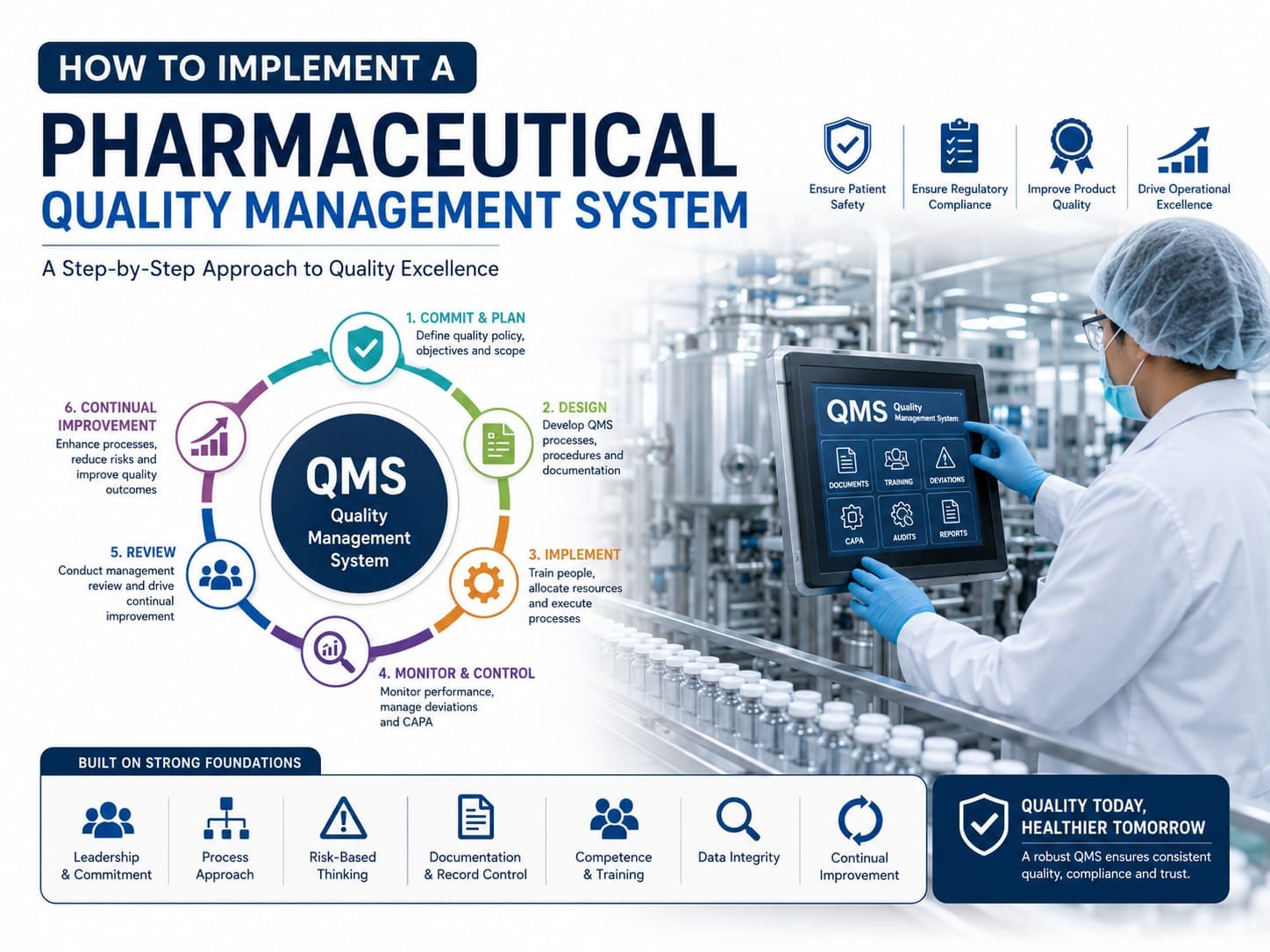
How to Implement a Pharmaceutical Quality Management System
Implementing an effective Pharmaceutical Quality Management System (QMS) requires more than creating procedures and documentation. It involves establishing a quality-driven culture supported by leadership, trained personnel, robust processes, and continual improvement. A well-designed QMS ensures compliance with global regulatory expectations while improving operational efficiency and product quality.
Step 1: Establish Quality Policy and Quality Objectives
Senior management should define a clear quality policy that aligns with the organization’s vision and regulatory obligations. Quality objectives should be measurable and periodically reviewed.
Examples of Quality Objectives:
- Reduce manufacturing deviations by 20%
- Achieve 100% on-time CAPA closure
- Maintain zero critical audit observations
- Reduce customer complaints year over year
- Improve Right First Time (RFT) performance
Step 2: Define Organizational Roles and Responsibilities
Quality is everyone’s responsibility. Every department should have clearly documented responsibilities within the QMS.
| Department | Primary Responsibilities |
|---|---|
| Quality Assurance | QMS oversight, investigations, audits, CAPA, change control |
| Quality Control | Testing, laboratory investigations, stability studies |
| Production | GMP manufacturing and documentation compliance |
| Engineering | Equipment qualification, maintenance, calibration |
| Warehouse | Storage, dispensing, inventory control |
| Regulatory Affairs | Regulatory compliance and submissions |
| Senior Management | Leadership commitment and resource allocation |
Step 3: Develop Controlled Documentation
Documentation forms the foundation of every pharmaceutical QMS. Every controlled document should follow an approved lifecycle that includes preparation, review, approval, issuance, revision control, archival, and periodic review.
Typical Controlled Documents:
- Quality Manual
- Quality Policy
- Standard Operating Procedures (SOPs)
- Specifications
- Validation Protocols
- Validation Reports
- Master Batch Records
- Batch Manufacturing Records
- Forms and Templates
- Logbooks
Step 4: Implement Employee Training Program
Personnel competency directly affects product quality. Every employee should receive appropriate training before performing GMP-related activities.
Training Program Should Include:
- Current Good Manufacturing Practices (cGMP)
- Data Integrity (ALCOA+ principles)
- Job-specific SOPs
- Health, hygiene, and gowning
- Equipment operation
- Quality Risk Management
- Deviation and CAPA procedures
- Change Control process
Training effectiveness should be evaluated through written assessments, practical demonstrations, observations, or competency checks.
Quality Risk Management (QRM)
Quality Risk Management enables organizations to make science- and risk-based decisions. Risk assessments should be documented and periodically reviewed throughout the product lifecycle.
Typical Risk Management Process
- Risk Identification
- Risk Analysis
- Risk Evaluation
- Risk Control
- Risk Communication
- Risk Review
Frequently Used Risk Assessment Tools:
- Failure Mode and Effects Analysis (FMEA)
- Hazard Analysis and Critical Control Points (HACCP)
- Fault Tree Analysis (FTA)
- Fishbone (Ishikawa) Diagram
- Risk Ranking and Filtering
- Risk Matrix
Quality Metrics Every Pharmaceutical Company Should Monitor
Monitoring quality metrics helps organizations identify trends, evaluate system performance, and support continual improvement.
| Quality Metric | Purpose |
|---|---|
| Number of Deviations | Measure process stability |
| CAPA Effectiveness | Evaluate problem resolution |
| Batch Rejection Rate | Monitor manufacturing quality |
| Market Complaints | Measure customer satisfaction |
| Product Recalls | Assess product risk |
| Audit Observations | Measure compliance level |
| Training Compliance | Ensure workforce competency |
| Right First Time (RFT) | Evaluate manufacturing performance |
| OOS/OOT Results | Monitor laboratory performance |
| Change Control Cycle Time | Measure process efficiency |
Management Review
Management Review is one of the core requirements of ICH Q10. Senior management should periodically evaluate the effectiveness of the Pharmaceutical Quality System and identify opportunities for continual improvement.
Management Review Inputs Include:
- Audit results
- Customer complaints
- Product recalls
- Deviation trends
- CAPA status
- Quality metrics
- Supplier performance
- Regulatory inspections
- Product Quality Review (PQR/APQR)
- Resource requirements
Expected Outputs:
- Improvement actions
- Resource allocation
- Quality objective updates
- Risk mitigation plans
- Process improvement initiatives
Digital Quality Management System (eQMS)
Many pharmaceutical companies are replacing paper-based systems with electronic Quality Management Systems (eQMS) to improve compliance, efficiency, and traceability.
Typical eQMS Modules:
- Document Control
- Training Management
- Deviation Management
- CAPA Management
- Change Control
- Audit Management
- Complaint Handling
- Supplier Quality Management
- Risk Management
- Equipment Calibration
Benefits of eQMS
- Reduced paperwork
- Automated workflows and approvals
- Electronic signatures compliant with applicable regulations
- Improved document traceability
- Real-time dashboards and quality metrics
- Better inspection readiness
- Reduced human error
- Faster CAPA and deviation closure
Regulatory Inspection Expectations
During inspections, regulatory agencies evaluate whether the QMS is effectively implemented rather than simply documented.
Inspectors commonly review:
- Quality Manual
- SOPs and controlled documents
- Training records
- Deviation investigations
- CAPA effectiveness
- Change control records
- Complaint investigations
- Supplier qualification records
- Internal audit reports
- Management review minutes
- Data integrity controls
- Validation documentation
Common Reasons for QMS Failure
- Lack of management commitment
- Poor documentation practices
- Weak root cause investigations
- Ineffective CAPA implementation
- Incomplete employee training
- Failure to trend quality data
- Delayed deviation closure
- Inadequate supplier oversight
- Poor change management
- Reactive rather than proactive quality culture