
Freeze-Thaw Study in Pharma: Complete GMP Guide for Stability & Biologics
In biologics and cold-chain products, temperature excursions during shipping or storage can destroy a batch worth crores.
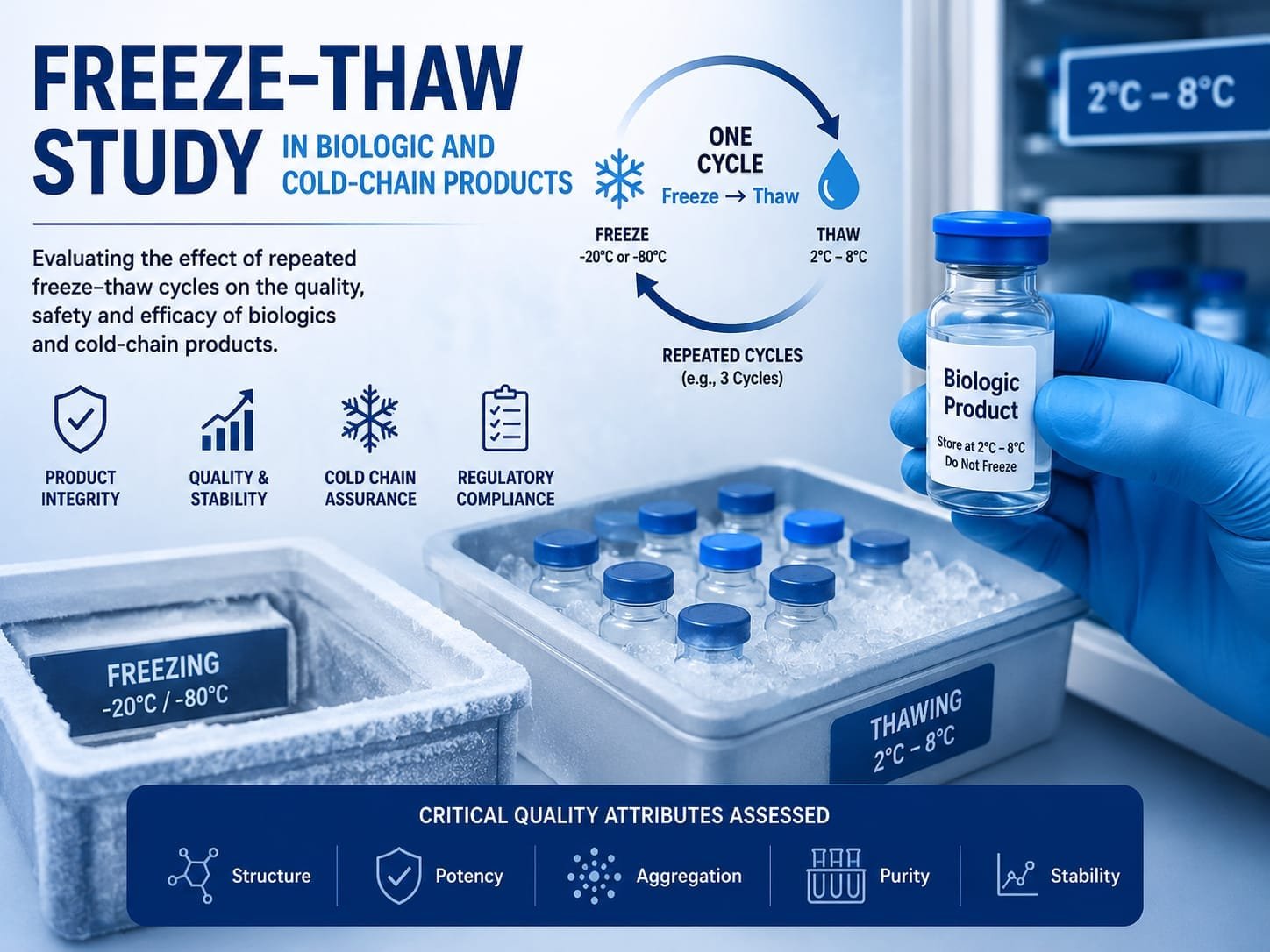
That’s where a Freeze-Thaw Study comes in. It proves whether your drug product can survive accidental freezing and thawing without losing quality, safety, or efficacy.
1. Why Do We Need a Freeze-Thaw Study?
Not all products are stored at 2-8°C in perfect conditions. During:
- Shipping: Dry ice, winter transport, airport tarmac
- Warehouse: Power failure in cold room
- Hospital: Kept in -20°C freezer by mistake
Regulators like USFDA, EMA, WHO, ICH Q1A, Q5C expect data to show what happens if the product freezes and thaws.
Key Purpose: To set handling instructions, shipping validation limits, and to support “Do Not Freeze” or “Can be frozen” label claims.
2. Regulatory References
| Guideline | Requirement |
|---|---|
| ICH Q5C | Stability testing of biotechnological products. Includes stress studies like freeze-thaw |
| ICH Q1A(R2) | Stress testing should include effect of temperature |
| WHO TRS 1011 Annex 9 | Shipping validation must consider freeze-thaw for cold chain |
| USFDA Guidance – Biologics | Freeze-thaw data required if product may be exposed to freezing |
3. When is a Freeze-Thaw Study Required?
- Biologics & Proteins: mAbs, Vaccines, Insulin, Biosimilars – Most sensitive to freezing
- Drug Products stored at 2-8°C: To justify “Do Not Freeze” warning
- Bulk Drug Substance: If stored frozen at -20°C or -80°C and thawed for use
- Shipping Validation: To support worst-case winter shipping
4. How to Design a Freeze-Thaw Study: Step-by-Step
Step 1: Define Cycles
1 cycle = Freeze for X hours + Thaw for X hours
Common Design: 3 to 5 cycles. Example: Freeze at -20°C for 24h, Thaw at 2-8°C for 24h
Rationale: 3 cycles cover most real-world excursions. 5 cycles for high-risk biologics.
Step 2: Select Containers
Test in final container closure system and also in bulk containers if applicable. Use minimum fill volume – worst case.
Step 3: Test Parameters / CQAs
Test before and after each cycle. Focus on quality attributes affected by freezing:
- Physical: Appearance, Particulate matter, pH, Osmolality
- Chemical: Assay, Related substances, Degradation products
- Biological: Potency, Binding activity
- Protein Specific: Aggregation by SEC-HPLC, Particles by LO, Charge variants by IEC
Step 4: Acceptance Criteria
Product should meet release specifications after all cycles. No new peaks, no increase in aggregates >10%, no visible particles.
5. Common Acceptance Criteria Example
| Test | Acceptance Criteria After 3 Cycles |
|---|---|
| Appearance | Clear to slightly opalescent, No visible particles |
| Assay | 90.0% – 110.0% of label claim |
| % Aggregates by SEC | NMT 5.0% increase from T0 |
| Potency | 80.0% – 125.0% |
6. Impact on Labeling and Handling
Case A: Product Passes
Label can say: “Protect from light. Store at 2-8°C. Do not freeze.” OR “Stable to 3 freeze-thaw cycles”
Case B: Product Fails
Label must have: “DO NOT FREEZE”. Add freeze indicators in shipping shippers. Train warehouse staff.
7. Common Mistakes During Freeze-Thaw Studies
- ❌ Using only 1 cycle. Regulators expect multiple cycles
- ❌ Testing in glass vial but shipping in plastic bag – container mismatch
- ❌ Not testing potency and aggregation – only doing assay
- ❌ No rationale for number of cycles chosen
- ❌ Slow freezing in -20°C freezer vs flash freezing – affects ice crystal formation
8. Freeze-Thaw vs Thermal Cycling vs Cold Chain Validation
Freeze-Thaw Study: Lab study on product to check stability
Thermal Cycling: Equipment qualification for stability chambers
Cold Chain/Shipping Validation: Real shipping lane study with temp loggers
All 3 are linked but different.
Conclusion
A Freeze-Thaw study is not just a stability checkbox. It directly protects patients and prevents batch loss during distribution.
Rule of thumb in global pharma: “If it can freeze in real life, you must prove it in the lab first.”
For QA and Stability teams, having robust freeze-thaw data is the difference between “Approved for global shipping” and “Restricted to local market only”.

About the Author
Mahummed Asif is a experienced pharmaceutical QA professional and publisher of Pharmashare. He has sound knowledge in GMP, Product Life Cycle Management, Regulatory filing, QMS, Product Complaint Management, Change control, risk management, and global audit preparation.