
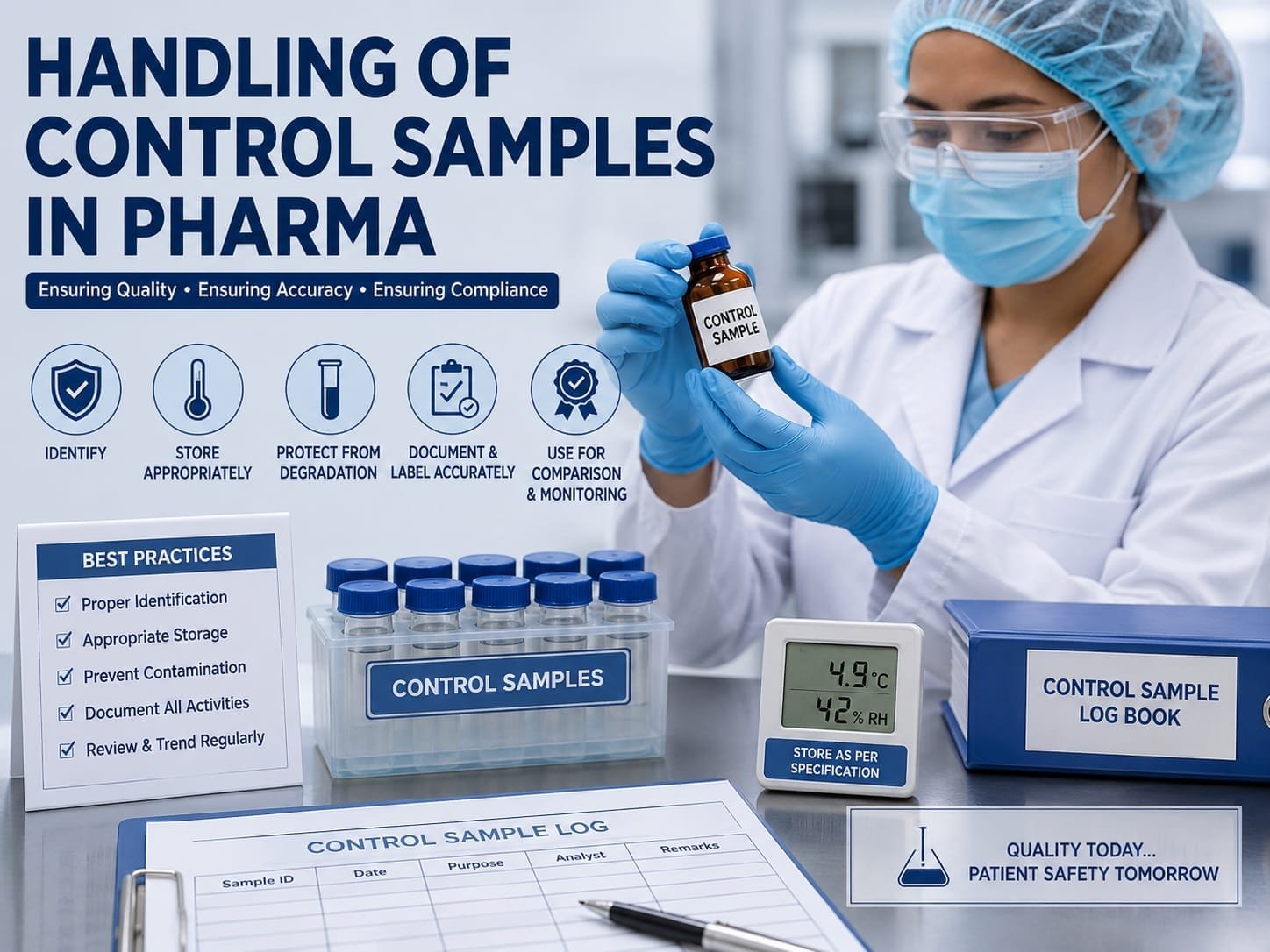
Handling of Control Samples in Pharma: Complete GMP Guide 2026
In pharmaceutical manufacturing, Control Samples and Retention Samples act as legal proof of what was released to market. If there’s a complaint, recall, or regulatory audit after 2 years, these are the samples that save you.
This blog covers WHO, USFDA, EU GMP Annex 19, and Schedule M requirements for collection, storage, retention, and destruction of control samples.
1. Regulatory Requirements for Control Samples
| Guideline | Requirement |
|---|---|
| WHO TRS 986 Annex 2 | 2x full QC quantity. Store in final pack. Retain 1 year after expiry |
| USFDA 21 CFR 211.170 | Reserve sample = 2x testing. Retain 1 year after expiry |
| EU GMP Annex 19 | Reference + Retention sample. Store under label conditions |
| Schedule M, India | 1 year after expiry OR 3 years after distribution, whichever is later |
2. Types of Samples in Pharma
A. Reference Sample
Used for analytical testing. Quantity: Minimum 2 times the quantity required to conduct all QC tests as per pharmacopoeia.
B. Retention Sample
Used for visual/physical examination. Usually 1 unit in final market pack. Helps during complaint investigation.
C. Stability Sample
Kept in stability chambers per ICH Q1A. Separate from control sample room.
3. SOP for Handling of Control Samples
Step 1: Collection & Labeling
- Collect from the batch that is released for distribution
- Must be in final market container and label
- Label details: Product Name, Batch No, Mfg & Exp Date, Quantity, Storage Condition, “CONTROL SAMPLE – NOT FOR SALE”
- Transfer from Production → QC → Control Sample Room via documented challan
Step 2: Storage Conditions
- Dedicated Control Sample Room with restricted access
- Temperature & Humidity mapping: 25°C ±2°C / 60% RH ±5% or 2-8°C as per label
- 24×7 continuous monitoring with alarm and data backup
- Segregation: By product, dosage form, and year of manufacturing
Step 3: Documentation & Inventory
- Control Sample Register / LIMS module
- Quarterly physical verification by QA
- Sample issue record if used for investigation
Step 4: Retention Period
Global: 1 year after expiry date of batch
India: 1 year after expiry OR 3 years after batch distribution, whichever is later
Example: Batch Expiry: Dec 2026 → Retain till Dec 2027
Step 5: Destruction
- Take QA Head approval after retention period
- Destruction by incineration/shredding as per waste management SOP
- Maintain Destruction Record with 2 witnesses
1. No temperature monitoring in sample room
2. Samples not in final container
3. Insufficient quantity for retesting
4. Best Practices
- Barcoding & LIMS: Each sample tagged for traceability
- Dual Access Control: 2-person rule to enter sample room
- Mock Recall: Retrieve 1 control sample yearly to test process
- PE Risk: Ensure control samples are never used for commercial supply
5. Common Mistakes to Avoid
- Storing bulk samples instead of finished pack
- Keeping less than 2x testing quantity
- No access log for sample room
- Destroying before approved retention period
- Missing temperature excursion investigation
Conclusion
Control sample management is a direct reflection of a company’s GMP maturity. A well-managed sample room means you can respond to any complaint or audit in < 30 minutes with full traceability.
As per USFDA and other global regulatory authorities: “If you can’t produce the sample, it’s as good as you never made the batch.”
The information provided in this article is for educational and informational purposes only.
It is based on WHO TRS, USFDA 21 CFR, EU GMP Annex 19, and Schedule M as of July 2026.
Readers should always refer to their company SOPs, latest regulatory guidelines, and consult
with Qualified Persons/QA Heads before implementing any practice. PharmaShare does not assume
responsibility for any errors or actions taken based on this content.

About the Author
Mahummed Asif is a experienced pharmaceutical QA professional and publisher of Pharmashare. He has sound knowledge in GMP, Product Life Cycle Management, Regulatory filing, QMS, Product Complaint Management, Change control, risk management, and global audit preparation.