
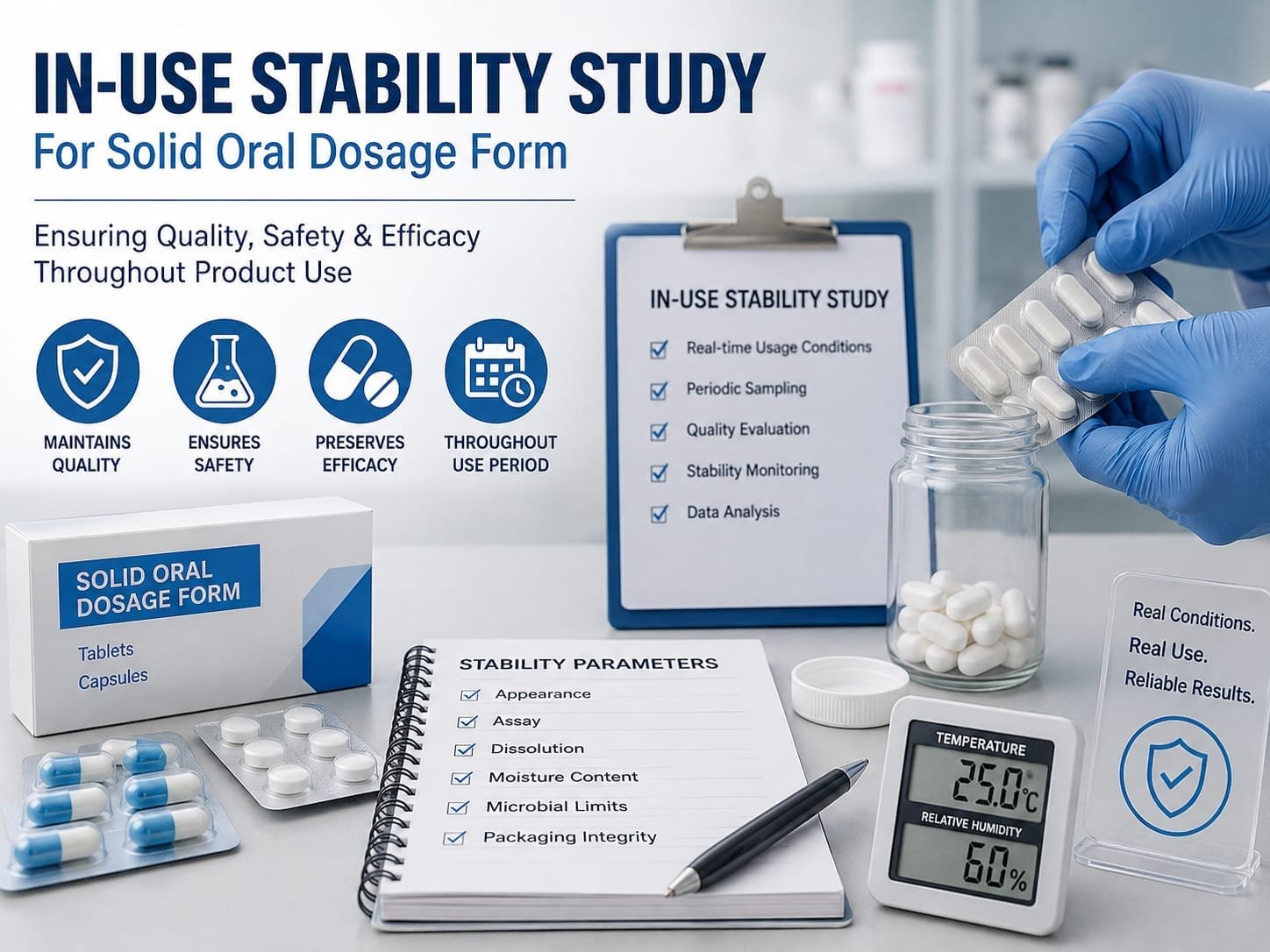
In-Use Stability Study for Solid Oral Dosage Forms in Pharma: A Complete Guide
In-use stability studies are an important component of pharmaceutical stability programs when a medicinal product may be stored, handled, opened, exposed to environmental conditions, or repeatedly accessed during its period of use.
For solid oral dosage forms such as tablets and capsules, the stability of the product may be affected after opening the original container, particularly when the packaging system provides protection against moisture, oxygen, light, or other environmental factors.
This article explains the scientific and practical aspects of designing and executing an in-use stability study for solid oral dosage forms, including study objectives, protocol development, storage conditions, sampling, testing parameters, acceptance criteria, documentation, and common challenges.
Table of Contents
- What Is an In-Use Stability Study?
- Why Is an In-Use Stability Study Required?
- Scope for Solid Oral Dosage Forms
- In-Use Stability vs. Standard Stability Study
- Factors Affecting In-Use Stability
- In-Use Stability of Tablets
- In-Use Stability of Capsules
- Role of the Packaging System
- In-Use Stability Study Protocol
- Storage and Exposure Conditions
- Sampling Plan
- Testing Parameters
- Acceptance Criteria
- Study Design Example
- Moisture-Sensitive Products
- Light-Sensitive Products
- Multidose Containers
- Blister-Pack Products
- Bottle-Pack Products
- Microbiological Considerations
- Handling OOS/OOT Results
- Documentation Requirements
- Regulatory Considerations
- Common Deficiencies
- Best Practices
- Frequently Asked Questions
- Conclusion
1. What Is an In-Use Stability Study?
An in-use stability study is a study designed to evaluate the quality and stability of a pharmaceutical product under the conditions that are expected to occur after the product has been opened or placed into use by the patient, healthcare professional, or other end user.
The objective is to determine whether the product continues to meet its established quality specifications throughout the proposed period of use.
In the case of solid oral dosage forms, an in-use study may be relevant when tablets or capsules are supplied in multidose containers, bottles, jars, or other packaging systems where the container is repeatedly opened and closed.
An unopened pharmaceutical product is protected by its approved packaging system. Once the container is opened repeatedly, the product may experience a different exposure profile. In-use stability studies help establish whether this exposure has a meaningful impact on product quality.
2. Why Is an In-Use Stability Study Required?
The stability profile of a pharmaceutical product may change after the packaging system is opened. The product may be exposed to humidity, oxygen, temperature variations, light, handling, and repeated opening and closing.
An in-use stability study may therefore be required to support the proposed in-use period, particularly where the formulation or packaging presents a potential stability risk.
Major objectives include:
- Establishing the stability of the product after opening.
- Determining an appropriate in-use period.
- Supporting storage instructions in product labeling.
- Evaluating the impact of repeated container opening.
- Assessing the suitability of the proposed multidose packaging system.
- Identifying degradation or physical changes during use.
- Supporting regulatory submissions and post-approval changes where applicable.
3. Scope for Solid Oral Dosage Forms
In-use stability studies can be relevant to various solid oral dosage forms, including:
- Immediate-release tablets
- Film-coated tablets
- Uncoated tablets
- Modified-release tablets
- Extended-release tablets
- Enteric-coated tablets
- Hard gelatin capsules
- Hypromellose capsules
- Modified-release capsules
- Other solid oral dosage forms supplied in multidose containers
The need for an in-use study should be assessed based on the formulation, dosage form, packaging configuration, proposed directions for use, environmental exposure, and known stability characteristics of the product.
4. In-Use Stability vs. Standard Stability Study
A standard stability study generally evaluates the product while it remains in its intended closed packaging system. An in-use stability study evaluates the product after it has been opened or during simulated conditions of use.
| Parameter | Standard Stability Study | In-Use Stability Study |
|---|---|---|
| Primary purpose | Establish shelf life | Establish stability during use |
| Packaging | Usually unopened/closed | Opened or repeatedly accessed |
| Exposure | Controlled according to stability protocol | Simulates expected use conditions |
| Opening frequency | Normally not applicable | May be defined in the protocol |
| Key concern | Long-term degradation | Impact of use-related environmental exposure |
5. Factors Affecting In-Use Stability
Several factors can influence the stability of tablets and capsules after opening.
5.1 Moisture
Moisture is one of the most important factors for many solid oral dosage forms. Hygroscopic formulations may absorb moisture after repeated opening of the container.
Moisture exposure can result in changes in hardness, disintegration, dissolution, assay, degradation products, physical appearance, and other critical quality attributes.
5.2 Temperature
Products may be exposed to temperature fluctuations during normal use. Temperature may influence chemical degradation and physical properties.
5.3 Oxygen
Oxygen exposure can be relevant for products containing oxidation-sensitive active ingredients or excipients.
5.4 Light
Light exposure can potentially cause photodegradation in photosensitive drug substances or formulations.
5.5 Repeated Opening and Closing
Repeated opening can introduce environmental air into a multidose container and may progressively increase exposure to moisture and oxygen.
5.6 Patient Handling
Direct handling of tablets or capsules can introduce physical contamination, moisture, or mechanical damage. The study design should consider realistic use conditions where appropriate.
6. In-Use Stability of Tablets
Tablets can exhibit different stability behavior depending on their formulation, coating, manufacturing process, and packaging system.
For example, moisture-sensitive tablets may require evaluation of dissolution, assay, degradation products, water content, hardness, friability, and appearance during an in-use study.
Modified-release tablets require particular attention because physical or chemical changes can potentially affect their drug-release characteristics.
7. In-Use Stability of Capsules
Capsules may be affected by moisture transfer between the capsule shell, fill material, and environment.
Hard gelatin capsules and hypromellose capsules can have different moisture-related characteristics. Therefore, the formulation and capsule shell should be considered when establishing the study design.
Testing may include appearance, assay, degradation products, dissolution, water content, and other dosage-form-specific attributes.
8. Role of the Packaging System
Packaging is a critical part of pharmaceutical stability. The packaging system protects the dosage form against environmental factors such as moisture, oxygen, light, and physical damage.
Common packaging configurations include:
- Aluminium-aluminium blister packs
- PVC/PVDC blister packs
- HDPE bottles
- Polypropylene containers
- Glass bottles
- Containers with desiccants
- Child-resistant multidose containers
The in-use study should use the proposed commercial packaging configuration or a scientifically justified representative configuration.
9. In-Use Stability Study Protocol
A well-designed protocol is essential for generating meaningful and defensible stability data.
The protocol should normally define:
- Study objective
- Product name and strength
- Dosage form
- Batch numbers
- Packaging configuration
- Storage conditions
- Opening frequency
- Simulated handling conditions
- Sampling intervals
- Test parameters
- Analytical methods
- Acceptance criteria
- Number of samples
- Sample identification and traceability
- Data evaluation approach
- Deviation handling
- Reporting requirements
10. Storage and Exposure Conditions
In-use storage conditions should be scientifically justified based on the intended market, product characteristics, packaging, and labeled storage requirements.
The study should simulate reasonably foreseeable conditions of use rather than selecting arbitrary conditions.
Factors to consider include:
- Temperature
- Relative humidity
- Light exposure
- Container opening frequency
- Duration of exposure
- Storage orientation where relevant
- Handling conditions
The selected in-use conditions should be scientifically justified in the approved protocol. A simple assumption that the product will always remain under ideal storage conditions may not adequately represent actual use.
11. Sampling Plan
The sampling plan should provide sufficient information to demonstrate whether the product remains within specification throughout the proposed in-use period.
Depending on the proposed in-use period, sampling may be performed at predefined intervals such as the initial condition, intermediate points, and the end of the proposed in-use period.
The exact sampling schedule should be scientifically justified rather than universally applying a fixed number of time points.
12. Testing Parameters
The test panel should be selected based on the dosage form, formulation characteristics, known degradation pathways, packaging, and regulatory expectations.
| Test Parameter | Purpose |
|---|---|
| Description/Appearance | Detect physical changes such as discoloration, cracking, swelling, sticking, or capsule deformation. |
| Assay | Evaluate the chemical potency of the active ingredient. |
| Related Substances/Degradation Products | Monitor chemical degradation. |
| Dissolution | Evaluate drug-release performance. |
| Disintegration | Evaluate dosage-form disintegration where applicable. |
| Water Content | Monitor moisture uptake or loss. |
| Hardness | Evaluate physical integrity of tablets where applicable. |
| Friability | Assess tablet resistance to mechanical stress where applicable. |
| Microbial Quality | Evaluate microbiological quality where scientifically justified. |
Not every parameter needs to be included in every study. The selection should be risk-based and scientifically justified.
13. Acceptance Criteria
Acceptance criteria should normally be based on the approved product specification and applicable regulatory commitments, unless a scientifically justified approach has been established for the particular study.
Typical acceptance criteria may include:
- Appearance remains acceptable.
- Assay remains within approved limits.
- Specified and unspecified degradation products remain within limits.
- Dissolution remains compliant.
- Disintegration remains within specification where applicable.
- Water content remains within established limits where applicable.
- Other critical quality attributes remain within predefined acceptance criteria.
14. Example of an In-Use Stability Study Design
The following is an illustrative example only. Actual study conditions should be established based on product-specific risk assessment and regulatory requirements.
| Study Element | Illustrative Approach |
|---|---|
| Dosage form | Film-coated tablet |
| Packaging | Multidose HDPE bottle with closure |
| Opening | Simulated according to expected patient use |
| Study duration | Proposed in-use period |
| Conditions | Representative of labeled storage and foreseeable use |
| Testing | Appearance, assay, degradation products, dissolution and other justified parameters |
| Evaluation | Comparison with predefined acceptance criteria and assessment of trends |
15. Special Considerations for Moisture-Sensitive Products
Moisture-sensitive products require particular attention during in-use stability studies.
Repeated opening of a bottle can introduce humid air into the container. Over time, moisture may accumulate and potentially affect the product.
For such products, the study may need to evaluate:
- Water content
- Assay
- Degradation products
- Dissolution
- Physical appearance
- Tablet hardness
- Disintegration
Where a desiccant is included in the packaging, the performance and continued presence of the desiccant should also be considered as part of the packaging risk assessment.
16. Special Considerations for Light-Sensitive Products
For photosensitive products, the study should consider the potential exposure that can occur during normal handling.
If the product is supplied in light-protective packaging, the study should evaluate whether the packaging continues to provide adequate protection during the proposed period of use.
Appropriate degradation-product testing may be particularly important when photodegradation is a known degradation pathway.
17. In-Use Stability of Multidose Containers
Multidose bottles represent one of the most common situations where an in-use stability assessment may be relevant.
During normal use, the container may be opened multiple times. Each opening introduces air into the container and may expose the remaining tablets or capsules to environmental moisture and oxygen.
The study should therefore simulate the anticipated opening frequency and handling pattern as closely as reasonably possible.
18. In-Use Stability of Blister-Pack Products
Blister-packed tablets and capsules generally remain individually protected until the individual blister pocket is opened.
Therefore, the in-use stability concern may differ from that of a multidose bottle.
However, once a blister pocket has been opened, the dosage unit may no longer receive the same protection from moisture, oxygen, and light.
Where patients are instructed to remove doses in advance or store removed doses before administration, an assessment may be necessary depending on the product and proposed use.
19. In-Use Stability of Bottle-Pack Products
Bottle-pack products require careful evaluation because the entire remaining contents may be exposed each time the container is opened.
Important considerations include:
- Container closure integrity
- Desiccant configuration
- Opening frequency
- Duration of use
- Headspace volume
- Moisture permeability
- Closure design
- Patient handling
20. Microbiological Considerations
Solid oral dosage forms generally present a lower microbiological risk than aqueous multidose products. However, the microbiological quality of a product should still be considered based on its formulation, manufacturing process, packaging, and intended use.
Where microbiological quality is a relevant critical quality attribute, appropriate testing and risk assessment should be incorporated into the study.
21. Handling OOS and OOT Results
Any Out-of-Specification (OOS) or significant Out-of-Trend (OOT) result obtained during an in-use stability study should be handled according to the applicable approved investigation procedure.
The investigation should consider:
- Analytical error
- Sample preparation
- Instrument performance
- Sample storage
- Study chamber performance
- Protocol deviations
- Packaging configuration
- Environmental exposure
- Actual product degradation
An OOT trend should not automatically be dismissed simply because the result remains within specification. A statistically or scientifically meaningful trend may indicate a potential future stability issue.
22. Documentation Requirements
Complete documentation is essential for demonstrating that the study was properly planned, executed, reviewed, and concluded.
Important documents may include:
- Approved stability protocol
- Risk assessment
- Batch manufacturing information
- Packaging configuration details
- Sample accountability records
- Stability chamber records
- Opening/handling records
- Analytical test results
- Chromatograms and raw data
- Environmental monitoring records where applicable
- Deviation records
- OOS/OOT investigations
- Final stability report
23. Regulatory Considerations
Stability studies should be designed in accordance with applicable regulatory expectations and relevant stability guidance. The principles of ICH stability guidance, particularly ICH Q1A(R2), provide an important framework for understanding pharmaceutical stability testing.
In-use stability requirements can also depend on the regulatory jurisdiction, dosage form, packaging configuration, product characteristics, and the proposed labeling instructions.
For products submitted to different markets, the applicable regional regulatory requirements should be assessed before finalizing the protocol.
The in-use stability study should be scientifically justified and appropriately documented rather than performed simply as a routine exercise.
24. Common Deficiencies in In-Use Stability Studies
Some common weaknesses observed in stability programs include:
- Inadequate scientific justification: The study conditions are selected without adequate product-specific rationale.
- Unrealistic opening frequency: The number of container openings does not represent the expected use pattern.
- Inappropriate storage conditions: Conditions do not adequately represent the intended use environment.
- Insufficient testing: Critical quality attributes are not included despite known stability risks.
- Weak packaging justification: The selected packaging configuration is not adequately justified.
- Failure to evaluate trends: Results are evaluated only against specifications without assessing trends.
- Poor sample traceability: Samples cannot be adequately linked to the relevant study condition and time point.
- Inadequate deviation assessment: Protocol deviations are not appropriately assessed for their potential impact on study conclusions.
- Incomplete final report: The report does not clearly establish whether the proposed in-use period is supported.
25. Best Practices for In-Use Stability Studies
1. Start with a risk assessment
Identify the product’s sensitivity to moisture, temperature, oxygen, light, and physical stress before designing the study.
2. Understand the packaging system
Evaluate how the packaging protects the product and how repeated opening can affect that protection.
3. Simulate realistic use
Opening frequency and handling should represent the intended patient or healthcare professional use as closely as practical.
4. Select meaningful test parameters
Do not automatically test every possible parameter. Select parameters based on known risks and critical quality attributes.
5. Evaluate trends
Stability evaluation should include both specification compliance and assessment of meaningful trends.
6. Maintain complete traceability
Every sample should be traceable to its batch, packaging configuration, exposure condition, time point, and test result.
7. Document deviations
Any deviation from the approved protocol should be documented, investigated where appropriate, and assessed for its impact on study conclusions.
8. Link the conclusion to the proposed in-use period
The final report should clearly state whether the generated data support the proposed in-use period and storage instructions.
26. Frequently Asked Questions
What is the main purpose of an in-use stability study?
The main purpose is to demonstrate that the pharmaceutical product continues to meet predefined quality requirements during the proposed period of use after opening or during simulated use.
Is an in-use stability study required for every tablet?
Not necessarily. The need should be determined through product-specific scientific and regulatory assessment, considering formulation, packaging, intended use, environmental exposure, and stability characteristics.
Is in-use stability different from shelf-life stability?
Yes. Shelf-life stability generally evaluates the product in its intended closed packaging system, whereas in-use stability evaluates stability after opening or under simulated conditions of use.
Which tests are commonly performed?
Depending on the product, common tests include appearance, assay, degradation products, dissolution, disintegration, water content, hardness, friability, and microbiological quality where applicable.
Why is opening frequency important?
Repeated opening can expose a multidose container to moisture, oxygen, and other environmental factors. Therefore, the opening frequency can have a direct impact on the exposure profile of the remaining product.
Does packaging influence in-use stability?
Yes. Packaging provides protection against environmental exposure. A bottle with a desiccant, a blister pack, and a highly moisture-permeable container can produce very different in-use stability profiles.
Can an in-use stability study support a labeled in-use period?
Yes. When appropriately designed and executed, the study can provide data supporting the proposed period of use after opening, subject to applicable regulatory requirements and scientific justification.
27. Conclusion
In-use stability studies are an important tool for demonstrating that solid oral dosage forms remain fit for their intended use after the product is opened or exposed to realistic handling conditions.
For tablets and capsules, the impact of moisture, oxygen, temperature, light, repeated opening, packaging configuration, and handling should be evaluated using a scientifically justified approach.
A successful in-use stability program should begin with a product-specific risk assessment and continue through protocol development, controlled study execution, appropriate analytical testing, trend evaluation, investigation of abnormalities, and a scientifically sound final conclusion.
Ultimately, the objective is not simply to generate stability data, but to demonstrate that the product’s quality, safety, and performance remain acceptable throughout the proposed period of use.
Key Takeaways
- In-use stability evaluates product quality after opening or during simulated use.
- It is particularly relevant for multidose packaging systems.
- Moisture exposure is a major consideration for many solid oral dosage forms.
- Opening frequency should reflect realistic conditions of use.
- Testing should be based on product-specific risks and critical quality attributes.
- Packaging plays an important role in protecting tablets and capsules.
- Both specification compliance and stability trends should be evaluated.
- All deviations and abnormal results should be appropriately assessed.
- The final report should clearly establish whether the proposed in-use period is supported.
- Applicable regional regulatory requirements should be considered when designing the study.
This article is provided for educational and informational purposes only. Pharmaceutical stability requirements can vary depending on the product, dosage form, packaging system, regulatory jurisdiction, and approved regulatory commitments. Always evaluate current applicable regulatory guidance, product-specific requirements, and approved procedures before designing or executing an in-use stability study.