
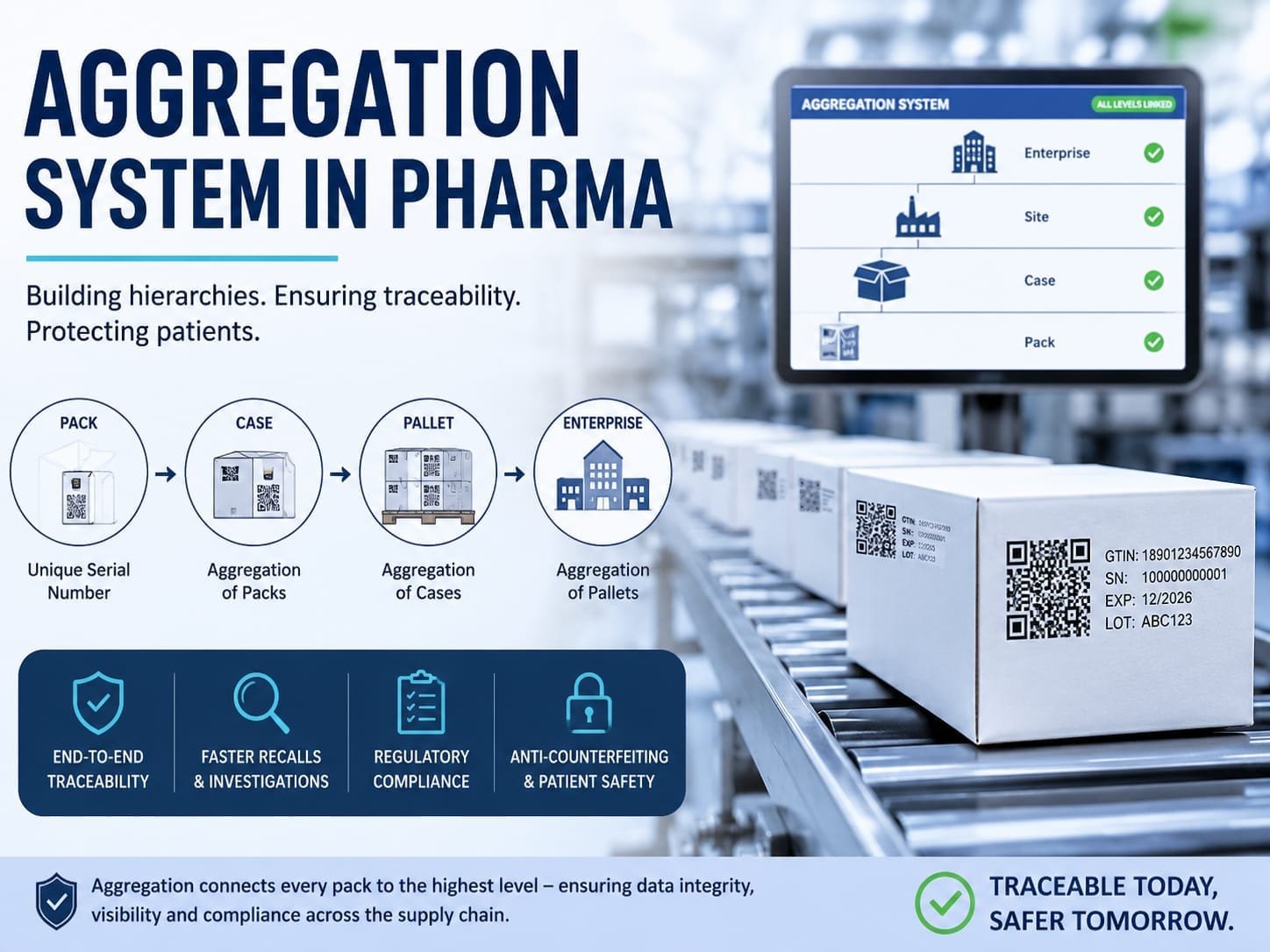
Aggregation System in Pharma: Complete Guide to Parent-Child Hierarchy, Validation & Compliance
Serialization tells you “what is in 1 pack”. Aggregation tells you “where is that pack”.
In 2026, regulators don’t just want a serial number on each bottle. They want to know which bundle, case, and pallet that bottle is in — from factory to pharmacy.
This is called Aggregation. And it’s where 70% of serialization failures happen.
This guide covers aggregation systems in pharma: how they work, common issues, validation, and how to run at >98% accuracy.
Aggregation = Establishing and maintaining a parent-child relationship between unique serial numbers at pack, bundle, case, and pallet level in L4/L5 system.
1. Why Aggregation is Mandatory in 2026
- DSCSA 2023-2026: US requires case/pallet level aggregation for wholesale verification
- EU FMD: No aggregation required, but many companies do it for supply chain efficiency
- India DAVA: Secondary pack aggregation to tertiary is mandatory
- Business Value: 10x faster recalls, warehouse automation, theft prevention
Without aggregation, you must scan every single pack during recall. With aggregation, scan 1 pallet = 10,000 packs traced.
2. Aggregation Hierarchy: L1 to L5
| Level | Description | Example |
|---|---|---|
| L1 – Primary | Bottle, Blister, Vial with unique SNo | Child |
| L2 – Secondary | Carton/Box containing multiple primaries | Parent of L1 |
| L3 – Tertiary/Case | Case containing multiple cartons | Parent of L2 |
| L4 – Pallet | Pallet containing multiple cases | Parent of L3 |
| L5 – Enterprise | Repository storing all parent-child links | TraceLink, SAP AII, DAVA |
3. How Aggregation System Works on Line
- Print & Commission: L1 and L2 codes printed and commissioned
- Bundle Aggregation: 10 cartons pass through tunnel scanner. System links 10 L2 to 1 Bundle ID
- Case Aggregation: Bundles go to case packer. Camera reads bundle codes + case code. L4 creates “Case = Parent, Bundles = Children”
- Pallet Aggregation: Cases loaded on pallet. Pallet ID scanned + all case IDs scanned. Link created.
- Upload to L5: All relationships sent to TraceLink/DAVA with “Aggregation” event
4. Top 10 Aggregation System Issues & Solutions
Issue 1: Orphan Packs
Problem: Pack was commissioned but never aggregated to case.
Cause: Conveyor gap, scanner missed, operator bypass.
Solution: “No Read = Line Stop”. End-of-batch orphan report review by QA.
Issue 2: Double Aggregation
Problem: Same pack scanned into 2 different cases.
Cause: Case changeover without clearing buffer.
Solution: L4 software logic to block duplicate child in 2 parents.
Issue 3: Wrong Case ID Scanned
Problem: Operator scanned old case label.
Solution: Use auto-generated case ID from L4. Barcode on job card.
Issue 4: Partial Case Aggregation
Problem: Case has 48 packs but only 46 aggregated.
Cause: 2 rejects not accounted.
Solution: Reject management: “Scan reject → Decommission → Remove from aggregation count”
Issue 5: Tunnel Scanner Read Rate <99.5%
Problem: 1-2% codes not read during case aggregation.
Solution: 4-camera tunnel, anti-vibration mount, lighting control, code quality ISO 15416 Grade C+
Issue 6: Aggregation Failure During Network Loss
Problem: L4-L5 down. Aggregation data stuck in L4 buffer.
Solution: Validated store-and-forward for 72 hours. Alert if buffer >1000 transactions.
Issue 7: Rework & Re-aggregation
Problem: Case opened for rework. How to break and rebuild aggregation?
Solution: SOP: “De-aggregate → Rework → Re-aggregate with audit trail”. QA approval required.
Issue 8: Mixed SKU in Case
Problem: 2 different GTINs packed in same case.
Solution: L4 recipe lock. Vision system to verify GTIN on each carton before aggregation.
Issue 9: Slow Case/Pallet Aggregation = Bottleneck
Problem: Manual scanning takes 5 mins per pallet.
Solution: RFID pallet tags or fixed overhead scanners. Target <30 sec per pallet.
Issue 10: Validation Gap
Problem: 483: “No evidence aggregation accuracy was validated”
Solution: PQ with 3 worst-case SKUs. Challenge: max speed, low light, damaged codes.
5. Validation Requirements: IQ, OQ, PQ for Aggregation
- IQ: Camera resolution, lighting, scanner placement, network diagram
- OQ: Read rate at min/mid/max line speed. Test damaged codes, reflective cartons
- PQ: Run 3 full batches. Target: >99.8% aggregation accuracy. 100% reconciliation: Children in L4 = Children in Case
- CSV: 21 CFR Part 11: Audit trail for aggregate, de-aggregate, edit events
6. Regulatory Expectations During Inspection
- Show me aggregation accuracy report for last 6 months
- What happens if 1 pack in case is not aggregated?
- Show procedure for de-aggregation during rework
- How do you reconcile physical case count vs system count?
7. Best Practices to Achieve >99.8% Aggregation Accuracy
- Material Qualification: Test carton material for print contrast before approval
- Golden Samples: Keep “Good Code” and “Bad Code” samples at line
- Operator Training: KPI = Aggregation Accuracy, not just Line Speed
- Real-time Dashboard: Display: Aggregated / Expected / Orphans per shift
- Daily Calibration: Verifier + Scanner calibration before start of shift
- Exception Handling SOP: Clear steps for orphan, duplicate, network failure
8. Aggregation vs Serialization: Key Difference
| Parameter | Serialization | Aggregation |
|---|---|---|
| Focus | Unique ID on 1 pack | Relationship between packs |
| Regulatory | Mandatory globally | Mandatory in US, India. Optional in EU |
| Business Impact | Anti-counterfeit | Recall speed, warehouse automation |
9. FAQs
Q1: Is aggregation required for EU FMD?
No. FMD only needs pack-level. But most MNCs do aggregation for global supply chain.
Q2: What is aggregation accuracy?
(Number of correctly aggregated children / Total children) x 100. Target >99.8%
Q3: Can we ship if 1 pack is orphan?
No. Per GMP and DSCSA, entire case/pallet must be 100% reconciled before release.
Conclusion
Aggregation is not just “scanning barcodes”. It’s the backbone of pharma traceability.
A weak aggregation system = recalls, regulatory action, and lost trust.
Invest in right hardware, validate properly, train people, and treat aggregation data like batch record data.
Remember: Serialization makes the pack legal. Aggregation makes the supply chain smart.

About the Author
Mahummed Asif is a experienced pharmaceutical QA professional and publisher of Pharmashare. He has sound knowledge in GMP, Product Life Cycle Management, Regulatory filing, QMS, Product Complaint Management, Change control, risk management, and global audit preparation.