Table of Contents
ToggleRole of Artificial Intelligence (AI) in the Pharmaceutical Industry
Category: Pharmaceutical Industry | Quality | Technology | Digital Transformation
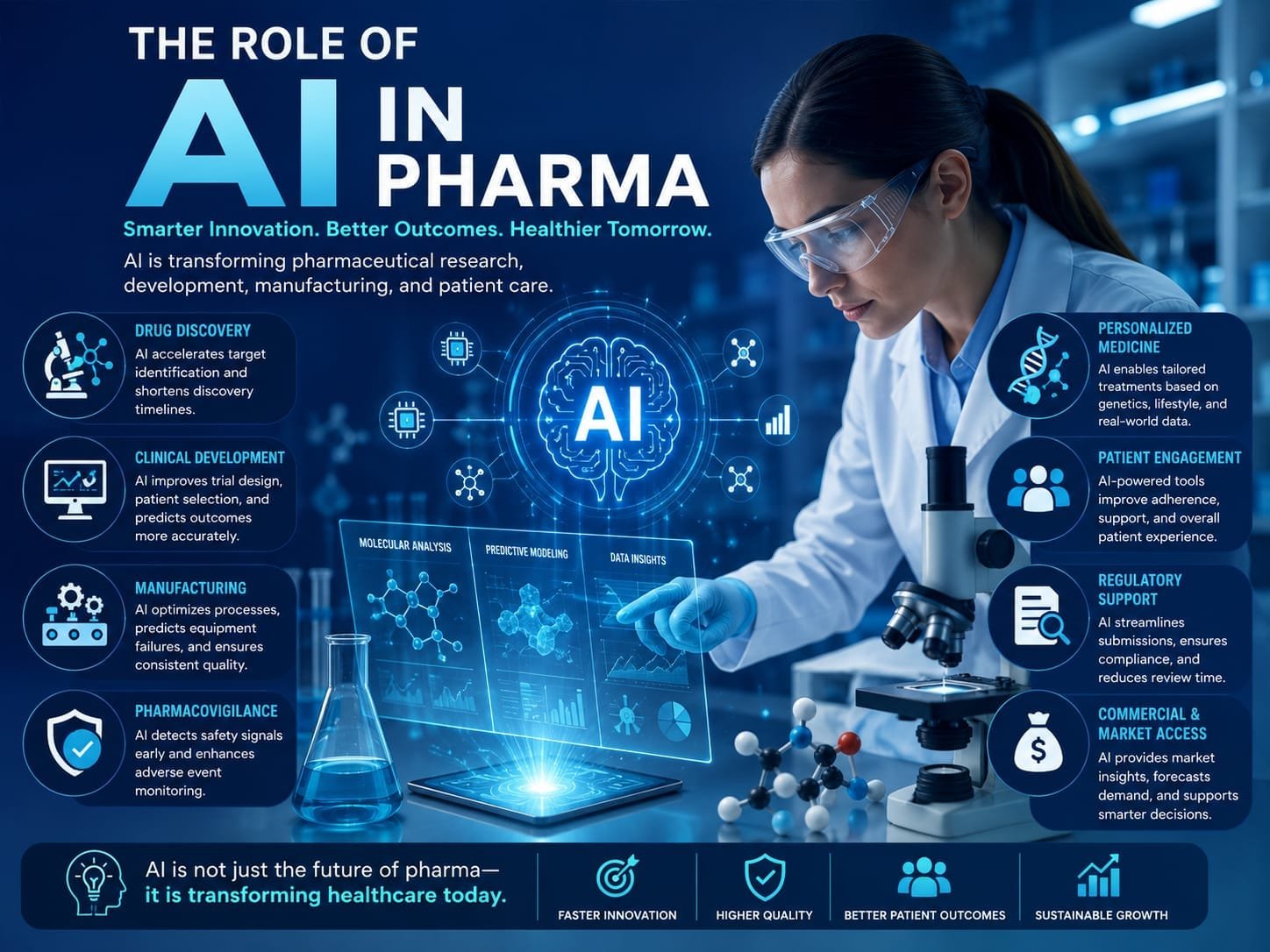
Artificial Intelligence (AI) is rapidly changing the pharmaceutical industry. From drug discovery and clinical development to pharmaceutical manufacturing, quality assurance, pharmacovigilance, regulatory affairs and supply-chain management, AI has the potential to improve how pharmaceutical companies generate, analyze and use information.
The pharmaceutical industry produces enormous volumes of structured and unstructured data. Manufacturing records, laboratory results, stability data, deviations, CAPA, complaints, regulatory submissions, clinical trial data, safety reports and supply-chain information can contain valuable insights. AI technologies can help organizations analyze this information more efficiently and identify patterns that may be difficult to detect through conventional manual approaches.
However, implementing AI in pharma is different from using AI in many other industries. Pharmaceutical companies operate within highly regulated environments where patient safety, product quality, data integrity, computer system validation, cybersecurity, privacy, traceability and regulatory compliance are critical.
Therefore, the future of AI in pharma is not simply about automating tasks. It is about implementing AI within a controlled, risk-based and compliant framework.
Table of Contents
- What Is Artificial Intelligence?
- Why Is AI Important for the Pharmaceutical Industry?
- AI Across the Pharmaceutical Product Lifecycle
- AI in Drug Discovery
- AI in Drug Development
- AI in Clinical Trials
- AI in Pharmaceutical Manufacturing
- AI in Pharmaceutical Quality Assurance
- AI in Quality Control and Laboratory Operations
- AI in Deviation and Investigation Management
- AI in CAPA Management
- AI in Product Complaints
- AI in Stability Studies
- AI in Process Validation and Continued Process Verification
- AI in Regulatory Affairs
- AI in Pharmacovigilance
- AI in Pharmaceutical Supply Chain
- AI in Serialization and Traceability
- AI in Pharmaceutical Product Recall
- AI in Demand Forecasting
- Predictive Maintenance Using AI
- AI in Pharmaceutical Documentation
- AI and Pharmaceutical Data Integrity
- AI Model Validation
- Benefits of AI in Pharma
- Risks and Challenges
- AI Governance in Pharma
- How to Implement AI in Pharma
- Future of AI in Pharma
- Frequently Asked Questions
- Conclusion
1. What Is Artificial Intelligence?
Artificial Intelligence refers to technologies that enable computer systems to perform tasks that normally require human intelligence.
AI systems can analyze data, identify patterns, classify information, generate predictions, process natural language and support decision-making.
Common AI technologies relevant to pharmaceutical organizations include:
- Machine learning
- Deep learning
- Natural language processing
- Computer vision
- Predictive analytics
- Generative AI
- Large language models
- Intelligent automation
- Anomaly detection
- Knowledge graphs
The appropriate technology depends on the intended use, data characteristics, risk level and regulatory requirements.
2. Why Is AI Important for the Pharmaceutical Industry?
Pharmaceutical organizations manage complex processes involving large amounts of data.
For example, a pharmaceutical quality organization may manage:
- Deviations
- CAPA
- Change controls
- OOS investigations
- OOT investigations
- Product complaints
- Batch records
- Audit findings
- Annual Product Quality Reviews
- Stability data
- Training records
- Supplier quality information
AI can help transform these datasets into actionable information.
AI opportunity in pharma: Instead of using technology only to store information, organizations can increasingly use technology to analyze information, recognize patterns, predict potential outcomes and support human decision-making.
3. AI Across the Pharmaceutical Product Lifecycle
AI has applications across almost every stage of the pharmaceutical product lifecycle.
4. AI in Drug Discovery
Drug discovery is one of the areas where AI has attracted significant attention.
Traditional drug discovery can require extensive research, experimentation and screening. AI can assist researchers in analyzing large datasets and identifying potential relationships between molecular structures, biological targets and therapeutic outcomes.
Potential applications include:
- Target identification
- Molecule screening
- Virtual screening
- Structure prediction
- Drug-target interaction prediction
- Lead optimization
- Property prediction
- Toxicity prediction
- Biomarker identification
AI does not eliminate the need for laboratory experimentation. Instead, it can help researchers prioritize candidates and make better use of experimental resources.
5. AI in Drug Development
AI can support pharmaceutical development by analyzing formulation and process data.
Potential applications include:
- Formulation optimization
- Excipient selection support
- Process parameter analysis
- Design space analysis
- Stability data evaluation
- Analytical method development support
- Process modeling
- Risk assessment support
For example, machine learning models can potentially identify relationships between formulation variables and critical quality attributes.
6. AI in Clinical Trials
Clinical trials generate large quantities of data and involve complex operational activities.
AI can potentially support:
- Patient recruitment
- Patient matching
- Site selection
- Protocol optimization
- Clinical data analysis
- Trial monitoring
- Patient adherence analysis
- Identification of potential safety signals
- Data quality monitoring
AI can also help identify patterns in clinical datasets that may require further investigation by clinical experts.
7. AI in Pharmaceutical Manufacturing
Pharmaceutical manufacturing is another major area for AI adoption.
Manufacturing processes generate information from equipment, sensors, environmental monitoring systems, laboratory testing, electronic batch records and manufacturing execution systems.
AI can analyze these datasets to support:
- Process monitoring
- Predictive process analytics
- Equipment monitoring
- Anomaly detection
- Yield optimization
- Process capability analysis
- Energy optimization
- Manufacturing scheduling
- Predictive maintenance
Example: An AI model could analyze historical process data and identify combinations of process parameters associated with increased risk of a particular process deviation. The result could then be reviewed by process and quality experts for appropriate action.
8. AI in Pharmaceutical Quality Assurance
AI has significant potential in pharmaceutical Quality Assurance because QA organizations manage large volumes of structured and unstructured information.
Potential applications include:
- Deviation trending
- CAPA effectiveness analysis
- Complaint trending
- Audit finding analysis
- Change-control impact assessment support
- Risk assessment support
- Batch record review assistance
- Quality metrics analysis
- Recurring event identification
- Investigation data analysis
AI can help QA professionals identify patterns across multiple records that may not be obvious when individual records are reviewed independently.
9. AI in Quality Control and Laboratory Operations
Quality Control laboratories generate extensive analytical data.
AI can potentially support:
- Analytical data review
- Trend analysis
- Chromatographic pattern recognition
- Spectral analysis
- Anomaly detection
- Laboratory scheduling
- Predictive maintenance of analytical equipment
- Sample management
Computer vision can also be used for certain inspection activities where appropriately validated, such as identifying visible defects in pharmaceutical packaging.
10. AI in Deviation and Investigation Management
Deviation investigations often involve reviewing large amounts of information.
AI can assist investigators by:
- Classifying deviations
- Identifying recurring events
- Analyzing historical deviations
- Identifying related equipment or processes
- Finding similar previous investigations
- Supporting root-cause hypothesis generation
- Identifying potential trends
Important: AI-generated suggestions should not automatically become the documented root cause. Investigators must evaluate evidence and establish scientifically justified conclusions through the approved investigation process.
11. AI in CAPA Management
Corrective and Preventive Action systems contain valuable historical information.
AI can help organizations analyze:
- CAPA recurrence
- CAPA overdue trends
- Root-cause categories
- Effectiveness failures
- Department-level trends
- Product or process trends
- Similar historical CAPAs
AI can also support identification of potentially recurring problems across different sites or business units.
However, CAPA decisions should remain under appropriate quality-system governance.
12. AI in Product Complaint Management
Product complaint databases can contain thousands of records.
AI and natural language processing can help classify complaints based on:
- Complaint type
- Product
- Defect category
- Market
- Batch
- Severity
- Potential medical impact
- Recurring failure mode
AI can support complaint trending and help identify emerging patterns that may require further investigation.
13. AI in Pharmaceutical Stability Studies
Stability programs generate substantial amounts of data over time.
AI can support stability data analysis by identifying trends in:
- Assay
- Degradation products
- Dissolution
- Moisture
- Hardness
- Related substances
- Physical characteristics
Machine learning and statistical models can potentially support prediction and trend identification, but stability conclusions must continue to follow scientifically sound methods and applicable regulatory requirements.
14. AI in Process Validation and Continued Process Verification
AI can support process validation and Continued Process Verification (CPV) by analyzing large datasets generated during commercial manufacturing.
Potential applications include:
- Critical Process Parameter trending
- Critical Quality Attribute trending
- Process capability analysis
- Multivariate analysis
- Process drift detection
- Early warning indicators
- Batch-to-batch comparison
- Identification of unusual process patterns
This can strengthen the transition from periodic review toward more continuous and proactive process monitoring.
15. AI in Regulatory Affairs
Regulatory affairs teams manage extensive documentation and regulatory information.
AI can support:
- Regulatory document review
- Document classification
- Regulatory intelligence
- Change monitoring
- Submission document preparation support
- Content comparison
- Regulatory requirement mapping
- Identification of missing information
Generative AI can also assist with drafting summaries and organizing information, but regulatory submissions require appropriate expert review and controlled approval.
16. AI in Pharmacovigilance
Pharmacovigilance involves collecting, processing, evaluating and monitoring information related to the safety of medicinal products.
AI and natural language processing can potentially assist with:
- Case intake
- Case classification
- Duplicate detection
- Safety signal detection
- Literature monitoring
- Case prioritization
- Medical information processing
- Data extraction
AI can help safety teams process large volumes of information while allowing qualified professionals to focus on complex medical evaluation and decision-making.
17. AI in Pharmaceutical Supply Chain
Pharmaceutical supply chains are complex and vulnerable to demand changes, manufacturing disruptions, transportation delays and inventory imbalances.
AI can support:
- Demand forecasting
- Inventory optimization
- Supply planning
- Distribution optimization
- Supplier risk analysis
- Transportation planning
- Cold-chain monitoring
- Shortage prediction
18. AI in Serialization and Pharmaceutical Traceability
Serialization systems generate large quantities of transaction and event data.
AI can potentially analyze serialization data to identify:
- Unusual transaction patterns
- Repeated serialization exceptions
- Potential data-quality problems
- Unexpected distribution patterns
- Aggregation anomalies
- Potential counterfeit patterns
- System interface issues
AI can therefore complement serialization platforms by providing advanced analytics on top of transactional traceability data.
19. AI in Pharmaceutical Product Recall
Product recall management can benefit from AI-supported data analysis.
AI may help recall teams analyze:
- Complaint trends
- Deviation trends
- Batch relationships
- Distribution data
- Serialization information
- Aggregation information
- Customer responses
- Returned quantities
- Historical recall patterns
For example, an AI system could identify relationships between a quality defect, affected batches and distribution records, allowing the recall team to investigate the potentially affected population more efficiently.
Final recall decisions must remain subject to appropriate quality and regulatory review.
20. AI in Pharmaceutical Demand Forecasting
Demand forecasting is essential for maintaining appropriate inventory levels.
AI models can analyze historical sales, seasonal patterns, market behavior and other relevant variables to support demand forecasting.
Better forecasting can help reduce:
- Stockouts
- Excess inventory
- Expired inventory
- Emergency manufacturing requirements
- Distribution inefficiencies
21. Predictive Maintenance Using AI
Unexpected equipment failure can cause production delays and potentially impact product quality.
AI-based predictive maintenance systems can analyze equipment parameters and historical failure patterns to identify potential equipment problems before a failure occurs.
Potential inputs include:
- Temperature
- Pressure
- Vibration
- Motor current
- Operating hours
- Maintenance history
- Alarm history
Maintenance teams can use these insights to prioritize inspection and maintenance activities.
22. AI in Pharmaceutical Documentation
Pharmaceutical companies manage a large volume of documentation.
AI can support document-related activities such as:
- Document classification
- Document search
- Content summarization
- Comparison of revisions
- Identification of missing information
- Knowledge retrieval
- Training material development
- Standard operating procedure review support
Generative AI can significantly improve access to organizational knowledge when implemented with appropriate controls.
23. AI and Pharmaceutical Data Integrity
Data integrity is a fundamental requirement in pharmaceutical operations.
AI implementation should therefore consider:
- Data accuracy
- Data completeness
- Data consistency
- Data traceability
- Audit trails
- Access control
- Data retention
- System security
- Model input quality
An AI model cannot produce reliable conclusions if the underlying data is incomplete, inaccurate or inappropriate for the intended use.
Key principle: Poor-quality data can produce poor-quality AI outputs. In a regulated pharmaceutical environment, data quality must therefore be treated as a critical component of AI implementation.
24. AI Model Validation in Pharma
One of the most important considerations when implementing AI in a regulated pharmaceutical environment is determining how the AI system will be controlled and validated.
Organizations should establish a risk-based approach that considers:
- Intended use
- Patient and product impact
- Decision criticality
- Model complexity
- Data sources
- Model performance
- Model limitations
- Change management
- Access controls
- Auditability
- Human oversight
AI models that support high-impact decisions require substantially stronger controls than AI tools used for low-risk administrative activities.
25. Major Benefits of AI in Pharma
| Benefit | Potential Impact |
|---|---|
| Automation | Reduces repetitive manual activities |
| Data analysis | Processes large datasets efficiently |
| Predictive capability | Supports early identification of potential problems |
| Quality improvement | Identifies recurring trends and patterns |
| Drug discovery | Supports identification and prioritization of candidates |
| Manufacturing optimization | Supports process monitoring and optimization |
| Supply-chain optimization | Improves forecasting and inventory planning |
| Knowledge management | Makes large volumes of information easier to access |
| Decision support | Provides data-driven insights for expert review |
26. Risks and Challenges of AI in Pharma
Despite its benefits, AI introduces new risks.
1. Incorrect outputs
AI systems can generate inaccurate or misleading outputs.
2. Hallucination in generative AI
Generative AI systems may produce information that appears credible but is incorrect.
3. Data bias
Models may produce biased results when training data is incomplete or unrepresentative.
4. Lack of explainability
Some complex AI models may be difficult to interpret.
5. Data privacy
Sensitive clinical, patient or business information requires appropriate controls.
6. Cybersecurity
AI systems create additional technology and cybersecurity considerations.
7. Model drift
Model performance may change when process conditions or underlying data change.
8. Over-reliance on automation
Employees may place excessive confidence in AI-generated recommendations.
AI should support human expertise, not eliminate appropriate human oversight.
27. AI Governance in the Pharmaceutical Industry
A pharmaceutical company implementing AI should establish an appropriate AI governance framework.
An AI governance program may include:
- AI policy
- Risk classification
- Approved AI use cases
- Data governance
- Security controls
- Privacy controls
- Model validation
- Human oversight
- Change management
- Performance monitoring
- Periodic review
- Incident management
- Vendor qualification
- Training
The governance framework should be aligned with the organization’s existing quality and computerized-system governance processes where appropriate.
28. How to Implement AI in a Pharmaceutical Company
Successful AI implementation should be approached systematically rather than starting with technology alone.
29. Examples of Low-, Medium- and High-Risk AI Use Cases
| Risk Level | Example | Typical Consideration |
|---|---|---|
| Lower | Internal document summarization | Human review before use |
| Lower | Knowledge search | Source verification |
| Medium | Quality trend analysis | Data quality and model performance monitoring |
| Medium | Deviation classification | QA review and controlled workflow |
| Higher | Safety signal support | Strong controls and expert evaluation |
| Higher | Critical manufacturing decision support | Risk-based validation and human oversight |
The actual risk classification should be determined based on the intended use, context and potential impact rather than simply categorizing AI technologies as inherently low or high risk.
30. Future of AI in Pharma
The role of AI in pharma is likely to expand significantly as organizations develop better data infrastructures, digital systems and AI governance frameworks.
Future applications may include:
- AI-assisted drug discovery
- Personalized medicine
- Digital twins for manufacturing
- Real-time process monitoring
- Advanced predictive quality systems
- Automated regulatory intelligence
- AI-supported pharmacovigilance
- Intelligent supply-chain management
- Automated document review
- AI-assisted inspection readiness
- Advanced serialization analytics
- Predictive product quality monitoring
The most important change may be the transition from reactive analysis to predictive quality and operations.
Instead of waiting for a deviation, complaint, equipment failure or supply disruption to occur, organizations can increasingly use data-driven models to identify early warning signals.
31. AI and the Future of Pharmaceutical Quality Management
AI has the potential to transform traditional Quality Management Systems from largely reactive systems into more proactive and predictive systems.
For example, a future AI-enabled QMS could analyze:
- Deviations
- CAPA
- Complaints
- OOS results
- Change controls
- Audit observations
- Training effectiveness
- Supplier performance
- Batch trends
- Stability data
The system could then identify relationships between apparently unrelated quality events and highlight areas requiring human attention.
Vision for the future: AI-enabled pharmaceutical quality systems could help organizations move from “detect and correct” toward “predict, prevent and continuously improve.”
32. Frequently Asked Questions About AI in Pharma
What is the role of AI in the pharmaceutical industry?
AI can support pharmaceutical research, drug discovery, clinical development, manufacturing, quality assurance, quality control, regulatory affairs, pharmacovigilance, supply-chain management and post-market surveillance.
How is AI used in pharmaceutical manufacturing?
AI can analyze manufacturing data to support process monitoring, anomaly detection, predictive maintenance, process optimization, yield improvement and early identification of potential process problems.
How can AI help pharmaceutical QA?
AI can assist with deviation trending, CAPA analysis, complaint trending, audit finding analysis, change-control review support, risk assessment and identification of recurring quality events.
Can AI replace pharmaceutical QA professionals?
AI should not be viewed as a replacement for qualified pharmaceutical professionals. In regulated activities, human expertise, scientific judgment and appropriate quality oversight remain essential.
What are the biggest challenges of AI in pharma?
Major challenges include data quality, model reliability, explainability, cybersecurity, privacy, validation, regulatory expectations, model drift and maintaining appropriate human oversight.
Is AI suitable for pharmaceutical deviation investigations?
AI can assist by analyzing historical deviations and identifying similar events or trends. However, the documented root cause and investigation conclusions should be based on appropriate evidence and reviewed through the established quality system.
How can AI support pharmacovigilance?
AI can assist with case processing, literature monitoring, data extraction, duplicate detection, case prioritization and safety signal analysis, subject to appropriate controls and expert review.
Can AI be used for pharmaceutical regulatory submissions?
AI can support activities such as document organization, comparison, summarization and regulatory intelligence. However, regulated submissions require appropriate review, verification and approval by qualified personnel.
Why is data quality important for AI in pharma?
AI models depend on the data used for training, testing and operation. Inaccurate, incomplete or biased data can result in unreliable outputs and inappropriate decisions.
33. Conclusion
Artificial Intelligence is becoming an important technology in the pharmaceutical industry. Its potential extends far beyond automation. AI can help pharmaceutical organizations analyze complex datasets, identify patterns, predict potential problems and support better decision-making.
From drug discovery and clinical trials to manufacturing, Quality Assurance, pharmacovigilance, regulatory affairs, serialization and supply-chain management, AI can create significant opportunities for improving efficiency and pharmaceutical operations.
For pharmaceutical quality professionals, one of the most promising applications is the use of AI to connect information from multiple quality processes. Deviation, CAPA, complaint, change control, audit, stability and manufacturing data can potentially be analyzed together to identify emerging risks.
However, pharmaceutical organizations must implement AI responsibly. Data integrity, system validation, cybersecurity, privacy, model performance, change control, governance and human oversight should be considered before deploying AI in regulated processes.
The future of AI in pharma is not about replacing pharmaceutical professionals. It is about augmenting their capabilities.
The organizations that successfully combine AI technology with scientific expertise, robust quality systems and strong regulatory governance will be better positioned to build more efficient, predictive and data-driven pharmaceutical operations.
Key Takeaways
- AI can support almost every stage of the pharmaceutical product lifecycle.
- Drug discovery is one of the major areas of AI application.
- AI can support pharmaceutical manufacturing and predictive process monitoring.
- Quality Assurance can use AI for trend analysis and identification of recurring quality events.
- AI can support deviation, CAPA and complaint management.
- AI can assist regulatory affairs and document management.
- AI has important applications in pharmacovigilance.
- AI can improve pharmaceutical supply-chain forecasting.
- AI can analyze serialization and traceability data.
- Data quality is fundamental to successful AI implementation.
- AI models require appropriate risk-based governance.
- Human oversight remains critical for regulated pharmaceutical activities.
- AI can help pharmaceutical organizations move toward predictive quality management.
Regulatory and Professional Disclaimer:
This article is intended for educational and informational purposes for pharmaceutical professionals. AI technologies, regulatory expectations and applicable legal requirements continue to evolve. The use of AI in regulated pharmaceutical activities should be assessed through an appropriate risk-based framework and in accordance with applicable laws, regulations, regulatory guidance, quality-system requirements, data-integrity principles and organizational procedures. AI-generated information should be independently verified before being used for critical pharmaceutical, regulatory, quality, clinical or patient-safety decisions.

About the Author
Mahummed Asif is a experienced pharmaceutical QA professional and publisher of Pharmashare. He has sound knowledge in GMP, Product Life Cycle Management, Regulatory filing, QMS, Product Complaint Management, Change control, risk management, and global audit preparation.