Cross Contamination in Pharma: Complete Guide to Prevention, Detection & Cleaning Validation
Cross contamination is the #1 reason for product recalls, FDA warning letters, and patient harm in pharmaceuticals.
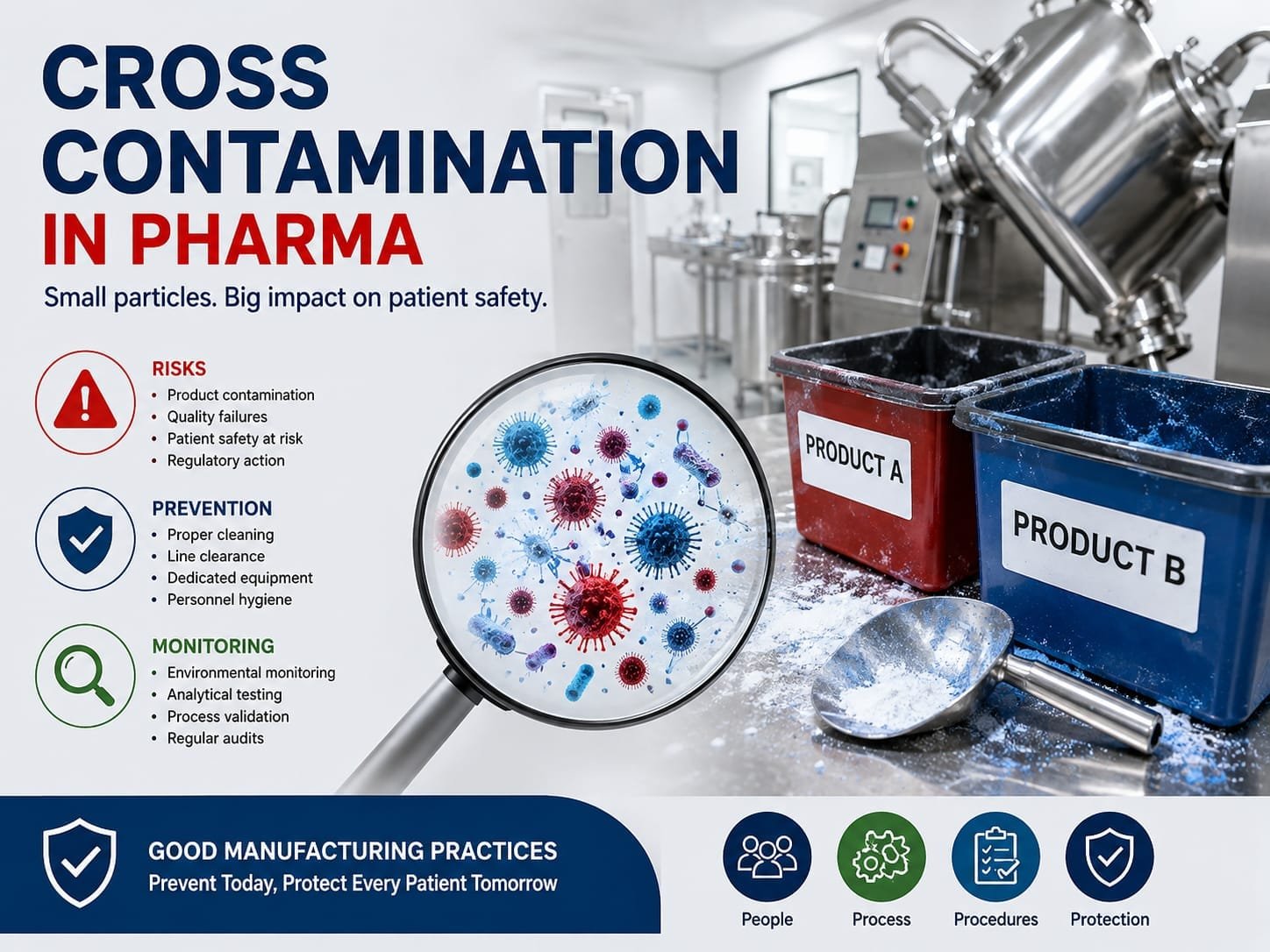
It happens when materials, products, or microbes from one source unintentionally get into another product, room, or equipment.
In pharma, even 1 ppm of the wrong drug can be dangerous. That’s why regulators treat it as a critical GMP failure.
Cross Contamination = Contamination of a starting material, intermediate product, or finished product with another material or product during production.
1. Why Cross Contamination is Critical in Pharma
- Patient Safety: A beta-lactam antibiotic in a non-penicillin product can cause anaphylaxis
- Regulatory: EU GMP Annex 1 Rev 2023, US FDA 21 CFR 211.42, 211.67, WHO TRS 961 Annex 3
- Business Impact: Recall, 483, import ban, brand damage
- Potent Drugs: Hormones, cytotoxics, steroids require dedicated facilities
2. 7 Main Sources of Cross Contamination
- Airborne: Dust from dispensing, fluid bed drying, milling. Carried through HVAC
- Equipment: Residue left in mixer, granulator, tablet press after cleaning
- Personnel: Gowning, gloves, shoes carrying product dust between areas
- Materials: Mix-up of raw materials, wrong labels, open containers in store
- Water: Shared water system between potent and non-potent areas
- Waste: Open dustbins, rejected product not segregated
- Pest/Environmental: Rodents, fungi spores, microbes
3. High-Risk Areas & Products
| Risk Level | Product Type | Control Required |
|---|---|---|
| Critical | Penicillins, Cephalosporins, Cytotoxics, Hormones | Dedicated facility + Dedicated HVAC |
| High | Steroids, Potent APIs, Sensitizing drugs | Closed systems + Campaign + Separate airlocks |
| Medium | General OSD, Liquids | Validated cleaning + Time separation |
4. Prevention Strategies: The 5 Layers of Defense
Layer 1: Facility & Engineering Controls
- Facility zoning: Dispensing, manufacturing, packing in separate areas
- Pressure cascades: Potent area negative pressure
- Dedicated HVAC with HEPA and no recirculation for high-risk products
- Closed processing: Isolators, RABS, contained transfer systems
Layer 2: Equipment Design & Cleaning
- Cleaning Validation: Prove equipment is clean to MACO limit
- Clean Hold Time + Dirty Hold Time studies
- CIP/SIP for liquid lines. Manual cleaning with validated swab/rinse method
- Color-coded tools: Red for potent, Blue for general
Layer 3: Procedures & Human Behavior
- Line clearance by QA before and after production
- Gowning procedures + airlocks + hand wash
- One-way material flow. No backtracking
- Training on contamination control as per Annex 1
Layer 4: Material & Label Control
- Double check of RM labels during dispensing
- Closed containers. No open drums on shop floor
- Waste segregation in closed bags with labeling
Layer 5: Monitoring
- Environmental monitoring: Air, surface, personnel
- Visual inspection under UV/black light for residue
- Trend of complaints, deviations, OOS
5. Cleaning Validation: The Proof That It Works
Cleaning validation is how you prove your cleaning procedure removes contamination to safe levels.
- Select Worst-Case Product: Most difficult to clean + most toxic + lowest batch size
- Calculate MACO: Maximum Allowable Carryover
MACO = (TD x BS x SF) / LDD
TD = Therapeutic Dose, BS = Batch Size, SF = Safety Factor 1/1000, LDD = Largest Daily Dose - Sampling: Swab method for direct contact surfaces. Rinse method for inaccessible areas
- Analytical Method: HPLC, TOC, Conductivity. Must be validated for LOD/LOQ
- Acceptance Criteria: Visual: No residue. Chemical: < MACO. Micro: < Alert limit
6. What to Do If Cross Contamination Occurs
- Immediate Action: Stop production. Quarantine affected batches
- Investigation: Use RCA tools – 5 Why, Fishbone. Check line clearance, cleaning records, HVAC data
- Impact Assessment: Which other products were made on same equipment?
- CAPA: Retraining, SOP revision, facility upgrade, dedicated equipment
- Product Decision: Release, Rework, or Destroy based on risk assessment
7. Common 483 Observations on Cross Contamination
- “No scientific justification for MACO limits”
- “Same equipment used for penicillin and non-penicillin without adequate controls”
- “Cleaning procedure not followed. Dirty hold time exceeded”
- “Air pressure differential not maintained during production”
- “No assessment of carryover risk for multi-product facility”
8. Best Practices for 2026
- Contamination Control Strategy: Mandatory in EU GMP Annex 1. Document all risks and controls
- Quality Risk Management: Use FMEA to rank cross-contamination risks
- Technology: Use barrier tech, closed systems, single-use components
- Culture: “If in doubt, stop and call QA”. Reward near-miss reporting
- Mock Contamination Drill: Test your response like a mock recall
9. FAQs
Q1: Can we manufacture penicillin and general products in same facility?
No. EU and WHO require dedicated and self-contained facility for penicillins, cephalosporins, cytotoxics.
Q2: What is the difference between contamination and cross contamination?
Contamination = any unwanted substance. Cross contamination = contamination from one product/process to another.
Q3: How often should cleaning validation be done?
Initially for all products, then revalidation on change, and periodic review every 1-3 years.
Conclusion
Cross contamination is not just a cleaning issue. It’s a design, procedure, and culture issue.
In 2026, regulators expect you to think like a contaminant. Where can it travel? How can it hide? How will you prove it’s gone?
Invest in facility design, validate your cleaning, train your people, and monitor continuously.
Remember: One particle in the wrong place can cost millions.

About the Author
Mahummed Asif is a experienced pharmaceutical QA professional and publisher of Pharmashare. He has sound knowledge in GMP, Product Life Cycle Management, Regulatory filing, QMS, Product Complaint Management, Change control, risk management, and global audit preparation.