
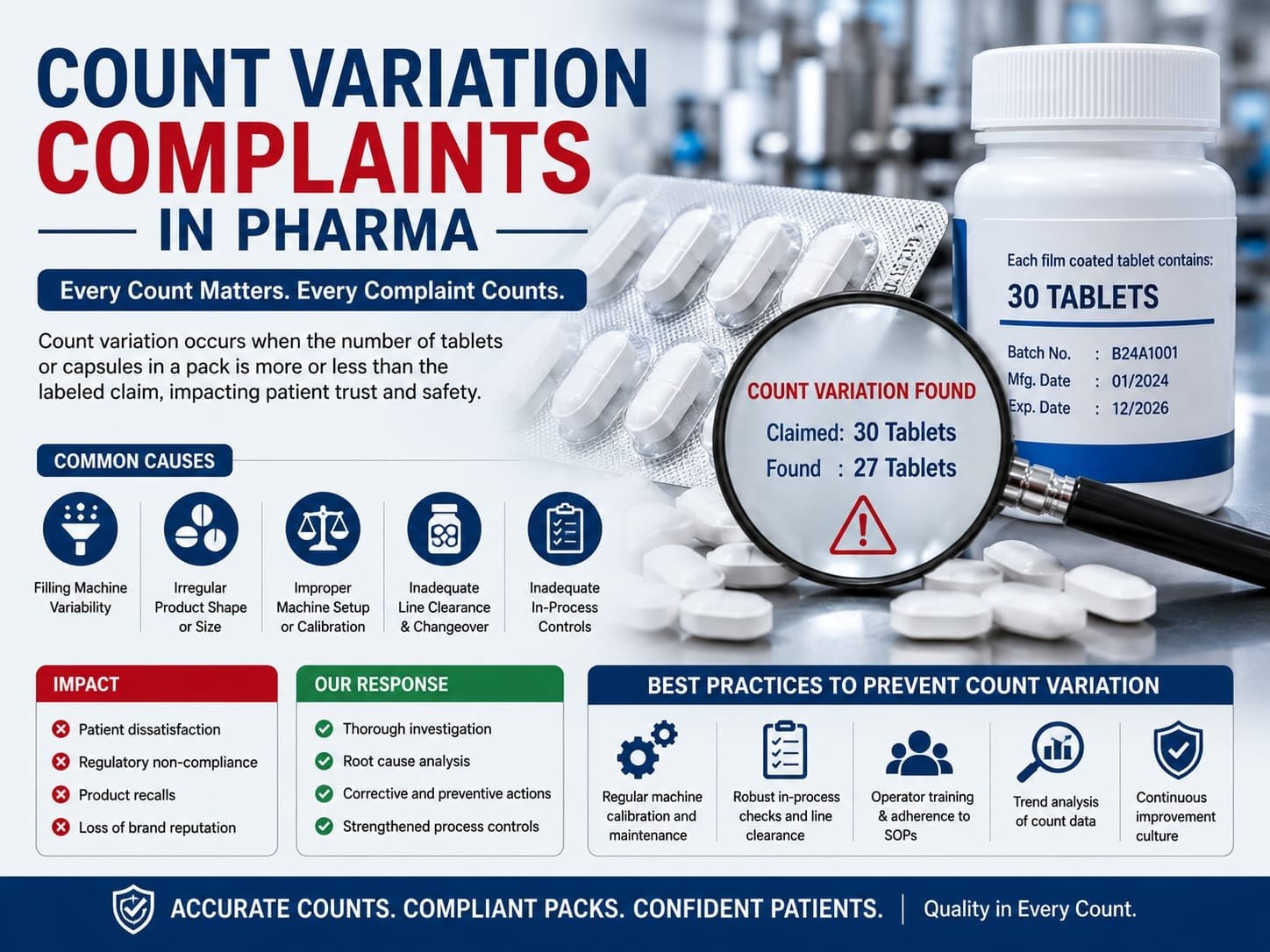
Count Variation Complaints in Pharma: Root Causes, CAPA & Prevention
“Customer received 98 tablets instead of 100”
“This is the 3rd complaint for short fill this month”
Count variation complaints are one of the most common and serious issues in solid dosage bottle packing. They directly impact patient trust, regulatory standing, and cost.
In 2026, with serialization and AI inspection, there is zero tolerance for count errors. Let’s break down why they happen and how to prevent them permanently.
FDA considers count variation as “misbranding” under FD&C Act.
EU GMP Annex 1: Requires 100% verification of fill.
1. What is Count Variation in Bottle Packs?
Count Variation = The number of tablets/capsules in the bottle is different from the declared count on label.
Types:
- Short Fill: 98 tablets instead of 100. Most common complaint.
- Over Fill: 102 tablets instead of 100. Cost + regulatory risk.
- Mixed Count: 100 tablets but 2 are broken/chipped pieces counted as 1.
2. Top 8 Root Causes of Count Variation
Cause 1: Counting Machine Malfunction
Issue: Dust on sensor, faulty photoelectric eye, vibration settings wrong.
Result: Machine skips 2-3 tablets per bottle.
Cause 2: Product Related Issues
Issue: Excessive fines, broken tablets, sticking capsules, static charge.
Result: Tablets don’t fall properly. Chute jamming.
Cause 3: Bottle Related Issues
Issue: Wrong bottle size, neck finish variation, oval bottles.
Result: Bottle not aligned under chute. Partial filling.
Cause 4: Feeding & Singulation Problem
Issue: Vibratory bowl amplitude too high/low. Double feeding.
Result: 2 tablets counted as 1 or 1 tablet missed.
Cause 5: Human Error During Changeover
Issue: Wrong count recipe selected in HMI. Operator forgot to clear previous batch tablets.
Result: 60 count recipe used for 100 count product.
Cause 6: Lack of In-process Checks
Issue: IPC done every 1 hour instead of every 30 min. No checkweigher installed.
Result: 5000 bottles produced with error before detection.
Cause 7: Rejects Rework
Issue: Rejected bottles from previous shift manually refilled without re-counting.
Result: Overfill or underfill goes to market.
Cause 8: Post-Packing Handling
Issue: Bottles dropped during transportation. Cotton/Desiccant absorbed tablets.
Result: Customer receives short count but it happened in distribution.
3. How to Investigate a Count Variation Complaint: 5 Step Approach
- Quarantine & Data Collection
Hold remaining stock of same batch. Collect: Batch record, IPC data, machine log, CCTV footage, complaint sample. - Verify the Complaint
Open complaint bottle in QA. Video record. Count manually 3 times. Check for broken pieces. - Check Retained Samples
Open 20 bottles from retain. If 2/20 are short, it’s a batch issue. If 0/20, it may be isolated. - Review Machine Data
Check L3 data: Was there any “short fill” alarm? Any reject bin activity? Any recipe change during batch? - Conclusion
Classify as: Machine, Material, Method, Man, or Measurement error. This decides CAPA.
4. CAPA for Count Variation Complaints
| Root Cause | Immediate CAPA | Preventive CAPA |
|---|---|---|
| Sensor Dust | Clean and re-qualify machine | Install auto air blow every 30 min. Add PM schedule |
| Wrong Recipe | Hold batch. Retrain operator | Barcode scan for recipe selection. L3 interlock |
| No IPC | Increase IPC frequency | Install inline checkweigher + vision system |
| Rework | Destroy reworked bottles | SOP: Rework must go through counting machine again |
5. Prevention Strategies: Building a Zero-Defect Line
Strategy 1: Technology
- Dual Counting: Primary sensor + Secondary weight check
- AI Vision: Detects broken tablets and rejects before filling
- Inline Checkweigher: 100% weight check. Triggers reject if ±2% deviation
- 360° Inspection: Verifies fill level in bottle
Strategy 2: Process Control
- IPC every 15 minutes for first 1 hour after startup
- Shift-wise reconciliation: Tablets fed vs Bottles filled x Count
- Lock HMI recipe with supervisor password
Strategy 3: People & Training
- Training on “Why 1 tablet matters” – Patient safety angle
- Second person verification for recipe change
- Reward system for zero-complaint months
6. Regulatory & Quality Impact
- FDA 483: “Failure to establish adequate process controls to ensure label claim”
- Recall Classification: Usually Class II. If for critical drug = Class I
- Customer Impact: Loss of trust. Hospital tenders cancelled.
- Cost: 1 recall = $2M to $10M. 1 complaint investigation = $5000
7. KPIs to Monitor
- Count Accuracy %: Target >99.99%
- Complaints per Million Bottles: Target <5 PPM
- IPC Failure Rate: Target 0%
- Reject Bin Reconciliation %: Must be 100%
8. FAQs
Q1: Is 1-2 tablet variation acceptable?
No. Label claim is a legal commitment. Even 99 instead of 100 is a deviation.
Q2: Who owns count variation – Production or QA?
Production owns prevention. QA owns detection and investigation. Both own CAPA.
Q3: Can serialization help?
Yes. Link count data to each SN. If complaint comes, trace exact time, operator, and machine.
9. Conclusion
Count variation is not a “small” complaint. It’s a symptom of a weak process.
You cannot inspect quality into the bottle. You must build it into the counting process.
The formula for 2026 is simple:
Right Machine + Right Process + Right People + Right Data = Zero Count Complaints
Invest in dual checks, train your team, and treat every complaint as a gift to improve.
Remember: The patient is counting on us to count correctly.
This article is for educational purposes only. Always follow your company SOP and latest regulatory guidelines.

About the Author
Mahummed Asif is a experienced pharmaceutical QA professional and publisher of Pharmashare. He has sound knowledge in GMP, Product Life Cycle Management, Regulatory filing, QMS, Product Complaint Management, Change control, risk management, and global audit preparation.
1 thought on “Count Variation Complaints in Pharma”