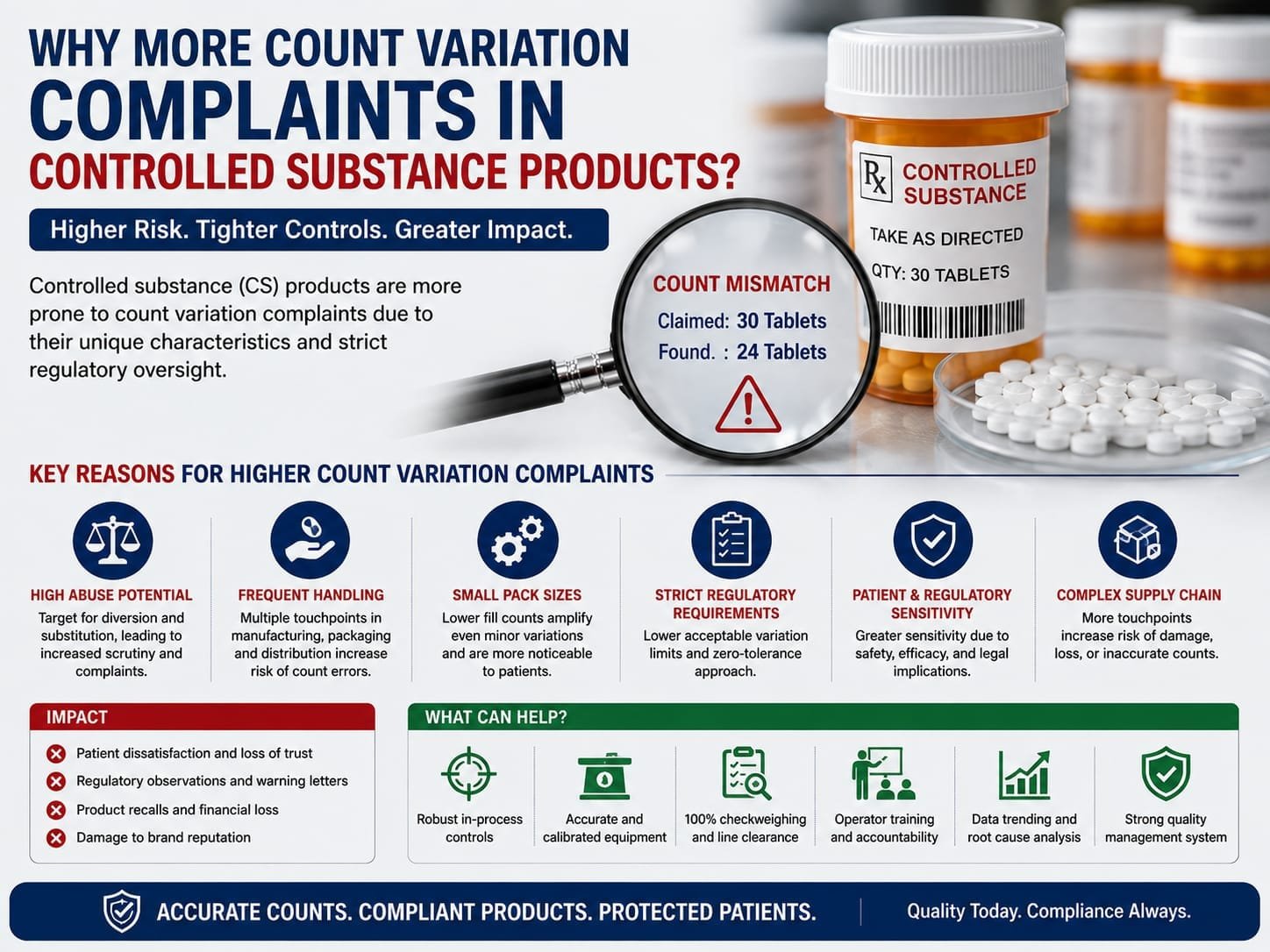
Why More Count Variation Complaints Are Reported in Controlled Substance Products
“Bottle of Alprazolam 1mg – Label claim 100, Received 99”
“Bottle of Tramadol – Short by 1 capsule”
Have you noticed? Count variation complaints are 5x to 10x higher for C-II to C-V products compared to regular tablets.
It’s not because machines are different. It’s because the entire ecosystem around controlled substances is different.
Let’s understand the real reasons, regulatory impact, and how to control it.
For controlled substances, 1 tablet missing = Regulatory violation + Law enforcement issue + Potential diversion case
1. The Core Reason: “Every Tablet is Accounted For”
For normal products, a count of 99 vs 100 is a quality complaint.
For controlled substances, a count of 99 vs 100 is a potential diversion investigation.
Why?
- DEA / CDSCO / Narcotics Bureau mandates 100% accountability from API to patient.
- Every tablet must be traced. “Missing” = “Stolen” until proven otherwise.
- Pharmacies, hospitals, and distributors count Controlled substances manually on receipt. They report even 1 tablet difference.
Result: The same 1-tablet error that goes unnoticed in Paracetamol gets reported immediately in Alprazolam.
2. 7 Reasons Why Count Variation Complaints Are Higher in Controlled Substances
Reason 1: Stricter Receiving & Inventory Checks
Regular Product: Warehouse counts 1 carton, assumes 100 bottles x 100 = 10,000 tablets.
Controlled Substance: Pharmacist opens each bottle and counts 100 tablets physically. Any shortage is documented and reported to manufacturer + regulator.
Reason 2: High Patient & Doctor Sensitivity
Patients on controlled substances track every pill. If they get 29 instead of 30, they call the pharmacy. Pharmacy calls the company.
Motive: Fear of abuse, withdrawal, or running out early.
Reason 3: Packaging Line Complexity
Controlled substances often run in small batches with frequent changeovers. More changeovers = More chance of recipe error.
Also, many Controlled substances are potent and low-dose. 1 extra or less tablet has high clinical impact.
Reason 4: Double Security = Double Handling
Controlled substance lines have: Vault storage, 2-person rule, CCTV, armed guards.
Every time a bin is moved, opened, or reconciled, there is chance of spillage or miscount. Broken tablets are treated as “missing” not waste.
Reason 5: Reconciliation Pressure
At end of batch: API Issued = Tablets Produced + Waste + Samples + Retention
If there is 1 tablet gap, QA cannot close the batch. This triggers deep investigation and often leads to complaint review of past shipments.
Reason 6: Fear of Regulatory Action
If a company gets multiple Controlled substance count complaints, DEA/CDSCO can:
- Suspend manufacturing license
- Increase inspection frequency
- File criminal charges for diversion
So companies and customers report and investigate even minor variations.
Reason 7: Manual Processes Still Exist
Many companies still use semi-auto counters for Controlled substances due to low volumes. Manual filling + manual verification = Higher human error.
3. Regulatory Framework That Makes It Worse
| Regulation | Requirement | Impact on Complaints |
|---|---|---|
| US DEA 21 CFR 1300 | Biennial inventory + Theft/loss reporting | 1 tablet loss must be reported in 24 hrs |
| India NDPS Act + CDSCO | Daily stock register, Form 3/3A | Any mismatch = explanation to inspector |
| DSCSA + EU FMD | Full traceability | SN linked to exact count. Easy to track complaint |
4. How to Investigate a Controlled Substance Count Complaint
Investigation is 3x deeper than regular product.
- Security Check First
Was there any CCTV blind spot? Who had vault access? Any broken seal? - Batch Reconciliation
Check: API issued vs Produced vs Waste vs Samples. Was batch closed with “0” variance? - Machine & IPC Data Review
Download counter log. Check for any “short fill” alarms during batch. - Retained Sample Check
Open 30 bottles from retain. Count manually with 2 QA persons + video. - Distribution Check
Was this the only complaint? Or same lot to other customers?
If root cause is not found = File “Potential Diversion” report to DEA/CDSCO within regulatory timeline.
5. CAPA & Prevention: “Zero Tolerance” Strategy
Strategy 1: Technology Upgrade
- AI Vision Counting: 99.99% accuracy. Detects broken/chipped tablets.
- Weight + Count Dual Verification: Every bottle weighed after filling.
- Serialization at Bottle Level: Link SN to exact count and operator.
Strategy 2: Process Controls
- 2-Person Verification for recipe selection and line clearance.
- IPC every 15 min instead of 1 hour for Controlled substances.
- No Rework Policy: Rejected bottles are destroyed, not refilled.
- Shift Handover Reconciliation: Physical count of hopper + line before handover.
Strategy 3: Culture & Training
- Train staff: “1 tablet = 1 compliance risk”
- Anonymous reporting for spillage or miscount
- Reward zero-variance batches
6. Business & Legal Impact of Count Complaints in Controlled Substances
- Regulatory: Warning letter, Import ban, Manufacturing suspension
- Legal: Investigation by narcotics bureau. Personal liability for QP.
- Commercial: Distributors stop stocking. Hospital contracts cancelled.
- Cost: 1 investigation = $20,000. 1 recall = $5M+
7. FAQs
Q1: Is “overfill” also a problem in Controlled substances?
Yes. Overfill means extra API was used. Reconciliation fails. Treated as potential diversion out.
Q2: Can we set a tolerance like ±1 tablet?
No. Label claim is absolute. Regulators expect 100%.
Q3: Does automation reduce complaints?
Yes. Companies with AI vision counters report 90% fewer Controlled substance count complaints.
8. Conclusion
More count variation complaints are reported in controlled substances not because there are more errors, but because every error is seen, tracked, and reported.
In C-substance manufacturing, you are not just making medicine. You are handling a legally controlled item.
The Rule is Simple:
If you can’t account for 1 tablet, you can’t run a Controlled substance line.
Invest in better counting tech, stricter processes, and a culture of accountability. That’s the only way to stay compliant and complaint-free.
This article is for educational purposes. Always comply with DEA, NDPS Act, CDSCO and your country’s narcotic regulations.

About the Author
Mahummed Asif is a experienced pharmaceutical QA professional and publisher of Pharmashare. He has sound knowledge in GMP, Product Life Cycle Management, Regulatory filing, QMS, Product Complaint Management, Change control, risk management, and global audit preparation.