
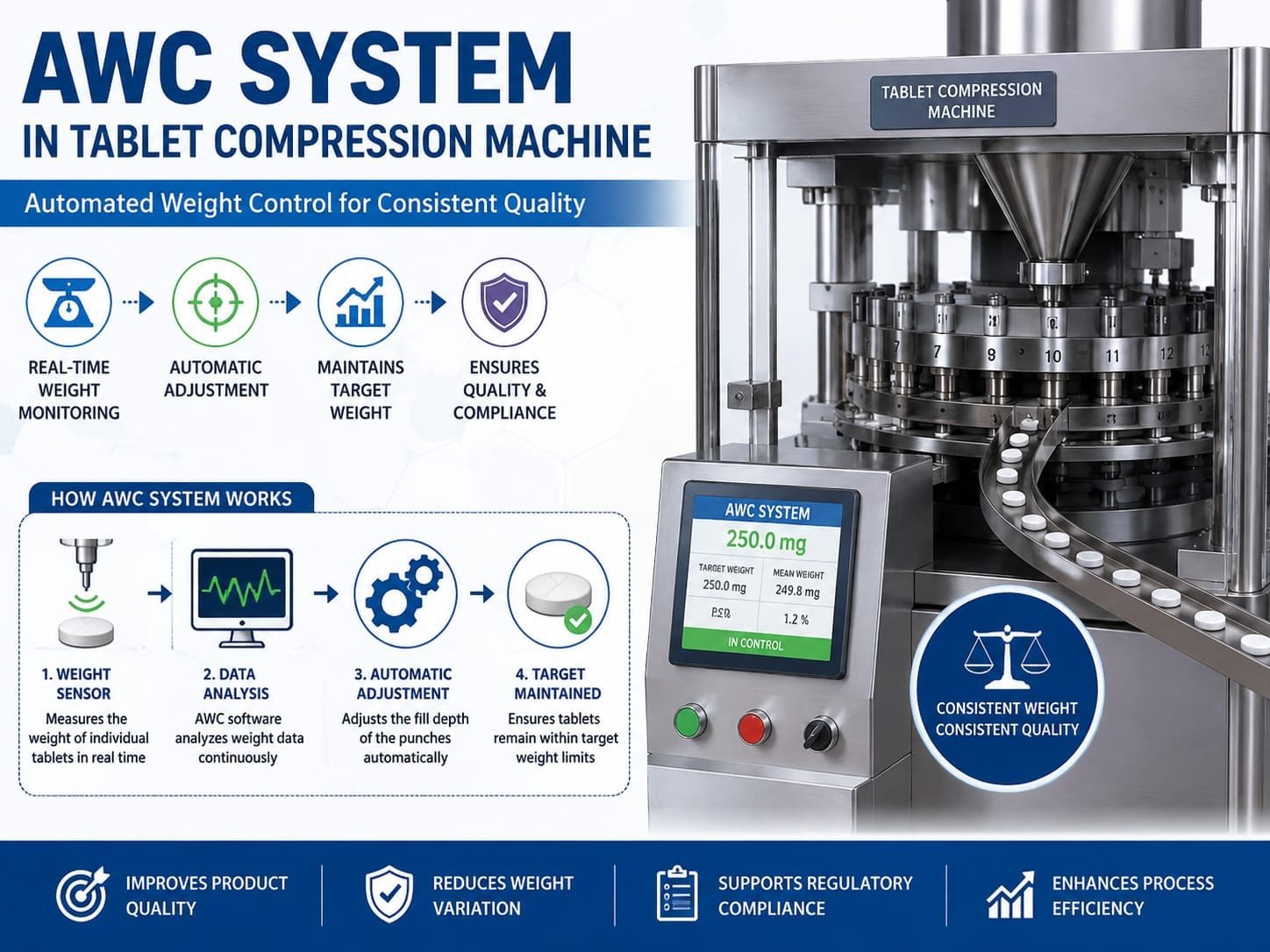
AWC System in Tablet Compression Machine: Principle, Working, Calibration & Troubleshooting
1. What is AWC System in Compression Machine?
AWC = Auto Weight Control / Automatic Weight Control System / Automatic Weight Regulation.
It is a patented feedback control system integrated with rotary tablet compression machines to automatically control individual tablet weight during high-speed compression without stopping the machine.
Without AWC, operator must manually check weight every 15-20 minutes using physical balance and adjust fill cam by handwheel. At 200,000 tablets/hour, even 10 minutes of drift means 30,000 tablets rejected.
With AWC: Machine checks weight every few seconds and auto-corrects in real-time.
2. Why AWC is Needed? Root Causes of Weight Variation
Tablet weight varies due to:
- Flow variation: Granule bulk density changes due to hopper level, humidity, fines
- Die filling inconsistency: Poor flow, rat-holing, paddle speed mismatch
- Punch wear: Lower punch length variation ±0.02mm causes weight change
- Machine vibration: At high RPM, fill cam shifts
- Granule segregation: API-rich fines settle
Regulatory Impact: Weight variation directly leads to Content Uniformity failure (USP <905>). USFDA expects ±5% weight control for >250mg tablet, ±7.5% for <250mg. AWC helps achieve ±2% consistently.
3. Principle & Components of AWC System
AWC works on Closed-Loop Feedback Control Principle: Measure → Compare → Correct.
| Component | Function | Example in Machine |
|---|---|---|
| 1. Weight Sensor / Checkmaster | Measures tablet weight / compression force | Strain gauge load cell, Piezo sensor, Fette Checkmaster 4.0 |
| 2. Amplifier & Controller (PLC) | Compares actual weight with target, calculates deviation | Siemens PLC, Bosch controller |
| 3. Actuator / Compensator | Corrects fill depth automatically | Servo Motor, Air Compensator (pneumatic cylinder), Dosing Cam motor |
| 4. HMI Display | Shows live weight, trend, rejection data, audit trail | 21 CFR Part 11 compliant screen with graph |
| 5. Rejection System | Rejects single tablets out of limit via flap | Compressed air nozzle, diverter flap |
4. How AWC Works – Step-by-Step Process
Step 1 – Sampling: Every 5-10 seconds, AWC diverts 1 tablet (or measures compression force of each tablet) to Checkmaster load cell.
Step 2 – Weighing: Load cell measures weight in mg with 0.1mg accuracy in 50ms. Or measures main compression force which is proportional to weight.
Step 3 – Comparison: PLC compares actual weight vs Target weight (e.g., Target 500mg, Actual 510mg = +2% high).
Step 4 – Calculation: PLC calculates correction needed. Formula: Correction = (Actual – Target) * Gain Factor.
Step 5 – Correction: Servo motor rotates dosing cam or air compensator changes lower punch fill depth by microns. If weight high → reduces fill depth. If weight low → increases fill depth.
Step 6 – Rejection Logic: If weight beyond ±5% (Alert) and ±7.5% (Action), AWC triggers rejection chute and rejects that tablet plus next 2-3 tablets to clear line. Event recorded in audit trail.
Loop Time: Full loop < 2 seconds. So drift corrected before 100 tablets are affected.
5. Types of AWC Systems – Which One to Choose?
A. Force-Based AWC (Indirect)
Principle: Measures main compression force. Higher weight = Higher force.
Pros: No physical sampling, measures 100% tablets, fast, no extra mechanism.
Cons: Affected by granule hardness, not true weight. If granule density changes, force changes even if weight same.
Used in: Fette FE55, Korsch XL 100, Cadmach 1100i
B. Checkmaster Based AWC (Direct – Best)
Principle: Physically diverts tablet to precision balance and weighs it.
Pros: True weight measurement, independent of granule properties, most accurate ±0.5%.
Cons: Sampling only, not 100% check, mechanical wear.
Used in: Fette Checkmaster 4.0, Korsch Checkmaster, Romaco Kilian
Latest 2026 Technology: Hybrid AWC – Uses both force for 100% monitoring + checkmaster for calibration every 30 sec. Best of both.
6. Benefits & Regulatory Compliance
- GMP Compliance: Reduces IPQC frequency, ensures continuous control as per Annex 15
- Yield Improvement: Reduces rejection from 2-3% to <0.5%. At 1 million tablets/day, saves ~$500/day
- Content Uniformity: Weight control = Dose control. Critical for low dose drugs (<5mg)
- 21 CFR Part 11: Modern AWC HMI stores electronic records – Every weight check, every correction, every rejection with time stamp, user ID, old/new value. Audit trail mandatory.
- Unmanned Operation: Machine can run 2-3 hours without operator intervention
7. AWC Calibration & Validation Procedure (IQ/OQ)
1. Zero calibration of load cell – No load → 0.00 mg
2. Span calibration – Use certified 500mg, 1000mg standard weights (Class F1) → Check reading within ±0.5mg
3. Test with 20 standard tablets of known weight → Compare AWC weight vs external analytical balance → Difference NMT 2mg
4. Check rejection – Intentionally set target 500mg, pass 600mg tablet → Must reject
5. Audit trail – Verify entry created with user ID
OQ / PQ:
Challenge at low (300mg), medium (500mg), high (800mg) weight with 3 different granule bulk densities. Prove AWC can bring back weight within ±3% within 3 correction cycles.
8. Troubleshooting – Top 5 AWC Problems & Solutions
| Problem | Root Cause | Solution |
|---|---|---|
| AWC not correcting, weight drifting | Servo motor jam, dosing cam stuck, air pressure low (<4 bar) | Check pneumatic supply, clean dosing cam track, check servo coupling |
| AWC shows erratic weight | Load cell damaged, vibration, granule dust on sensor | Clean with air, isolate machine feet, replace load cell, reduce turret RPM |
| Over-correction / Hunting | Gain factor too high | Reduce Proportional Gain in PLC from 1.5 to 0.8, increase sampling time |
| False rejection high | Limit set too tight, checkmaster timing wrong | Set Alert ±4%, Action ±6%, check photo-sensor alignment for tablet diversion |
| Audit trail not capturing corrections | Software bug, user logged as admin | Update HMI version, ensure unique login, validate per 21 CFR Part 11 |
9. AWC vs Manual Weight Control – ROI Calculation
Without AWC: Operator checks weight every 15 min. 1 hour drift of 3% on 600kg batch = 18kg tablets need rework = $900 loss.
With AWC: Initial cost $25k-40k extra for machine. Payback in 6-8 months via yield + manpower saving + less QC failure. For USFDA plant, AWC is not optional – It’s expected.
Conclusion
AWC system is the heart of modern tablet compression machine. It converts compression from manual art to automatic science. For any plant targeting US/EU market, force-based + checkmaster hybrid AWC with 21 CFR Part 11 audit trail is baseline requirement. Don’t buy a press without it.
Buying Tip: When you ask for quotation for Fette, Korsch, Cadmach, always ask: “Is Checkmaster 4.0 with hybrid AWC and 21 CFR audit trail included?” and “What is correction resolution in microns?” Lower micron = Better control.
⚠️ Disclaimer & Keywords
This blog is for educational purpose. For machine-specific SOP, refer to OEM manual (Fette Compacting, Korsch AG, Cadmach Machinery).

About the Author
Mahummed Asif is a experienced pharmaceutical Quality Assurance professional and publisher of Pharmashare. He has worked with leading Pharmaceutical organizations and has developed extensive expertise in Quality Assurance, deviation management, investigations, CAPA, QMS, Product Life Cycle Management, change control, risk management, validation, product complaints, product recalls, and regulatory compliance. He is passionate about sharing practical pharmaceutical knowledge with professionals, students, and quality practitioners across the industry.