Process Analytical Technology (PAT) Techniques: How to Move From Testing Quality to Building Quality in Real-Time
- What is PAT? FDA Philosophy
- Fundamental Shift – Traditional vs PAT
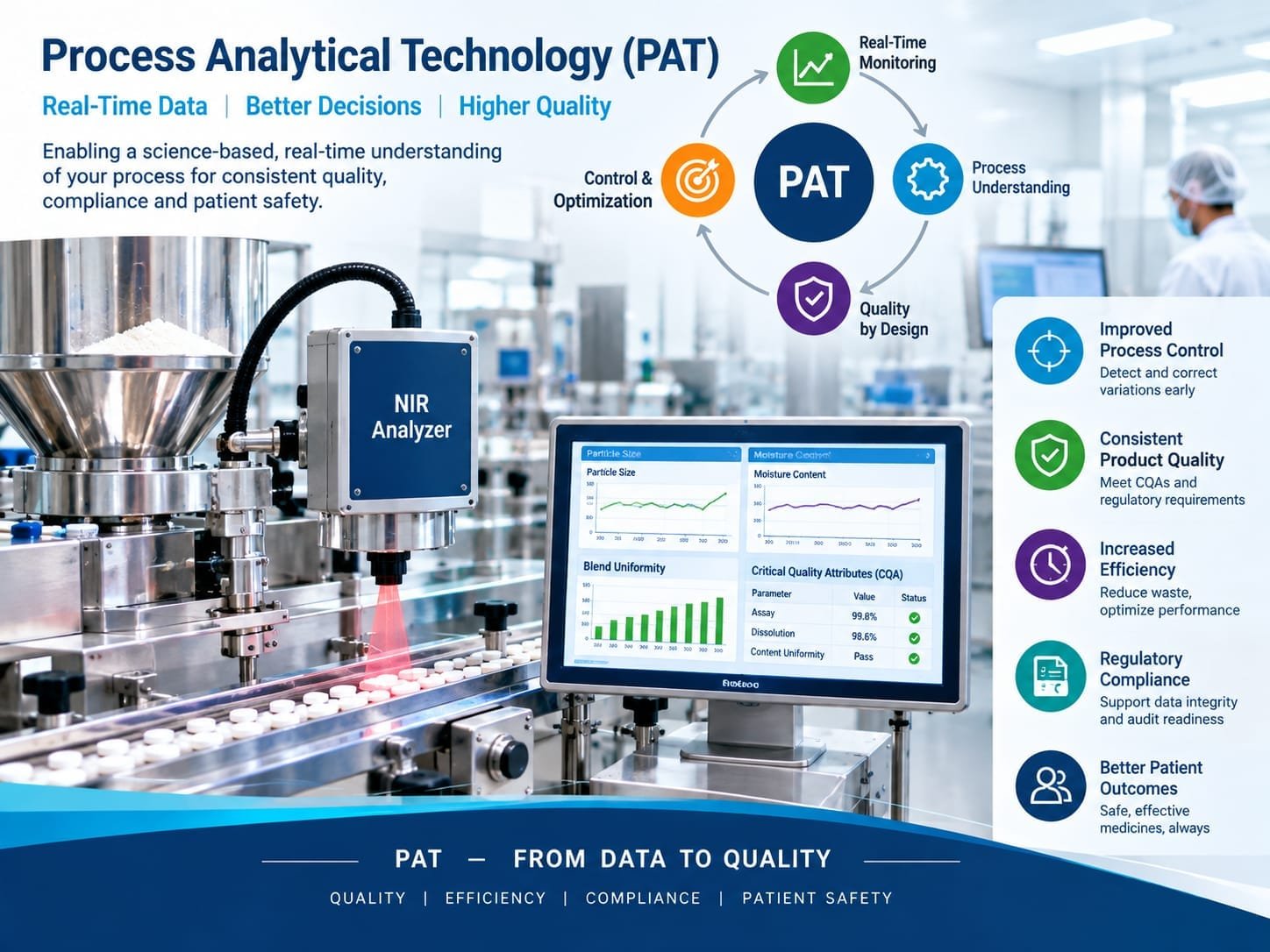
- Goals & Benefits of PAT Framework
- PAT Tools – 4 Categories Explained
- Process Analyzers: At-line, On-line, In-line
- 3 Steps of PAT Implementation
- Real Time Release (RTR) & Continuous Improvement
1. What is Process Analytical Technology (PAT)?
As per FDA Guidance 2004, PAT is defined as:
Note the word analytical in PAT is broad. It includes chemical, physical, microbiological, mathematical, and risk analysis conducted in an integrated manner.
In simple words: PAT is process analysis in real-time. At-line real-time analytical measurements can replace off-line time-consuming chemical analyses. Locating information in those measurements, identifying important process parameters and creating a model able to measure quality instantaneously are the main stakes in PAT.
This is fundamental change in working practices. Traditional QC says make batch -> take sample -> test in lab -> pass/fail. PAT says monitor critical quality attributes (CQAs) all along the process and keep process under multivariate statistical control, so final quality is assured automatically.
2. Philosophy Behind PAT – The Big Shift
FDA’s philosophy is clear: Quality cannot be tested into products; it should be built-in or should be by design.
PAT represents a move away from traditional product-centric measurements to a process-centric focus on quality.
| Traditional Approach | PAT Approach |
|---|---|
| Quality tested at end – Lab testing after batch completion | Quality built in during process – Real-time measurement |
| Fixed process end-point (e.g., blend for 10 mins) | End-point based on desired attribute (e.g., blend until RSD <3%) - Time is flexible within design space |
| Univariate – pH, temperature, pressure only | Multivariate – Chemical, physical, biological attributes together via MVA |
| Discrete specification – Pass/Fail | Process signature comparison against reference – Continuous control |
This process-centric approach may start at early design stages (QbD) so as to have quality built-in. It continues throughout entire lifecycle. Measurement of CQAs along entire process defines Design Space.
3. Goals & Benefits of PAT Framework
As per FDA, desired goal of PAT is to design and develop well-understood processes that consistently ensure predefined quality at end of manufacturing. Gains vary by product, but key benefits are:
Using on-, in-, at-line measurements instead of waiting for lab QC
Detect deviation early, correct via feedback loop
Release batch based on process data, not final lab testing
Reduce human errors, improve operator safety
Continuous processing, flexible use of equipment within design space
Pharma raw materials have physical attributes (particle size, shape) not well understood. PAT helps manage that variability via feed-forward control.
4. PAT Tools – 4 Categories (As per FDA)
FDA categorizes PAT tools into 4 groups. Appropriate combination may be applicable to single unit operation or entire process:
a) Multivariate Tools for Design, Data Acquisition and Analysis
Pharma products and processes are complex multi-factorial systems. Experiments during product and process development serve as building blocks of knowledge.
- Design of Experiments (DOE): To identify optimal formulations and processes
- Multivariate Analysis (MVA): PCA, PLS, MVA models to handle large data – These models show interactions, not just one factor
- Knowledge Management: As knowledge base grows, it can be mined for future projects, process simulation models, reduce development time
These tools help identify Critical Process Parameters (CPPs), potential failure modes, and quantify their effects on CQA.
b) Process Analyzers – Heart of PAT
Earlier we only measured pH, temperature, pressure (univariate). Now PAT analyzers measure chemical and physical attributes in real-time.
| Type | Definition | Pharma Example |
|---|---|---|
| At-line | Sample removed, isolated, analyzed close to process | Rapid at-line NIR for blend uniformity, at-line particle size via Malvern |
| On-line | Sample diverted from process, may be returned | On-line HPLC for reaction monitoring |
| In-line | Sample NOT removed, invasive or non-invasive, real-time | In-line NIR probe in blender, in-line FBRM for crystallization, in-line Raman for granulation |
Popular PAT Analyzers in Pharma:
- NIR (Near Infrared): Most used – Blend uniformity, moisture, assay, content uniformity, coating thickness
- Raman Spectroscopy: Polymorph, API form, blend uniformity, granulation end-point
- FBRM (Focused Beam Reflectance Measurement): Particle size and count during crystallization
- FTIR / Mid-IR: Reaction monitoring, chemical identity
- Laser Diffraction / Imaging: Particle size/shape
- Acoustic / Microwave: Moisture, density
Key Point: PAT measurements need not be absolute values. Ability to measure relative differences (within lot, lot-to-lot, supplier to supplier) is enough for process control. But data must be validated via risk-based approach and mechanistic understanding – simple correlation is not enough.
c) Process Control Tools
Strong link between product design and process development is essential. PAT control strategies should:
- Identify and measure critical material and process attributes relating to product quality
- Design measurement system for real-time monitoring
- Design controls that provide adjustments (feed-forward and feedback loops) to ensure control of all critical attributes
- Develop mathematical relationships between quality attributes and process measurements
Example: If NIR shows blend RSD is 5% at 8 min, but target is <3%, system automatically extends blending for 2 more mins (feedback control). If incoming API particle size is coarse (feed-forward), granulation water addition is adjusted automatically.
Within PAT, process end-point is NOT fixed time. It is achievement of desired material attribute. But process window (acceptable time range) is still evaluated.
d) Continuous Improvement and Knowledge Management Tools
Continuous learning through data collection over lifecycle is important. Data from production batches can justify post-approval changes. IT systems should support knowledge acquisition and secure access for real-time control. Approaches need to evaluate applicability of knowledge in different scenarios (generalization).
5. Three Steps of PAT Implementation – Practical Approach
Situation analysis – Evaluate historical data (spec results, CAPA)
Impact analysis – Identify process steps, sources of variation, variables critical to quality using FMEA, statistical analysis
Develop process models – Define which parts have flexibility (Design Space) and which are rigorous
↓
STEP 2: Monitoring & Controlling
Definition and implementation of relevant measurements (NIR, Raman etc.)
Obtain data for better process understanding and control
↓
STEP 3: Verification of Control Cycle
Verify impact of process parameters on product quality
Complete equipment validation including control cycle – Not just equipment functionality
6. Real Time Release (RTR) – Ultimate Goal of PAT
As per FDA, Real Time Release is ability to evaluate and ensure acceptable quality of in-process and/or final product based on process data.
Typically, PAT component of RTR includes valid combination of assessed material attributes and process controls. Combined process measurements and other test data gathered during manufacturing can serve as basis for real time release and demonstrate batch conforms to regulatory quality attributes.
We consider RTR to be comparable to alternative analytical procedure for final product release. Material attributes as well as process parameters are measured and controlled.
With real-time QA, desired quality ensured through continuous assessment. Data from production batches can serve to validate process and support validation with each batch.
Example: Instead of doing final dissolution test (which takes 12 hours), you have validated in-line NIR for blend uniformity + in-line particle size for granulation + compression force + PAT for coating thickness. If all PAT signatures meet reference, you release batch in real-time – No need to wait for lab dissolution.
7. Impact of PAT on Pharma – What Changes?
| Area | Traditional Impact | PAT Impact |
|---|---|---|
| Specification | Discrete pass/fail | Real-time comparison of process signature against reference – Specification looks different, flexible set values based on design space |
| QC Testing | High QC headcount for lab testing | Parametric release, in-line control reduces lab work but needs additional verification of prerequisites |
| Process Technology | Batch processing, fixed equipment | Continuous production possible, equipment used more flexibly, needs new sensors, better interface between system engineering and product engineering |
| Validation | Test immediate equipment functionality | Validate complete control cycle including analyzer, model, feedback loop |
8. Risk-Based & Integrated Systems Approach
Within established quality system, there is inverse relationship between level of process understanding and risk of producing poor quality product. For well-understood processes, opportunities exist to develop less restrictive regulatory approaches to manage change. So focus on process understanding facilitates risk-based regulatory decisions.
Fast pace of innovation necessitates integrated systems thinking – Development, manufacturing, QA, and IT/knowledge management should be coordinated. Upper management support is critical for PAT success.
Final Words from Me
PAT is not just buying NIR probe. It is fundamental change. It needs QbD mindset, multivariate thinking, risk-based approach, and integrated IT systems.
Start small: Pick one critical unit operation – e.g., blending or drying. Apply at-line NIR, develop simple MVA model, establish correlation with CQA. Show benefit to management. Then scale to on-line and in-line with control loops.
Once PAT is established, you can move towards continuous manufacturing and real-time release – which is future of pharma.
The information provided on this page is for educational and informational purposes only. It is not intended to provide regulatory, legal, or compliance advice.
Pharmaceutical regulations including FDA 21 CFR, EU GMP Annexes, ICH Guidelines, EDQM, WHO, and CDSCO requirements are subject to frequent updates and interpretation by regulatory authorities.
Readers are responsible for ensuring compliance with current applicable laws and regulations in their jurisdiction. PharmaShare does not guarantee the accuracy, completeness, or currentness of this content.
This content does not create a consultant-client relationship. For product-specific regulatory strategy, dossier preparation, or inspection readiness, please consult qualified regulatory professionals or contact us directly.

About the Author
Mahummed Asif is a experienced pharmaceutical Quality Assurance professional and publisher of Pharmashare. He has worked with leading Pharmaceutical organizations and has developed extensive expertise in Quality Assurance, deviation management, investigations, CAPA, QMS, Product Life Cycle Management, change control, risk management, validation, product complaints, product recalls, and regulatory compliance. He is passionate about sharing practical pharmaceutical knowledge with professionals, students, and quality practitioners across the industry.