
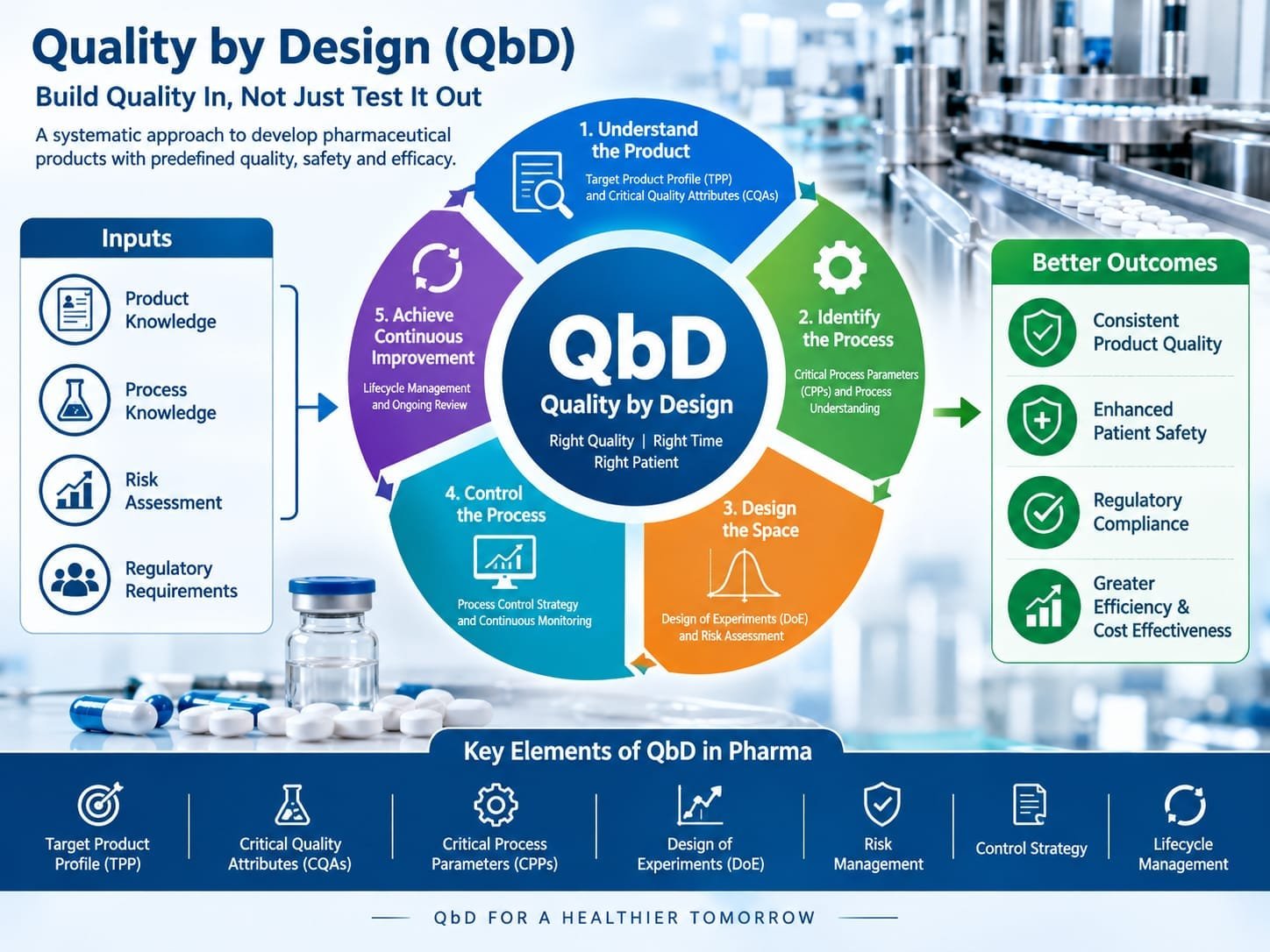
Knowledge of Quality by Design (QbD) in Pharma: From Concept to Design Space & Control Strategy
- What is Quality by Design (QbD)?
- ICH Q8, Q9, Q10 – How They Work Together
- Core Concepts: QTPP, CQA, CPP, CMA, Design Space, Control Strategy
- Traditional vs QbD Approach
- Tools of QbD: DOE, PAT, Risk Assessment
- Challenges in Implementing QbD
- Benefits of QbD
1. What is Quality by Design? – Beyond The Slogan
We have been hearing this line for decades – “You can’t test quality into drug products” – So what’s new in QbD?
QbD is not just a guideline. It’s a culture. It’s a systematic way of thinking.
As per ICH Q8(R2), QbD means:
- It incorporates quality principles along with strong compliance function
- It incorporates risk assessment and risk management from day one
- It refocuses attention on what is important to the customer – the patient, health professionals, payers and distribution chain
- It is a systematic approach to development – begins with predefined objectives
- It emphasizes product and process understanding and process control, based on sound science
- And continuous improvement is hallmark of QbD
In simple words: In traditional approach we make product and then test. In QbD we first decide what quality we want for patient, then design the formulation and process to achieve that quality consistently.
2. ICH Q8, Q9, Q10 – The QbD Trinity
QbD does not work with only one guideline. It needs three guidelines together:
| Guideline | Role in QbD |
|---|---|
| ICH Q8 (R2) – Pharmaceutical Development | Focuses on Module 3.2.P.2 of CTD. It tells us HOW to do development. It introduced concepts of QTPP, CQA, Design Space, Control Strategy. It says development knowledge gained through lifecycle should support design space, specifications and manufacturing controls. Quality cannot be tested, it should be built by design. |
| ICH Q9 – Quality Risk Management | Defines risk and gives systematic approach to risk assessment. What might go wrong? What is probability? What is severity? Tools like FMEA, FMECA, FTA, HACCP, HAZOP, Risk Ranking. Q9 helps us to prioritize what is critical and what is not. |
| ICH Q10 – Pharmaceutical Quality System (PQS) | Based on ISO concepts. It describes model for effective quality system for lifecycle of product. Change control, CAPA, Management Review, Knowledge Management. Q10 ensures that any changes to process within or outside design space are managed properly. |
My Understanding: If Q8 tells us HOW to develop product, Q9 tells us HOW to assess risk, and Q10 tells us HOW to manage that knowledge across lifecycle. If you implement Q8+Q9+Q10 together in holistic manner, you get assurance that patient will always receive product that meets CQA. FDA also said this in 2006 workshop.
3. Overview of QbD – Step by Step Approach
QTPP is summary of quality characteristics that ideally will be achieved considering safety and efficacy. Example: Route of administration, dosage form, strength, bioavailability, stability, container closure. For a tablet – Immediate release, 500mg, oral, stable for 24 months, bioequivalent to innovator.
Step 2: Identify Critical Quality Attributes (CQAs)
CQA is physical, chemical, biological property that should be within appropriate limit to ensure desired product quality. Example: Assay, Content Uniformity, Dissolution, Degradation products. If dissolution fails, bioavailability fails.
Step 3: Identify Critical Material Attributes (CMAs) and Critical Process Parameters (CPPs) and Link to CQAs
Perform risk assessment to link raw material attributes and process parameters to CQAs. Example: API particle size (CMA) affects dissolution (CQA). Granulation kneading time (CPP) affects hardness and dissolution.
Step 4: Develop Design Space via DOE
Design Space is multidimensional combination of input variables (CMAs, CPPs) that provides assurance of quality. Working within design space is NOT considered change. Moving out is change and needs regulatory approval. Developed using Design of Experiments (DOE).
Step 5: Design and Implement Control Strategy
Control Strategy is planned set of controls to ensure process is maintained within Design Space. Includes material controls, process controls (PAT), in-process controls, finished product specifications.
Step 6: Manage Lifecycle – Continuous Improvement
Use knowledge gained during lifecycle for continual improvement – Process validation, trending, CAPA.
4. Traditional vs QbD – Real Difference
| Aspect | Traditional Approach | QbD Approach |
|---|---|---|
| Philosophy | Quality by Testing | Quality by Design – Build in quality |
| Process Understanding | Limited, based on experience | High, scientific, mechanistic understanding |
| Specification | Based on batch data | Based on desired product performance (QTPP) |
| Control Strategy | End product testing | Risk-based, PAT, real-time release (RTR) |
| Regulatory Flexibility | Any change needs submission | Changes within Design Space – No submission needed |
5. Tools Used in QbD – DOE, PAT, Risk Assessment
a) Design of Experiments (DOE)
DOE is most efficient approach for organizing experimental work. It selects diverse and representative set of experiments where all factors are varied simultaneously but independently. Result is causal predictive model showing importance of all factors and interactions.
Benefits: Improved understanding, enhanced efficiency, Right First Time. Studies must have adequate statistical power to measure effects on dissolution, content uniformity etc. We need statistical software (Minitab, JMP, Design-Expert) and statisticians.
b) Design Space
As per ICH Q8: “Multidimensional combination and interaction of input variables (e.g., material attributes) and process parameters that have been demonstrated to provide assurance of quality.”
Determination approaches:
- First principle approach: Combination of experimental data and mechanistic knowledge
- Statistically designed experiments: DOE for impact of multiple parameters
- Scale-up Correlation: Semi-empirical approach to translate operating condition between scales
Important: A combination of proven acceptable ranges (PAR) does NOT constitute Design Space. PAR is univariate. Design Space is multivariate with interactions. Also determining edge of failure is helpful but not essential.
c) Risk Assessment – Per ICH Q9
Risk assessment starts with 3 fundamental questions:
- What might go wrong?
- What is likelihood (probability) it will go wrong?
- What are consequences (severity)?
Steps: Risk Identification → Risk Analysis (Probability x Severity x Detectability) → Risk Evaluation → Risk Control → Risk Review.
Tools: Basic flowcharts, FMEA, FMECA, FTA, HACCP, HAZOP, PHA, Risk Ranking. Degree of rigor should be commensurate with complexity and criticality. Uncertainty due to incomplete knowledge must be considered.
d) Process Analytical Technology (PAT) & Control Strategy
PAT is tool to ensure production remains within Design Space. It allows real-time monitoring – e.g., NIR for blend uniformity, FBRM for particle size. This can lead to Real-Time Release Testing (RTRT) instead of end-product testing.
6. Challenges in QbD Adoption – Why Companies Struggle
Internal Misalignment
R&D sees cost, Manufacturing sees benefit. Horizontal misalignment across org, disconnect between leadership and middle management, culture of conservatism – “Best CMC strategy is not to show all cards”. For some, QbD remains low priority.
Lack of Belief in Business Case
Generics companies feel QbD slows time to file – First to File concept not conducive. Some biologics feel clinical trials needed make business case negative. Others feel QbD won’t change safety/efficacy.
Lack of Technology
Insufficient control for raw material variability – biggest cause of variability. Limited understanding of CQA implications – especially for biologics. Limited knowledge of DOE, PAT techniques and difficulty with huge data management – Need more statisticians.
Regulatory Challenges
Inconsistency across FDA – ONDQA vs OGD understanding different. Lack of tangible guidance – “How to actually do it on ground”. Reviewers not prepared, high turnover. Regulatory benefits not codified – No flexibility yet. Misalignment between international agencies (US vs EU vs Japan).
7. Benefits of QbD – Why We Must Adopt
- Better innovation: Can improve process without resubmission if within Design Space
- More efficient tech transfer to manufacturing – Less batch failures
- Greater regulator confidence – Risk-based, less intense oversight
- Less post-approval submissions and less investigations
- For patient: Greater drug consistency, more availability, less recall
- For industry: Improved yields, lower cost, reduced testing, standardized definitions, best practice sharing globally, improved public image
Critical Success Factors I observed: 1. Alignment across entire operating model – Technical processes, Management system (leadership sponsorship), and Culture & Capabilities. 2. High quality of FDA review and delivery of promised regulatory flexibility.
Conclusion
QbD is not documentation exercise. It is scientific understanding. Start with QTPP, identify CQA, use risk assessment to find CPP/CMA, use DOE to build Design Space, and implement Control Strategy with PAT.
Level of knowledge gained, not volume of data, provides basis for science-based submission. Changes during development should be seen as opportunity to learn.
If you understand ICH Q8, Q9, Q10 together, QbD becomes simple.
The information provided on this page is for educational and informational purposes only. It is not intended to provide regulatory, legal, or compliance advice.
Pharmaceutical regulations including FDA 21 CFR, EU GMP Annexes, ICH Guidelines, EDQM, WHO, and CDSCO requirements are subject to frequent updates and interpretation by regulatory authorities.
Readers are responsible for ensuring compliance with current applicable laws and regulations in their jurisdiction. PharmaShare does not guarantee the accuracy, completeness, or currentness of this content.
This content does not create a consultant-client relationship. For product-specific regulatory strategy, dossier preparation, or inspection readiness, please consult qualified regulatory professionals or contact us directly.

About the Author
Mahummed Asif is a experienced pharmaceutical Quality Assurance professional and publisher of Pharmashare. He has worked with leading Pharmaceutical organizations and has developed extensive expertise in Quality Assurance, deviation management, investigations, CAPA, QMS, Product Life Cycle Management, change control, risk management, validation, product complaints, product recalls, and regulatory compliance. He is passionate about sharing practical pharmaceutical knowledge with professionals, students, and quality practitioners across the industry.