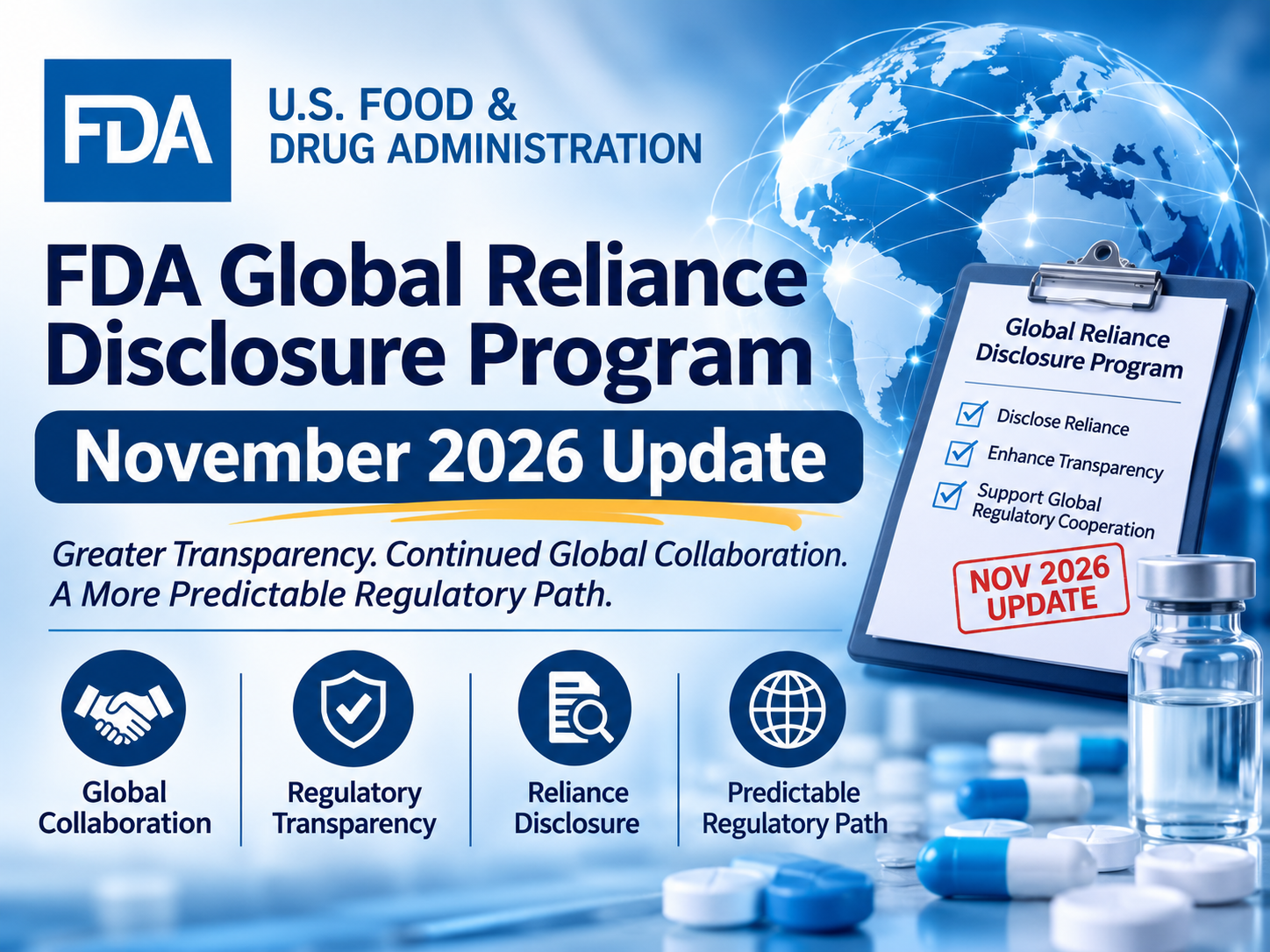
FDA Global Reliance Disclosure Program: November 2026 Update
Last Updated: November 23, 2026
The pharmaceutical regulatory landscape is entering a new phase of international collaboration with the introduction of the FDA Global Reliance Disclosure Program (GRDP).
On November 17, 2026, the U.S. Food and Drug Administration (FDA) announced this important initiative to facilitate the sharing of minimally redacted drug and biologic approval packages with eligible pharmaceutical applicants. These packages contain detailed scientific and regulatory assessments prepared during the FDA review process.
The primary objective is to help regulatory authorities outside the United States access FDA scientific assessments and use them to support their own regulatory evaluations. This approach may reduce duplicated regulatory assessment activities and accelerate access to safe and effective medicines worldwide.
For pharmaceutical companies, this initiative creates new opportunities to leverage FDA regulatory assessments when preparing marketing authorization applications in international markets.
1. What Is the FDA Global Reliance Disclosure Program?
The Global Reliance Disclosure Program is an FDA initiative designed to facilitate international regulatory reliance by allowing eligible pharmaceutical applicants to obtain minimally redacted copies of FDA approval action packages.
An FDA approval action package contains scientific and regulatory documentation associated with the agency’s evaluation of a drug or biological product.
Depending on the application, these documents may include:
- Clinical review assessments.
- Nonclinical review assessments.
- Chemistry, Manufacturing, and Controls (CMC) assessments.
- Clinical pharmacology assessments.
- Statistical review documentation.
- Regulatory and administrative assessments.
- Relevant approval-related documentation.
Under GRDP, eligible applicants can request these packages from the FDA and share them with foreign regulatory authorities in support of marketing authorization applications.
This enables national regulatory authorities to consider the FDA’s scientific assessments while conducting their own regulatory reviews.
Important: GRDP does not automatically grant marketing authorization in other countries. Each foreign regulatory authority retains full authority and responsibility for its own regulatory decisions.
2. Why Did the FDA Introduce GRDP?
One of the major challenges in global pharmaceutical development is the difference in regulatory review timelines across countries.
A medicine may receive FDA approval in the United States, while patients in other countries continue waiting for access because their national regulatory authorities must independently evaluate extensive scientific and technical documentation.
This situation can be particularly challenging for countries with limited regulatory resources and review capacity.
The GRDP is intended to address this challenge by making FDA scientific assessments more accessible to foreign regulatory authorities.
Major objectives of GRDP
- Accelerating patient access: Supporting faster regulatory assessment and availability of medicines in international markets.
- Reducing duplicated assessments: Allowing authorities to consider existing FDA scientific and regulatory evaluations.
- Strengthening regulatory collaboration: Encouraging cooperation between the FDA, pharmaceutical applicants, and international health authorities.
- Supporting global health initiatives: Improving access to important medicines in countries with limited regulatory infrastructure.
- Promoting regulatory reliance: Enabling authorities to use trusted regulatory assessments while maintaining their own decision-making authority.
3. When Was the Program Launched?
The FDA officially announced the Global Reliance Disclosure Program on November 17, 2026. However, the program’s operational launch took place on October 30, 2026.
The first application supported under this initiative was a PEPFAR tentative approval for lenacapavir, a medicine indicated for HIV prevention and treatment.
The initial implementation focuses on eligible PEPFAR-related tentative approvals.
Important implementation dates
| Date | Development |
|---|---|
| October 30, 2026 | Operational launch of GRDP. |
| November 17, 2026 | Official FDA announcement. |
| November 2026 | Initial implementation for eligible PEPFAR tentative approvals. |
| January 2027 | Planned expansion to novel drugs and biologics. |
| Early 2027 | Planned additional pathway for approved and licensed drugs and biologics. |
4. Initial Scope and Eligibility Requirements
As of November 2026, the GRDP is initially available for PEPFAR tentative approvals, excluding tentatively approved Abbreviated New Drug Application (ANDA) products.
PEPFAR stands for the President’s Emergency Plan for AIDS Relief, a U.S. government initiative supporting global efforts to combat HIV/AIDS.
The initial program is particularly relevant to antiretroviral medicines intended to support HIV prevention and treatment programs.
Initial eligibility criteria
| Parameter | GRDP requirement |
|---|---|
| Program | Global Reliance Disclosure Program |
| Initial application category | PEPFAR tentative approvals |
| Exclusion | Tentatively approved ANDA products |
| Package provided | Minimally redacted FDA approval action package |
| Intended use | Submission to a foreign regulatory authority |
| Request timeline | Within 10 calendar days of approval |
| Regulatory decision | Remains with the foreign regulatory authority |
Applicants should carefully review their FDA approval correspondence to determine whether their application qualifies for the program.
5. What Is an FDA Approval Action Package?
An FDA approval action package is a collection of regulatory and scientific records associated with the agency’s review and decision on a drug or biologic application.
These records provide important information about how the FDA evaluated the product’s quality, safety, efficacy, and regulatory compliance.
A. Quality and CMC assessments
- Drug substance evaluation.
- Drug product formulation assessment.
- Manufacturing process evaluation.
- Process validation considerations.
- Specifications and analytical controls.
- Stability data assessment.
- Container closure system evaluation.
- Pharmaceutical quality risk considerations.
B. Nonclinical assessments
- Pharmacology assessment.
- Toxicology evaluation.
- Safety pharmacology.
- Relevant nonclinical study conclusions.
C. Clinical assessments
- Clinical efficacy evaluation.
- Clinical safety assessment.
- Clinical study review.
- Benefit-risk evaluation.
- Statistical assessment.
D. Regulatory assessments
- Regulatory review documentation.
- Application-related assessment records.
- FDA regulatory decision documentation.
- Relevant approval-related correspondence.
The actual contents will depend on the application type and the records associated with the FDA review.
6. What Does Minimally Redacted Mean?
One of the important features of GRDP is the provision of minimally redacted approval packages.
Redaction means removing or concealing certain information from a document before sharing it with another party.
The objective is to provide foreign regulatory authorities with useful scientific and regulatory information while protecting legally confidential information.
According to the FDA, confidential commercial or financial information and trade secrets will not be disclosed in the package. Other types of non-public information will be redacted.
This approach seeks to balance two important requirements:
- Providing sufficient regulatory information to support international regulatory reliance.
- Protecting confidential business information and legally protected information.
For pharmaceutical applicants, this is particularly important because approval packages may contain commercially sensitive manufacturing and product-related information.
7. How Can Pharmaceutical Companies Request an FDA Approval Package?
Eligible applicants must follow the FDA’s specified request procedure.
The request must be submitted within 10 calendar days of the approval date.
Applicants should refer to their FDA approval letter for the applicable instructions and submission details.
Step 1: Confirm application eligibility
Verify whether the application falls within the eligible GRDP category. For the initial implementation, the program covers PEPFAR tentative approvals, excluding tentatively approved ANDA products.
Step 2: Review the FDA approval letter
Check the approval correspondence for information about the Global Reliance Disclosure Program and instructions for requesting the action package.
Step 3: Prepare the request
The request should clearly identify the application and product. The FDA approval-letter instructions specify the following information:
- Application number.
- Product name.
- Name and contact details of the person who should receive the action package.
- Confirmation that the package will be submitted to a foreign regulatory authority in support of a marketing application.
Step 4: Submit within the specified timeline
The applicant must submit the request within 10 calendar days of the approval date to receive prioritized processing under the program.
Step 5: Receive the approval package
The FDA intends to provide eligible minimally redacted action packages on an expedited basis.
Step 6: Submit the package to the foreign regulatory authority
The pharmaceutical applicant can share the received package with the relevant foreign regulatory authority to support its marketing authorization application.
Important regulatory consideration: Requests for approval packages for purposes other than submission to a foreign regulatory authority in support of a marketing application, or requests submitted after the 10-calendar-day period, will not be processed on a prioritized basis under GRDP. Such requests should be submitted through the applicable Freedom of Information Act (FOIA) process.
8. Planned Expansion of GRDP in January 2027
The FDA has indicated that the program will be expanded in January 2027.
This is an important development because the initial implementation is limited to eligible PEPFAR tentative approvals.
A. Novel Drug Applications (NDAs)
The program is expected to include New Molecular Entity (NME) New Drug Applications.
These applications represent innovative drug products containing new active molecular entities.
B. Biological License Applications (BLAs)
The program is also expected to include original Biologics License Applications submitted under Section 351(a) of the Public Health Service Act.
This expansion will extend the program beyond the initial PEPFAR-related implementation.
Expected impact
The expansion may provide pharmaceutical companies developing innovative medicines and biological products with additional opportunities to use FDA scientific assessments when pursuing international marketing authorization.
However, companies should distinguish between the announced expansion plan and the operational eligibility criteria in force at the time of their application.
9. Additional FDA Pathway Planned for Early 2027
In addition to the January 2027 expansion, the FDA intends to introduce another pathway in early 2027.
This pathway is expected to facilitate applicants’ requests for minimally redacted approval action packages for drugs and biologics that have already received FDA approval or licensure.
The objective is to support international access to products that are already available in the United States.
This is particularly relevant for pharmaceutical companies seeking to expand their products into additional international markets after receiving FDA approval.
The detailed operational requirements and implementation procedures for this additional pathway should be confirmed when the FDA publishes further information.
10. Difference Between GRDP and Traditional Regulatory Reliance
Regulatory reliance is not a new concept in the pharmaceutical industry. Several international regulatory systems already use assessments, decisions, and scientific evaluations performed by trusted regulatory authorities.
However, GRDP introduces a specific mechanism for sharing minimally redacted FDA approval packages with eligible applicants.
| Parameter | Traditional regulatory reliance | FDA GRDP |
|---|---|---|
| Basic concept | Use of assessments or decisions from another regulatory authority. | Sharing FDA approval action packages. |
| Regulatory information | Depends on the applicable reliance framework. | Minimally redacted FDA action package. |
| Applicant involvement | Depends on local regulatory requirements. | Applicant requests and receives the package. |
| Foreign authority role | Retains regulatory decision-making authority. | Retains regulatory decision-making authority. |
| Initial scope | Depends on individual framework. | Eligible PEPFAR tentative approvals. |
| Future scope | Depends on the applicable framework. | Planned expansion to NME NDAs and 351(a) BLAs. |
GRDP should therefore be viewed as a mechanism supporting regulatory reliance rather than a replacement for national marketing authorization procedures.
11. Benefits of GRDP for Pharmaceutical Companies
1. Improved international regulatory submissions
Access to FDA scientific and regulatory assessments may help companies prepare more comprehensive regulatory submissions in other countries.
2. Reduced duplication of scientific assessments
Foreign regulatory authorities may be able to use FDA review documentation to support their own evaluations, potentially reducing repetitive review activities.
3. Better understanding of regulatory expectations
The detailed FDA assessment can help applicants understand the scientific and regulatory considerations behind the FDA’s decision.
4. Potentially faster market access
By facilitating regulatory reliance, the program may contribute to shorter review timelines in certain markets. Actual timelines will continue to depend on the foreign authority’s requirements and review procedures.
5. Support for global product expansion
Pharmaceutical companies may be able to use the FDA approval package to support applications in multiple international markets.
12. Impact on Pharmaceutical Quality Assurance and Regulatory Affairs
The introduction of GRDP has important implications for pharmaceutical Quality Assurance, Regulatory Affairs, CMC, and global regulatory teams.
Although the program is primarily a regulatory disclosure initiative, its implementation requires effective coordination across different pharmaceutical functions.
Regulatory Affairs
- Identify applications eligible for GRDP.
- Monitor FDA approval letters and regulatory communications.
- Track the 10-calendar-day request deadline.
- Coordinate approval package requests.
- Identify foreign regulatory authorities where the package will be submitted.
- Ensure consistency between FDA-approved information and international submissions.
Quality Assurance
- Ensure consistency of product quality information across regulatory submissions.
- Review relevant manufacturing and quality documentation.
- Maintain appropriate document control.
- Support the management of confidential information.
- Coordinate responses to regulatory questions where required.
CMC and Manufacturing
- Review relevant manufacturing and analytical information.
- Ensure consistency of manufacturing site details.
- Support product specifications and stability information.
- Maintain alignment between approved manufacturing processes and international submissions.
Global Regulatory Teams
- Identify potential markets for regulatory reliance.
- Understand local regulatory submission requirements.
- Coordinate with regional regulatory authorities.
- Track differences between FDA-approved information and local requirements.
13. Important Considerations for Pharmaceutical Companies
Although GRDP provides an important opportunity, pharmaceutical companies should consider several points before participating.
- Eligibility must be confirmed: Not every FDA-approved drug or biologic is automatically eligible under the initial program.
- The 10-day deadline is critical: Companies should establish an internal process to identify eligible applications immediately after FDA approval.
- Confidential information must be protected: Applicants should understand the FDA’s redaction approach and ensure that the received package is handled appropriately.
- Local regulatory requirements remain applicable: The foreign regulatory authority may request additional documents, country-specific information, or supplementary studies.
- FDA approval does not guarantee foreign approval: Each national regulatory authority retains its independent regulatory decision-making authority.
- Monitor future FDA announcements: The January 2027 expansion and additional pathway planned for early 2027 may introduce further eligibility criteria and operational requirements.
14. Practical Action Plan for Pharmaceutical Regulatory Teams
Pharmaceutical companies can begin preparing for GRDP implementation through the following activities:
| Activity | Recommended action |
|---|---|
| Regulatory monitoring | Monitor FDA announcements and approval letters. |
| Eligibility assessment | Identify applications meeting GRDP criteria. |
| Timeline management | Establish a 10-calendar-day deadline tracker. |
| Internal coordination | Align Regulatory Affairs, QA, CMC and Global Regulatory teams. |
| Document management | Establish controlled handling of approval packages. |
| Market assessment | Identify relevant foreign regulatory authorities. |
| Submission planning | Assess country-specific marketing authorization requirements. |
| Regulatory updates | Monitor the planned 2027 expansion. |
An internal GRDP procedure or work instruction may also be useful for companies with multiple international regulatory submissions.
15. Frequently Asked Questions (FAQs)
Q1. What is the FDA Global Reliance Disclosure Program?
The FDA Global Reliance Disclosure Program is an initiative that enables eligible pharmaceutical applicants to obtain minimally redacted FDA approval action packages and share them with foreign regulatory authorities to support marketing authorization applications.
Q2. When was GRDP announced?
The FDA officially announced the program on November 17, 2026. Its operational launch took place on October 30, 2026.
Q3. Which products are initially eligible?
The initial scope covers PEPFAR tentative approvals, excluding tentatively approved ANDA products.
Q4. What is the deadline for requesting the FDA approval package?
Eligible applicants must request participation within 10 calendar days of the approval date to receive prioritized processing under the program.
Q5. What information should be included in the request?
The request should include the application number, product name, recipient contact details, and confirmation that the package will be submitted to a foreign regulatory authority in support of a marketing application.
Q6. Does GRDP provide complete unredacted FDA approval packages?
No. The program provides minimally redacted approval packages. Confidential commercial or financial information and trade secrets will not be disclosed, and other types of non-public information will be redacted.
Q7. Will foreign regulatory authorities automatically approve products under GRDP?
No. Foreign regulatory authorities retain their independent decision-making authority and must follow their respective national regulatory requirements.
Q8. Will the program be expanded in 2027?
Yes. The FDA intends to expand the program in January 2027 to include NME NDAs and 351(a) BLAs. An additional pathway for approved and licensed drugs and biologics is also planned for early 2027.
Q9. Can pharmaceutical companies request approval packages for purposes other than foreign marketing authorization?
Requests for other purposes are not processed under the prioritized GRDP pathway. Applicants should use the applicable FOIA process.
Q10. What is the significance of GRDP for the global pharmaceutical industry?
The initiative may facilitate international regulatory reliance, reduce duplication of scientific assessments, improve regulatory collaboration, and support faster patient access to safe and effective medicines.
16. Conclusion
The FDA Global Reliance Disclosure Program represents an important development in international pharmaceutical regulation.
By enabling eligible applicants to obtain minimally redacted FDA approval action packages, the initiative provides an opportunity for foreign regulatory authorities to access detailed scientific and regulatory assessments and use them to support their own marketing authorization reviews.
The initial implementation focuses on eligible PEPFAR tentative approvals, while the planned expansion in January 2027 is expected to include NME NDAs and 351(a) BLAs.
For pharmaceutical companies, particularly Regulatory Affairs, Quality Assurance, CMC, and Global Regulatory teams, understanding the program’s eligibility criteria, request timelines, and documentation requirements will be important.
As the program evolves, it may become a valuable mechanism for strengthening international regulatory collaboration and facilitating timely access to quality medicines worldwide.
Stay updated with PharmaShare.in for the latest pharmaceutical regulatory developments, FDA updates, GMP requirements, Quality Assurance practices, and global pharmaceutical industry news.
References
- FDA – Launches the Global Reliance Disclosure Program to Expand Patient Access to Medicines Worldwide, November 17, 2026.
- FDA approval correspondence – Global Reliance Disclosure Program request requirements.
Disclaimer: This article is intended for educational and informational purposes for pharmaceutical industry professionals. Readers should refer to the latest official FDA announcements, approval letters, and applicable regulatory requirements before making regulatory or business decisions. Future implementation dates and program eligibility may be subject to FDA updates.

About the Author
Mahummed Asif is a experienced pharmaceutical Quality Assurance professional and publisher of Pharmashare. He has worked with leading Pharmaceutical organizations and has developed extensive expertise in Quality Assurance, deviation management, investigations, CAPA, QMS, Product Life Cycle Management, change control, risk management, validation, product complaints, product recalls, and regulatory compliance. He is passionate about sharing practical pharmaceutical knowledge with professionals, students, and quality practitioners across the industry.