Recent Changes in ICH Guidelines (2025–2026): Latest Regulatory Updates and Their Impact on the Pharmaceutical Industry
Last Updated: 22 November 2026
The International Council for Harmonisation of Technical Requirements for Pharmaceuticals for Human Use (ICH) plays a significant role in harmonising pharmaceutical regulatory requirements across the world. ICH guidelines provide internationally accepted scientific and technical standards for the development, manufacturing, quality control, safety evaluation and registration of pharmaceutical products.
With continuous advancements in pharmaceutical technology, clinical research, data science, manufacturing processes and regulatory expectations, ICH regularly develops new guidelines and revises existing guidelines to address emerging challenges.
During 2025 and 2026, several important developments have taken place across ICH Quality, Safety, Efficacy and Multidisciplinary guidelines. These include the revision of Good Clinical Practice requirements, developments in stability testing, model-informed drug development, bioequivalence, pharmacovigilance and electronic regulatory submissions.
This article provides an overview of the most important recent changes in ICH guidelines, their current regulatory status and their practical implications for pharmaceutical companies, particularly Quality Assurance (QA), Quality Control (QC), Regulatory Affairs, Research and Development (R&D) and manufacturing departments.
1. What Are ICH Guidelines?
ICH stands for the International Council for Harmonisation of Technical Requirements for Pharmaceuticals for Human Use.
ICH was established to promote harmonisation of technical requirements for pharmaceutical product registration among regulatory authorities and pharmaceutical industry representatives.
The primary objective is to ensure that safe, effective and high-quality medicines are developed and made available to patients while reducing unnecessary duplication of regulatory requirements.
ICH guidelines are classified into four major categories:
| Category | Description | Examples |
|---|---|---|
| Quality (Q) | Pharmaceutical quality, manufacturing, stability, impurities and quality management. | Q1, Q2, Q3, Q7, Q8, Q9, Q10, Q12, Q13 |
| Safety (S) | Nonclinical safety and toxicological evaluation of pharmaceutical products. | S1, S2, S5, S7, S9, S10, S11, S13 |
| Efficacy (E) | Clinical trials, good clinical practice, clinical safety and efficacy evaluation. | E2, E6, E8, E11, E14 |
| Multidisciplinary (M) | Guidelines covering multiple scientific and regulatory disciplines. | M4, M7, M8, M12, M13, M14, M15 |
2. Important Recent Changes in ICH Guidelines (2025–2026)
The following table summarises important guideline developments that pharmaceutical professionals should monitor.
| ICH Guideline | Subject | Recent Development |
|---|---|---|
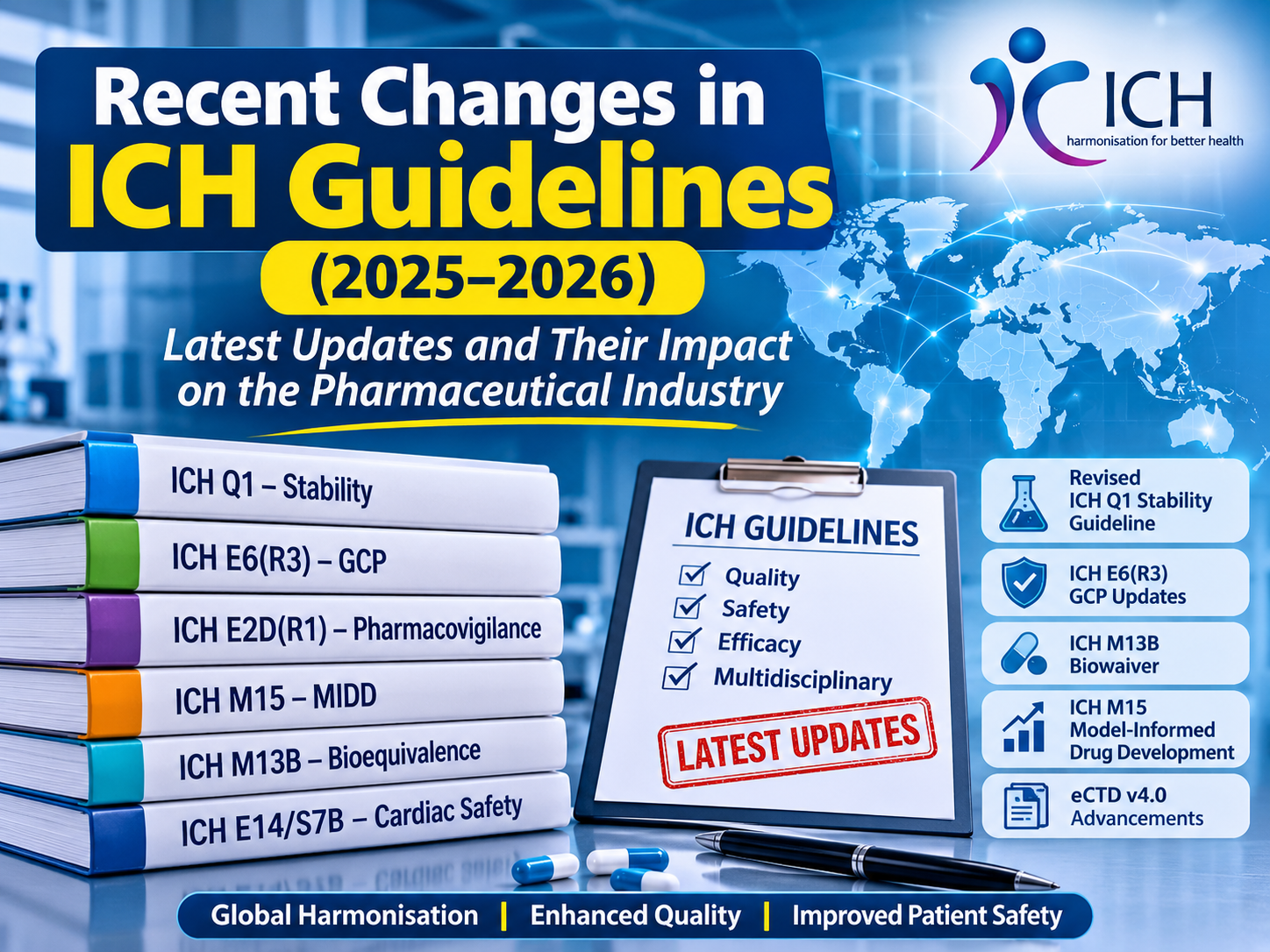
| ICH Q1 | Stability Testing | Revised consolidated guideline adopted in November 2026; publication pending. |
| ICH E6(R3) | Good Clinical Practice | Principles and Annex 1 adopted in January 2025; Annex 2 adopted in June 2026. |
| ICH E2D(R1) | Post-Approval Safety Data | Revised guideline implemented in the EU from March 2026. |
| ICH M15 | Model-Informed Drug Development | Final Step 4 guideline adopted in January 2026. |
| ICH M13B | Bioequivalence | Additional strengths biowaiver guideline advanced to final adoption in 2026. |
| ICH E14/S7B Q&A (R1) | QT/QTc Assessment | Updated Questions and Answers published in September 2026. |
| ICH eCTD v4.0 | Electronic Regulatory Submissions | Implementation Guide v1.7 and controlled vocabulary package v1.0.3 endorsed in June 2026. |
| ICH S13 | Oligonucleotide Therapeutics | Draft guideline released for public consultation in November 2026. |
3. ICH Q1: Major Developments in Stability Testing Guidelines
One of the most significant developments for pharmaceutical manufacturers in November 2026 is the adoption of the revised consolidated ICH Q1 stability testing guideline.
The existing ICH stability guidance consists of several individual guidelines addressing different aspects of stability testing. These include:
- ICH Q1A(R2): Stability Testing of New Drug Substances and Products.
- ICH Q1B: Photostability Testing of New Drug Substances and Products.
- ICH Q1C: Stability Testing for New Dosage Forms.
- ICH Q1D: Bracketing and Matrixing Designs for Stability Testing.
- ICH Q1E: Evaluation of Stability Data.
- ICH Q1F: Stability Data for Climatic Zones III and IV.
The new consolidated guideline is intended to replace the existing Q1A–Q1F series and ICH Q5 stability-related guidance.
What is the significance of the revised ICH Q1 guideline?
The consolidated approach is intended to provide a more integrated framework for stability assessment throughout pharmaceutical product development and lifecycle management.
Areas of interest for pharmaceutical companies include:
- Stability study design and scientific justification.
- Selection of stability batches.
- Long-term, intermediate and accelerated stability studies.
- Photostability assessment.
- Bracketing and matrixing study designs.
- Evaluation and statistical interpretation of stability data.
- Stability considerations for different dosage forms.
- Lifecycle management of stability protocols and specifications.
Important regulatory status: The ICH Assembly adopted the revised Q1 guideline in November 2026. As of 22 November 2026, publication was still expected in the coming weeks. Therefore, companies should monitor the official ICH publication and subsequent regional implementation dates before changing approved stability procedures.
Impact on pharmaceutical QA and QC
After publication and applicable regional implementation, pharmaceutical companies should evaluate the impact on:
- Stability protocols and stability master plans.
- Stability-indicating analytical procedures.
- Stability specifications and acceptance criteria.
- Stability chambers and environmental monitoring.
- Ongoing stability programmes.
- Stability data trending and evaluation.
- Product quality reviews and regulatory commitments.
QA should coordinate a documented gap assessment to identify changes required in existing stability-related SOPs, protocols and quality systems.
4. ICH E6(R3): Revised Good Clinical Practice Guidelines
ICH E6(R3) is one of the most important recent revisions in the ICH Efficacy guideline series.
The guideline replaces the previous ICH E6(R2) framework and modernises Good Clinical Practice (GCP) requirements to address changes in clinical trial design, digital technologies, data management and risk-based clinical trial oversight.
Important developments
- The ICH E6(R3) Principles and Annex 1 were adopted at Step 4 in January 2025.
- The Principles and Annex 1 became effective in the European Union on 23 July 2025.
- Annex 2 was adopted at Step 4 on 3 June 2026.
- Annex 2 addresses additional considerations for different clinical trial designs and data sources.
Key areas covered under ICH E6(R3)
- Quality by Design (QbD) in clinical trials.
- Risk-based quality management.
- Critical-to-quality factors.
- Data governance and data integrity.
- Digital health technologies.
- Decentralised clinical trial elements.
- Pragmatic clinical trials.
- Use of real-world data where appropriate.
- Essential records and documentation.
- Responsibilities of sponsors and investigators.
What is Annex 2 of ICH E6(R3)?
Annex 2 provides additional GCP considerations for clinical trials incorporating innovative designs and data sources.
These include:
- Decentralised clinical trial elements.
- Pragmatic clinical trial elements.
- Clinical trials using real-world data sources.
- Other innovative clinical trial approaches covered by the guideline.
Annex 2 should be read together with the ICH E6(R3) Principles and Annex 1.
Implementation note: In the EU, Annex 2 is scheduled to become effective on 15 January 2027. Other ICH regions may follow their respective regional implementation procedures.
5. ICH E2D(R1): Post-Approval Safety Data Management
ICH E2D(R1) is an important revision concerning post-approval safety data management and the reporting of Individual Case Safety Reports (ICSRs).
Pharmaceutical companies are required to maintain effective pharmacovigilance systems to identify, evaluate, document and report adverse events associated with marketed medicinal products.
Key areas addressed by ICH E2D(R1)
- Definitions and standards for post-approval safety data.
- Management of individual case safety reports.
- Safety information from organised data collection systems.
- Reports originating from patient support programmes.
- Reports from market research programmes.
- Safety data collected through digital platforms.
- Alignment with relevant ICH E2B(R3) data specifications.
Implementation in the European Union
The revised ICH E2D(R1) guideline became effective in the EU on 18 March 2026.
Companies should review their pharmacovigilance SOPs, safety database configurations, case processing workflows, reporting procedures and training programmes to ensure alignment with applicable regional requirements.
6. ICH M15: General Principles for Model-Informed Drug Development
ICH M15 is a significant multidisciplinary guideline that provides general principles for Model-Informed Drug Development (MIDD).
Model-informed drug development uses mathematical, statistical, computational and pharmacological models to support drug development decisions.
These models can help pharmaceutical companies understand drug behaviour, predict clinical outcomes, optimise dosing strategies and support regulatory decision-making.
Important aspects of ICH M15
- Planning model-informed drug development activities.
- Defining the question of interest and context of use.
- Assessing model risk and model impact.
- Evaluating model performance and suitability.
- Model verification and validation.
- Assessment of model applicability.
- Documentation of model analysis.
- Presentation of model-informed evidence in regulatory submissions.
ICH M15 reached Step 4 adoption on 29 January 2026.
Importance for pharmaceutical companies
ICH M15 encourages a structured and scientifically justified approach to using modelling and simulation in pharmaceutical development.
It is particularly relevant to clinical pharmacology, pharmacokinetics, pharmacodynamics, dose selection, exposure-response analysis and regulatory submissions.
7. ICH M13B: Additional Strengths Biowaiver
ICH M13 is a guideline series addressing bioequivalence requirements for immediate-release solid oral dosage forms.
ICH M13A established harmonised recommendations for bioequivalence studies involving immediate-release solid oral dosage forms.
ICH M13B extends this work by addressing additional-strength biowaivers.
What is an additional-strength biowaiver?
An additional-strength biowaiver is a regulatory approach that may allow certain additional strengths of a pharmaceutical product to be approved without conducting a separate in vivo bioequivalence study for every strength, provided the applicable scientific and regulatory criteria are satisfied.
Important considerations
- Proportionality of formulation composition.
- Drug substance solubility and permeability considerations, where applicable.
- Comparative dissolution profiles.
- Manufacturing process consistency.
- Appropriate justification of formulation differences.
- Compliance with applicable regulatory acceptance criteria.
M13B progressed to final adoption during 2026. Pharmaceutical companies developing multiple strengths of immediate-release oral products should evaluate the guideline and the applicable regional implementation requirements before relying on an additional-strength biowaiver.
8. ICH E14/S7B Q&A (R1): Updated Cardiac Safety Assessment
ICH E14 and ICH S7B address the evaluation of the potential effects of pharmaceutical products on cardiac repolarisation and proarrhythmic risk.
These guidelines are important for evaluating the potential risk of QT/QTc interval prolongation and associated cardiac safety concerns during drug development.
In September 2026, ICH published revised Questions and Answers (R1) for E14 and S7B.
Why is this update important?
The updated Q&A provides additional clarification for the clinical and nonclinical assessment of QT/QTc prolongation and proarrhythmic potential.
It supports a more consistent scientific approach to integrating nonclinical and clinical evidence when evaluating cardiac safety risks.
Pharmaceutical R&D, clinical pharmacology and regulatory teams should review the revised Q&A when designing or evaluating cardiac safety assessment strategies.
9. ICH eCTD v4.0: Electronic Regulatory Submission Updates
The electronic Common Technical Document (eCTD) provides a harmonised structure for submitting regulatory information electronically to health authorities.
ICH eCTD v4.0 is an important development in the modernisation of electronic regulatory submissions.
In June 2026, the ICH Assembly endorsed the following updated implementation documents:
- ICH eCTD v4.0 Implementation Guide Version 1.7.
- ICH eCTD v4.0 Controlled Vocabulary Package Version 1.0.3.
Importance of eCTD v4.0
- Supports harmonised electronic submission structures.
- Provides updated implementation guidance.
- Supports controlled terminology and vocabulary management.
- Facilitates electronic lifecycle management of regulatory submissions.
- Supports regulatory information exchange.
Regulatory Affairs and IT teams should evaluate regional submission timelines, technical specifications, controlled vocabularies and applicable transition requirements before implementing eCTD v4.0.
10. ICH S13: Nonclinical Safety Evaluation of Oligonucleotide Therapeutics
Oligonucleotide-based therapeutics represent an evolving area of pharmaceutical development. These products include different therapeutic approaches based on nucleic acid technologies.
In November 2026, ICH released the draft S13 guideline covering the nonclinical safety evaluation of oligonucleotide-based therapeutics for public consultation.
The development of this guideline reflects the need for scientific and regulatory recommendations that address the specific safety considerations associated with these emerging therapeutic products.
Regulatory status: S13 is a draft guideline under consultation, not a final Step 4 guideline. Interested stakeholders should review the official consultation document and submit comments through the applicable ICH process.
11. ICH Q9(R1): Quality Risk Management
ICH Q9(R1) is an important revision of the original ICH Q9 Quality Risk Management guideline.
Although it was finalised before the 2025–2026 period, its implementation remains highly relevant to pharmaceutical companies.
The revised guideline reinforces the importance of applying scientific knowledge and risk-based decision-making throughout the pharmaceutical product lifecycle.
Important principles of ICH Q9(R1)
- Quality risk management based on scientific knowledge.
- Identification and evaluation of quality risks.
- Risk-based decision-making.
- Reduction of subjectivity in risk assessments.
- Management of product availability risks.
- Appropriate levels of formality in quality risk management.
- Continual review of quality risks.
Practical applications in pharmaceutical manufacturing
ICH Q9(R1) principles are applicable to:
- Deviation investigations.
- CAPA management.
- Change control.
- Process validation.
- Cleaning validation.
- Equipment qualification.
- Supplier qualification.
- Environmental monitoring.
- Product quality reviews.
- Technology transfer.
- Contamination control strategies.
QA departments should ensure that risk assessments are scientifically justified, appropriately documented and periodically reviewed.
12. ICH Q8/Q9/Q10: New Training Materials in 2026
ICH published additional training resources in October 2026 to support harmonised implementation of its quality guidelines.
The new training materials include fundamental concepts and principles covering the ICH Quality guideline series.
Important subjects include:
- Understanding the principles and applicability of Quality Risk Management.
- Interactions between ICH Quality guidelines.
- Co-implementation of related quality guidelines.
- Pharmaceutical product lifecycle management.
These materials support better understanding of how pharmaceutical quality systems, quality risk management and product lifecycle management work together.
QA professionals should use the training resources to strengthen their understanding of Q8, Q9, Q10 and related quality guidelines.
13. Summary of Important ICH Guidelines for Pharmaceutical QA Professionals
| Guideline | Area of Application | Recommended Departmental Focus |
|---|---|---|
| Q1 | Stability testing | Stability protocols, specifications and stability programme review. |
| Q8 | Pharmaceutical development | QbD, process understanding and control strategy. |
| Q9(R1) | Quality risk management | Risk assessments, deviations, CAPA and change control. |
| Q10 | Pharmaceutical quality system | PQS effectiveness, management review and continual improvement. |
| Q12 | Product lifecycle management | Post-approval change management. |
| Q13 | Continuous manufacturing | Continuous process control and lifecycle management. |
| E6(R3) | Good Clinical Practice | Clinical trial quality and data governance. |
| E2D(R1) | Pharmacovigilance | Post-approval safety data management. |
| M15 | Model-informed drug development | Scientific model assessment and regulatory evidence. |
| M13B | Bioequivalence | Additional-strength biowaiver assessment. |
14. What Should Pharmaceutical Companies Do to Prepare for Recent ICH Changes?
Pharmaceutical companies should establish a systematic process to monitor, assess and implement applicable ICH guideline updates.
The following activities are recommended:
1. Regulatory intelligence monitoring
Establish a defined process to monitor the official ICH website and relevant regulatory authority websites for newly published guidelines, revised documents, Q&As and implementation announcements.
2. Regulatory impact assessment
Evaluate whether new or revised guidelines affect existing products, manufacturing processes, analytical methods, regulatory submissions or quality systems.
3. Gap assessment
Compare existing company procedures and practices against the new applicable requirements. Document identified gaps and establish appropriate action plans.
4. SOP and documentation updates
Revise relevant SOPs, protocols, specifications, validation documents and quality system procedures where required by the applicable guideline.
5. Employee training
Provide appropriate training to QA, QC, Production, Engineering, R&D, Regulatory Affairs, Pharmacovigilance and other impacted departments.
6. Change control management
Initiate change controls for required procedural, technical and system changes. Evaluate associated risks and establish implementation timelines.
7. Effectiveness verification
Verify that implemented changes are effective through internal audits, compliance monitoring, quality metrics and management reviews.
15. Difference Between ICH Step 2, Step 3, Step 4 and Step 5
Understanding the ICH harmonisation process is essential because a draft guideline should not be treated as a final regulatory requirement.
| ICH Step | Description |
|---|---|
| Step 1 | Development of a consensus draft guideline by the Expert Working Group. |
| Step 2 | Endorsement of the draft for regional regulatory consultation. |
| Step 3 | Review of consultation comments and finalisation of the expert draft. |
| Step 4 | Adoption of the final harmonised guideline by ICH Regulatory Members. |
| Step 5 | Implementation through the applicable national or regional regulatory procedures. |
Important: Step 4 adoption does not automatically mean that a guideline becomes legally effective on the same date in every country. Regional authorities determine implementation and effective dates according to their applicable procedures.
16. Where Can You Find the Latest ICH Guidelines?
Pharmaceutical professionals should refer to official regulatory sources instead of relying exclusively on secondary articles or unofficial summaries.
- Official ICH Website – Latest ICH announcements, guidelines and consultation documents.
- ICH Quality Guidelines – Quality guideline documents and supporting resources.
- ICH Efficacy Guidelines – Clinical research and GCP guidelines.
- ICH Safety Guidelines – Nonclinical safety guidelines.
- ICH Multidisciplinary Guidelines – Cross-functional regulatory guidelines.
- European Medicines Agency (EMA) – European implementation information.
- US FDA – US regulatory guidance and implementation information.
- MHRA – UK regulatory guidance and implementation updates.
17. Conclusion
The recent developments in ICH guidelines during 2025 and 2026 demonstrate the continuing evolution of global pharmaceutical regulatory expectations.
The revised ICH Q1 stability guideline, ICH E6(R3), ICH E2D(R1), ICH M15, ICH M13B and updated E14/S7B Questions and Answers represent important developments in stability testing, clinical research, pharmacovigilance, drug development and scientific risk assessment.
For pharmaceutical manufacturers, these changes reinforce the importance of maintaining an effective Pharmaceutical Quality System, strong regulatory intelligence, risk-based decision-making, data integrity and continual improvement.
QA and Regulatory Affairs professionals should proactively monitor guideline developments, evaluate their impact on existing processes and implement changes in accordance with applicable regional requirements.
Keeping up to date with ICH guidelines is not simply a regulatory activity; it is an important part of ensuring consistent product quality, patient safety and global regulatory compliance.
Frequently Asked Questions (FAQs)
1. What are the latest changes in ICH guidelines in 2026?
Important developments include the revised ICH Q1 stability guideline adopted in November 2026, ICH E6(R3) Annex 2 adopted in June 2026, ICH M15 adopted in January 2026, ICH M13B, updated ICH E14/S7B Q&As and ICH eCTD v4.0 implementation documents.
2. What is the latest version of ICH E6?
ICH E6(R3) is the revised Good Clinical Practice guideline. Its Principles and Annex 1 were adopted in January 2025, while Annex 2 was adopted in June 2026.
3. What is the major change in the new ICH Q1 guideline?
The revised ICH Q1 guideline consolidates the previous stability guidance into a more integrated framework. It was adopted in November 2026, with publication expected in the coming weeks as of 22 November 2026.
4. Is ICH Q9(R1) mandatory for pharmaceutical companies?
ICH Q9(R1) is an internationally harmonised quality risk management guideline. Its regulatory implementation depends on the applicable ICH region. Companies should follow the version and implementation requirements adopted by their relevant regulatory authorities.
5. What is the purpose of ICH M15?
ICH M15 provides general principles for Model-Informed Drug Development. It supports the scientific planning, evaluation, documentation and regulatory use of modelling and simulation evidence during pharmaceutical development.
6. What is the difference between ICH Step 4 and Step 5?
Step 4 represents final adoption of the harmonised guideline by ICH Regulatory Members. Step 5 involves implementation through the applicable national or regional regulatory procedures.
7. Where can I download the latest ICH guidelines?
The latest ICH guidelines can be accessed through the official ICH website at www.ich.org.
8. How should QA departments manage new ICH guideline changes?
QA departments should perform regulatory impact assessments, gap assessments, risk assessments, SOP updates, employee training, change control and effectiveness verification as appropriate.
Disclaimer: This article is intended for educational and professional information purposes only. It is not a substitute for the official ICH guidelines or applicable regional regulatory requirements. Readers should always refer to the latest official documents and implementation dates published by ICH and the relevant regulatory authorities.

About the Author
Mahummed Asif is a experienced pharmaceutical Quality Assurance professional and publisher of Pharmashare. He has worked with leading Pharmaceutical organizations and has developed extensive expertise in Quality Assurance, deviation management, investigations, CAPA, QMS, Product Life Cycle Management, change control, risk management, validation, product complaints, product recalls, and regulatory compliance. He is passionate about sharing practical pharmaceutical knowledge with professionals, students, and quality practitioners across the industry.