
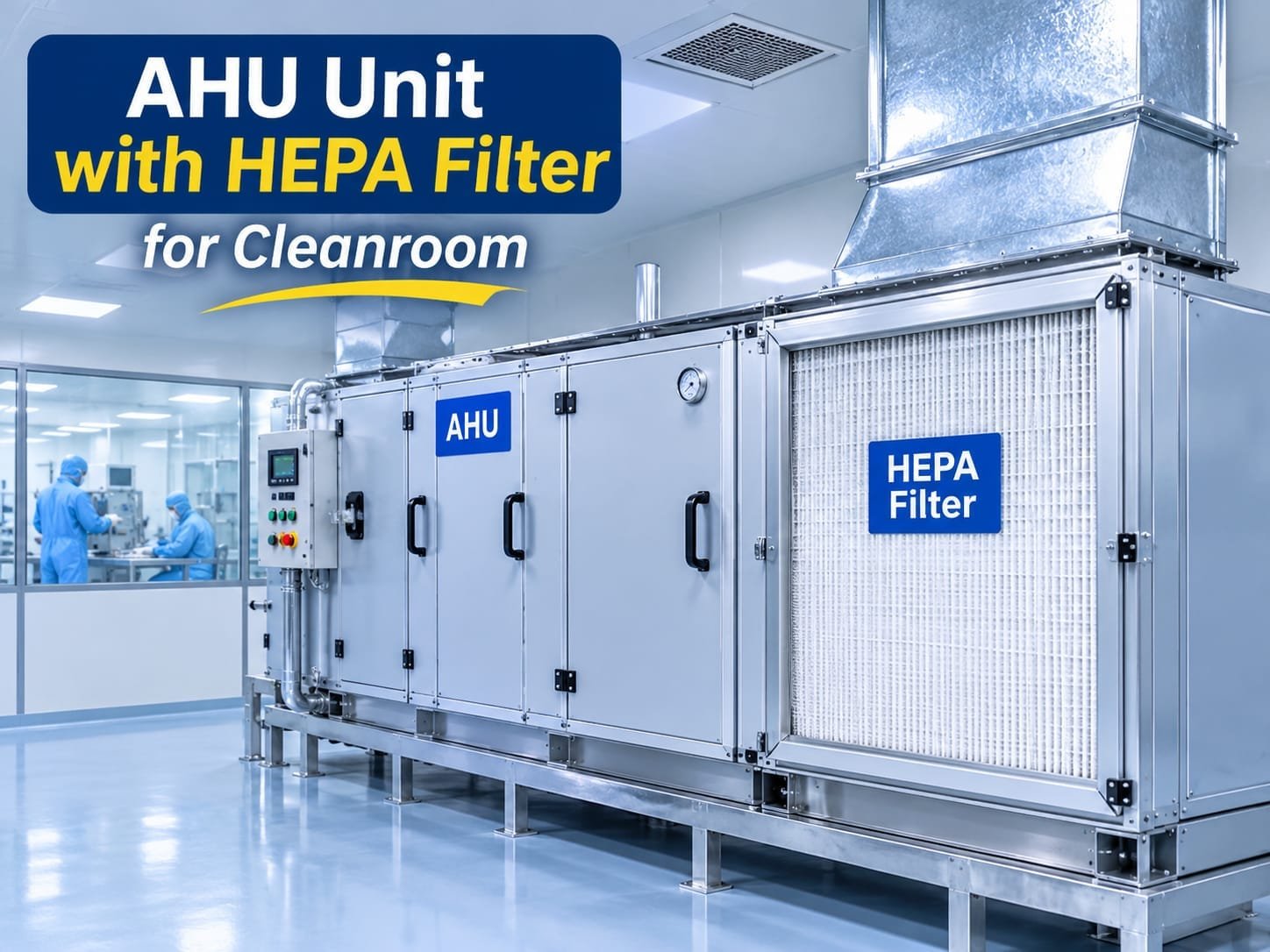
AHU in Pharma: Complete Guide to Air Handling Unit, HVAC, Qualification & Validation [2026]
AHU in Pharma – Air Handling Unit – is the heart of your cleanroom. If AHU fails, your product is exposed to contamination, your differential pressure collapses, and your batch is at risk.
In 2023-2025, USFDA and EU GMP auditors issued hundreds of observations related to HVAC failure, inadequate air changes, HEPA filter leakage, and poor differential pressure monitoring. Most of them were preventable – with proper AHU design, qualification, and maintenance.
In this practical guide, you will learn everything about AHU in pharmaceutical industry – working principle, components, types, cleanroom classification, HEPA filters, qualification IQ/OQ/PQ, validation, and how to avoid FDA 483.
- 1. What is AHU in Pharma?
- 2. Why AHU is Critical in Pharma?
- 3. Working Principle of AHU – Step by Step
- 4. Components of AHU – Explained Simply
- 5. Types of AHU in Pharma
- 6. AHU & Cleanroom Classification – Grade A/B/C/D
- 7. Key Parameters – Air Changes, Pressure, Temp, Humidity
- 8. HEPA Filter in AHU – Testing & Integrity
- 9. AHU Qualification – IQ OQ PQ Protocol
- 10. AHU Validation & Monitoring
- 11. Common FDA 483 Findings & Troubleshooting
- 12. AHU Maintenance & FAQ
1. What is AHU in Pharma?
AHU (Air Handling Unit) is a large metal box containing fans, filters, cooling coils, heating coils, and dampers. It is a part of the HVAC system (Heating, Ventilation & Air Conditioning) in a pharmaceutical plant.
Its job is simple but critical:
- Take Fresh Air + Return Air from cleanrooms
- Filter it to remove dust, microbes, particles
- Cool or Heat it to required temperature
- Control Humidity
- Supply it back to cleanrooms at correct pressure and air changes
Without AHU, you cannot maintain Grade A/B/C/D cleanrooms. No AHU = No sterile manufacturing = No GMP compliance.
2. Why AHU is Critical in Pharma?
- Product Protection: Prevents cross-contamination, microbial contamination, dust, and particles from entering product.
- Personnel Protection: In potent / cytotoxic / hormonal plants, AHU with proper exhaust prevents operator exposure.
- Cleanroom Classification: Maintains particle count as per EU GMP Annex 1 – Grade A/B/C/D.
- Pressure Cascade: Maintains differential pressure – air flows from clean to less clean, not reverse.
- Temperature & Humidity Control: Critical for stability – e.g., tablets need 22±2°C, 45±5% RH; sterile area needs 20-24°C.
- Regulatory Requirement: EU GMP Annex 1, WHO TRS, USFDA 21 CFR 211.42 & 211.46 mandate adequate HVAC.
3. Working Principle of AHU – Step by Step
Think of AHU like lungs of your factory:
- Mixing: Fresh Air (10-20%) + Return Air (80-90%) mix in mixing box via dampers.
- Pre-Filtration: Air passes through Pre-filter (G3/G4) – removes large dust, insects.
- Cooling / Heating: Air passes over Cooling Coil (Chilled Water) to cool & dehumidify, or Heating Coil / Heater to heat.
- Fine Filtration: Air passes through Fine Filter (F7/F8/F9) – removes fine particles.
- Fan / Blower: Supply fan pushes air at required velocity (CFM) into duct.
- HEPA Filtration: Final HEPA filter (H13/H14) at terminal – removes 99.97% of 0.3 micron particles & microbes.
- Supply to Cleanroom: Clean air enters room via ceiling HEPA / diffusers.
- Return / Exhaust: Air returns via low-level return grills to AHU, or exhausts out if potent / toxic.
4. Components of AHU – Explained Simply
| Component | Function | Specification in Pharma |
|---|---|---|
| Fresh Air Damper | Controls fresh air intake | 10-20% fresh air, with bird screen |
| Pre-Filter | Removes coarse dust | G3/G4, Washable / Disposable |
| Cooling Coil | Cools & dehumidifies air | Chilled water 7-12°C |
| Heating Coil / Heater | Heats air in winter / for RH control | Steam / Hot water / Electric |
| Fine Filter | Removes fine particles | F7/F8/F9 (EU) / MERV 14-15 |
| Supply Fan / Blower | Moves air through duct | Centrifugal, with VFD for speed control |
| HEPA Filter (Terminal) | Final sterilizing filtration | H13 / H14, 99.97% @ 0.3 micron |
| Humidifier / Dehumidifier | Controls RH | Steam humidifier preferred (no microbial growth) |
| Dampers / Ducts | Controls air flow, pressure | SS / GI ducts, leak-tested, insulated |
| BMS Sensors | Monitors Temp, RH, DP, Air velocity | Calibrated, with alarm & trend |
5. Types of AHU in Pharma
- 1. Once-Through AHU (100% Fresh Air): Used for Potent, Cytotoxic, Hormonal, Beta-lactam plants. Air is not recirculated. Expensive but safest. No cross-contamination risk.
- 2. Recirculatory AHU (80-90% Return Air): Used for OSD, General formulations. Energy efficient. Most common in pharma.
- 3. Single Zone AHU: One AHU for one area / one grade. Better control. Used for Sterile Core.
- 4. Multi-Zone AHU: One AHU serves multiple rooms with different temp requirements via reheat coils. Cost-effective for OSD.
- 5. Packaged AHU / Rooftop Unit: Compact unit on terrace. Used for small plants / warehouses.
Pro Tip: Never use same AHU for Beta-lactam and General products, or for Potent and Non-potent. This is a critical GMP violation.
6. AHU & Cleanroom Classification – Grade A/B/C/D
| Grade (EU GMP Annex 1) | Where Used | Air Changes / Hour (ACP H) | Air Velocity |
|---|---|---|---|
| Grade A | Filling zone, LAF, RABS, Isolator | Not defined by ACPH, Laminar flow | 0.36 – 0.54 m/s (Unidirectional) |
| Grade B | Background to Grade A, Aseptic area | 50 – 60 ACPH | Turbulent, HEPA |
| Grade C | Preparation, Compounding, Washing | 25 – 40 ACPH | Turbulent, HEPA |
| Grade D | Corridors, OSD manufacturing, Packing | 15 – 25 ACPH (OSD: 10-20) | Turbulent, HEPA / Fine filter |
Note: ACPH values are industry practice, not fixed in regulation. Must be justified by validation – particle count, recovery test, and smoke study.
7. Key Parameters Controlled by AHU
| Parameter | Typical Limit (Pharma) | How AHU Controls It |
|---|---|---|
| Temperature | 22 ± 2°C (OSD), 20-24°C (Sterile) | Cooling coil + Heater + BMS |
| Relative Humidity | 45 ± 5% RH (OSD), ≤ 60% (Sterile) | Cooling coil (dehumidify) + Humidifier |
| Differential Pressure (DP) | 10-15 Pa between grades, ≥ 12.5 Pa Grade B to C | Supply vs Return dampers, Fan speed |
| Air Changes (ACPH) | As per table above | Fan speed (VFD) + Duct design |
| Particle Count | Grade A: 3520 @ 0.5µm, Grade D: 3,520,000 @ 0.5µm | HEPA filter integrity |
| Microbial Count | Grade A: <1 CFU, Grade B: 10 CFU, Grade C: 100 CFU, Grade D: 200 CFU | HEPA + Fresh air + No water stagnation |
8. HEPA Filter in AHU – Testing & Integrity
HEPA = High Efficiency Particulate Air filter. It is the most important component of AHU.
- Efficiency: H13 = 99.95%, H14 = 99.995% @ 0.3 micron (MPPS)
- Leak Test: PAO / DOP Test – Challenge with PAO aerosol, scan filter face with photometer. Acceptance: Leakage ≤ 0.01%.
- Frequency: Integrity test every 6 months for Grade A/B, annually for Grade C/D. After any filter change, after any vibration / maintenance.
- Velocity Test: Measure air velocity at HEPA face with anemometer – Uniformity ± 20%.
- Common Mistake: Not testing HEPA after AHU shutdown for > 7 days. Always re-test.
9. AHU Qualification – IQ OQ PQ Protocol
AHU qualification is done in 3 phases, as per ISPE / EU GMP:
9.1 IQ – Installation Qualification
- Verify AHU model, serial no, location as per design (DQ / URS)
- Verify filters – type, size, MOC, gasket
- Verify coils, fan, motor, belts, dampers, duct MOC & insulation
- Verify instruments – Temp, RH, DP sensors calibrated
- Verify electrical – VFD, starter, earthing
- Verify SOPs, manuals, drawings (GA, P&ID)
9.2 OQ – Operational Qualification
- Fan ON/OFF, VFD speed control – Low / Medium / High
- Damper operation – Fresh air, Return, Exhaust
- Cooling coil / Heating coil operation – Temp control test
- Humidifier operation – RH control test
- Alarm tests – High temp, High RH, Low DP, Fan failure, Fire alarm interlock
- BMS interlock – AHU OFF on fire, AHU auto-restart after power failure
- Filter DP alarm – High DP across filter
9.3 PQ – Performance Qualification
✅ Air Changes Per Hour (ACPH) – Measure supply air velocity, calculate ACPH
✅ Air Velocity at HEPA / Diffuser
✅ Differential Pressure – Between all rooms, 3 days continuous trend
✅ Temperature & Humidity Mapping – 24 hrs, all seasons (Summer + Winter + Monsoon)
✅ Particle Count – At Rest + In Operation, as per ISO 14644
✅ Microbial Count – Settle plate + Active air sampling
✅ Recovery Test – After particle challenge, how fast room recovers to Grade limit? (Should be 15-20 min)
✅ Smoke Study / Air Flow Visualization – For Grade A/B, to prove unidirectional flow, no turbulence
✅ HEPA Integrity Test – PAO test
✅ Noise Level – ≤ 75 dB in production area
Acceptance: All parameters within limits for 3 consecutive days.
10. AHU Validation & Continuous Monitoring
- Daily Monitoring: Temp, RH, DP via BMS – with alarm limits. Record in logbook.
- Weekly: Check filter DP, fan belt tension, drain trap (U-trap must have water – prevents air leakage & microbial growth).
- Monthly: Particle count (Grade A/B), Microbial monitoring, AHU cleaning.
- Quarterly: Calibration of Temp/RH/DP sensors.
- 6-Monthly: HEPA integrity, ACPH verification.
- Annual: Requalification – Full PQ, Duct leakage test.
- After Shutdown: If AHU OFF > 24 hrs, perform sanitization, particle count, microbial count before starting production.
11. Common FDA 483 Findings for AHU & How to Avoid Them
- Finding: Differential pressure not maintained / No alarm. Fix: BMS with continuous DP monitoring + audible alarm + trend review daily.
- Finding: HEPA filter leakage not detected. Fix: PAO test every 6 months, with record.
- Finding: AHU used for both Beta-lactam and General. Fix: Dedicated AHU, dedicated duct, no recirculation.
- Finding: No recovery test / smoke study. Fix: Include in PQ, repeat after any HVAC change.
- Finding: Temperature / Humidity excursion, no investigation. Fix: Define excursion limits, investigate impact on product.
- Finding: AHU filters not changed, high DP. Fix: Define filter change frequency based on DP trend, not calendar only.
- Finding: Drain trap dry, microbial growth. Fix: Weekly check, add water, clean with disinfectant.
12. AHU Troubleshooting – Quick Guide
| Problem | Probable Cause | Action |
|---|---|---|
| Low DP | Door open, Fan speed low, Filter leakage, Duct leak | Check doors, VFD, damper, duct |
| High Temp | Cooling coil choked, Chilled water issue | Check chilled water temp, coil cleaning |
| High RH | Cooling coil not dehumidifying, Fresh air high | Check coil temp, reduce fresh air |
| High Particle Count | HEPA leak, Door open, Gowning failure | PAO test, check gasket, retrain gowning |
| Low ACPH | Filter choked, Fan belt loose | Replace filter, tighten belt, increase VFD |
FAQ – AHU in Pharma
Q1. What is the difference between AHU and HVAC?
HVAC is the whole system – Heating, Ventilation, Air Conditioning. AHU is one machine inside HVAC that handles air. HVAC also includes chiller, boiler, duct, BMS.
Q2. How often should AHU filters be changed?
Pre-filter: Every 1-3 months (based on DP). Fine filter: Every 6 months. HEPA: Every 2-3 years or when PAO fails / DP high. Always based on DP trend, not just calendar.
Q3. Can we shut down AHU at night to save power?
For Grade A/B/C sterile areas: No, 24×7 running is recommended. For OSD Grade D: You can reduce to low speed at night (setback mode) but must prove recovery before production. Never fully OFF for sterile.
Q4. What is the ideal DP in pharma?
10-15 Pa between adjacent rooms of different grades. Corridor to outside: Positive pressure for sterile, Negative for potent / containment.
Conclusion
AHU in Pharma is not just an engineering utility. It is a Quality System.
If your AHU is not qualified, your cleanroom is not qualified. If your cleanroom is not qualified, your product is not safe.
Remember: Good AHU = Good Air = Good Product = No 483.
Design it right, qualify it right, maintain it right – and your HVAC will never be a reason for audit failure.
Related Articles: Analyst Qualification in Pharma QC | Visual Inspector Qualification in OSD | End-to-End Migration of Quality Processes
The information provided on this page is for educational and informational purposes only. It is not intended to provide regulatory, legal, or compliance advice.
Pharmaceutical regulations including FDA 21 CFR, EU GMP Annexes, ICH Guidelines, EDQM, WHO, and CDSCO requirements are subject to frequent updates and interpretation by regulatory authorities.
Readers are responsible for ensuring compliance with current applicable laws and regulations in their jurisdiction. PharmaShare does not guarantee the accuracy, completeness, or currentness of this content.
This content does not create a consultant-client relationship. For product-specific regulatory strategy, dossier preparation, or inspection readiness, please consult qualified regulatory professionals or contact us directly.

About the Author
Mahummed Asif is a experienced pharmaceutical Quality Assurance professional and publisher of Pharmashare. He has worked with leading Pharmaceutical organizations and has developed extensive expertise in Quality Assurance, deviation management, investigations, CAPA, QMS, Product Life Cycle Management, change control, risk management, validation, product complaints, product recalls, and regulatory compliance. He is passionate about sharing practical pharmaceutical knowledge with professionals, students, and quality practitioners across the industry.