
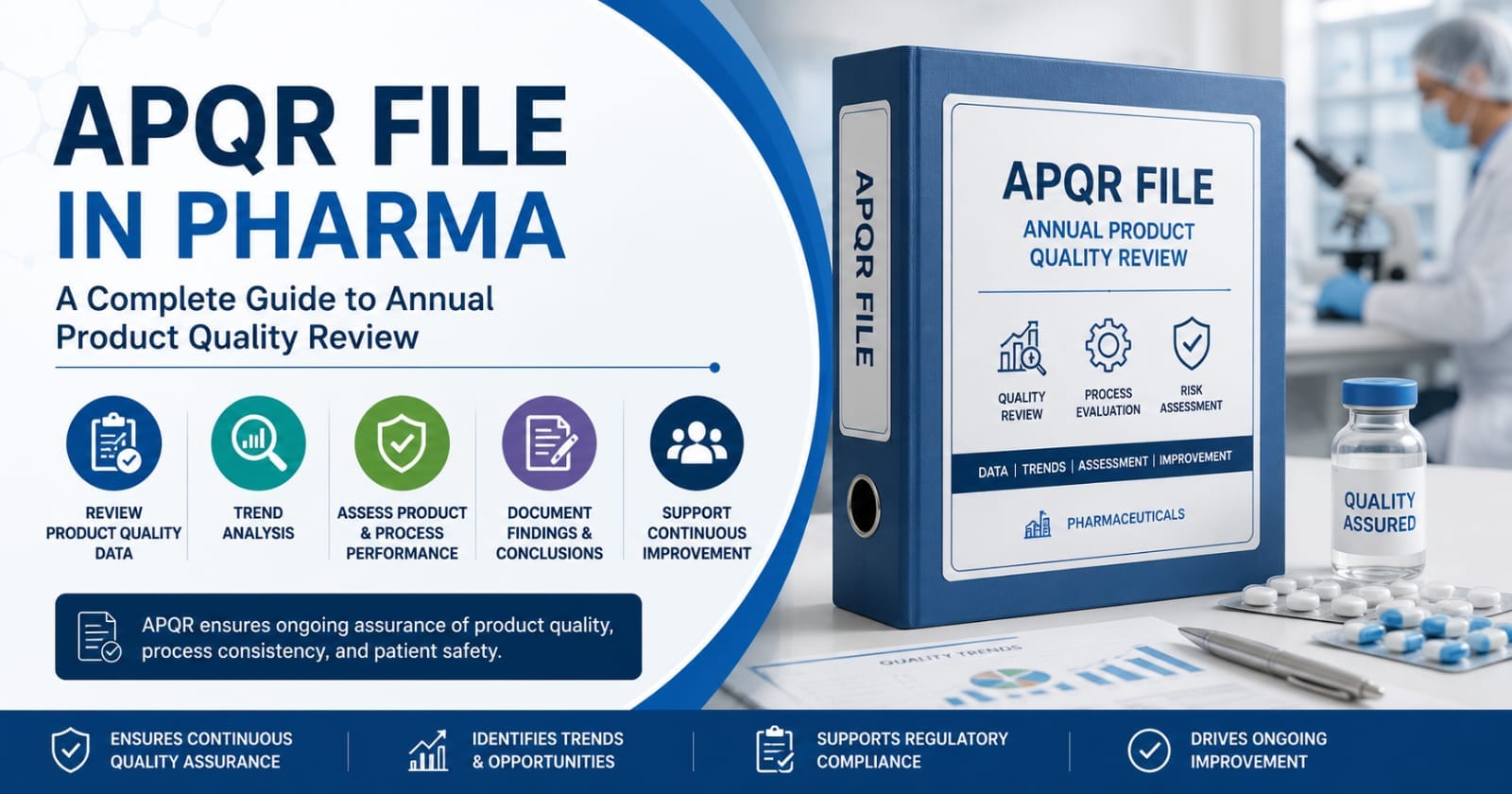
APQR in Pharma: Complete Guide to Annual Product Quality Review
Annual Product Quality Review (APQR) is one of the most critical Quality Management System (QMS) activities performed by pharmaceutical manufacturers. It provides a structured annual evaluation of manufacturing performance, analytical trends, product quality, process consistency, regulatory compliance, and opportunities for continual improvement.
Global regulatory agencies expect pharmaceutical companies to periodically review each marketed product to ensure that manufacturing processes remain validated, products consistently meet predetermined quality attributes, and quality systems continue to operate effectively throughout the product lifecycle.
This comprehensive guide explains every aspect of APQR, including regulatory expectations, objectives, review elements, statistical evaluation, documentation practices, inspection readiness, and industry best practices.
Table of Contents
- What is APQR?
- Regulatory Requirements
- Objectives of APQR
- Frequency of APQR
- Cross Functional Team
- Data Sources
- Major Components of APQR
- Batch Review
- Process Performance Review
- Quality Trends
- Deviation Review
- Complaint Analysis
- Stability Review
- Change Control Review
- Validation Status Review
- CAPA Review
- Supplier Performance
- Statistical Analysis
- Benefits of APQR
- Common Inspection Findings
- Best Practices
- Frequently Asked Questions
What is APQR?
Annual Product Quality Review (APQR) is a documented, systematic, and comprehensive assessment of all quality-related activities associated with a pharmaceutical product during a defined review period, typically one calendar year. The purpose of APQR is to determine whether the manufacturing process remains in a state of control and continues to consistently produce products meeting predefined quality requirements.
Unlike routine batch release activities, APQR evaluates the overall health of the product throughout its lifecycle by examining manufacturing trends, laboratory performance, process capability, deviations, complaints, change controls, stability studies, validation status, supplier performance, and CAPA effectiveness.
Primary Goal of APQR
To ensure that pharmaceutical products continue to meet safety, efficacy, identity, strength, purity, and quality requirements while identifying opportunities for continuous improvement.
Why is APQR Important?
The pharmaceutical industry operates under stringent Good Manufacturing Practice (GMP) regulations where consistent product quality is mandatory. Individual batch reviews alone cannot identify long-term trends that may gradually affect product quality. APQR bridges this gap by analyzing data collectively over an annual period.
The review enables manufacturers to proactively identify recurring deviations, process drifts, analytical variability, supplier issues, equipment reliability concerns, and emerging quality risks before they develop into significant compliance issues.
An effective APQR also serves as documented evidence during regulatory inspections that the company maintains ongoing oversight of product quality and actively pursues continual improvement.
Regulatory Requirements for APQR
Although terminology may vary between different regulatory agencies, nearly all global GMP regulations require periodic evaluation of pharmaceutical products.
European Union GMP (EU GMP Chapter 1)
EU GMP explicitly requires manufacturers to perform regular Product Quality Reviews covering all marketed medicinal products. The review should evaluate manufacturing consistency, analytical performance, deviations, complaints, recalls, stability data, validation status, supplier quality, and change controls.
The review should also determine whether corrective or preventive actions are necessary and whether any variations to the Marketing Authorization should be submitted.
United States FDA Expectations
While the United States FDA does not specifically use the term “Annual Product Quality Review” in regulations, manufacturers are expected to maintain ongoing process monitoring under:
- 21 CFR Part 210
- 21 CFR Part 211
- Process Validation Guidance
- Continued Process Verification (CPV)
- ICH Q10 Pharmaceutical Quality System
FDA investigators frequently request annual product review reports during inspections to evaluate process monitoring and continual improvement activities.
WHO GMP Requirements
WHO Good Manufacturing Practices recommend periodic quality reviews to verify manufacturing consistency, identify adverse trends, improve process understanding, and ensure continued compliance with approved specifications.
PIC/S GMP
PIC/S PE009 Guide to GMP also requires periodic Product Quality Reviews comparable to EU GMP requirements, emphasizing lifecycle management and continual process verification.
Objectives of APQR
The Annual Product Quality Review is much more than a regulatory obligation. It functions as a strategic quality management tool supporting continual process improvement and patient safety.
The major objectives include:
- Confirm manufacturing process consistency.
- Verify validated process performance.
- Evaluate Critical Process Parameters (CPPs).
- Review Critical Quality Attributes (CQAs).
- Analyze annual manufacturing trends.
- Evaluate laboratory analytical performance.
- Review deviations and investigations.
- Assess complaint trends.
- Review Out-of-Specification investigations.
- Evaluate stability study results.
- Assess supplier quality performance.
- Verify CAPA effectiveness.
- Support continual improvement initiatives.
- Ensure ongoing regulatory compliance.
Frequency of APQR
The Product Quality Review is generally conducted once every twelve months for each commercial product. Many pharmaceutical organizations prepare APQR reports on a calendar-year basis, while others use a rolling 12-month review period depending on internal procedures and regulatory commitments.
Depending on company policy, APQR may be prepared:
- Per Product
- Per Strength
- Per Manufacturing Site
- Per Product Family
- Per Contract Manufacturing Location
Cross Functional Team Involved in APQR
Preparation of an APQR requires collaboration between several departments because relevant information originates from multiple quality systems.
Typical contributors include:
- Quality Assurance
- Quality Control
- Manufacturing
- Engineering
- Validation
- Regulatory Affairs
- Warehouse
- Supply Chain
- Microbiology
- Packaging Department
- Maintenance
- IT/Data Management
Quality Assurance generally coordinates the review, compiles the report, performs trend analysis, and obtains management approval.
Data Sources Used in APQR
One of the strengths of APQR lies in its comprehensive evaluation of information collected from multiple GMP systems. Reliable data collection ensures meaningful trend analysis and scientifically sound conclusions.
Typical data sources include:
- Batch Manufacturing Records
- Batch Packaging Records
- Laboratory Information Management Systems (LIMS)
- Electronic Batch Records
- Deviation Database
- CAPA Management System
- Change Control Records
- Complaint Management System
- Recall Database
- Annual Stability Program
- Environmental Monitoring Records
- Equipment Qualification Reports
- Calibration Records
- Preventive Maintenance Records
- Cleaning Validation Reports
- Process Validation Reports
- Supplier Qualification Files
- Internal Audit Reports
- Regulatory Inspection Observations
- Product Release Documentation
The integration of information from these systems allows pharmaceutical manufacturers to assess product quality holistically rather than relying solely on isolated batch-specific information.
Major Components of an APQR
A comprehensive Annual Product Quality Review should evaluate every critical aspect of product manufacturing and quality performance over the review period. Each section contributes to determining whether the product and manufacturing process remain in a state of control.
1. Product Information
Every APQR begins with basic product information that clearly identifies the product being reviewed. This section provides traceability and establishes the scope of the review.
| Parameter | Example |
|---|---|
| Product Name | Paracetamol Tablets IP |
| Strength | 500 mg |
| Dosage Form | Tablet |
| Manufacturing Site | Site A |
| Market | India, EU, USA |
| Shelf Life | 36 Months |
| Review Period | January–December 2025 |
2. Batch Manufacturing Review
A summary of all commercial batches manufactured during the review period should be included. This provides an overview of manufacturing consistency and batch disposition.
| Batch Status | Number of Batches |
|---|---|
| Manufactured | 48 |
| Released | 47 |
| Rejected | 1 |
| Reworked | 2 |
| Reprocessed | 0 |
The review should explain reasons for rejected, reworked, or reprocessed batches and evaluate whether recurring trends exist.
3. Review of Critical Process Parameters (CPPs)
Critical Process Parameters directly influence product quality and therefore require annual trend evaluation. The review confirms that process variability remains within validated operating ranges.
Typical CPPs include:
- Mixing time
- Granulation endpoint
- Drying temperature
- Drying time
- Compression force
- Tablet weight
- Tablet thickness
- Coating weight gain
- Filling speed
- Sterilization parameters
Trend charts are commonly used to identify gradual process drift before product quality is affected.
4. Review of Critical Quality Attributes (CQAs)
CQAs represent measurable product characteristics that directly impact safety and efficacy. APQR should evaluate annual trends for every important quality attribute.
Examples include:
- Assay
- Dissolution
- Content Uniformity
- Impurities
- Related Substances
- Water Content
- Friability
- Hardness
- Disintegration Time
- Appearance
Statistical evaluation of CQAs provides evidence that product quality remains stable throughout the review period.
5. Yield Review
Manufacturing yield trends should be evaluated to identify abnormal losses or process inefficiencies.
| Process Step | Expected Yield | Average Actual Yield |
|---|---|---|
| Granulation | 98% | 97.8% |
| Compression | 99% | 98.7% |
| Packaging | 99.5% | 99.2% |
Unexpected reductions in yield should trigger investigations to determine root causes.
6. Deviation Review
Annual trending of deviations is one of the most valuable sections of APQR. It enables identification of recurring problems and supports continual improvement.
The review should include:
- Total deviations
- Minor deviations
- Major deviations
- Critical deviations
- Repeat deviations
- Root cause analysis
- CAPA effectiveness
Trend analysis helps determine whether similar deviations continue to occur despite implemented corrective actions.
7. Out-of-Specification (OOS) Review
All confirmed and invalidated OOS investigations should be summarized and evaluated during APQR.
The review typically includes:
- Total OOS investigations
- Laboratory errors
- Manufacturing-related OOS
- Analytical method issues
- Root causes
- CAPA implementation
Recurring OOS events may indicate process capability issues requiring additional validation or process improvements.
8. Out-of-Trend (OOT) Review
OOT investigations identify undesirable analytical trends before specifications are exceeded.
Examples include:
- Gradual decrease in assay
- Increasing impurity levels
- Declining dissolution results
- Increasing moisture content
- Stability drift
Monitoring OOT trends allows manufacturers to take preventive action before quality failures occur.
9. Complaint Review
Customer complaints provide valuable feedback regarding product performance in the marketplace. Complaint trending is a mandatory component of APQR.
The review should summarize:
- Total complaints received
- Critical complaints
- Major complaints
- Minor complaints
- Complaint rate
- Root cause analysis
- CAPA implementation
Typical complaint categories include:
- Broken tablets
- Missing blister pockets
- Incorrect labeling
- Leakage
- Foreign particles
- Packaging defects
- Short count
- Color variation
10. Product Recall Review
Any market recalls conducted during the review period should be evaluated to determine whether improvements are required within the Pharmaceutical Quality System.
The review should include:
- Recall classification
- Reason for recall
- Affected markets
- Root cause
- Corrective actions
- Preventive actions
- Regulatory notifications
11. Stability Program Review
The stability section confirms that the approved shelf life remains scientifically justified based on ongoing stability studies.
Data reviewed includes:
- Long-term stability
- Accelerated stability
- Intermediate stability
- Ongoing stability program
- OOT trends
- OOS stability results
- Shelf-life evaluation
Trend graphs are particularly useful for assay, dissolution, degradation products, and moisture content.
12. Change Control Review
All approved change controls implemented during the review period should be evaluated to determine whether they had any impact on product quality, manufacturing consistency, validation status, or regulatory commitments. Effective change management is essential for maintaining a state of control throughout the product lifecycle.
The review should include:
- Manufacturing process changes
- Equipment modifications
- Analytical method revisions
- Raw material supplier changes
- Packaging material changes
- Facility modifications
- Software or computerized system updates
- Regulatory filing status (where applicable)
13. Validation Status Review
Validation activities should be reviewed annually to ensure that all validation programs remain current and effective. Any expired or pending revalidation activities should be identified and addressed.
The APQR should summarize:
- Process Validation status
- Continued Process Verification (CPV)
- Cleaning Validation
- Analytical Method Validation
- Equipment Qualification (IQ/OQ/PQ)
- Utility Qualification
- Computer System Validation (CSV)
- Hold Time Validation
- Transport Validation
Any validation activities requiring requalification or revalidation should be included in the action plan.
14. CAPA Review
Corrective and Preventive Actions (CAPAs) implemented during the review period should be assessed to verify their completion and effectiveness. This review helps ensure that recurring quality issues have been adequately addressed.
Typical CAPA metrics include:
- Total CAPAs opened
- Total CAPAs closed
- Overdue CAPAs
- CAPA effectiveness checks completed
- Repeat issues after CAPA implementation
Recurring deficiencies despite CAPA implementation may indicate ineffective root cause analysis or inadequate corrective actions.
15. Supplier Performance Review
Raw material and packaging material suppliers play a critical role in product quality. APQR should evaluate supplier performance using predefined quality metrics.
Typical supplier performance indicators include:
- Material rejection rate
- Incoming material quality
- Supplier deviations
- Audit observations
- On-time delivery performance
- Change notifications
- Quality Agreement compliance
16. Environmental Monitoring Review
For sterile and controlled manufacturing environments, environmental monitoring data should be reviewed to verify that cleanroom conditions remain within validated limits.
The review may include:
- Viable monitoring results
- Non-viable particle counts
- Surface monitoring trends
- Personnel monitoring
- Water system monitoring
- Compressed air monitoring
- HVAC performance
17. Equipment Performance Review
Equipment performance should be reviewed to determine whether equipment reliability could impact product quality or manufacturing efficiency.
Parameters commonly reviewed include:
- Equipment breakdowns
- Preventive maintenance compliance
- Calibration status
- Equipment qualification status
- Recurring equipment failures
- Spare parts availability
Statistical Tools Used in APQR
Modern APQR reports incorporate statistical techniques to evaluate manufacturing performance objectively and identify trends that may not be visible through routine data review.
Common statistical tools include:
- Control Charts
- Run Charts
- Pareto Analysis
- Histograms
- Box Plots
- Scatter Plots
- Regression Analysis
- Process Capability Analysis (Cp/Cpk)
- Moving Range Charts
- Standard Deviation Analysis
- Trend Charts
Statistical analysis enables proactive identification of process drift, variability, and opportunities for continual process improvement.
Benefits of APQR
A well-executed APQR delivers significant operational and regulatory benefits beyond basic compliance.
- Demonstrates compliance with global GMP requirements.
- Supports inspection readiness.
- Verifies continued process validation.
- Identifies adverse quality trends early.
- Improves manufacturing consistency.
- Enhances product quality and patient safety.
- Strengthens the Pharmaceutical Quality System (PQS).
- Supports Quality Risk Management (QRM).
- Facilitates continual improvement.
- Reduces regulatory and business risks.
Common Regulatory Deficiencies Observed During Inspections
Regulatory agencies frequently identify deficiencies in APQR programs during GMP inspections. Common observations include:
- Failure to perform APQR annually.
- Incomplete product quality reviews.
- Lack of statistical trend analysis.
- Recurring deviations not evaluated.
- Missing stability data review.
- Ineffective CAPA follow-up.
- Failure to assess process capability.
- Poor management review and approval.
- No documented conclusions or action plans.
- Inadequate documentation supporting review outcomes.
Best Practices for an Effective APQR
- Establish a standardized APQR template across all products.
- Automate data collection using electronic quality systems.
- Use statistical tools for trend analysis.
- Include cross-functional stakeholders in the review process.
- Evaluate recurring deviations and CAPA effectiveness.
- Link APQR findings with Continued Process Verification (CPV).
- Review supplier quality performance annually.
- Ensure management approval and documented conclusions.
- Track all improvement actions to completion.
- Retain APQR reports for regulatory inspections.
Frequently Asked Questions (FAQs)
1. What does APQR stand for?
APQR stands for Annual Product Quality Review, a periodic evaluation of product quality and manufacturing performance.
2. Is APQR mandatory?
Yes. APQR or Product Quality Review is expected under EU GMP, WHO GMP, PIC/S GMP, and is aligned with FDA expectations for ongoing process monitoring and quality management.
3. How often should APQR be performed?
Generally, APQR is performed once every 12 months for each commercial product or product family, depending on company procedures and regulatory commitments.
4. Which department owns APQR?
Quality Assurance (QA) typically owns and coordinates APQR, with contributions from Quality Control, Manufacturing, Engineering, Validation, Regulatory Affairs, Supply Chain, and other functional departments.
5. What is the difference between APQR and CPV?
APQR is an annual review of overall product quality, while Continued Process Verification (CPV) focuses on continuous monitoring of process performance throughout the product lifecycle. CPV data often forms a key input to the APQR.
Conclusion
Annual Product Quality Review (APQR) is a cornerstone of the Pharmaceutical Quality System, providing a structured approach to evaluating product quality, manufacturing performance, analytical trends, and regulatory compliance. Rather than serving solely as a regulatory requirement, APQR functions as a strategic quality management tool that supports lifecycle management, risk mitigation, and continuous improvement.
By integrating information from manufacturing, laboratory testing, deviations, complaints, stability studies, validation, supplier management, and CAPA systems, organizations can make informed decisions that enhance process robustness, maintain product quality, and protect patient safety. A well-designed APQR program also strengthens inspection readiness and demonstrates a company’s commitment to GMP compliance and operational excellence.
Regulatory Disclaimer
Disclaimer:
This article is intended solely for educational and informational purposes. It summarizes current industry practices and publicly available regulatory expectations related to Annual Product Quality Review (APQR). It should not be interpreted as regulatory, legal, or quality system advice.
Manufacturers should always refer to the latest applicable regulations and guidance documents issued by their respective health authorities, including but not limited to the US FDA, European Commission, EMA, MHRA, WHO, PIC/S, ICH, and local regulatory agencies. Company-specific procedures and quality systems should always take precedence where applicable.

About the Author
Mahummed Asif is a pharmaceutical QA professional with sound knowledge on GMP, Product Life Cycle Management, Regulatory filing, QMS, Product Complaint Management, Change control, risk management, and USFDA audit preparation.