Best Practices for an Effective Change Management System
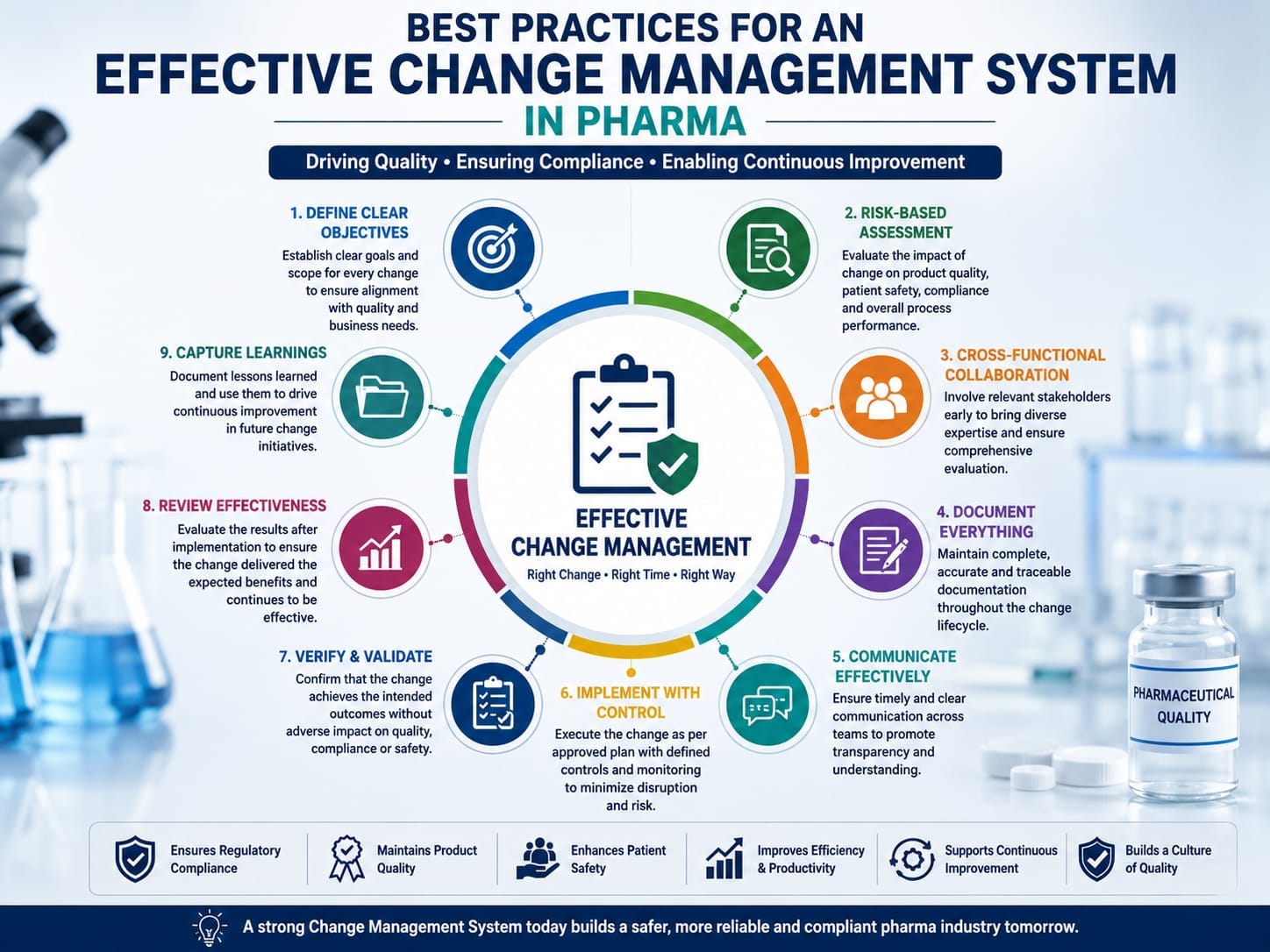
A mature Change Management System goes beyond regulatory compliance. It promotes continuous improvement while ensuring product quality, patient safety, and data integrity are maintained. The following best practices are widely adopted by leading pharmaceutical manufacturers.
- Establish a clear and comprehensive Change Control SOP.
- Apply Quality Risk Management (QRM) principles to every proposed change.
- Involve cross-functional teams early in the evaluation process.
- Clearly define roles and responsibilities.
- Ensure technical justification supports every change.
- Evaluate regulatory filing requirements before implementation.
- Complete qualification and validation activities where required.
- Train all affected personnel before the change becomes effective.
- Verify effectiveness after implementation.
- Periodically review Change Control metrics for continuous improvement.
Key Performance Indicators (KPIs)
Monitoring KPIs helps organizations evaluate the effectiveness of their Change Management System and identify opportunities for improvement.
| KPI | Purpose |
|---|---|
| Number of Change Controls initiated | Measure workload and change frequency |
| Average closure time | Evaluate process efficiency |
| Overdue Change Controls | Identify delays requiring management attention |
| Major vs Minor changes | Monitor change profile |
| Changes requiring validation | Track validation workload |
| Changes requiring regulatory submission | Assess regulatory impact |
| Effectiveness check success rate | Measure implementation success |
| Repeat Change Controls | Identify recurring issues |
Example: Equipment Replacement Change Control
| Parameter | Example |
|---|---|
| Proposed Change | Replacement of Tablet Compression Machine |
| Reason | Obsolete equipment with high maintenance cost |
| Risk Level | High |
| Departments Involved | Engineering, Production, QA, QC, Validation, Regulatory Affairs |
| Qualification Required | IQ, OQ, PQ |
| Validation Required | Process Validation |
| Documentation | SOPs, BMRs, Maintenance Procedures, Validation Protocols |
| Training Required | Operators, Maintenance, QA |
| Effectiveness Check | Three successful commercial batches without deviations |
Case Study 1: Supplier Change
A pharmaceutical manufacturer decides to qualify a second supplier for an active pharmaceutical ingredient (API) to reduce supply chain risks.
Potential impacts include:
- Raw material specifications
- Impurity profile
- Stability studies
- Analytical method verification
- Regulatory variation filing
- Process validation
Following a structured Change Management process ensures that the new supplier is qualified without affecting product quality or regulatory compliance.
Case Study 2: Software Upgrade
An organization upgrades its Laboratory Information Management System (LIMS).
Required assessments include:
- Computer System Validation (CSV)
- Data migration verification
- User Acceptance Testing (UAT)
- Electronic records review
- Audit trail verification
- User training
Without proper change management, software upgrades may compromise data integrity and regulatory compliance.
Internal Audit Checklist for Change Management
- Is there an approved Change Control SOP?
- Are changes initiated before implementation?
- Is Quality Risk Management documented?
- Are impact assessments comprehensive?
- Are all required departments involved?
- Are validation requirements documented?
- Are SOP revisions completed before implementation?
- Are personnel trained?
- Are effectiveness checks documented?
- Are Change Controls closed within defined timelines?
- Are overdue changes periodically reviewed?
- Is management reviewing Change Control trends?
Common Challenges in Change Management
- Incomplete risk assessments
- Insufficient technical justification
- Poor communication between departments
- Delayed approvals
- Inadequate planning
- Incomplete validation documentation
- Lack of management oversight
- Failure to identify regulatory filing requirements
- Insufficient effectiveness verification
- Backlog of overdue Change Controls
Benefits of an Effective Change Management System
- Improved GMP compliance
- Enhanced patient safety
- Reduced product quality risks
- Better regulatory inspection readiness
- Improved cross-functional collaboration
- Reduced deviations and investigations
- Maintained validated state
- Improved operational efficiency
- Support for continuous improvement initiatives
- Greater confidence in decision-making
Frequently Asked Questions (FAQs)
1. What is Change Management in pharmaceutical manufacturing?
Change Management is a formal process used to evaluate, approve, implement, document, and verify changes that may affect product quality, patient safety, validation status, or regulatory compliance.
2. Is Change Management required by GMP regulations?
Yes. FDA, EU GMP, WHO, PIC/S, and ICH Q10 all require pharmaceutical manufacturers to maintain an effective Change Management System as part of the Pharmaceutical Quality System.
3. What is the difference between Change Management and Change Control?
The terms are often used interchangeably. “Change Management” refers to the overall quality system governing changes, while “Change Control” generally refers to the documented process used to evaluate and approve individual changes.
4. Which department owns Change Management?
Quality Assurance typically owns the Change Management process, but successful implementation requires collaboration across Production, QC, Engineering, Validation, Regulatory Affairs, IT, and Warehouse functions.
5. Why is risk assessment important?
Risk assessment ensures that changes are evaluated scientifically so that potential impacts on product quality, patient safety, and regulatory compliance are identified and mitigated before implementation.
Conclusion
An effective Change Management System is one of the foundational elements of a robust Pharmaceutical Quality System. As pharmaceutical manufacturing processes become increasingly complex, organizations must manage changes using a structured, science-based, and risk-driven approach.
Every change—whether involving equipment, facilities, suppliers, manufacturing processes, analytical methods, computerized systems, or documentation—should be assessed for its potential impact on product quality, patient safety, validation status, and regulatory compliance.
Organizations that integrate Change Management with Quality Risk Management, Validation, CAPA, Deviation Management, and Management Review are better positioned to maintain regulatory compliance, improve operational efficiency, and foster a culture of continuous improvement.
Regulatory References
- ICH Q10 – Pharmaceutical Quality System
- ICH Q9(R1) – Quality Risk Management
- 21 CFR Parts 210 & 211 – Current Good Manufacturing Practice (cGMP)
- EU GMP Guidelines – Chapter 1 (Pharmaceutical Quality System)
- EU GMP Annex 15 – Qualification and Validation
- WHO Good Manufacturing Practices for Pharmaceutical Products
- PIC/S Guide to Good Manufacturing Practice for Medicinal Products
Key Takeaways
- Change Management is a regulatory requirement and a core component of the Pharmaceutical Quality System.
- Every change should be documented, risk assessed, reviewed, approved, implemented, verified, and formally closed.
- Quality Risk Management should guide the level of review and control applied to each change.
- Cross-functional collaboration ensures that all quality, validation, engineering, and regulatory impacts are addressed.
- Routine monitoring of Change Control metrics supports continuous improvement and inspection readiness.
Regulatory Disclaimer
Disclaimer: This article is intended solely for educational and informational purposes. While every effort has been made to ensure accuracy based on current pharmaceutical regulations and industry best practices, readers should always refer to the latest official guidance issued by regulatory authorities such as the US FDA, EMA, MHRA, WHO, PIC/S, and ICH before making compliance or business decisions. Company-specific Standard Operating Procedures (SOPs), internal quality systems, and applicable national regulations should always take precedence where relevant.
Author: Mahummed Asif
Founder, PharmaShare | Pharmaceutical Quality & Regulatory Professional