Certificate of Conformance (CoC) in the Pharmaceutical Industry: A Complete Guide
Category: Pharmaceutical Quality Assurance | GMP | Quality Management System
1. Introduction
Quality assurance and regulatory compliance are essential elements of pharmaceutical manufacturing. Every pharmaceutical product must be manufactured, tested, packaged, stored and distributed in accordance with approved specifications, applicable regulatory requirements and Good Manufacturing Practices (GMP).
To provide documented assurance that a particular product, material or batch meets the applicable requirements, pharmaceutical manufacturers and suppliers may issue a document known as a Certificate of Conformance (CoC), also commonly called a Certificate of Conformity.
A Certificate of Conformance is a formal declaration issued by an authorized manufacturer, supplier or quality organization confirming that a specified material, product, component or batch complies with defined specifications, contractual requirements, approved standards or applicable GMP requirements, as relevant to the scope of the certificate.
In pharmaceutical organizations, CoC plays an important role in supplier qualification, incoming material verification, batch documentation, customer requirements, contract manufacturing and quality agreements.
It provides customers, distributors, regulatory stakeholders and other interested parties with documented confirmation of the claimed conformity of the supplied material or product.
However, a Certificate of Conformance should not be considered a replacement for a Certificate of Analysis (CoA), batch manufacturing records, quality control testing or the formal batch release process.
2. What Is a Certificate of Conformance (CoC)?
A Certificate of Conformance is a controlled quality document issued by an authorized person or organization to declare that a specific product, material, component or batch has been manufactured, processed, inspected or supplied in accordance with the applicable requirements.
Depending on the product and intended application, the certificate may confirm conformity with:
- Approved product specifications.
- Applicable pharmacopoeial requirements.
- Approved manufacturing or packaging procedures.
- Good Manufacturing Practices (GMP).
- Customer-approved specifications.
- Purchase order requirements.
- Technical agreements and quality agreements.
- Applicable regulatory commitments.
- Approved material or product standards.
The exact scope of the certificate should be clearly defined. A manufacturer should not make a broader compliance declaration than can be supported by its approved records and quality system.
3. Objectives of a Certificate of Conformance in Pharma
The primary objective of a CoC is to provide documented assurance that the supplied material or product meets the requirements agreed between the manufacturer and customer.
The important objectives include:
3.1 Assurance of Product Quality
It provides documented confirmation that the relevant product or material conforms to its applicable quality requirements.
3.2 GMP Compliance Assurance
Where included within the defined scope, the certificate confirms that the applicable manufacturing and quality control activities were performed in accordance with relevant GMP requirements.
3.3 Customer Requirements
Many pharmaceutical customers require a CoC as part of their supplier documentation or batch-specific documentation package.
3.4 Regulatory Documentation
It supports the documentation system used to demonstrate compliance with applicable specifications, standards and contractual commitments.
3.5 Supply Chain Traceability
By identifying the product, batch or lot number, manufacturer and issue date, the CoC helps maintain traceability throughout the pharmaceutical supply chain.
3.6 Supplier and Vendor Management
It supports supplier qualification and material receipt processes by providing a documented declaration of conformity from the supplier.
4. Where Is a Certificate of Conformance Used in the Pharmaceutical Industry?
CoC can be used across different pharmaceutical operations, depending on the applicable regulatory, contractual and customer requirements.
| Area | Application of CoC |
|---|---|
| Active Pharmaceutical Ingredients (API) | Confirmation of conformity with agreed API specifications, applicable GMP requirements and relevant DMF, CEP or pharmacopoeial requirements, where applicable. |
| Excipients | Declaration that the supplied excipient conforms to agreed specifications and applicable requirements. |
| Raw Materials | Confirmation of conformity with approved material specifications. |
| Packaging Materials | Declaration of conformity of printed or primary packaging materials with approved drawings, specifications and purchase requirements. |
| Finished Pharmaceutical Products | Confirmation of conformity with agreed product and manufacturing requirements, where requested. |
| Contract Manufacturing | Documentation supporting customer requirements and technical or quality agreements. |
| Equipment and Instruments | Confirmation that supplied equipment or instruments meet agreed technical specifications. |
| Serialization and Packaging | Confirmation of conformity with agreed packaging and serialization requirements, within the scope of the supplier’s documented verification. |
5. Difference Between Certificate of Conformance (CoC) and Certificate of Analysis (CoA)
CoC and CoA are two different quality documents frequently used in pharmaceutical manufacturing. Although they may be issued together or combined into one document, their purposes are different.
Certificate of Analysis (CoA)
A Certificate of Analysis is a batch-specific analytical document that provides the tests performed, applicable acceptance criteria and actual analytical results obtained for a particular material or product.
It provides objective analytical evidence of conformity with the relevant specification.
Certificate of Conformance (CoC)
A Certificate of Conformance is a formal declaration that the identified material, product or batch complies with the specified requirements within the scope of the declaration.
It generally does not reproduce all individual analytical test results.
| Parameter | Certificate of Analysis (CoA) | Certificate of Conformance (CoC) |
|---|---|---|
| Primary purpose | Reports analytical test results. | Declares conformity with defined requirements. |
| Nature | Analytical document. | Conformity declaration. |
| Test results | Includes actual test results. | Generally does not include detailed analytical results. |
| Specifications | Includes test specifications and acceptance criteria. | References applicable specifications or standards. |
| Batch identification | Normally batch or lot specific. | Should identify the relevant product or lot when batch-specific. |
| Issuing authority | Authorized QC laboratory or responsible quality personnel. | Authorized manufacturer, supplier or quality organization. |
| Typical content | Test parameters, methods, limits and actual results. | Declaration of conformity, product identification and applicable standards. |
| Replacement | Does not automatically replace a CoC when one is contractually required. | Does not replace required analytical testing or CoA. |
Important: A CoC cannot be used as a substitute for a CoA when actual analytical results are required. Similarly, a CoA alone may not satisfy a customer’s separate requirement for a declaration of manufacturing or GMP conformity.
6. Regulatory Expectations for Certificate of Conformance
There is no single universal regulatory format or standalone mandatory CoC requirement applicable to every pharmaceutical product and material worldwide. The requirement and content depend on the product category, applicable regulations, marketing authorization, customer agreements and quality system requirements.
Nevertheless, several internationally recognized regulatory and industry frameworks provide relevant expectations for batch documentation, quality certification and conformity assurance.
6.1 USFDA Requirements
The USFDA’s current Good Manufacturing Practice requirements under 21 CFR Parts 210 and 211 establish requirements for manufacturing, laboratory controls, component approval, production records, packaging, labeling and finished product release.
For example:
- 21 CFR 211.84 addresses testing and approval or rejection of components, drug product containers and closures.
- 21 CFR 211.160 addresses general requirements for laboratory controls.
- 21 CFR 211.165 addresses testing and release for distribution.
- 21 CFR 211.188 addresses batch production and control records.
- 21 CFR 211.192 addresses production record review.
A CoC may support a manufacturer’s or supplier’s documentation package, but it does not independently establish compliance with all applicable USFDA requirements.
6.2 ICH Q7 Guidelines
ICH Q7 provides GMP guidance for the manufacture of Active Pharmaceutical Ingredients (APIs).
Section 11.4 describes the requirements for Certificates of Analysis, including product identification, batch number, release date, tests performed, acceptance limits, analytical results and authorization by appropriate quality personnel.
For API manufacturers, an additional Certificate of Conformance may be issued where required by customer agreements or applicable business requirements.
6.3 EU GMP Requirements
EU GMP establishes requirements for pharmaceutical manufacturing, quality control, documentation and batch certification.
EU GMP Annex 16 describes certification by a Qualified Person (QP) and batch release requirements for medicinal products intended for the EU/EEA market.
A supplier-issued CoC should not be confused with the formal QP certification required under applicable EU legislation.
6.4 WHO Guidelines
WHO GMP guidance provides internationally recognized expectations for pharmaceutical manufacturing and quality control.
WHO also operates a Certification Scheme on the Quality of Pharmaceutical Products Moving in International Commerce. The scheme includes the Certificate of Pharmaceutical Product (CPP) and model batch certificate documentation.
These certificates have different purposes from an ordinary manufacturer-issued CoC.
Reference:
- USFDA – ICH Q7 GMP Guidance
- EMA – GMP and GDP Guidance
- WHO – Pharmaceutical Product Certification Scheme
7. Essential Contents of a Certificate of Conformance
A well-designed CoC should contain sufficient information to identify the supplied product or material and establish the basis of the conformity declaration.
The following information is generally recommended, subject to the applicable product and customer requirements.
7.1 Document Identification
- Document title: Certificate of Conformance.
- Unique certificate number.
- Document revision number, where applicable.
- Date of issue.
- Page number and total number of pages.
7.2 Manufacturer or Supplier Details
- Name of the manufacturer or supplier.
- Registered address.
- Manufacturing site address, where relevant.
- Contact details.
7.3 Product or Material Details
- Product or material name.
- Product code or material code.
- Grade, strength or dosage form, where applicable.
- Batch or lot number.
- Date of manufacture, where relevant.
- Expiry date or retest date, where applicable.
- Quantity and packaging details, if required.
7.4 Specification and Compliance Details
- Applicable approved specification number and revision.
- Applicable pharmacopoeial standard, if relevant.
- Customer specification or purchase order reference.
- Applicable GMP requirements.
- Reference to relevant quality or technical agreement.
7.5 Declaration Statement
A clear statement confirming that the identified product or material conforms to the applicable requirements should be included.
7.6 Authorization Details
- Name of authorized person.
- Designation.
- Department.
- Signature or validated electronic approval.
- Date of approval.
8. Procedure for Preparation and Issuance of a CoC
The issuance of a Certificate of Conformance should be governed by an approved Standard Operating Procedure (SOP) or another controlled quality system process.
A typical workflow is described below.
Step 1: Receipt of CoC Request
The process may begin when a customer, distributor, procurement department or internal department requests a CoC for a specific product or batch.
The responsible department should identify the purpose of the certificate and applicable customer or regulatory requirements.
Step 2: Identification of Product or Batch
Identify the relevant product, material, batch number, manufacturing location and quantity to ensure that the certificate is issued against the correct batch or lot.
Step 3: Verification of Applicable Specifications
Verify the applicable approved specification, product standard, purchase order, quality agreement and other relevant requirements.
Step 4: Review of Manufacturing and Quality Records
Where the declaration includes manufacturing or GMP conformity, relevant records should be reviewed before issuing the certificate.
These may include:
- Batch Manufacturing Records (BMR).
- Batch Packaging Records (BPR).
- In-process quality control records.
- Finished product analytical results.
- Deviation and investigation records.
- Change control records, where relevant.
- Approved CAPA records, where relevant.
- Material and component traceability records.
- Batch release documentation.
Step 5: Quality Assurance Verification
Quality Assurance should verify that the declaration is supported by appropriate evidence and that there are no unresolved quality issues that would make the proposed statement inaccurate or misleading.
Where the CoC relates to a released finished product batch, the applicable batch release status should be verified.
Step 6: Preparation of Certificate
The certificate should be prepared using an approved template with the correct product, batch, specification and customer details.
Step 7: Review and Approval
The certificate should be reviewed and approved by authorized personnel according to the organization’s SOP and delegation of authority.
Step 8: Issuance to Customer
After approval, the certificate can be issued through the approved document distribution process.
Step 9: Record Retention
A copy of the issued certificate and associated supporting records should be retained according to the applicable document retention procedure.
9. Responsibilities of Different Departments
Preparation and issuance of a CoC may involve multiple departments. Responsibilities should be clearly defined in the applicable SOP.
| Department | Key Responsibilities |
|---|---|
| Quality Assurance | Review applicable quality records, verify conformity claims, check batch status and authorize the certificate as per the approved procedure. |
| Quality Control | Provide approved analytical results and relevant laboratory documentation. |
| Production | Provide manufacturing records and confirm compliance with approved manufacturing instructions. |
| Packaging | Provide packaging records, labeling information and packaging compliance evidence. |
| Regulatory Affairs | Verify applicable regulatory commitments, market-specific requirements and approved product information. |
| Supply Chain | Provide batch identification, shipment and quantity information where applicable. |
| Procurement / Vendor Quality | Obtain and verify supplier certificates and ensure that vendor documentation meets agreed requirements. |
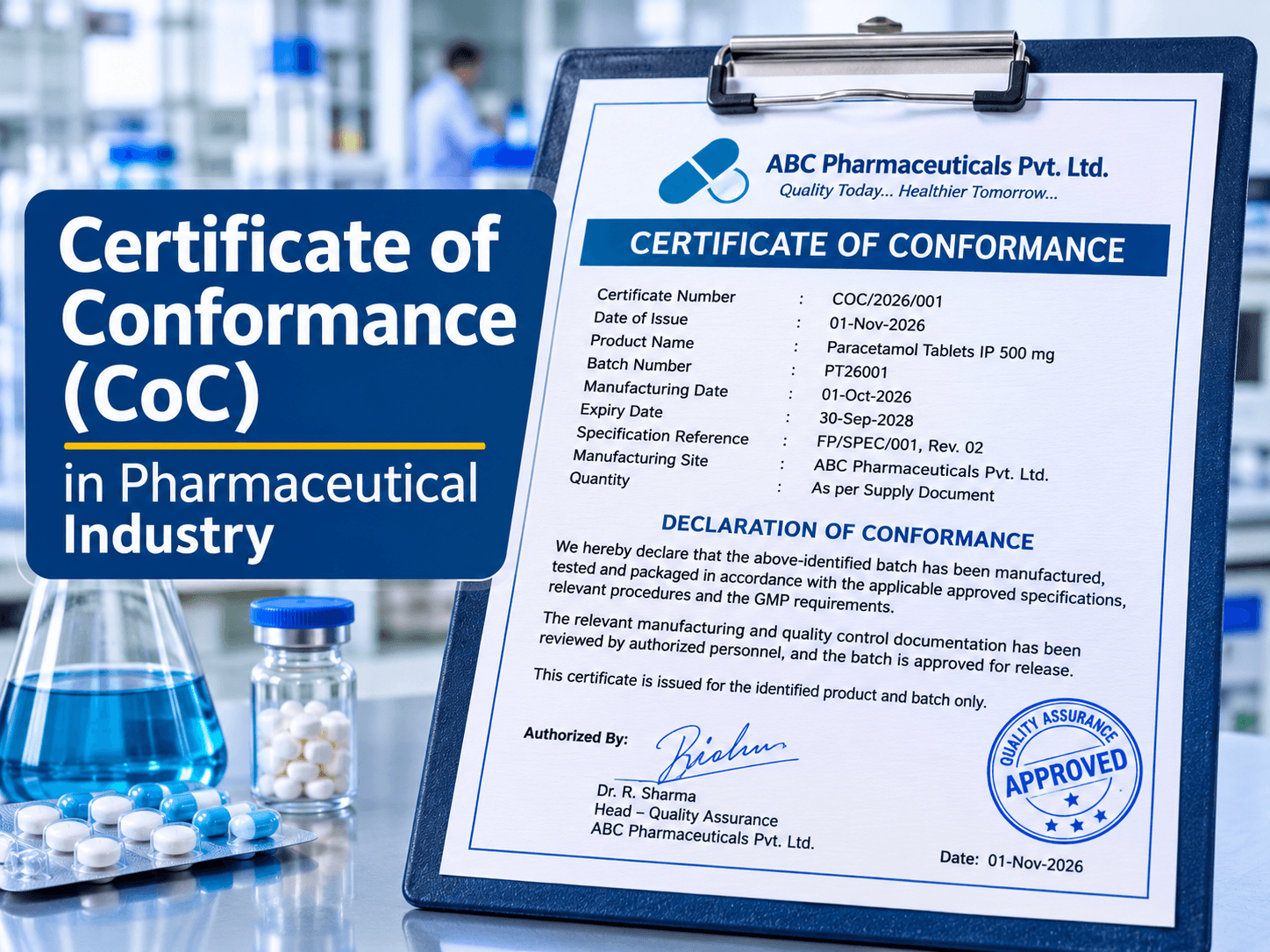
10. Sample Certificate of Conformance Format
The following is an illustrative format that can be adapted according to the organization’s quality system and customer requirements.
CERTIFICATE OF CONFORMANCE
| COMPANY NAME AND LOGO | |
| Certificate Number | COC/2026/001 |
| Date of Issue | 01-Nov-2026 (Illustrative) |
| Product Name | Paracetamol Tablets IP 500 mg |
| Batch Number | PT26001 |
| Manufacturing Date | 01-Oct-2026 |
| Expiry Date | 30-Sep-2028 |
| Specification Reference | FP/SPEC/001, Revision 02 |
| Manufacturing Site | Example Pharmaceutical Manufacturing Site |
| Quantity | As per applicable supply documentation |
|
DECLARATION OF CONFORMANCE
We hereby declare that the above-identified batch has been manufactured, tested and packaged in accordance with the applicable approved specifications, relevant approved procedures and the applicable GMP requirements within the scope of this declaration. The relevant manufacturing, packaging and quality control documentation has been reviewed by authorized personnel, and the batch has been approved for release in accordance with the organization’s approved quality procedures. This declaration is applicable only to the product and batch identified in this certificate. |
|
| Authorized By | ________________________ |
| Name | Authorized QA Representative |
| Designation | Head / Designee – Quality Assurance |
| Signature and Date | ________________________ |
Note: This is an illustrative template and not a prescribed regulatory certificate. The declaration must be modified to reflect the actual evidence reviewed, the applicable product category and the contractual or regulatory requirements. It must not be issued against a batch that has not completed the applicable release process.
11. Important QA Checks Before Issuing a CoC
Before approving a Certificate of Conformance, QA should ensure the following:
- Correct product name and batch number are mentioned.
- Manufacturing and expiry dates are accurate, where applicable.
- The applicable specification and revision are correctly identified.
- All required manufacturing and packaging activities have been completed.
- Required analytical testing has been completed and reviewed.
- All relevant deviations and investigations have been assessed.
- Applicable change controls have been reviewed.
- Batch release status is confirmed where the certificate refers to a released batch.
- The declaration is consistent with approved regulatory and customer requirements.
- The certificate is reviewed and approved by authorized personnel.
- Certificate number and issue date are correctly assigned.
- A copy of the issued certificate is retained for traceability.
12. Common Mistakes and Deficiencies in CoC
During customer audits, supplier audits and quality documentation reviews, the following deficiencies may be identified:
| Deficiency | Potential Impact | Recommended Control |
|---|---|---|
| Incorrect batch number | Loss of batch traceability. | Verify against approved batch and dispatch records. |
| Incorrect specification revision | Incorrect conformity declaration. | Verify the current approved specification. |
| Issuance before batch release | Premature or misleading conformity statement. | Verify batch status before issuance. |
| Missing authorization | Uncontrolled certificate issuance. | Use approved signatures and authorization controls. |
| Generic declaration without supporting evidence | Inability to demonstrate conformity. | Define the scope and retain supporting records. |
| Incorrect manufacturing details | Documentation discrepancies. | Cross-check against approved batch records. |
| Uncontrolled certificate template | Use of obsolete or incorrect information. | Maintain approved templates under document control. |
| Alteration after approval | Data integrity and traceability concerns. | Control revisions and reissuance through approved procedures. |
13. Data Integrity Requirements for CoC
Certificate preparation, approval and distribution should comply with applicable data integrity principles.
Organizations using paper-based or electronic systems should ensure that the certificate is accurate, complete, attributable and traceable.
Important controls include:
- Unique certificate identification numbers.
- Controlled certificate templates.
- Restricted access to certificate preparation and approval.
- Traceable signatures and approval dates.
- Electronic signature controls, where applicable.
- Audit trails for relevant electronic records.
- Prevention of unauthorized modification.
- Controlled cancellation and reissuance.
- Retention of original approved records.
Where electronic systems are used, applicable electronic record and signature requirements, including 21 CFR Part 11 where relevant, should be considered.
14. Electronic Certificate of Conformance (e-CoC)
With the increasing adoption of digital quality management systems, pharmaceutical organizations are moving towards electronic preparation, review, approval and distribution of certificates.
An Electronic Certificate of Conformance (e-CoC) is a digitally generated certificate managed through an approved electronic system.
Some advantages include:
- Reduced manual documentation errors.
- Faster certificate preparation and distribution.
- Improved batch traceability.
- Controlled access and authorization.
- Improved document retrieval.
- Better integration with ERP and QMS platforms.
- Electronic approval and audit trail availability.
- Reduced paper documentation.
However, electronic certificates must be managed through appropriately validated systems with suitable access controls, audit trails, electronic signature controls and backup arrangements, as applicable.
15. CoC in Supplier Qualification and Vendor Management
Supplier qualification is an important element of the pharmaceutical Quality Management System.
When purchasing raw materials, APIs, excipients, packaging materials or other GMP-relevant components, manufacturers may request CoC documentation from approved suppliers.
During supplier qualification, the manufacturer’s QA or Vendor Quality team should evaluate:
- Supplier manufacturing capabilities.
- Applicable GMP or quality certifications.
- Approved material specifications.
- Supplier testing and inspection controls.
- Certificate authenticity and reliability.
- Supplier audit observations.
- Change notification arrangements.
- Deviation and complaint management.
- Material traceability arrangements.
A supplier-issued CoC should be treated as supporting documentation. It does not automatically eliminate the pharmaceutical manufacturer’s responsibility for incoming material verification, testing, approval and release under applicable GMP requirements.
16. Difference Between CoC, CoA, Certificate of Manufacture and Certificate of Pharmaceutical Product
These documents are sometimes confused because they are all used in pharmaceutical quality and regulatory documentation. However, their purposes are different.
| Document | Main Purpose |
|---|---|
| Certificate of Conformance (CoC) | Declares that a specified product, material or batch conforms to defined requirements. |
| Certificate of Analysis (CoA) | Provides analytical test results and acceptance criteria for a specific sample or batch. |
| Certificate of Manufacture (CoM) | Confirms that a particular batch has been manufactured according to the applicable manufacturing documentation. |
| Certificate of Pharmaceutical Product (CPP) | A certificate issued under the WHO certification scheme by the competent authority of the exporting country to provide information about the product and its regulatory status. |
| EU QP Batch Certification | Formal certification of a medicinal product batch by a Qualified Person under applicable EU requirements before release to the market. |
17. Best Practices for Pharmaceutical Manufacturers
To ensure effective control of CoC issuance, pharmaceutical manufacturers should establish a standardized process covering the following activities:
- Develop an approved SOP for CoC preparation and issuance.
- Establish a standardized and controlled CoC template.
- Define the responsibilities of QA, QC, Production and other departments.
- Clearly define the conformity requirements applicable to different products and materials.
- Ensure batch-specific information is verified against approved records.
- Establish an approval matrix for authorized signatories.
- Maintain certificate numbering and issuance registers.
- Implement appropriate controls for electronic certificates.
- Establish procedures for correction, cancellation and reissuance.
- Periodically review CoC processes through internal audits.
- Ensure customer-specific requirements are incorporated into relevant quality agreements.
- Train concerned personnel on certificate preparation and verification.
18. Frequently Asked Questions (FAQs)
Q1. What is a Certificate of Conformance in the pharmaceutical industry?
A Certificate of Conformance is a formal document issued by an authorized manufacturer or supplier confirming that a specified product, material or batch complies with defined specifications, standards or applicable requirements.
Q2. Is a Certificate of Conformance mandatory for every pharmaceutical batch?
No. There is no universal requirement to issue a separate CoC for every pharmaceutical batch. Its issuance depends on applicable regulatory requirements, customer agreements, product specifications and organizational procedures.
Q3. What is the difference between CoC and CoA?
A CoA provides actual analytical test results and acceptance criteria, whereas a CoC provides a declaration that the identified product or material conforms to defined requirements.
Q4. Who is responsible for issuing a CoC?
It is generally issued by the manufacturer or supplier through its authorized quality system. QA commonly reviews and approves the certificate according to the applicable SOP.
Q5. Can QA issue a CoC before batch release?
Where the certificate declares that a finished product batch has been manufactured, tested and released in conformity with requirements, it should not be issued before completion of the applicable release process. Other limited conformity statements may be issued at an earlier stage only when their scope is clearly defined and supported by evidence.
Q6. Can CoC and CoA be combined into one document?
Yes. Depending on customer requirements and the applicable quality system, CoC and CoA information may be presented in separate documents or combined into one document. The analytical results and conformity declaration should remain clearly distinguishable.
Q7. Is a CoC a replacement for batch manufacturing records?
No. A CoC does not replace approved batch manufacturing records, packaging records, laboratory records or other GMP documentation.
Q8. Does a supplier CoC eliminate incoming material testing?
No. Supplier certificates may support incoming material verification, but they do not automatically eliminate applicable testing and approval requirements. Any reliance on supplier test results must be justified and controlled under applicable GMP requirements.
Q9. What should QA verify before approving a CoC?
QA should verify product identification, batch details, applicable specifications, supporting manufacturing and quality records, batch release status where relevant, accuracy of the declaration and authorization requirements.
Q10. What is an Electronic Certificate of Conformance?
An e-CoC is a certificate generated, reviewed, approved and distributed through an electronic document or quality management system with appropriate controls for access, signatures, audit trails and record retention.
19. Conclusion
The Certificate of Conformance is an important supporting document in the pharmaceutical quality management system. It provides documented assurance that a specified product, material or batch meets the applicable requirements within the scope of the declaration.
When properly controlled, CoC supports supplier qualification, customer confidence, material traceability, quality agreements and regulatory documentation.
From a Quality Assurance perspective, the most important consideration is that every conformity statement must be accurate, supported by appropriate documented evidence and approved by authorized personnel.
Pharmaceutical manufacturers should therefore establish a well-defined procedure for CoC preparation, verification, approval, issuance and record retention to ensure transparency, traceability and GMP compliance.
Remember: A Certificate of Conformance is not merely a document confirming quality. It is a formal quality declaration that must be supported by evidence and maintained under an effective pharmaceutical Quality Management System.
References
- USFDA – Q7A Good Manufacturing Practice Guidance for Active Pharmaceutical Ingredients.
- European Medicines Agency – GMP and GDP Guidelines and Questions & Answers.
- WHO – Certification Scheme on the Quality of Pharmaceutical Products Moving in International Commerce.
- WHO – Model Certificate of a Pharmaceutical Product.
- USFDA – Questions and Answers on Current Good Manufacturing Practice Regulations.
Disclaimer: This article is intended for educational and professional knowledge-sharing purposes. It should not be considered a substitute for applicable regulatory requirements, approved company procedures, customer agreements or professional regulatory advice. Always refer to the latest applicable regulations and approved quality documentation.