Change Management System in Pharmaceutical Industry: Complete Guide (2026)
The pharmaceutical industry operates in one of the most highly regulated environments in the world. Every modification made to a manufacturing process, facility, equipment, computer system, analytical method, supplier, packaging material, or documentation has the potential to impact product quality, patient safety, regulatory compliance, and business continuity. Because of these risks, pharmaceutical companies are required to establish a robust Change Management System, commonly referred to as a Change Control System, as part of their Pharmaceutical Quality System (PQS).
A well-designed Change Management System ensures that every proposed change is scientifically evaluated, documented, approved, implemented, verified, and monitored before becoming part of routine operations. Rather than preventing change, the objective is to manage change in a controlled manner while maintaining the validated state of processes and ensuring continued compliance with Good Manufacturing Practices (GMP).
Regulatory agencies including the US FDA, European Medicines Agency (EMA), MHRA, WHO, PIC/S, and many national authorities routinely inspect pharmaceutical companies for the effectiveness of their change management procedures. Deficiencies in change control remain one of the common observations issued during regulatory inspections because poorly controlled changes frequently lead to deviations, complaints, recalls, validation failures, and data integrity issues.
Table of Contents
- Introduction to Change Management
- What is Change Management?
- Objectives of Change Control
- Importance in Pharmaceutical Manufacturing
- Regulatory Requirements
- Types of Pharmaceutical Changes
- Classification of Changes
- Change Management Lifecycle
- Key Elements of an Effective System
What is Change Management in Pharma?
Change Management is a formal, documented, and systematic process used to evaluate, approve, implement, and verify changes that may affect pharmaceutical products, manufacturing processes, quality systems, facilities, utilities, computerized systems, equipment, analytical methods, packaging, suppliers, or regulatory commitments.
The primary objective is to ensure that any change introduced into the organization does not adversely affect:
- Product Quality
- Patient Safety
- Product Efficacy
- Regulatory Compliance
- Validated State
- Data Integrity
- Business Continuity
Instead of viewing change as a risk, pharmaceutical quality systems recognize that improvements are necessary for innovation, efficiency, technological advancement, and continuous improvement. A structured change management system allows organizations to embrace improvements while minimizing risks.
Definition According to ICH Q10
ICH Q10 describes Change Management as a systematic approach to proposing, evaluating, approving, implementing, and reviewing changes. It requires that quality risk management principles be applied throughout the change process to ensure product quality is maintained.
The guideline emphasizes that the level of effort and formality associated with change management should be proportional to the level of risk associated with the proposed change.
Objectives of Change Management System
An effective Change Management System is designed to achieve several important objectives that support the Pharmaceutical Quality System.
- Maintain product quality throughout the product lifecycle.
- Ensure patient safety is never compromised.
- Maintain compliance with GMP regulations.
- Protect the validated status of facilities, equipment, utilities, and processes.
- Identify and mitigate potential risks before implementation.
- Ensure cross-functional review and approval.
- Maintain complete documentation for regulatory inspections.
- Evaluate regulatory impact before implementing changes.
- Prevent unintended consequences resulting from uncontrolled modifications.
- Support continuous improvement initiatives.
Why is Change Management Important?
Every pharmaceutical manufacturing operation depends on consistency. Even a seemingly insignificant modification can create unexpected consequences if it is introduced without proper evaluation.
Examples include:
- Replacing an equipment component with a non-equivalent spare part
- Changing raw material suppliers
- Updating manufacturing software
- Changing sterilization parameters
- Modifying analytical methods
- Introducing new packaging materials
- Changing environmental monitoring frequencies
- Updating batch manufacturing records
- Relocating manufacturing equipment
- Changing cleaning agents
Each of these modifications may affect validated processes, regulatory filings, product quality, or patient safety. Therefore, structured evaluation before implementation is essential.
Regulatory Requirements for Change Management
Global regulatory agencies consistently require pharmaceutical manufacturers to establish documented procedures for change management. Although wording differs slightly among guidelines, the expectations remain fundamentally the same.
US FDA
The FDA expects manufacturers to establish written procedures that evaluate all changes affecting identity, strength, quality, purity, or potency of drug products. Changes should be scientifically justified, appropriately documented, and supported through validation whenever required.
ICH Q10 Pharmaceutical Quality System
ICH Q10 identifies Change Management as one of the four major quality system elements alongside:
- Process Performance and Product Quality Monitoring
- Corrective and Preventive Action (CAPA)
- Management Review
- Change Management
Quality Risk Management principles from ICH Q9 should be integrated into every stage of the change process.
EU GMP Chapter 1
European GMP requires that quality risk management principles be applied to evaluate planned changes before implementation. Appropriate qualification, validation, and regulatory assessment should be completed where applicable.
WHO GMP
WHO GMP guidelines recommend that pharmaceutical manufacturers establish documented procedures to ensure proposed changes are reviewed, approved, implemented, and verified systematically.
PIC/S GMP
PIC/S guidance emphasizes that all changes should undergo formal assessment for potential impacts on product quality, patient safety, regulatory commitments, and validated status before implementation.
Types of Changes in Pharmaceutical Industry
Pharmaceutical organizations manage hundreds of changes every year. These changes may originate from engineering projects, quality improvements, regulatory commitments, cost reduction initiatives, supplier changes, or technological upgrades.
1. Facility Changes
- HVAC modifications
- Room classification changes
- Building expansion
- Warehouse modifications
- New production areas
2. Equipment Changes
- Equipment replacement
- Major repairs
- Capacity upgrades
- Automation improvements
- Installation of new manufacturing machines
3. Utility Changes
- Purified water system modifications
- Compressed air system upgrades
- Steam system changes
- Nitrogen supply modifications
- Electrical system improvements
4. Manufacturing Process Changes
- Mixing time revision
- Granulation parameter changes
- Compression force adjustment
- Coating parameter optimization
- Drying temperature modification
5. Analytical Changes
- Method revision
- New analytical instruments
- Column replacement
- Software upgrades
- Sample preparation modifications
6. Documentation Changes
- SOP revisions
- Batch Manufacturing Record updates
- Specification revisions
- Validation protocol updates
- Quality Manual revisions
7. Computerized System Changes
- ERP upgrades
- LIMS updates
- MES implementation
- SCADA modifications
- Electronic Batch Record updates
8. Supplier Changes
- New API supplier
- Packaging vendor qualification
- Excipient manufacturer changes
- Contract laboratory additions
- Contract manufacturing organization changes
Classification of Changes
Most pharmaceutical companies classify changes based on their potential impact on product quality, regulatory commitments, validation status, and patient safety. A risk-based classification ensures that resources are focused on changes with the greatest potential impact.
| Classification | Risk Level | Typical Examples |
|---|---|---|
| Major Change | High | Manufacturing process changes, facility modifications, equipment replacement, API supplier changes, sterilization process changes |
| Moderate Change | Medium | SOP revisions, analytical method updates, packaging component changes, software upgrades |
| Minor Change | Low | Editorial document corrections, equivalent spare part replacement, minor layout improvements |
Organizations should define clear criteria within their SOPs to classify changes consistently and determine the appropriate level of review, approval, validation, and regulatory assessment.
The Change Management Lifecycle
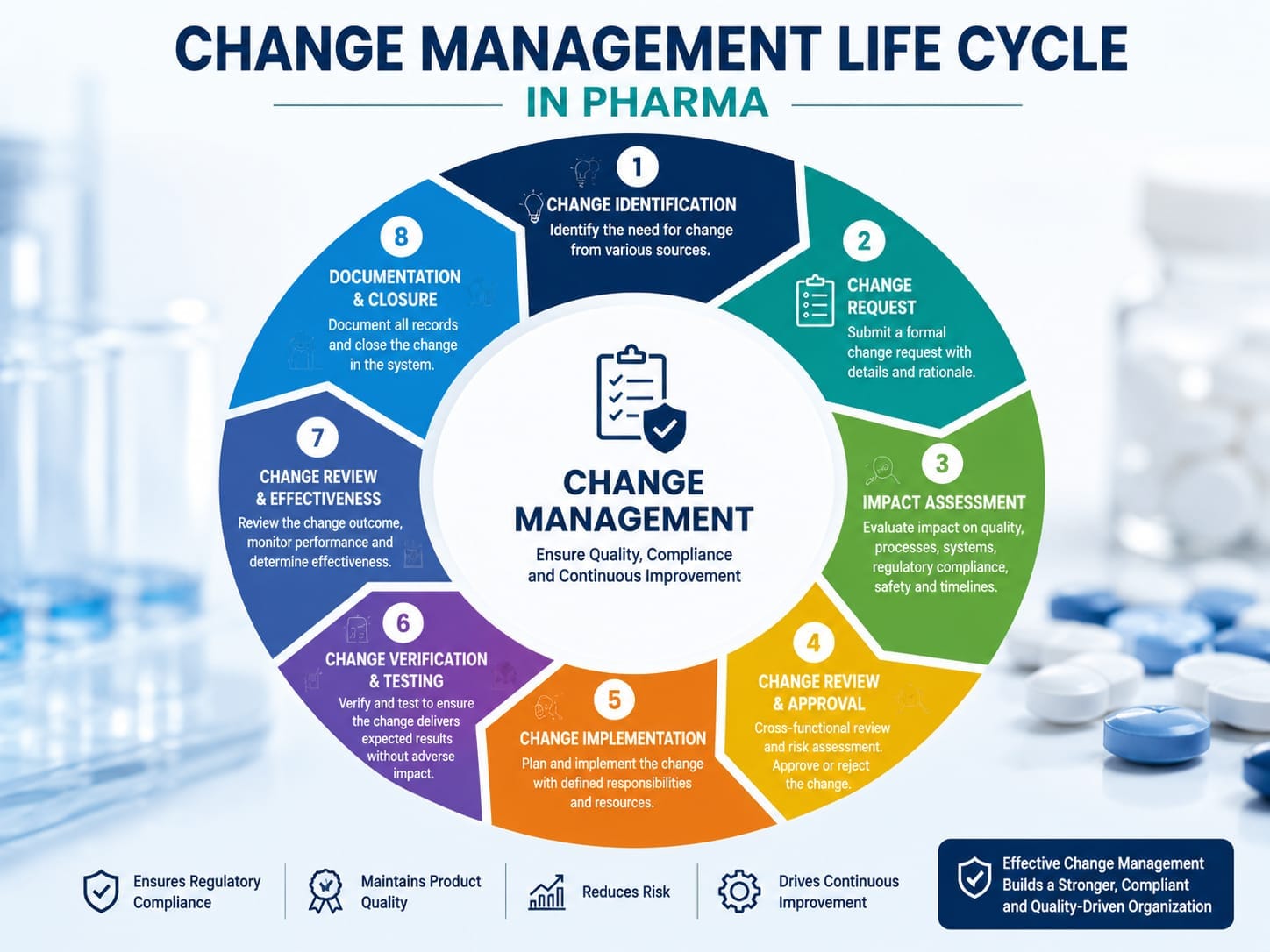
An effective Change Management System follows a structured lifecycle to ensure every proposed modification is evaluated, approved, implemented, verified, and documented before routine use.
- Change Request Initiation
- Preliminary Review
- Risk Assessment
- Impact Assessment
- Cross-Functional Approval
- Implementation Planning
- Execution of the Change
- Qualification and Validation Activities
- Effectiveness Verification
- Final Review and Closure
Each stage requires documented evidence to demonstrate that the change was implemented in a controlled manner and that it achieved the intended outcome without introducing new risks.
Key Elements of an Effective Change Management System
- Documented Change Control SOP
- Risk-based decision making
- Cross-functional review and approval
- Scientific justification for every change
- Impact assessment on quality, validation, and regulatory filings
- Defined implementation plans
- Training requirements
- Qualification and validation activities
- Effectiveness checks after implementation
- Management oversight and periodic review
When these elements are consistently applied, organizations can implement improvements confidently while maintaining compliance with global GMP requirements and protecting product quality throughout the product lifecycle.
Continue to Part 2: In the next section, we’ll cover the complete Change Control workflow, roles and responsibilities, quality risk management, impact assessment, validation requirements, documentation practices, implementation, effectiveness checks, and common FDA inspection observations related to Change Management.
Regulatory Disclaimer
Disclaimer: This article is intended solely for educational and informational purposes. While every effort has been made to ensure accuracy based on current pharmaceutical regulations and industry best practices, readers should always refer to the latest official guidance issued by regulatory authorities such as the US FDA, EMA, MHRA, WHO, PIC/S, and ICH before making compliance or business decisions. Company-specific Standard Operating Procedures (SOPs), internal quality systems, and applicable national regulations should always take precedence where relevant.
Author: Mahummed Asif
Founder, PharmaShare | Pharmaceutical Quality & Regulatory Professional