
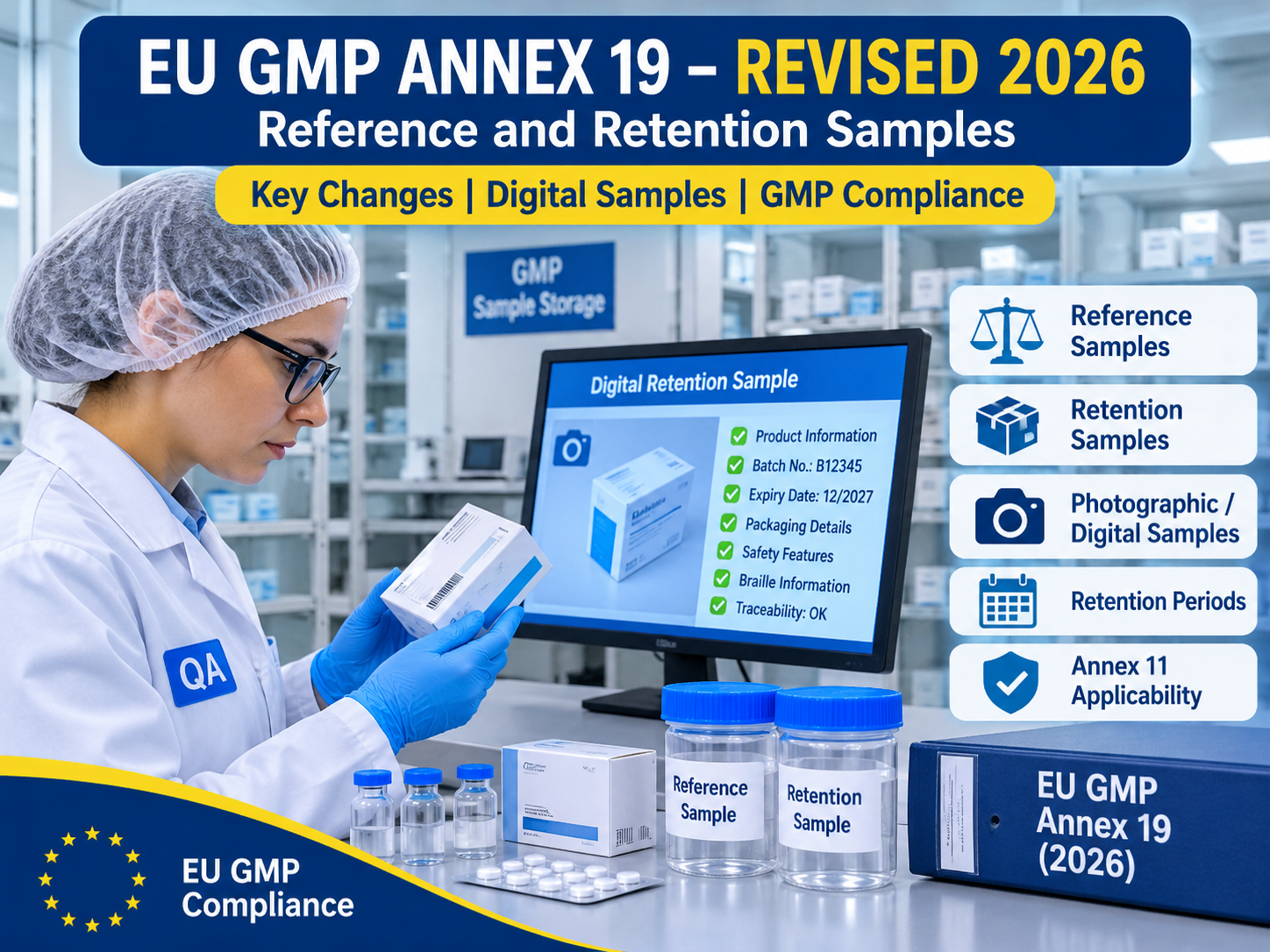
EU GMP Annex 19 Revised in 2026: Complete Guide to Reference and Retention Samples
Last Updated: November 2026
Introduction
The European Union (EU) Good Manufacturing Practice (GMP) guidelines establish essential requirements for pharmaceutical manufacturers to ensure the quality, safety and efficacy of medicinal products.
Within EU GMP Volume 4, Annex 19 specifically addresses the requirements for Reference and Retention Samples. These samples play an important role in pharmaceutical quality assurance, batch traceability, product investigations, complaint handling and regulatory compliance.
In an important regulatory development, the European Commission published a revised version of EU GMP Annex 19 on 24 June 2026. The revised requirements became applicable on 24 September 2026, three months after publication.
The revision primarily focuses on reference and retention samples for parallel-imported, parallel-distributed and parallel-traded medicinal products. It also provides provisions for using photographic or digital samples as an alternative to physical retention samples under specific conditions.
This article explains the revised Annex 19, its major requirements, changes introduced in 2026 and the practical actions pharmaceutical manufacturers and quality assurance departments should consider.
1. What Is EU GMP Annex 19?
EU GMP Annex 19 is a guideline under EudraLex Volume 4 that describes the requirements for taking, storing and maintaining reference and retention samples of pharmaceutical materials and finished products.
Its primary objective is to ensure that appropriate samples are available throughout the required retention period for investigation, identification and analytical testing whenever necessary.
Reference and retention samples are particularly important during:
- Market complaints and product quality investigations.
- Out-of-specification (OOS) investigations.
- Product recalls and field safety corrective actions.
- Packaging and labelling investigations.
- Regulatory inspections and audits.
- Pharmacovigilance-related investigations.
- Verification of compliance with the marketing authorisation.
2. Reference Sample vs Retention Sample
Although the terms reference sample and retention sample are sometimes used interchangeably, they have different purposes under EU GMP Annex 19.
2.1 Reference Sample
A reference sample is a sample of a batch of starting material, packaging material or finished product retained for the purpose of analytical testing whenever required during the shelf life of the relevant batch.
Reference samples help laboratories perform additional testing when investigating quality concerns or verifying product compliance.
Examples include:
- Active pharmaceutical ingredients (APIs).
- Excipients.
- Starting materials.
- Primary packaging materials.
- Printed packaging materials.
- Finished pharmaceutical products.
2.2 Retention Sample
A retention sample is a fully packaged unit of a finished pharmaceutical product retained primarily for identification purposes.
It should represent the product as released for the market, including its packaging and labelling information.
Examples of information available in a retention sample include:
- Product name and strength.
- Batch or lot number.
- Manufacturing and expiry dates, where applicable.
- Primary packaging configuration.
- Secondary packaging configuration.
- Product labels and patient information leaflet.
- Safety features and other market-specific information.
2.3 Key Differences
| Parameter | Reference Sample | Retention Sample |
|---|---|---|
| Primary purpose | Analytical testing | Product identification |
| Sample type | Starting materials, packaging materials and finished products | Fully packaged finished product |
| Testing | Used for analytical testing when required | Used for identification and examination |
| Packaging | Appropriate representative sample packaging | Marketed packaging configuration |
| Typical application | Quality investigations and analytical verification | Packaging, labelling and product presentation investigations |
For finished products, reference and retention samples may be interchangeable when they are presented identically as fully packaged units.
3. Major Changes in EU GMP Annex 19 – 2026 Revision
The 2026 revision focuses on requirements for reference and retention samples associated with parallel-imported, parallel-distributed and parallel-traded medicinal products.
The main updates are associated with Section 9 of Annex 19.
3.1 Introduction of Photographic/Digital Retention Samples
One of the important developments in the revised Annex 19 is the provision allowing photographic or digital samples as an alternative to physical retention samples for repackaged products in qualifying circumstances.
However, this is not a general permission to replace all physical retention samples with photographs.
The use of photographic/digital samples is permitted only when:
- There is a justified reason why a physical retention sample cannot reasonably be retained.
- The proposed arrangement is agreed in advance with the competent authority.
- The digital sample provides sufficient information for a full visual examination.
- The digital record supports investigations equivalent to those possible using a physical retention sample.
- Appropriate traceability to the relevant batch packaging record is maintained.
3.2 Requirements for Digital Retention Samples
According to the revised Section 9, photographic/digital samples should meet specific requirements.
A. High-quality photographs
The photographs should be of sufficient quality to permit a complete visual examination of the repackaged finished product.
B. Primary and secondary packaging information
The digital record should include all relevant information appearing on both primary and secondary packaging, including:
- Product identification.
- Batch number.
- Expiry date.
- Packaging and labelling information.
- Other relevant market-specific information.
C. Safety features
The digital sample should provide evidence that applicable safety features have been applied to the product packaging.
D. Braille information
The photographic/digital record should allow the identification of information presented in Braille on the packaging.
E. Traceability
The digital sample should be traceable to the batch packaging record of the specific repackaged finished product.
F. Electronic record integrity
Digital samples stored electronically should comply with the applicable principles of EU GMP Annex 11 to ensure the integrity of the electronic records throughout the retention period.
3.3 Physical Samples of Repackaging Materials
The revised Annex 19 continues to require physical samples of packaging materials used during the repackaging process.
Examples include:
- Labels.
- Cartons.
- Patient information leaflets.
- Other package inserts.
These physical packaging samples should be retained for the duration of the shelf life of the repackaged finished product.
3.4 Reference Samples of Repackaged Products
Under Section 9.2 of the revised Annex 19, reference samples of the repackaged product are not required.
However, the applicable retention sample requirements continue to apply.
4. Detailed Requirements for Reference and Retention Samples
Although the 2026 revision focuses on parallel-traded products, the other general requirements of Annex 19 remain important for pharmaceutical manufacturers.
4.1 Duration of Storage
Annex 19 establishes the following general retention periods:
| Sample Category | Minimum Retention Period |
|---|---|
| Finished product reference samples | At least one year after the expiry date |
| Finished product retention samples | At least one year after the expiry date |
| Starting material samples | At least two years after release of the finished product, subject to applicable exceptions |
| Packaging material samples | For the duration of the shelf life of the finished product concerned |
| Repackaging material samples under revised Section 9 | For the duration of the shelf life of the repackaged finished product |
Important: Starting material samples, other than solvents, gases and water used in the manufacturing process, are generally retained for at least two years after release of the finished product. The period may be shortened when the material’s specified stability period is shorter, subject to the applicable requirements. National legislation may also prescribe a longer period.
4.2 Size of Reference Samples
Reference samples should be sufficient in quantity to allow full analytical testing of the relevant batch on at least two occasions, in accordance with the approved marketing authorisation specifications.
Where required, unopened packs should be used for each set of analytical controls.
Any proposed exception should be justified and agreed with the relevant competent authority.
4.3 Representativeness of Samples
Reference samples should be representative of the batch from which they are taken.
Additional samples may be collected from the most stressed parts of the manufacturing process, such as the beginning or end of a production run.
Where a batch is packaged in two or more distinct packaging operations, at least one retention sample should be taken from each individual packaging operation.
4.4 Storage Conditions
Reference and retention samples should be stored under appropriate conditions to maintain their integrity and suitability for the intended purpose.
Storage conditions should be consistent with the marketing authorisation and applicable product storage requirements.
Examples include:
- Controlled room temperature.
- Refrigerated conditions.
- Frozen storage, where applicable.
- Protection from light and moisture.
- Other product-specific storage conditions.
Storage areas should be appropriately controlled, monitored and protected against unauthorised access.
5. Written Agreements and Responsibilities
When the marketing authorisation holder (MAH) and the site responsible for batch release are different legal entities, responsibilities for taking and storing reference and retention samples should be defined in a written agreement.
These arrangements should also be established when manufacturing, packaging, testing or batch-release activities are performed at different locations.
The written agreement should clearly define:
- Responsibility for sample collection.
- Responsibility for sample storage.
- Sample quantities and identification.
- Storage conditions.
- Sample traceability.
- Access to samples during investigations.
- Responsibilities for sample transfer.
- Responsibilities during site closure or discontinuation.
The Qualified Person (QP) responsible for batch certification should ensure that relevant reference and retention samples are accessible at all reasonable times.
6. Reference Sample Requirements – General Points
Reference samples should be conveniently accessible to a laboratory with appropriate validated analytical methods.
For starting materials used in products manufactured within the EEA, the reference samples should generally be available at the original site of manufacture of the finished product.
For finished products manufactured within the EEA, reference samples should generally be maintained at the original manufacturing site.
For finished products manufactured outside the EEA, the storage arrangements depend on whether an operational Mutual Recognition Agreement (MRA) is in place.
- Where an operational MRA is in place, reference samples may be stored at the manufacturing site outside the EEA, subject to an appropriate written agreement.
- Where an operational MRA is not in place, reference samples of finished medicinal products should be taken and stored at an authorised manufacturer within the EEA.
- Reference samples of starting and packaging materials should be maintained at the original site where they were used.
7. Retention Sample Requirements – General Points
Retention samples should represent the finished product as distributed in the EEA.
They should be suitable for examining non-technical attributes to verify compliance with the marketing authorisation and relevant EU legislation.
Important requirements include:
- Retention samples should be located within the EEA.
- They should preferably be stored at the site where the QP responsible for batch certification is located.
- They should be maintained at authorised manufacturer premises.
- They should be readily accessible to competent authorities.
- Written agreements should define responsibilities when multiple sites are involved.
8. Revised Section 9: Parallel Imported, Distributed and Traded Products
This section represents the primary focus of the 2026 revision.
Parallel trade involves the movement and supply of medicinal products between different markets within the applicable regulatory framework. Such products may require repackaging or relabelling to comply with the requirements of the destination market.
The revised Annex 19 provides specific expectations for sample management associated with these activities.
8.1 Physical Packaging Material Samples
Physical samples of packaging materials used during repackaging, such as labels, cartons and patient information leaflets, should be retained for the shelf life of the repackaged finished product.
8.2 No Requirement for Repackaged Product Reference Samples
Reference samples of the repackaged product are not required under Section 9.2.
8.3 Retention Sample for Each Repackaging Operation
A retention sample of the repackaged finished product should be taken for every repackaging operation.
It should be retained for at least one year after the expiry date.
8.4 Representation of Repackaged Products
The retention sample should represent the repackaged finished product released to the market.
It should include:
- Primary packaging.
- Secondary packaging.
Where the secondary packaging is not opened, only the packaging material used needs to be retained.
8.5 Alternative to Physical Retention Samples
Where it is duly justified that retaining a physical sample of the repackaged finished product is not reasonably possible, and the competent authority has agreed in advance, a photographic/digital sample may be retained.
This provision should be implemented through a controlled and documented procedure.
9. Application of EU GMP Annex 11 to Digital Retention Samples
The introduction of photographic/digital retention samples makes electronic record integrity an important compliance consideration.
Annex 19 specifically requires electronically stored photographic/digital samples to comply with the principles of Annex 11.
Pharmaceutical organisations should consider the following controls:
| Control Area | Recommended GMP Control |
|---|---|
| Access control | Role-based access and unique user identification |
| Data integrity | Protection against unauthorised modification or deletion |
| Audit trail | Appropriate traceability of relevant electronic record changes |
| Backup | Regular and verified backup of electronic records |
| Data retrieval | Ability to retrieve and display records throughout the retention period |
| Validation | Validation of the computerized system according to its intended use |
| Security | Protection against unauthorised access and cyber threats |
| Record linkage | Traceability between digital samples and batch packaging records |
Organisations should also assess whether their electronic sample management systems, image repositories and associated workflows are appropriately validated and controlled.
These measures support reliable electronic records and help ensure that digital samples remain available and trustworthy throughout the required retention period.
10. Requirements During Manufacturer Site Closure
Annex 19 also addresses the management of reference and retention samples when a manufacturer closes down or its manufacturing authorisation is surrendered, revoked or ceases to exist.
The manufacturer should establish arrangements to transfer reference and retention samples, together with relevant GMP documentation, to an authorised storage location.
The arrangements should ensure:
- Continued storage under appropriate conditions.
- Availability of samples for competent authority inspection.
- Accessibility for analytical testing when required.
- Availability of associated GMP documentation.
- Defined responsibilities for sample management.
Where the manufacturer cannot make these arrangements, the responsibility may be delegated to another manufacturer. The marketing authorisation holder has responsibilities for such delegation and for providing relevant information to the competent authority.
11. Impact of the 2026 Annex 19 Revision on Pharmaceutical QA Departments
The revised Annex 19 requires pharmaceutical organisations involved in parallel trade and repackaging activities to evaluate their existing sample management practices.
Quality Assurance should assess the impact of the revised requirements through a documented gap assessment.
The following actions are recommended:
11.1 Perform a Gap Assessment
Compare existing sample management procedures against the revised Annex 19 requirements, particularly Section 9.
11.2 Revise SOPs
Update relevant SOPs covering:
- Reference sample collection and storage.
- Retention sample collection and storage.
- Parallel trade and repackaging operations.
- Digital sample management.
- Sample traceability and retrieval.
- Sample destruction and disposal.
11.3 Evaluate Digital Sample Management Systems
Where photographic/digital retention samples are proposed, evaluate the system’s suitability, validation status, electronic record integrity and compliance with applicable Annex 11 principles.
11.4 Obtain Competent Authority Agreement
Do not replace physical retention samples with digital samples under Section 9.5 without documented justification and prior agreement with the competent authority.
11.5 Train Relevant Personnel
Provide training to QA, QC, packaging, warehouse, regulatory affairs and other relevant personnel on the revised requirements.
11.6 Review Quality Agreements
Review agreements between marketing authorisation holders, manufacturers, importers, repackaging sites and batch-release sites to ensure that sample responsibilities are clearly defined.
11.7 Maintain Traceability
Ensure that every sample or digital record can be linked to the relevant batch, packaging operation, product and associated documentation.
12. Practical GMP Implementation Checklist
The following checklist can be used by pharmaceutical QA departments during implementation of the revised Annex 19.
| Sr. No. | Verification Point | Expected Status |
|---|---|---|
| 1 | Revised Annex 19 reviewed and assessed | Compliant |
| 2 | Gap assessment completed | Documented |
| 3 | Reference sample SOP reviewed | Updated, if required |
| 4 | Retention sample SOP reviewed | Updated, if required |
| 5 | Sample retention periods verified | Compliant |
| 6 | Sample quantities verified | Compliant |
| 7 | Sample storage conditions verified | Compliant |
| 8 | Repackaging operation sample requirements reviewed | Compliant |
| 9 | Digital sample justification documented, if applicable | Available |
| 10 | Prior competent authority agreement obtained, if applicable | Available |
| 11 | Digital record integrity controls assessed | Compliant |
| 12 | Written agreements reviewed | Updated, if required |
| 13 | Personnel training completed | Documented |
| 14 | Sample traceability verified | Compliant |
13. Common GMP Inspection Observations Related to Reference and Retention Samples
During GMP inspections, inadequate sample management can create significant compliance concerns.
Examples of potential deficiencies include:
- Reference samples are not available for the required retention period.
- Retention samples do not represent the marketed product.
- Insufficient quantities of reference samples are maintained.
- Storage conditions are not adequately monitored.
- Samples cannot be traced to the relevant batch.
- Responsibilities between the MAH and manufacturing site are not clearly documented.
- Physical samples are replaced with digital photographs without prior competent authority agreement.
- Digital samples do not contain all required primary and secondary packaging information.
- Electronic sample records are not adequately protected against unauthorised modification or deletion.
- Samples are not readily accessible during regulatory inspections or investigations.
QA departments should periodically review their sample management systems through internal audits and documented compliance assessments.
14. Benefits of the Revised EU GMP Annex 19
The revised Annex 19 provides a more specific framework for managing reference and retention samples associated with parallel-traded products.
Its potential benefits include:
- Improved regulatory clarity: Clearer expectations for sample management during parallel trade and repackaging.
- Controlled digital alternatives: A defined pathway for photographic/digital retention samples in justified circumstances.
- Improved traceability: Stronger linkage between digital records and batch packaging documentation.
- Better packaging verification: Availability of visual information for examining labels, packaging and safety features.
- Electronic record integrity: Application of relevant Annex 11 principles to electronically stored samples.
- Efficient investigations: Better access to product and packaging information during quality investigations.
15. Important Difference Between the Previous and Revised Annex 19
| Subject | Previous Version | Revised 2026 Version |
|---|---|---|
| Revision focus | Existing requirements for reference and retention samples | Targeted update concerning parallel-traded products |
| Parallel-trade packaging samples | Physical packaging samples required | Physical packaging material samples continue to be required |
| Repackaged product reference samples | Reference samples not required | No change: not required |
| Repackaged product retention samples | Physical retention sample requirement | Digital alternative introduced under defined conditions |
| Digital sample acceptance | No equivalent explicit provision in Section 9 | Permitted when justified and agreed in advance with the competent authority |
| Digital sample content | Not specifically covered by the new provision | High-quality images, packaging information, safety features, Braille and traceability |
| Electronic record integrity | General applicable electronic record requirements | Explicit reference to Annex 11 principles for electronically stored digital samples |
| Effective date | Previous version | 24 September 2026 |
16. Frequently Asked Questions (FAQs)
Q1. What is EU GMP Annex 19?
EU GMP Annex 19 is a guideline that defines requirements for taking, storing and maintaining reference and retention samples of starting materials, packaging materials and finished pharmaceutical products.
Q2. When was EU GMP Annex 19 revised in 2026?
The European Commission published the revised Annex 19 on 24 June 2026. The revised requirements became applicable on 24 September 2026.
Q3. What is the major change in the revised Annex 19?
The major change concerns Section 9, which introduces the possibility of using photographic/digital samples instead of physical retention samples for qualifying parallel-imported, parallel-distributed or parallel-traded repackaged products.
Q4. Can pharmaceutical companies replace all physical retention samples with photographs?
No. The digital alternative is limited to the circumstances described in Section 9.5. It requires documented justification that a physical sample cannot reasonably be retained and prior agreement with the competent authority.
Q5. What information should be included in digital retention samples?
Digital samples should include high-quality photographs of the repackaged product, all relevant information on primary and secondary packaging, batch number, expiry date, safety features, Braille information and traceability to the specific batch packaging record.
Q6. Is EU GMP Annex 11 applicable to digital retention samples?
Yes. Section 9.5.4 requires electronically stored photographic/digital samples to comply with Annex 11 principles to ensure electronic record integrity throughout the retention period.
Q7. Are reference samples required for repackaged parallel-traded products?
No. Section 9.2 states that reference samples of the repackaged product are not required.
Q8. What is the retention period for repackaged finished product samples?
A retention sample should be taken for each repackaging operation and retained for at least one year after the expiry date.
Q9. What is the retention period for finished product reference and retention samples?
Both should generally be retained for at least one year after the expiry date, in accordance with the applicable requirements of Annex 19.
Q10. What should pharmaceutical QA departments do after the 2026 revision?
QA departments should perform a gap assessment, review relevant SOPs and quality agreements, evaluate digital sample management systems where applicable, train personnel and ensure that the revised Section 9 requirements are implemented.
17. Conclusion
The 2026 revision of EU GMP Annex 19 is an important regulatory development for pharmaceutical organisations involved in parallel-imported, parallel-distributed and parallel-traded medicinal products.
The introduction of photographic/digital retention samples as a controlled alternative to physical samples provides additional flexibility, but it also establishes specific expectations for justification, competent authority agreement, packaging information, traceability and electronic record integrity.
Pharmaceutical manufacturers, marketing authorisation holders, importers, repackaging organisations and Qualified Persons should review their existing sample management procedures to ensure compliance with the revised requirements.
From a Quality Assurance perspective, the key takeaway is that digital retention samples are not simply photographs stored in a computer system. They must be complete, traceable, reliable and maintained under appropriate GMP controls.
References and Regulatory Resources
- European Commission – EudraLex Volume 4: EU Guidelines for Good Manufacturing Practice
- European Commission – Revised Annex 19 publication, 24 June 2026
- Official EU GMP Annex 19 – Reference and Retention Samples (2026 PDF)
- EU GMP Annex 11 – Computerised Systems
Disclaimer: This article is intended for educational and professional information purposes only. It is not a substitute for the official European Commission GMP guidelines, applicable national legislation or competent authority requirements. Pharmaceutical organisations should refer to the current official regulatory documents when implementing GMP procedures.
About the Author
Mahummed Asif is a pharmaceutical Quality Assurance professional with extensive experience in pharmaceutical manufacturing, GMP compliance, Quality Management Systems, regulatory inspections, validation and continuous process improvement. He shares practical pharmaceutical QA and regulatory knowledge through PharmaShare.in.
Website: www.pharmashare.in