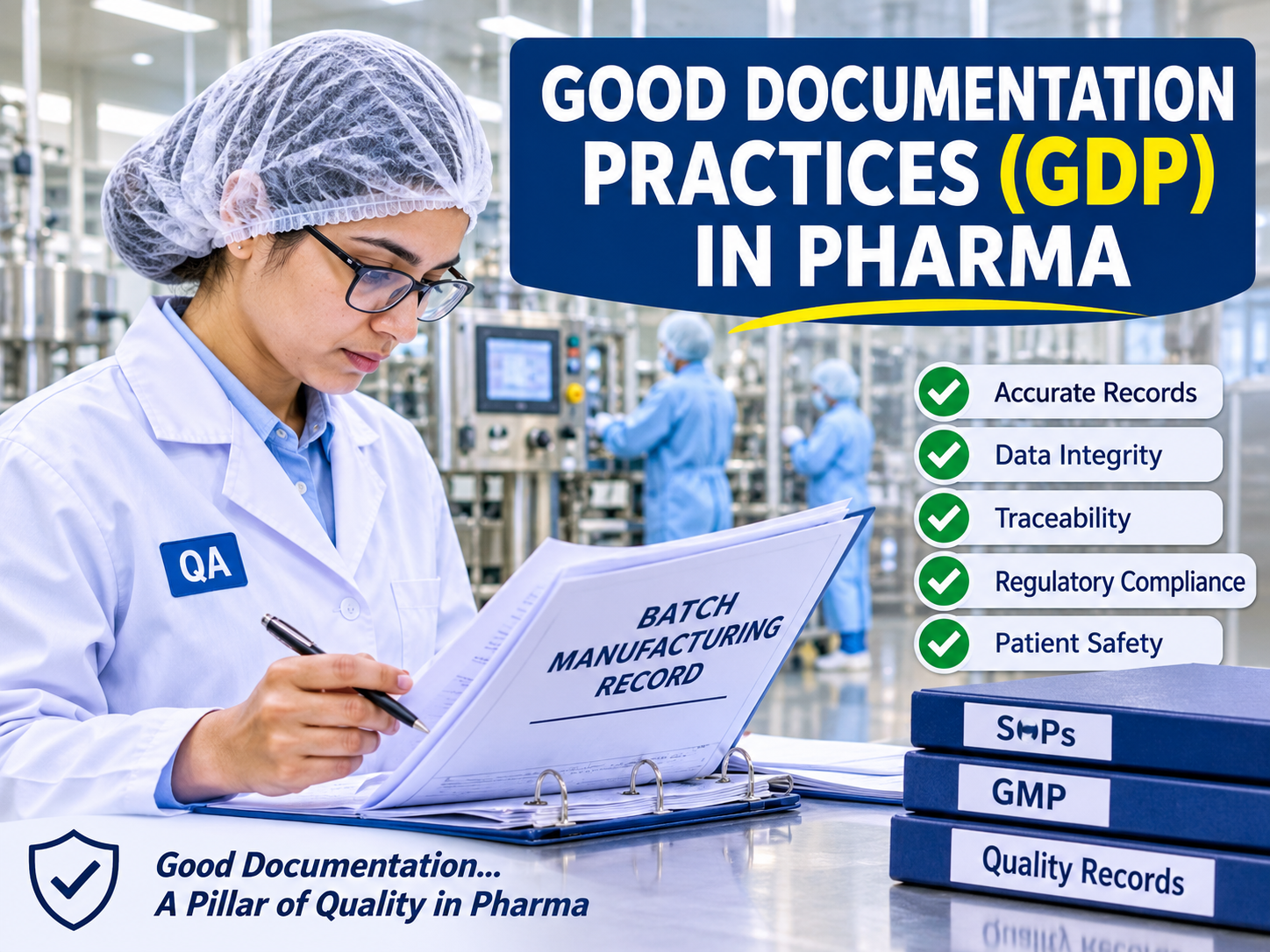
Good Documentation Practices (GDP) in Pharmaceutical Industry: A Complete Guide
Good Documentation Practices (GDP) are fundamental to pharmaceutical Quality Assurance and Good Manufacturing Practices (GMP). In pharmaceutical manufacturing, every critical activity must be properly documented to demonstrate that it was performed according to approved procedures, established specifications and regulatory requirements.
Documentation provides objective evidence of manufacturing, testing, cleaning, equipment maintenance, validation, quality control and other GMP-related activities. Accurate and reliable records help pharmaceutical companies maintain product quality, ensure traceability, investigate deviations and demonstrate regulatory compliance.
Regulatory authorities such as the US Food and Drug Administration (USFDA), European Medicines Agency (EMA), World Health Organization (WHO), and national regulatory agencies expect pharmaceutical manufacturers to maintain complete, accurate, legible and reliable records.
With increasing regulatory focus on data integrity, Good Documentation Practices are no longer limited to correct handwriting and proper record corrections. They also cover electronic records, audit trails, access controls, data governance, record retention and the complete data lifecycle.
This article explains the principles, requirements, practical implementation and common mistakes associated with Good Documentation Practices in the pharmaceutical industry.
1. What Are Good Documentation Practices (GDP)?
Good Documentation Practices are a set of principles and procedures used to ensure that pharmaceutical documents and records are created, reviewed, approved, completed, corrected, stored and retained in a controlled and consistent manner.
These practices ensure that all GMP-related activities are accurately recorded and that the information remains traceable, readable, reliable and available throughout its required retention period.
In simple terms, Good Documentation Practices ensure that pharmaceutical records provide a trustworthy account of what was actually performed, when it was performed, who performed it and what results were obtained.
Important: In this article, GDP refers to Good Documentation Practices or Good Documentation Practice (GDocP), not Good Distribution Practice.
2. Why Are Good Documentation Practices Important in Pharma?
Pharmaceutical products are manufactured for human and animal healthcare. Inaccurate or incomplete documentation can affect product quality, patient safety and regulatory compliance.
Effective documentation practices help pharmaceutical organizations to:
- Maintain compliance with applicable GMP requirements.
- Ensure the integrity and reliability of manufacturing and laboratory data.
- Provide traceability of manufacturing and testing activities.
- Demonstrate that approved procedures have been followed.
- Support batch manufacturing, packaging and batch release decisions.
- Facilitate deviation investigations and root cause analysis.
- Support CAPA implementation and effectiveness verification.
- Prevent unauthorized changes, manipulation or loss of records.
- Support regulatory inspections and customer audits.
- Maintain historical information for product quality reviews and investigations.
A well-maintained documentation system supports an effective Pharmaceutical Quality System and contributes to consistent product quality and patient safety.
3. Regulatory Requirements for Good Documentation Practices
Good Documentation Practices are supported by several international and national GMP regulations and guidance documents.
3.1 USFDA Requirements – 21 CFR Part 211
The USFDA Current Good Manufacturing Practice regulations for finished pharmaceuticals include several requirements related to documentation and records.
| Regulation | Subject | Documentation expectation |
|---|---|---|
| 21 CFR 211.100 | Written procedures | Written production and process control procedures, including required documentation of deviations. |
| 21 CFR 211.180 | General requirements | Retention, availability and maintenance of records. |
| 21 CFR 211.186 | Master production and control records | Approved master manufacturing and control instructions. |
| 21 CFR 211.188 | Batch production and control records | Complete records of significant manufacturing and control operations for each batch. |
| 21 CFR 211.192 | Production record review | Review of production and control records, including investigation of unexplained discrepancies and failures. |
| 21 CFR 211.194 | Laboratory records | Complete laboratory data, test results, calculations and supporting records. |
| 21 CFR 211.198 | Complaint files | Written records and investigation documentation for product complaints. |
3.2 EU GMP – Chapter 4: Documentation
EU GMP Volume 4, Chapter 4 describes documentation requirements within the pharmaceutical quality system.
It covers two major categories:
- Instructions: Specifications, procedures, protocols, manufacturing instructions and other controlled documents.
- Records and reports: Batch records, laboratory records, equipment logs, validation reports, deviation reports and other evidence of completed activities.
Documentation should be designed and controlled to ensure accuracy, integrity, availability and legibility. Records should provide sufficient information to reconstruct the history of relevant activities.
3.3 WHO Guidelines
WHO Technical Report Series No. 1033, Annex 4, provides guidance on data integrity and good data and record management practices for pharmaceutical products.
The guideline addresses paper-based, electronic and hybrid documentation systems and emphasizes the ALCOA+ principles.
3.4 PIC/S GMP Guide
PIC/S GMP Guide, Part I, Chapter 4 addresses documentation and Good Documentation Practices. It emphasizes controlled documents, accurate entries, traceability, document lifecycle management and data integrity.
3.5 Indian Revised Schedule M
The revised Schedule M notified through G.S.R. 922(E), dated 28 December 2023, includes requirements for documentation and records under its GMP provisions.
Section 17.2 addresses document control, clear and legible entries, corrections, contemporaneous recording, retention and electronic documentation controls. Manufacturers should assess the applicable requirements and implementation provisions for their manufacturing category.
3.6 21 CFR Part 11 – Electronic Records and Electronic Signatures
21 CFR Part 11 establishes criteria under which electronic records and electronic signatures may be considered trustworthy, reliable and generally equivalent to paper records and handwritten signatures within its scope.
Where applicable, organizations should establish appropriate controls for system validation, access restrictions, audit trails, electronic signatures, record protection and retrieval.
4. ALCOA and ALCOA+ Principles in Pharmaceutical Documentation
ALCOA and ALCOA+ are widely used principles for ensuring data integrity in pharmaceutical operations.
ALCOA represents five fundamental characteristics of reliable data. ALCOA+ extends these principles with additional expectations for complete, consistent, enduring and available records.
4.1 ALCOA Principles
| Principle | Meaning | Practical pharmaceutical example |
|---|---|---|
| A – Attributable | It should be possible to identify who performed an activity and when. | Operator signs and dates the manufacturing record after completing the operation. |
| L – Legible | Records must be readable and understandable throughout their retention period. | Manufacturing entries are recorded clearly using approved indelible ink. |
| C – Contemporaneous | Information must be recorded at the time the activity is performed. | Compression parameters are recorded during the compression operation. |
| O – Original | The original record or a verified true copy must be retained. | Original instrument output or a verified copy is maintained with the laboratory record. |
| A – Accurate | Information must correctly represent the activity or result. | Actual equipment readings and analytical results are recorded without alteration or approximation. |
4.2 ALCOA+ Principles
| Additional principle | Meaning | Example |
|---|---|---|
| Complete | All relevant data, including repeat tests, invalidations, deviations and supporting information, are retained. | All analytical injections and associated results are preserved. |
| Consistent | Records follow a logical sequence with appropriate dates, times and chronology. | Equipment cleaning, inspection and release activities are recorded in their actual sequence. |
| Enduring | Records are maintained on durable media for the required retention period. | Approved records are archived under controlled environmental and security conditions. |
| Available | Records can be retrieved and reviewed when required. | Batch records and laboratory raw data are readily accessible during an inspection. |
Key point: ALCOA+ applies to both paper-based and electronic records. It should be considered throughout the data lifecycle, from data generation to archival and controlled disposal.
5. Types of Documents Used in the Pharmaceutical Industry
Pharmaceutical documentation generally consists of controlled instructions, specifications, protocols, records, reports and supporting data.
5.1 Quality Management System Documents
- Quality Manual
- Site Master File
- Quality Policy
- Standard Operating Procedures (SOPs)
- Work Instructions
- Quality Risk Assessments
- Quality Management Review records
5.2 Manufacturing and Packaging Documents
- Master Formula Record (MFR)
- Batch Manufacturing Record (BMR)
- Batch Packaging Record (BPR)
- Equipment usage and cleaning logbooks
- Line clearance records
- In-process quality control records
- Yield and reconciliation records
- Manufacturing and packaging checklists
5.3 Quality Control Documents
- Analytical Standard Operating Procedures
- Specifications and test methods
- Analytical worksheets
- Laboratory notebooks
- Instrument usage and calibration records
- Chromatographic raw data and audit trails
- Out-of-Specification (OOS) investigation reports
- Out-of-Trend (OOT) investigation reports
5.4 Quality Assurance Documents
- Deviation reports
- CAPA records
- Change control documents
- Product quality review reports
- Internal and external audit reports
- Batch release records
- Market complaint investigation reports
- Product recall documentation
5.5 Validation and Qualification Documents
- Validation Master Plan (VMP)
- Validation protocols and reports
- Installation Qualification (IQ)
- Operational Qualification (OQ)
- Performance Qualification (PQ)
- Process validation protocols and reports
- Cleaning validation records
- Computerised system validation documents
6. General Rules of Good Documentation Practices
All personnel involved in GMP activities should follow approved documentation procedures. The following practices are commonly incorporated into pharmaceutical GDP procedures.
6.1 Use Approved and Current Documents
- Use only approved and effective documents.
- Verify the document number, revision number and effective date before use.
- Do not use obsolete or uncontrolled copies for GMP activities.
- Ensure that the latest approved SOP or format is available at the point of use.
- Return or dispose of obsolete controlled copies according to the document control procedure.
6.2 Make Entries Clearly and Legibly
- Make entries in clear, readable and understandable handwriting where paper records are used.
- Use approved permanent and indelible ink as defined in the site SOP.
- Avoid overwriting, smudging and unclear abbreviations.
- Use approved units of measurement.
- Record numerical values without ambiguity.
6.3 Record Information at the Time of Activity
Records should be completed contemporaneously, meaning that information is entered when the activity is performed.
For example, during tablet compression, the operator should record the actual machine speed, compression force, operating time and in-process observations at the time of the operation, as required by the approved batch record.
Recording several activities later from memory can compromise the reliability and traceability of GMP records.
6.4 Identify the Person Performing the Activity
- Use individual signatures or initials as defined in the approved procedure.
- Maintain a signature and initials register where required.
- Use unique individual user accounts in electronic systems.
- Never share passwords or electronic credentials.
- Ensure that reviews and approvals are performed by authorized personnel.
6.5 Use Standard Date and Time Formats
Dates and times should be recorded in a clear and consistent format approved by the organization.
For example, a site may adopt DD-MMM-YYYY, such as 15-Nov-2026, to reduce ambiguity between different date formats.
Time should be recorded using the approved 12-hour or 24-hour format, with appropriate AM/PM or time-zone identification where applicable.
6.6 Do Not Leave Unexplained Blank Spaces
Unused spaces should be addressed according to the approved GDP procedure and record design. Where required, unused fields should be marked as Not Applicable (N/A) or otherwise closed in a controlled manner.
Blank fields should not be completed with assumptions or information that was not verified.
6.7 Use Approved Abbreviations
Only approved abbreviations should be used in GMP documents. Unapproved abbreviations may lead to incorrect interpretation of manufacturing or testing information.
Where appropriate, the full term should be written at first use, followed by the approved abbreviation.
6.8 Attachments and Supporting Documents
Attachments such as printouts, chromatograms, equipment charts, photographs and calculation sheets should be properly identified and traceable to the associated record.
Each attachment should be controlled as defined by the applicable procedure. Its identification, page numbering, date and relationship to the main record should be clear.
7. Correct Method of Correcting Entries in GMP Documents
Errors in paper-based GMP records must be corrected in a controlled and transparent manner. The original information should remain readable, and the correction should be traceable to the person making it.
7.1 Correct Procedure for Paper Record Corrections
- Draw a single line through the incorrect entry so that the original information remains readable.
- Enter the correct information near the original entry, where practical.
- Provide initials or signature of the person making the correction.
- Record the date of correction.
- Document the reason for correction when required by the applicable procedure or when necessary to understand the change.
7.2 Example of a Correct Documentation Correction
Incorrect entry: Equipment cleaning completed at 10:30 AM.
Corrected entry:
10:30 AM 11:30 AM
Reason: Transcription error.
Corrected by: Initials / Signature
Date: DD-MMM-YYYY
Important: The example is illustrative. Corrections should follow the site’s approved GDP procedure and should reflect the actual event and supporting evidence.
7.3 Practices That Must Be Avoided
| Incorrect practice | Why it is unacceptable |
|---|---|
| Using correction fluid or correction tape | It obscures the original entry and prevents traceability. |
| Overwriting incorrect information | The original entry becomes difficult or impossible to verify. |
| Erasing entries | It removes the original recorded information. |
| Backdating entries | It creates a false or misleading record of when an activity occurred. |
| Writing entries on behalf of another person without an approved process | It may compromise attribution and accountability. |
| Using an unauthorized signature or initials | It prevents reliable identification of the person responsible. |
| Making undocumented changes to completed records | It compromises record integrity and traceability. |
8. Good Documentation Practices in Batch Manufacturing Records
Batch Manufacturing Records (BMRs) are among the most important GMP documents in pharmaceutical manufacturing. They provide a complete history of the manufacturing activities performed for a particular batch.
Manufacturing personnel should ensure that all entries are accurate, complete and recorded according to the approved batch record.
Important GDP Requirements for BMRs
- Verify the product name, batch number and manufacturing order.
- Confirm that the approved batch record revision is being used.
- Record material names, batch numbers and actual quantities dispensed.
- Document equipment identification numbers.
- Record actual processing parameters and observations.
- Document start and completion times for relevant operations.
- Record in-process test results and observations.
- Document deviations and abnormal events through the approved quality system.
- Ensure operator and verifier signatures are completed as required.
- Review calculations, yields and reconciliation data.
Example: Documentation During Tablet Compression
| Parameter | Example of required record |
|---|---|
| Product name | Product identification as per approved BMR |
| Batch number | Assigned batch number |
| Equipment ID | Unique compression machine number |
| Machine speed | Actual operating speed |
| Compression force | Actual recorded value, where applicable |
| Tablet weight | Actual in-process test results |
| Disintegration | Result according to approved sampling frequency |
| Start and end time | Actual operation times |
| Operator and verifier | Authorized signatures or electronic identities |
9. Good Documentation Practices in Quality Control Laboratories
Laboratory records must provide a complete and reliable account of analytical testing activities. This includes raw data, calculations, instrument outputs, observations, repeat testing and final reported results.
Important practices include:
- Use approved and current analytical test methods.
- Record sample identification and sample receipt details.
- Record standard and reagent preparation details, including relevant lot numbers and expiry information.
- Document instrument identification and calibration status.
- Record actual analytical observations and results.
- Maintain original instrument-generated data and relevant metadata.
- Retain all relevant chromatographic injections and associated audit trails.
- Document calculations and independent checks where required.
- Investigate OOS and OOT results according to approved procedures.
- Maintain traceability between raw data, worksheets, reports and final results.
Example: HPLC Analysis Documentation
During HPLC analysis, the analyst should ensure that the following information is recorded or retained as appropriate:
- Product and sample identification.
- Batch number and sample preparation details.
- Analytical method number and revision.
- Instrument identification number.
- Column details and relevant usage information.
- Mobile phase and standard preparation details.
- Sequence information and injection details.
- Chromatograms and integration information.
- System suitability results.
- Raw data, processing parameters and audit trails.
- Calculations and final reported results.
- Analyst and reviewer identification.
Repeated, aborted, invalidated or reprocessed injections should not be hidden or omitted. They should be retained and assessed according to approved laboratory procedures.
10. Document Control System in the Pharmaceutical Industry
A document control system ensures that GMP documents are properly prepared, reviewed, approved, issued, revised, distributed, archived and withdrawn.
The system should prevent unauthorized use of documents and ensure that employees have access to the current approved versions.
10.1 Document Lifecycle
- Document preparation: The document is drafted by the responsible department.
- Review: Relevant departments review the content for technical accuracy and compliance.
- Approval: Authorized personnel approve the document.
- Issuance: The approved document is issued through the document control system.
- Training: Relevant personnel are trained before implementation, where required.
- Implementation: The effective document is used for the intended activity.
- Periodic review: Documents are reviewed at defined intervals or when changes occur.
- Revision: Changes are evaluated, approved and recorded through the applicable process.
- Obsolete document withdrawal: Superseded copies are withdrawn or otherwise controlled.
- Archival: Documents are retained according to approved retention requirements.
10.2 Essential Elements of a Controlled Document
| Element | Purpose |
|---|---|
| Document title | Identifies the subject and purpose. |
| Document number | Provides unique identification. |
| Revision number | Identifies the current version. |
| Effective date | Identifies when the document becomes effective. |
| Page numbering | Confirms document completeness. |
| Prepared by | Identifies the document originator. |
| Reviewed by | Records technical or functional review. |
| Approved by | Records authorization for use. |
| Revision history | Provides traceability of document changes. |
11. Good Documentation Practices for Electronic Records
Many pharmaceutical organizations use electronic systems for manufacturing, laboratory testing, quality management and document control.
Examples include:
- Laboratory Information Management Systems (LIMS)
- Manufacturing Execution Systems (MES)
- Electronic Batch Record Systems (EBR)
- Electronic Document Management Systems (EDMS)
- Quality Management Systems (eQMS)
- Chromatography Data Systems (CDS)
- Enterprise Resource Planning (ERP) systems
11.1 Important Controls for Electronic Documentation
- Use unique user IDs for individual users.
- Restrict access based on approved roles and responsibilities.
- Prevent unauthorized changes and deletion of records.
- Maintain secure and appropriate audit trails.
- Ensure that system clocks and timestamps are controlled.
- Validate computerised systems according to intended use and risk.
- Maintain backup and recovery arrangements.
- Ensure records remain readable and retrievable throughout the retention period.
- Control electronic signatures where applicable.
- Review audit trails according to documented procedures and risk.
11.2 Audit Trail Review
An audit trail is a secure, computer-generated record that allows reconstruction of relevant activities relating to the creation, modification or deletion of electronic records.
Audit trails are important for identifying unauthorized activities, unexplained changes and potential data integrity concerns.
Audit trail review should be defined through approved procedures and should consider the criticality of the data and the associated process.
Examples of events that may require review include:
- Modification of critical manufacturing parameters.
- Changes to laboratory results or processing methods.
- Deletion or invalidation of analytical injections.
- Changes to user access privileges.
- Modification of master data.
- Changes to approved electronic records.
12. Good Documentation Practices for Logbooks
Equipment and area logbooks provide a chronological history of important activities performed in manufacturing and laboratory areas.
Common examples include:
- Equipment usage logbooks
- Equipment cleaning logbooks
- Preventive maintenance logbooks
- Calibration logbooks
- Temperature and humidity monitoring records
- Area cleaning records
- Water system monitoring records
- Environmental monitoring records
Important GDP Requirements for Logbooks
- Use only approved and controlled logbooks.
- Ensure pages are appropriately numbered and identifiable.
- Record equipment or area identification details.
- Make entries in chronological order.
- Record the date and time of the activity.
- Identify the person performing the activity.
- Document abnormal observations and follow-up actions.
- Maintain completed logbooks in designated storage locations.
13. Good Documentation Practices During Deviations and CAPA
Deviation and CAPA documentation must provide a clear and traceable history of the event, investigation, root cause, corrective action and preventive action.
Important documentation requirements include:
- Record the event promptly according to the deviation procedure.
- Describe what happened using factual and objective language.
- Identify the date, time, location, product, batch and equipment, where relevant.
- Assess potential product quality and patient safety impact.
- Record investigation activities and supporting evidence.
- Document the root cause assessment and its scientific justification.
- Define corrective and preventive actions with clear responsibilities.
- Record implementation evidence.
- Perform and document effectiveness checks where required.
- Ensure review and closure by authorized personnel.
Investigation reports should distinguish confirmed facts from assumptions and should retain supporting evidence for conclusions.
14. Common Good Documentation Practice Errors Observed During GMP Audits
Documentation deficiencies are frequently identified during internal audits and regulatory inspections. Even small documentation errors can raise concerns about record reliability when they are repeated or affect critical data.
| No. | Common observation | Recommended control |
|---|---|---|
| 1 | Incomplete entries in batch records | Ensure entries are completed at the time of the activity. |
| 2 | Missing signatures or dates | Verify completion before record review and closure. |
| 3 | Use of correction fluid | Train employees on the approved correction procedure. |
| 4 | Unexplained corrections | Ensure corrections are traceable and justified where required. |
| 5 | Use of obsolete SOPs | Strengthen document issuance and withdrawal controls. |
| 6 | Uncontrolled loose sheets | Control blank forms and issued records through an approved system. |
| 7 | Recording activities after completion | Reinforce contemporaneous recording requirements. |
| 8 | Unapproved abbreviations | Maintain an approved abbreviation list. |
| 9 | Missing raw data | Maintain complete original data and associated metadata. |
| 10 | Inadequate audit trail review | Establish risk-based review procedures. |
| 11 | Shared electronic user accounts | Provide unique user IDs and role-based access. |
| 12 | Missing supporting attachments | Ensure attachments are identified and linked to the main record. |
15. Roles and Responsibilities for Implementing GDP
Good Documentation Practices are the responsibility of every employee involved in GMP activities. However, different departments have specific responsibilities.
| Department | Key responsibilities |
|---|---|
| Quality Assurance | Establish GDP procedures, document control, training oversight, record review and compliance monitoring. |
| Production | Maintain accurate manufacturing, packaging, equipment and in-process records. |
| Quality Control | Maintain laboratory worksheets, raw data, analytical results and supporting records. |
| Engineering | Maintain equipment maintenance, calibration, utility and qualification records. |
| Validation | Maintain validation protocols, execution records, deviations and reports. |
| Warehouse | Maintain material receipt, sampling, dispensing, storage and inventory records. |
| IT / System Administration | Maintain computerised system controls, access management, backups and technical support. |
| Senior Management | Provide resources, establish accountability and support an effective quality culture. |
16. GDP Training and Awareness
Employees should receive appropriate training on Good Documentation Practices before performing activities that require GMP documentation.
Training should be repeated periodically and whenever significant changes are introduced to documentation procedures or electronic systems.
Recommended GDP Training Topics
- Introduction to GMP documentation requirements.
- ALCOA and ALCOA+ principles.
- Correct method of making paper record entries.
- Correction of documentation errors.
- Contemporaneous recording.
- Document control and revision management.
- Batch manufacturing and laboratory documentation.
- Electronic records and electronic signatures.
- Audit trail awareness and review responsibilities.
- Data integrity risks and prevention.
- Reporting documentation errors and suspected data integrity issues.
Training effectiveness should be assessed using suitable methods such as knowledge assessments, practical exercises, record reviews or workplace observation.
17. Practical GDP Checklist for Pharmaceutical Professionals
The following checklist can be used during routine manufacturing activities, laboratory operations, internal audits and self-inspections.
Document Control Checklist
- Is the document approved and effective?
- Is the correct revision being used?
- Is the document number clearly mentioned?
- Are obsolete copies controlled?
- Are blank formats and logbooks controlled?
Record Completion Checklist
- Are entries clear and legible?
- Are entries recorded contemporaneously?
- Are dates and times recorded correctly?
- Are signatures and initials traceable?
- Are all required fields completed?
- Are corrections made according to the approved procedure?
- Are calculations checked where required?
- Are attachments properly identified?
Electronic Data Integrity Checklist
- Are individual user accounts used?
- Are access privileges appropriate?
- Are audit trails enabled where required?
- Are relevant audit trails reviewed?
- Are original electronic data and metadata retained?
- Are backups and restoration arrangements tested?
- Are electronic records retrievable?
- Are electronic signatures appropriately controlled?
Record Retention Checklist
- Are records retained according to applicable regulatory requirements?
- Are archival conditions suitable?
- Is access restricted to authorized personnel?
- Can records be retrieved promptly during an inspection?
- Is record destruction authorized and documented?
18. Best Practices to Strengthen GDP Compliance
Pharmaceutical organizations should establish a strong documentation culture rather than treating GDP as a simple paperwork requirement.
The following practices can improve documentation compliance:
- Establish a comprehensive GDP SOP: Define requirements for paper-based, electronic and hybrid records.
- Use standardized templates: Design formats with sufficient space for accurate entries and clear instructions.
- Implement effective document control: Ensure only approved and current documents are available for use.
- Conduct periodic GDP audits: Review records from production, QC, engineering, warehouse and QA.
- Provide practical training: Use real documentation examples to explain correct and incorrect practices.
- Strengthen data integrity controls: Assess risks associated with paper and electronic records.
- Improve record review: Verify completeness, accuracy, traceability and supporting evidence.
- Encourage prompt reporting: Employees should report documentation mistakes and data integrity concerns without concealment.
- Use quality metrics: Monitor recurring documentation errors and department-wise trends.
- Promote management accountability: Ensure adequate time, staffing and resources for accurate documentation.
19. Difference Between GDP and Data Integrity
Good Documentation Practices and data integrity are closely related, but they are not exactly the same.
| Aspect | Good Documentation Practices | Data Integrity |
|---|---|---|
| Meaning | Practices for creating, completing, correcting, controlling and retaining documents and records. | Assurance that data remains complete, consistent and accurate throughout its lifecycle. |
| Scope | Paper, electronic and hybrid documentation. | Data generation, processing, review, reporting, storage and archival. |
| Main focus | Correct and controlled documentation. | Reliability and trustworthiness of data. |
| Key principles | Legibility, contemporaneous entries, traceability and document control. | ALCOA+ and appropriate data governance controls. |
| Examples | Correctly completing a batch record and making a traceable correction. | Retaining original chromatographic data and associated audit trails. |
Effective GDP is an important part of a comprehensive data integrity program.
20. Frequently Asked Questions (FAQs)
1. What is GDP in the pharmaceutical industry?
GDP in this article refers to Good Documentation Practices. These are principles and procedures that ensure GMP documents and records are accurate, legible, complete, traceable and properly controlled.
2. What is the full form of GDP in pharma?
GDP can refer to Good Documentation Practices or Good Distribution Practice, depending on the context. This article focuses on Good Documentation Practices, also commonly called GDocP.
3. What is the difference between GDP and GMP?
GMP refers to Good Manufacturing Practices, which establish requirements for manufacturing and controlling pharmaceutical products. GDP, in the documentation context, focuses on the correct creation, completion, correction, control and retention of GMP records.
4. What are the ALCOA+ principles?
ALCOA+ stands for Attributable, Legible, Contemporaneous, Original, Accurate, Complete, Consistent, Enduring and Available. These principles support data integrity in pharmaceutical operations.
5. Why is contemporaneous recording important?
Contemporaneous recording ensures that information is documented when the activity is performed. It reduces reliance on memory and supports reliable traceability.
6. Can correction fluid be used in GMP documents?
Correction fluid should not be used to conceal or obscure original GMP entries. Paper record corrections should follow the approved procedure and preserve the original information.
7. How should an incorrect entry be corrected in a GMP document?
Generally, draw a single line through the incorrect entry so it remains readable, enter the correct information, and add the required initials or signature and date. Record the reason where required by the procedure or necessary for clarity.
8. What is an audit trail in pharma?
An audit trail is a secure, computer-generated record that helps reconstruct relevant activities involving electronic records, including their creation, modification or deletion.
9. Is GDP applicable to electronic records?
Yes. Good Documentation Practices apply to paper-based, electronic and hybrid records. Electronic systems require appropriate controls for access, changes, audit trails, retention and retrieval.
10. What is the importance of GDP during regulatory inspections?
GDP ensures that the organization can provide reliable evidence of manufacturing, testing, cleaning, validation and other GMP activities. Inspectors use these records to assess compliance and trace the history of operations.
11. Who is responsible for GDP compliance?
All employees who create, review, approve, process or maintain GMP records are responsible for following applicable GDP procedures. QA typically provides oversight of the documentation system.
12. What is the difference between ALCOA and ALCOA+?
ALCOA covers five basic characteristics of reliable data: Attributable, Legible, Contemporaneous, Original and Accurate. ALCOA+ adds Complete, Consistent, Enduring and Available.
21. Conclusion
Good Documentation Practices are a fundamental component of pharmaceutical GMP compliance and data integrity. Accurate documentation provides evidence that manufacturing, testing, cleaning, validation and quality-related activities have been performed according to approved procedures.
Implementation of ALCOA+ principles, effective document control, contemporaneous recording, proper correction practices, secure electronic records and appropriate record retention helps pharmaceutical organizations maintain reliable documentation systems.
Every employee involved in pharmaceutical operations should understand that documentation is not merely an administrative task. It is an essential part of product quality assurance, regulatory compliance and patient safety.
Remember: Good documentation is evidence of good pharmaceutical practices.
References and Further Reading
- USFDA – 21 CFR Part 211: Current Good Manufacturing Practice for Finished Pharmaceuticals
- USFDA – Questions and Answers on Current Good Manufacturing Practice Requirements: Records and Reports
- USFDA – Data Integrity and Compliance With Drug CGMP: Questions and Answers
- European Commission – EudraLex Volume 4: EU Guidelines for Good Manufacturing Practice
- WHO – TRS 1033, Annex 4: Guideline on Data Integrity
- PIC/S – GMP Guides and Publications
- CDSCO – Revised Schedule M, G.S.R. 922(E), 28 December 2023
- USFDA – 21 CFR Part 11: Electronic Records and Electronic Signatures
About the Author
Mahummed Asif is a pharmaceutical Quality Assurance professional with extensive experience in pharmaceutical manufacturing, GMP compliance, Quality Management Systems, IPQA, validation and regulatory requirements. Through PharmaShare.in, he shares practical pharmaceutical quality and regulatory knowledge to support pharmaceutical professionals and students.
Disclaimer: This article is intended for educational and professional knowledge-sharing purposes only. It does not replace applicable regulatory requirements, approved company procedures, quality risk assessments or qualified professional advice. Pharmaceutical organizations should follow the current regulations and guidance applicable to their products, markets and manufacturing activities.