Line Clearance Procedures in Pharmaceutical Industry: Complete GMP Guide for Manufacturing and Packaging Operations
1. Introduction
Line clearance in pharmaceutical manufacturing is one of the most important Good Manufacturing Practice (GMP) activities performed to prevent product mix-ups, cross-contamination and packaging errors.
Before starting any new manufacturing or packaging operation, the production area, equipment, machinery and surrounding environment must be inspected to ensure that materials, products, documents and remnants belonging to previous operations have been removed.
Line clearance is generally performed by Production personnel and independently verified or approved by Quality Assurance (QA), as defined in the approved site SOP.
In pharmaceutical manufacturing, an effective line clearance procedure ensures that:
- The manufacturing or packaging area is clean and suitable for the next operation.
- Materials and documents from previous batches have been removed.
- The correct product and batch are being processed.
- Equipment is clean and has the appropriate status identification.
- Only approved raw materials, bulk products and packaging materials are available.
- Mix-ups and cross-contamination are prevented.
- All line clearance activities are properly documented.
Line clearance is not merely a routine housekeeping activity. It is an important GMP control that protects product quality, regulatory compliance and patient safety.
2. What Is Line Clearance in Pharmaceutical Manufacturing?
Line clearance is a documented inspection and verification process performed before starting a manufacturing or packaging operation to confirm that the area, equipment, machinery and associated documents are free from materials and remnants of previous operations that are not required for the current batch.
The purpose is to ensure that the area is ready for the intended manufacturing or packaging activity and that no unwanted material or product can cause contamination or mix-ups.
Line clearance generally involves verification of the following:
- Cleanliness of the manufacturing or packaging area.
- Removal of previous product residues.
- Removal of previously used raw materials and packaging materials.
- Removal of obsolete batch documents and labels.
- Equipment cleanliness and equipment status.
- Availability of approved manufacturing or packaging documents.
- Correct identification of the current product and batch.
- Availability of required tools and accessories.
- Verification of environmental and equipment conditions, where applicable.
3. Objectives of Line Clearance
The major objectives of line clearance in the pharmaceutical industry are:
3.1 Prevention of Product Mix-ups
Line clearance ensures that materials, labels, documents and products belonging to previous batches are removed before starting the next operation.
3.2 Prevention of Cross-Contamination
Removal of previous product residues and verification of equipment cleanliness help minimise the possibility of contamination between different products or batches.
3.3 Prevention of Packaging Errors
Verification of product identity, batch number, strength, printed packaging materials and coding details helps prevent incorrect labelling and packaging.
3.4 Verification of Equipment Readiness
Line clearance confirms that the equipment is clean, properly assembled, suitable for use and appropriately identified.
3.5 GMP Compliance
Properly documented line clearance demonstrates that the manufacturer has implemented appropriate controls to prevent mix-ups and cross-contamination.
3.6 Protection of Patient Safety
Preventing incorrect product identification, packaging errors and contamination directly contributes to patient safety.
4. Regulatory Requirements for Line Clearance
Line clearance requirements are supported by various pharmaceutical GMP regulations and guidelines.
4.1 Indian Revised Schedule M
The revised Schedule M, notified through G.S.R. 922(E) dated 28 December 2023, specifically addresses line clearance before packaging operations.
Clause 18.5.2 requires that before packaging operations begin, the work area, packaging lines, printing machines and other equipment are clean and free from products, materials or documents used previously that are not required for the current operation.
It also requires line clearance to be performed according to an appropriate procedure and checklist and to be recorded.
Clause 18.5.3 requires the name and batch number of the product being handled to be displayed at each packaging station or line.
4.2 US FDA 21 CFR Part 211
US FDA regulations include several requirements relevant to line clearance and packaging controls.
- 21 CFR 211.130: Packaging and labelling operations, including inspection of facilities immediately before use to ensure removal of previous products and unsuitable packaging materials.
- 21 CFR 211.125: Labelling issuance and reconciliation requirements.
- 21 CFR 211.188: Batch production and control records.
- 21 CFR 211.67: Equipment cleaning and maintenance requirements.
- 21 CFR 211.100: Written procedures and documentation requirements.
4.3 EU GMP Guidelines
EU GMP Volume 4, particularly Chapter 5 (Production) and Chapter 4 (Documentation), provides requirements relevant to contamination prevention, mix-up prevention, packaging operations and documentation.
GMP expectations include verification that equipment and workstations are clear of previous products, documents and materials that are not required for the planned operation.
4.4 WHO GMP Guidelines
WHO GMP guidelines emphasise the prevention of cross-contamination, product mix-ups and labelling errors during pharmaceutical manufacturing and packaging operations.
Manufacturers should establish written procedures for line clearance and ensure that the activities are properly documented.
5. Types of Line Clearance in Pharmaceutical Manufacturing
Line clearance is performed at different stages of pharmaceutical manufacturing depending on the process, equipment and product changeover requirements.
5.1 Manufacturing Area Line Clearance
Manufacturing area line clearance is performed before starting a new manufacturing operation or batch in a production area.
It is commonly applicable to:
- Dispensing and weighing areas.
- Granulation areas.
- Drying areas.
- Blending areas.
- Tablet compression areas.
- Capsule filling areas.
- Coating areas.
- Oral liquid manufacturing areas.
5.2 Packaging Line Clearance
Packaging line clearance is performed before starting a new packaging batch or changing over from one product, strength or batch to another, as defined in the approved procedure.
It involves verification of:
- Primary packaging machines.
- Secondary packaging machines.
- Cartoning machines.
- Blister packing machines.
- Strip packing machines.
- Label printing machines.
- Batch coding machines.
- Serialization systems.
- Checkweighers and inspection systems.
5.3 Product Changeover Line Clearance
Product changeover line clearance is performed when changing from one product to another on the same manufacturing or packaging line.
Special attention should be given to removing previous product residues, printed packaging materials, labels, documents and product-specific machine settings.
5.4 Batch Changeover Line Clearance
Batch changeover clearance is performed when a new batch of the same product is introduced into the manufacturing or packaging area.
The previous batch identification, documents, materials and product remnants must be removed or appropriately controlled according to the approved procedure.
5.5 Post-Maintenance Line Clearance
Following maintenance, repair or modification activities, the area and equipment should be inspected before returning to production.
Verification should include:
- Removal of tools and spare parts.
- Removal of maintenance waste.
- Verification of equipment assembly.
- Removal of lubricants or other unintended residues.
- Verification of equipment cleanliness.
- Completion of maintenance documentation.
- Required functional checks and equipment release.
6. Line Clearance Procedure: Step-by-Step Process
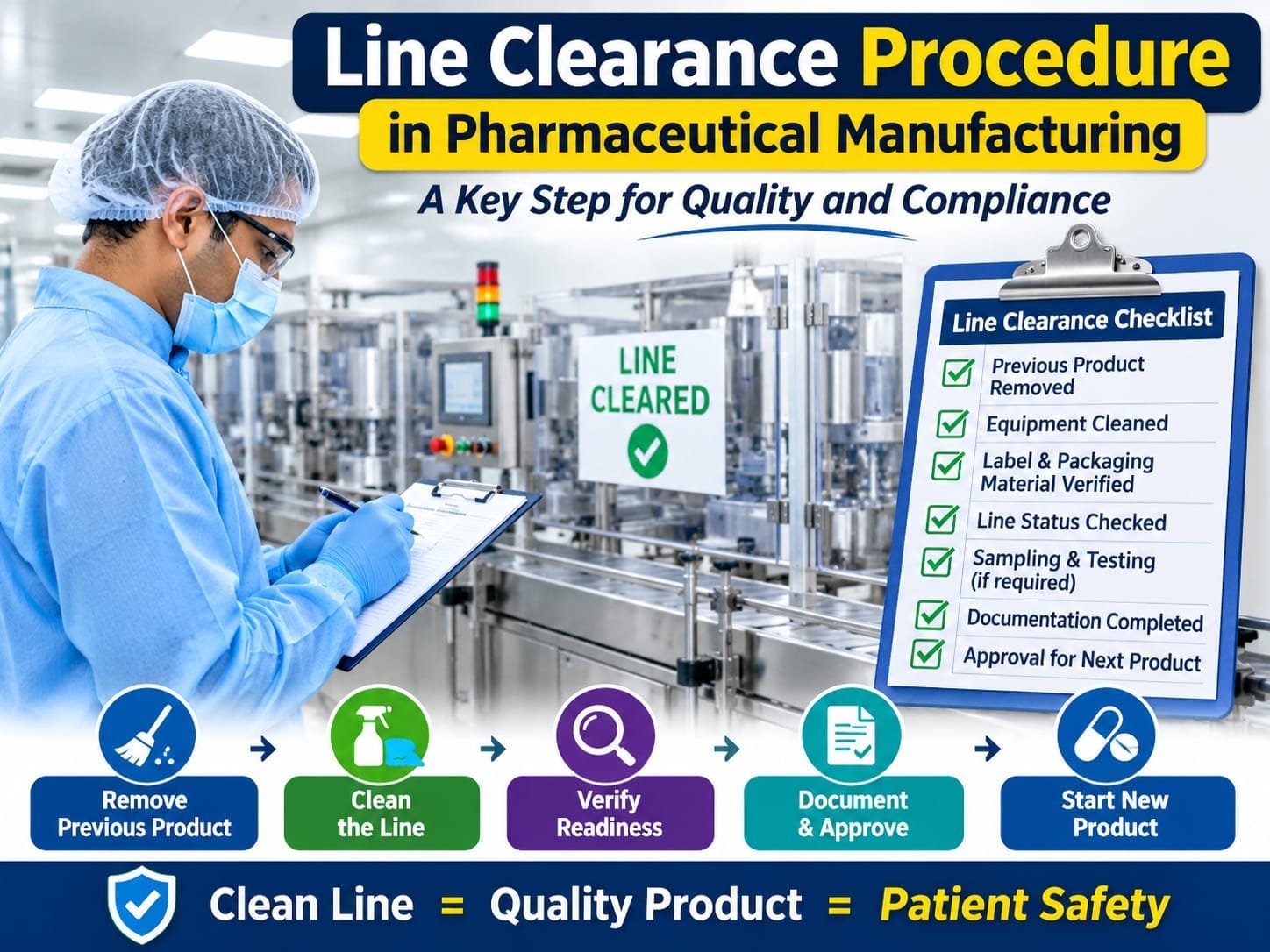
An effective line clearance procedure should be performed according to an approved SOP and documented checklist.
The following steps provide a general approach for pharmaceutical manufacturing and packaging operations.
Step 1: Review Previous Batch Completion
Before initiating line clearance, verify that the previous batch or operation has been completed and that all relevant records are updated.
Check:
- Previous batch manufacturing or packaging activity is completed.
- Remaining bulk product is removed or appropriately identified and transferred.
- Previous batch materials are accounted for.
- Previous batch documents are removed from the workstation.
- Rejected materials are segregated.
Step 2: Removal of Previous Product and Materials
Remove all materials that are not required for the next operation.
Examples include:
- Previous product containers.
- Raw materials and in-process materials.
- Intermediate products.
- Printed packaging materials.
- Labels and cartons.
- Leaflets and inserts.
- Rejected products and packaging materials.
- Previous batch records and documents.
Step 3: Cleaning Verification
Verify that the area, equipment and accessories have been cleaned according to the approved cleaning SOP.
Check:
- Equipment contact surfaces.
- Machine guards and external surfaces.
- Floor and surrounding areas.
- Equipment discharge points.
- Hoppers and product-contact parts.
- Transfer containers.
- Dust extraction points.
- Machine conveyors and chutes.
Where applicable, review cleaning records, equipment cleaning status labels and cleaning verification results before releasing the equipment for use.
Step 4: Equipment Status Verification
Verify that all equipment required for the next operation has the correct status identification.
Typical equipment status labels include:
- Cleaned.
- Under cleaning.
- To be cleaned.
- Under maintenance.
- Released for use.
Check the equipment identification number, cleaning status and validity of the clean status according to the site SOP.
Step 5: Verification of Manufacturing Documents
Ensure that only current and approved documents relevant to the intended batch are available.
Check:
- Approved Batch Manufacturing Record (BMR).
- Current manufacturing instructions.
- Approved equipment usage records.
- Relevant SOPs and work instructions.
- Required process parameters.
- Correct product and batch identification.
Step 6: Verification of Area Identification
Ensure that the area and equipment display the correct identification details for the current operation.
The status board or identification label should include, as applicable:
- Product name.
- Product strength.
- Batch number.
- Manufacturing stage.
- Equipment identification.
- Operation status.
Step 7: Verification of Environmental Conditions
Where required by the manufacturing process, verify that environmental conditions are within approved operating limits.
These may include:
- Temperature.
- Relative humidity.
- Room differential pressure.
- Area cleanliness status.
- Environmental monitoring status, where applicable.
Step 8: Verification of Machine Settings and Accessories
Verify that the equipment is configured for the intended product and process.
Check:
- Correct machine configuration.
- Appropriate change parts.
- Correct tooling, where applicable.
- Correct machine speed and settings, as specified.
- Availability of approved accessories.
- Safety guards and interlocks.
Step 9: QA Inspection and Approval
Production personnel should complete the required checks and request QA/IPQA verification according to the approved procedure.
QA should independently verify the critical line clearance requirements and ensure that the checklist is completed correctly.
Any discrepancy should be resolved before the operation is authorised to start.
Step 10: Documentation and Release
Record the line clearance results in the approved checklist or batch record.
The documentation should include:
- Product name and batch number.
- Area and equipment identification.
- Date and time of line clearance.
- Checklist results.
- Observations, if any.
- Name and signature of the person performing the inspection.
- Name and signature of the QA verifier or approver, as applicable.
Important: Manufacturing or packaging operations should not begin until the required line clearance approval has been documented.
7. Manufacturing Line Clearance: Area-Wise Verification
Line clearance requirements vary depending on the manufacturing operation. The following examples provide practical verification points for common pharmaceutical manufacturing areas.
7.1 Dispensing Area
- Previous product and raw material containers removed.
- Previous batch documents removed.
- Dispensing booth cleaned.
- Weighing balance cleaned and status verified.
- Balance calibration status verified.
- Weighing accessories cleaned.
- Material transfer containers cleaned and identified.
- Correct dispensing documents available.
- Area environmental conditions verified, where applicable.
7.2 Granulation Area
- Rapid Mixer Granulator (RMG) cleaned.
- Binder preparation vessel cleaned.
- Product contact parts cleaned.
- Previous product residues removed.
- Transfer containers cleaned.
- Equipment status labels verified.
- Previous batch documents removed.
- Correct manufacturing documents available.
7.3 Drying Area
- Fluid Bed Dryer (FBD) cleaned.
- Product contact bowl and filters cleaned.
- Previous granule residues removed.
- Air handling and equipment status verified.
- Temperature and process monitoring instruments verified.
- Clean containers available.
7.4 Blending Area
- Blender cleaned.
- Previous product residues removed.
- Blender discharge assembly cleaned.
- Sampling accessories cleaned.
- Product containers removed.
- Correct batch documents available.
- Equipment identification and cleaning status verified.
7.5 Tablet Compression Area
- Tablet compression machine cleaned.
- Previous product residues removed.
- Hopper and feed frame cleaned.
- Turret and compression components inspected.
- Deduster and metal detector cleaned, where applicable.
- Previous tablets removed.
- Previous batch documents removed.
- Correct tooling installed and identified.
- Tooling condition verified.
- Machine status and calibration status verified, where applicable.
7.6 Coating Area
- Coating pan cleaned.
- Spray guns and solution delivery system cleaned.
- Previous coating solution removed.
- Exhaust and supply air arrangements checked.
- Product contact accessories cleaned.
- Previous batch documents removed.
- Correct coating instructions available.
8. Packaging Line Clearance Procedure
Packaging line clearance is a critical GMP activity because incorrect packaging materials, labels or batch coding can result in serious product mix-ups and mislabelling.
Before initiating packaging operations, the entire packaging line should be inspected.
8.1 Blister Packing Line Clearance
Verify the following:
- Previous blister foils removed.
- Previous PVC/PVDC or other forming materials removed.
- Previous printed lidding foil removed.
- Previous product tablets or capsules removed.
- Forming and sealing stations cleaned.
- Product feeding system cleaned.
- Rejected blisters removed.
- Previous batch documents removed.
- Correct batch coding details verified.
- Correct product and packaging materials available.
8.2 Cartoning Line Clearance
- Previous cartons removed.
- Previous package inserts removed.
- Previous labels removed.
- Previous batch coding materials removed.
- Carton feeding system cleaned.
- Leaflet insertion system checked.
- Carton printing system checked.
- Reject bins emptied and inspected.
- Correct carton and leaflet details verified.
8.3 Bottle Packing Line Clearance
- Previous bottles removed.
- Previous caps removed.
- Previous labels removed.
- Previous product residues removed.
- Bottle unscrambler and conveyor cleaned.
- Filling and capping equipment cleaned.
- Labelling machine cleaned.
- Previous batch coding materials removed.
- Correct labels and packaging materials verified.
8.4 Strip Packing Line Clearance
- Previous strip foils removed.
- Previous tablets or capsules removed.
- Sealing and cutting areas cleaned.
- Product feeding system cleaned.
- Rejected strips removed.
- Printing details verified.
- Correct packaging materials available.
8.5 Serialization System Verification
For packaging lines using serialization systems, line clearance should also include verification of the electronic and machine-level configuration.
- Previous batch serialization job closed as required.
- Previous product and batch data cleared from the line interface.
- Correct product master data selected.
- Correct GTIN and packaging configuration verified.
- Correct batch number and expiry date configured.
- Correct serial number commissioning and aggregation settings verified.
- Previous batch codes and printed labels removed.
- Vision inspection and reject verification systems checked.
- Correct communication with the serialization platform confirmed.
Serialization checks should be integrated with the approved electronic batch and packaging procedures. A physical line clearance alone does not establish that the electronic configuration is correct.
9. Line Clearance Checklist: Important Verification Points
A standard line clearance checklist should be designed according to the manufacturing or packaging operation.
The following is an illustrative checklist for pharmaceutical packaging operations.
| Sr. No. | Verification Parameter | Acceptance Criteria | Status |
|---|---|---|---|
| 1 | Previous product removal | No previous product available on the line | Pass / Fail / NA |
| 2 | Previous packaging materials | All previous materials removed | Pass / Fail / NA |
| 3 | Previous batch documents | No obsolete or previous batch documents present | Pass / Fail / NA |
| 4 | Equipment cleanliness | Equipment visually clean and released | Pass / Fail / NA |
| 5 | Area cleanliness | Area clean and free from unwanted materials | Pass / Fail / NA |
| 6 | Equipment status | Correct equipment status label available | Pass / Fail / NA |
| 7 | Product identification | Correct product and strength displayed | Pass / Fail / NA |
| 8 | Batch identification | Correct batch number displayed | Pass / Fail / NA |
| 9 | Packaging materials | Correct approved materials available | Pass / Fail / NA |
| 10 | Batch coding | Correct coding details verified | Pass / Fail / NA |
| 11 | Reject bins | Previous rejected products removed | Pass / Fail / NA |
| 12 | Machine configuration | Correct machine setup verified | Pass / Fail / NA |
| 13 | Environmental conditions | Within approved limits, where applicable | Pass / Fail / NA |
| 14 | QA verification | QA clearance completed as per SOP | Pass / Fail / NA |
Note: This is an illustrative checklist. Each pharmaceutical manufacturer should establish an approved checklist based on the equipment, product, process and contamination or mix-up risks.
10. Responsibilities of Production and Quality Assurance During Line Clearance
Line clearance is generally a joint responsibility of Production and Quality Assurance, with responsibilities defined in the site SOP.
10.1 Production Department Responsibilities
- Complete the previous manufacturing or packaging operation.
- Remove previous products and materials.
- Ensure cleaning is completed according to approved SOPs.
- Complete the line clearance checklist.
- Verify equipment status.
- Ensure current batch documents are available.
- Display the correct product and batch identification.
- Request QA verification where required.
- Ensure the operation does not start before required approval.
10.2 Quality Assurance / IPQA Responsibilities
- Independently verify critical line clearance requirements.
- Check removal of previous products and materials.
- Verify area and equipment cleanliness.
- Verify equipment status and identification.
- Check availability of current approved documents.
- Verify product and batch identification.
- Verify packaging material identity, where applicable.
- Review the completed line clearance checklist.
- Ensure discrepancies are resolved before release.
- Provide approval as required by the approved SOP.
QA verification should be meaningful and based on actual inspection. Signing a checklist without performing the required checks is a serious GMP documentation deficiency.
11. Documentation Requirements for Line Clearance
Documentation is an essential part of line clearance because it provides evidence that the required checks were performed before starting the manufacturing or packaging operation.
Line clearance documentation should include:
- Line clearance checklist number.
- Product name and strength.
- Batch number.
- Manufacturing or packaging area.
- Equipment identification number.
- Previous product or batch identification, where applicable.
- Date and time of clearance.
- Individual verification results.
- Observations and corrective actions, if applicable.
- Production operator name and signature.
- QA/IPQA verifier name and signature.
- Final clearance approval and time.
Good Documentation Practices
Line clearance records should comply with Good Documentation Practices (GDP).
- Record information contemporaneously.
- Use approved formats and checklists.
- Avoid blank fields; mark not applicable entries appropriately.
- Do not overwrite or backdate records.
- Correct errors using approved GDP practices.
- Ensure signatures and dates are attributable to the actual personnel performing the checks.
- Maintain records as part of the relevant batch documentation.
12. What Should Be Done If Line Clearance Fails?
If any discrepancy is observed during line clearance, the area or equipment should not be released for the next operation until the discrepancy has been appropriately evaluated and resolved.
Examples of line clearance failures include:
- Previous product found on the manufacturing floor.
- Previous batch documents present on the line.
- Incorrect product label found on the packaging machine.
- Equipment cleaning status not updated.
- Packaging material from the previous batch found in the area.
- Previous batch code retained in the coding machine.
- Unidentified material found near the manufacturing equipment.
- Incorrect serialization job selected.
Recommended Actions
- Stop the line clearance activity and do not release the area.
- Inform the Production Supervisor and QA/IPQA.
- Identify and segregate the discrepancy.
- Remove unwanted materials or documents under controlled conditions.
- Reclean the area or equipment if required.
- Repeat the affected verification checks.
- Assess whether the event requires deviation initiation.
- Document the investigation and corrective actions.
- Obtain the required QA approval before starting operations.
Where there is a possibility that the discrepancy affected a previous or current batch, the impact assessment should cover potentially affected products and batches. Corrective and Preventive Actions (CAPA) should be initiated when warranted by the investigation.
13. Common Line Clearance Deficiencies Observed During GMP Audits
Line clearance documentation and execution are frequently examined during pharmaceutical GMP inspections and customer audits.
Some common deficiencies include:
- Line clearance performed without an approved checklist.
- Incomplete line clearance documentation.
- Previous product or packaging materials found on the line.
- Incorrect equipment status labels.
- QA approval obtained without physical verification.
- Line clearance performed after the operation has already started.
- Incorrect product or batch identification displayed.
- Previous batch coding details retained in the machine.
- Inadequate verification of reject bins and collection containers.
- Inadequate reconciliation of printed packaging materials.
- Failure to investigate repeated line clearance failures.
- Inadequate training of Production and QA personnel.
- Use of uncontrolled or obsolete checklists.
14. Difference Between Cleaning Verification and Line Clearance
Cleaning verification and line clearance are closely related but are not the same activity.
| Parameter | Cleaning Verification | Line Clearance |
|---|---|---|
| Primary objective | Verify equipment and area cleanliness | Verify readiness for the next operation |
| Scope | Cleaning effectiveness and cleanliness status | Area, equipment, product, materials and documentation |
| Previous product residues | Assessed through approved cleaning controls | Verify that previous product and materials are removed |
| Equipment status | Cleaning status verification | Overall readiness and identification verification |
| Documentation | Cleaning records and verification records | Approved line clearance checklist |
| Responsibility | As defined in cleaning SOP | Production and QA/IPQA as defined in line clearance SOP |
A successful cleaning verification does not automatically mean that line clearance is complete. Other checks, such as material removal, document removal, product identification and equipment readiness, must also be completed.
15. Best Practices for Effective Line Clearance
Pharmaceutical manufacturers should implement the following best practices to strengthen line clearance compliance:
- Develop separate checklists for different manufacturing and packaging operations where needed.
- Establish clear responsibilities for Production and QA.
- Provide regular GMP training to line clearance personnel.
- Use visual identification and equipment status labels.
- Ensure physical segregation of different products and batches.
- Verify printed packaging material identity before use.
- Control batch coding and serialization settings.
- Use a systematic inspection approach rather than relying only on visual assumptions.
- Document every verification step accurately.
- Trend line clearance failures and deviations.
- Review checklists periodically through the document control system.
- Use electronic line clearance systems where appropriate and validated.
16. Electronic Line Clearance and Digital GMP Systems
With the increasing adoption of digital manufacturing systems, pharmaceutical companies are implementing electronic line clearance systems to improve documentation accuracy and operational control.
Electronic line clearance can provide:
- Electronic checklists.
- Role-based user access.
- Electronic signatures.
- Time-stamped verification records.
- Mandatory field completion.
- Controlled approval workflows.
- Audit trail functionality.
- Integration with Manufacturing Execution Systems (MES).
- Integration with electronic batch records.
- Improved traceability and review.
Electronic systems used for GMP activities must be appropriately validated and maintained. Where applicable, requirements of 21 CFR Part 11 and relevant data integrity expectations should be considered.
17. Key Performance Indicators (KPIs) for Line Clearance
Pharmaceutical QA departments can monitor line clearance performance through suitable quality metrics.
| KPI | Purpose |
|---|---|
| Number of line clearance failures | Measures the frequency of unsuccessful clearance activities |
| Line clearance-related deviations | Identifies recurring GMP issues |
| Repeat line clearance observations | Evaluates the effectiveness of corrective actions |
| Average line clearance completion time | Monitors operational efficiency without compromising verification quality |
| Documentation error rate | Evaluates GDP compliance |
| QA verification compliance | Measures adherence to required independent verification |
| Training compliance | Monitors personnel qualification and training status |
These KPIs should be reviewed periodically to identify trends and opportunities for continuous improvement.
18. Frequently Asked Questions (FAQs)
Q1. What is line clearance in the pharmaceutical industry?
Line clearance is a documented inspection performed before starting a manufacturing or packaging operation to ensure that the area and equipment are free from previous products, materials and documents that are not required for the current operation.
Q2. Why is line clearance important in pharma?
Line clearance prevents product mix-ups, cross-contamination, packaging errors and incorrect labelling. It also helps demonstrate compliance with GMP requirements.
Q3. Who is responsible for line clearance in pharmaceutical manufacturing?
Production personnel generally perform the initial checks, while QA/IPQA independently verifies and approves line clearance as defined in the approved site SOP.
Q4. When should line clearance be performed?
Line clearance should be performed before starting a new manufacturing or packaging operation and at defined changeover points, including product or batch changeovers, according to the approved procedure.
Q5. What is included in a line clearance checklist?
A line clearance checklist generally includes area cleanliness, equipment cleanliness, removal of previous products and materials, document verification, equipment status, product identification, batch details and QA approval.
Q6. What is the difference between line clearance and cleaning verification?
Cleaning verification confirms that equipment and areas meet defined cleanliness requirements. Line clearance is a broader inspection that also verifies removal of previous materials, documents and products and confirms readiness for the next operation.
Q7. What is the regulatory requirement for line clearance in India?
Indian Revised Schedule M, particularly Clause 18.5.2, requires line clearance before packaging operations according to an appropriate procedure and checklist, with the activity recorded.
Q8. What is the US FDA requirement related to line clearance?
21 CFR 211.130 requires inspection of packaging and labelling facilities immediately before use to ensure that products from previous operations and unsuitable packaging materials have been removed. The inspection results must be documented in batch production records.
Q9. Can production start before QA line clearance approval?
Where the approved site SOP requires QA/IPQA approval, production or packaging must not start until the required clearance and approval have been completed and documented.
Q10. What should be done if previous batch materials are found during line clearance?
The area should not be released. The material must be identified and controlled, the discrepancy investigated, the affected checks repeated and QA approval obtained before the next operation begins.
19. Conclusion
Line clearance is a fundamental GMP requirement in pharmaceutical manufacturing and packaging operations. It plays a vital role in preventing product mix-ups, cross-contamination, incorrect labelling and packaging errors.
An effective line clearance programme requires a systematic inspection of manufacturing and packaging areas, equipment, materials, documents and product identification before starting a new operation.
Production and Quality Assurance departments must work together to ensure that all required checks are completed, discrepancies are resolved and clearance activities are properly documented.
With the implementation of robust SOPs, operation-specific checklists, personnel training, independent QA verification and electronic documentation systems, pharmaceutical manufacturers can strengthen GMP compliance and improve operational reliability.
Remember: Effective line clearance is not just about ensuring that the previous product is removed; it is about verifying that the entire manufacturing or packaging line is ready for the next operation without compromising product quality and patient safety.
Regulatory References
- Indian Revised Schedule M – G.S.R. 922(E), 28 December 2023.
- US FDA 21 CFR Part 211 – Current Good Manufacturing Practice for Finished Pharmaceuticals.
- EU GMP Guidelines – EudraLex Volume 4, Chapter 4 and Chapter 5.
- WHO GMP Guidelines – Pharmaceutical Production.
About the Author
Mahummed Asif is a pharmaceutical Quality Assurance professional with extensive experience in pharmaceutical manufacturing, GMP compliance, IPQA, Quality Management Systems and regulatory requirements. Through PharmaShare.in, he shares practical knowledge, industry insights and educational resources for pharmaceutical QA, QC, Production and regulatory professionals.
Disclaimer: This article is intended for educational and professional reference. The procedures and checklists described are illustrative and should be adapted to the specific product, process, equipment, risk assessment and approved site SOP. Always follow applicable regulatory requirements and approved GMP documentation.