Pharmaceutical Recall Process in India – Complete CDSCO Regulatory Guide 2026
Pharmaceutical Recall Process in India – Complete Regulatory Guide
A pharmaceutical product recall is one of the most critical quality management activities within the pharmaceutical industry. It is designed to protect patients by removing defective, potentially harmful, or non-compliant medicinal products from the market quickly and effectively. In India, pharmaceutical recalls are governed primarily by the Central Drugs Standard Control Organization (CDSCO), supported by the Drugs and Cosmetics Act, 1940, Drugs and Cosmetics Rules, 1945, Schedule M (Revised), and the CDSCO Guidance Document on Recall and Rapid Alert System for Drugs.
An effective recall system demonstrates a pharmaceutical company’s commitment to patient safety, Good Manufacturing Practices (GMP), and regulatory compliance. Regulatory authorities expect every manufacturer, importer, distributor, and marketing authorization holder to establish a documented recall procedure capable of rapidly identifying, tracing, retrieving, and documenting recalled products.
Key Takeaway:
Every pharmaceutical manufacturer operating in India should maintain a documented recall procedure, trained recall team, effective distribution traceability system, and periodic mock recalls to ensure regulatory compliance.
Table of Contents
- Introduction
- What is a Pharmaceutical Recall?
- Objectives of Drug Recall
- Regulatory Framework in India
- Types of Pharmaceutical Recalls
- Recall Classifications
- Common Reasons for Product Recall
- Responsibilities of Pharmaceutical Companies
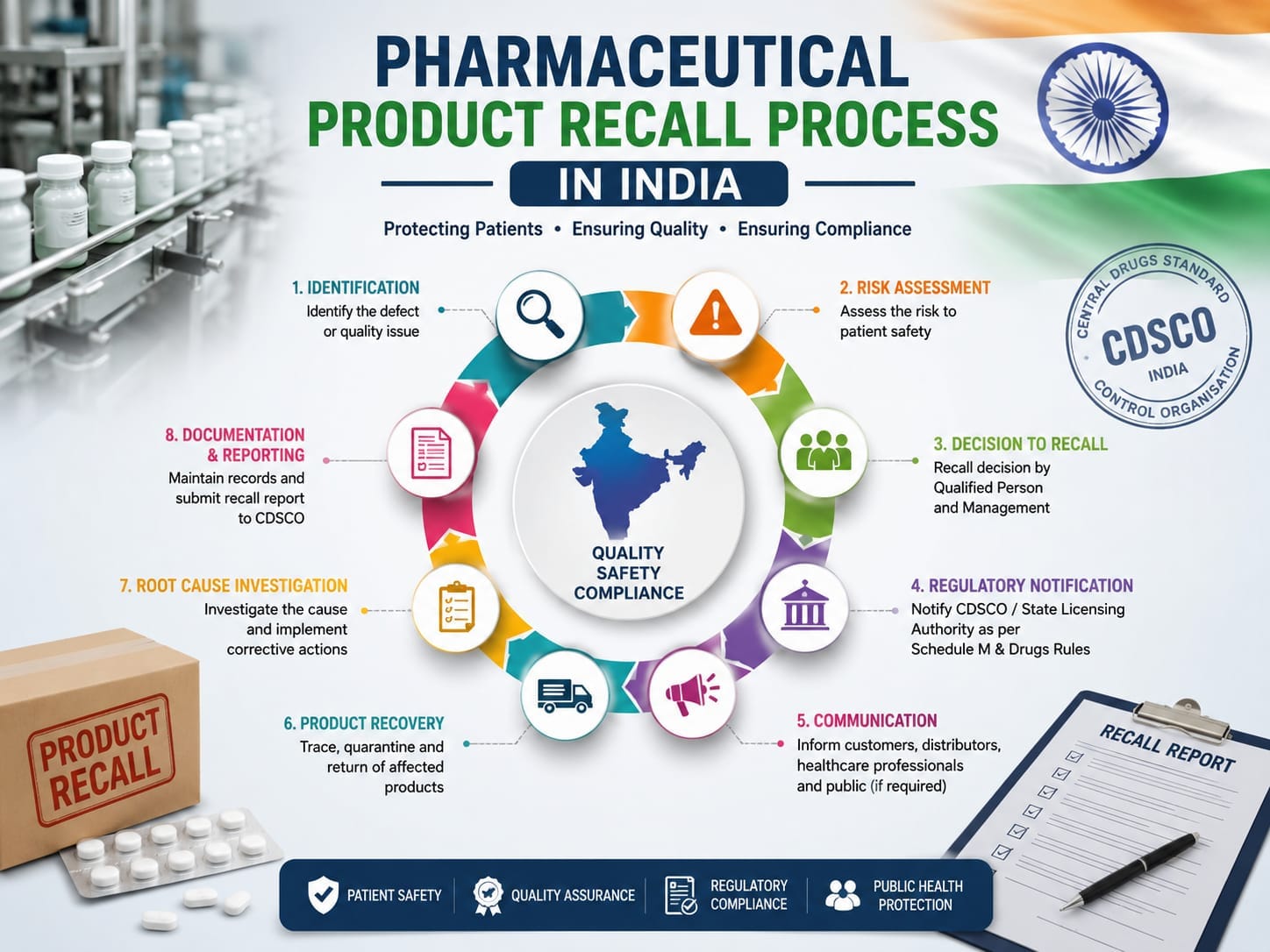
- Overview of Recall Process
What is a Pharmaceutical Recall?
A pharmaceutical recall is the process of removing a medicinal product from the supply chain because it may present a risk to patient health, fails to meet quality specifications, violates regulatory requirements, or has been distributed in error.
The recalled product may be removed from:
- Manufacturing warehouses
- Carrying & Forwarding (C&F) agents
- Distributors
- Wholesalers
- Retail pharmacies
- Hospitals
- Government supply chains
- Patients (where applicable)
The recall process continues until every reasonable effort has been made to recover the affected product and verify recall effectiveness.
Objectives of Pharmaceutical Product Recall
The primary objective of any pharmaceutical recall is to minimize patient risk while ensuring regulatory compliance.
Main Objectives
- Protect patient safety
- Remove defective products from the market
- Prevent further product distribution
- Maintain public confidence
- Meet CDSCO regulatory requirements
- Identify root causes of product failure
- Implement corrective and preventive actions (CAPA)
- Prevent recurrence of similar quality issues
Regulatory Framework Governing Drug Recall in India
Although India does not currently have a standalone pharmaceutical recall regulation comparable to the US FDA’s 21 CFR Part 7, multiple regulations collectively require manufacturers to establish an effective recall system.
| Regulation |
Purpose |
| Drugs and Cosmetics Act, 1940 |
Legal control over manufacture, sale and distribution of drugs |
| Drugs and Cosmetics Rules, 1945 |
Operational requirements for licensing and compliance |
| Schedule M (Revised GMP) |
Requires documented recall procedures and traceability |
| CDSCO Guidance Document on Recall and Rapid Alert System |
Provides recall classifications and implementation guidance |
| WHO GMP Guidelines |
International recall expectations |
| PIC/S GMP Guide |
Global pharmaceutical quality requirements |
Important:
Schedule M requires manufacturers to establish written procedures for recall, complaint handling, investigation, and distribution records to facilitate rapid product retrieval.
Types of Pharmaceutical Recalls
Recalls may be initiated under different circumstances depending on who identifies the issue.
1. Voluntary Recall
A voluntary recall is initiated by the manufacturer after identifying a quality defect, stability issue, labeling error, contamination, or other potential risk.
Most recalls globally are voluntary recalls because responsible manufacturers act before regulatory enforcement becomes necessary.
Examples
- OOS investigation confirms contamination
- Failed stability results
- Incorrect labeling discovered internally
- Packaging mix-up
- Market complaint investigation confirms defect
2. Statutory (Regulatory) Recall
A statutory recall is directed by the regulatory authority after inspections, market surveillance, adverse event reports, testing by government laboratories, or complaint investigations reveal that a marketed drug poses unacceptable risk.
The CDSCO or State Drug Control Authorities may instruct the manufacturer to immediately initiate recall activities.
Recall Classifications
The CDSCO guidance categorizes recalls according to the level of health risk associated with the defective product.
| Recall Class |
Health Risk |
Examples |
| Class I |
Life-threatening or serious health consequences |
Sterility failure, wrong active ingredient, toxic contamination |
| Class II |
Temporary or medically reversible health effects |
Dissolution failure, potency variation, labeling errors |
| Class III |
Low probability of adverse health consequences |
Minor packaging defects, cosmetic issues, printing mistakes |
Example:
If an injectable product fails sterility testing after release, the recall would generally be considered a Class I recall because patient safety is immediately compromised.
Common Reasons for Pharmaceutical Product Recall
Drug recalls may occur due to manufacturing failures, laboratory issues, packaging defects, regulatory non-compliance, or post-marketing surveillance findings.
| Category |
Examples |
| Microbiological |
Sterility failure, microbial contamination |
| Chemical |
Impurity above limits, nitrosamines, degradation |
| Physical |
Glass particles, foreign matter, black particles |
| Packaging |
Wrong leaflet, carton mix-up, damaged packaging |
| Labeling |
Wrong strength, incorrect batch number, missing warnings |
| Manufacturing |
Deviation affecting product quality |
| Distribution |
Temperature excursion, counterfeit infiltration |
| Regulatory |
Government laboratory failure, inspection findings |
Responsibilities of Pharmaceutical Companies
Every pharmaceutical manufacturer should establish a robust recall management system integrated with the Pharmaceutical Quality System (PQS).
Major responsibilities include:
- Develop written recall SOPs
- Maintain complete distribution records
- Nominate a Recall Coordinator
- Train recall team members
- Conduct mock recalls periodically
- Notify regulatory authorities promptly
- Perform health hazard assessment
- Maintain recall documentation
- Implement CAPA after recall completion
Overview of the Pharmaceutical Recall Process
Although every recall is unique, the overall workflow generally follows a structured sequence to ensure rapid product removal and regulatory compliance.
| Step |
Activity |
| 1 |
Quality defect identified |
| 2 |
Risk assessment performed |
| 3 |
Recall decision approved |
| 4 |
CDSCO/State Authority notified |
| 5 |
Recall communication issued |
| 6 |
Distribution chain informed |
| 7 |
Product retrieval initiated |
| 8 |
Recall effectiveness verified |
| 9 |
Root cause investigation completed |
| 10 |
CAPA implemented and recall closed |
Step-by-Step Pharmaceutical Recall Process in India
An effective pharmaceutical recall process requires prompt decision-making, clear communication, complete product traceability, and continuous monitoring until all affected products are recovered or accounted for. Every step should be documented and supported by objective evidence to satisfy CDSCO inspections and GMP requirements.
Step 1: Identification of a Quality Defect
A recall generally begins when a quality issue or potential safety concern is identified. The source of the information may vary depending on the nature of the defect.
Common Sources of Recall Initiation
- Customer complaints
- Market complaints
- Out-of-Specification (OOS) results
- Out-of-Trend (OOT) investigations
- Stability failures
- Government laboratory test failures
- Regulatory inspection observations
- Pharmacovigilance reports
- Adverse Drug Reactions (ADR)
- Internal GMP investigations
- Packaging complaints
- Temperature excursion during transportation
Best Practice:
Every potential recall should first be evaluated through a documented quality investigation before initiating market action.
Step 2: Preliminary Risk Assessment
Once a defect has been identified, the Quality Assurance department performs a preliminary risk assessment to determine whether the issue could impact patient safety, product efficacy, or regulatory compliance.
The assessment generally considers:
- Nature of the defect
- Severity of patient risk
- Likelihood of occurrence
- Extent of product distribution
- Patient population affected
- Whether the defect is detectable before use
- Availability of alternative medicines
- Potential regulatory impact
| Risk Level |
Typical Action |
| Critical |
Immediate recall and regulatory notification |
| Major |
Urgent recall after management approval |
| Minor |
Investigation with possible market correction |
Step 3: Health Hazard Evaluation (HHE)
The Health Hazard Evaluation (HHE) is one of the most important activities during recall decision-making. It evaluates the potential impact of the defective product on patients and helps determine the recall classification.
Typical Questions Considered During HHE
- Can the defect cause serious injury?
- Can the defect result in death?
- Will the defect reduce therapeutic efficacy?
- Could immunocompromised patients be affected?
- Are children or elderly patients at higher risk?
- Has any adverse event already been reported?
- How many batches are affected?
Example:
A sterility failure in an injectable antibiotic supplied to intensive care units would require an immediate health hazard assessment due to the high risk of severe patient harm.
Step 4: Recall Decision
Based on the investigation findings and health hazard evaluation, senior management authorizes the recall. The decision should be documented and supported by scientific evidence.
The Recall Committee typically includes representatives from:
- Quality Assurance
- Quality Control
- Manufacturing
- Regulatory Affairs
- Supply Chain
- Warehouse
- Pharmacovigilance
- Senior Management
Recall Committee Responsibilities
- Approve recall initiation
- Determine recall classification
- Review affected batches
- Approve recall communication
- Monitor recall progress
- Approve recall closure
Step 5: Regulatory Notification
After deciding to initiate a recall, the manufacturer should promptly notify the appropriate regulatory authorities, including CDSCO and the relevant State Drug Control Authority, as applicable.
The notification generally includes:
- Product name
- Dosage form
- Strength
- Batch/Lot numbers
- Manufacturing date
- Expiry date
- Quantity manufactured
- Quantity distributed
- Nature of defect
- Risk assessment summary
- Recall classification
- Proposed recall strategy
Documentation Tip:
Maintain acknowledgement copies of all communications sent to regulatory authorities as part of the recall file.
Step 6: Stop Distribution Immediately
Before recall communication is issued externally, the company should immediately stop the distribution of all affected batches.
Typical actions include:
- Block inventory in ERP system
- Quarantine warehouse stock
- Suspend dispatches
- Inform depots and C&F agents
- Prevent export shipments
- Freeze online sales where applicable
Step 7: Recall Communication
The recall communication should be clear, concise, and immediately actionable. It should be distributed to every entity within the supply chain that may possess the affected product.
Recipients
- Distributors
- Wholesalers
- Hospitals
- Retail pharmacies
- Institutional customers
- Government procurement agencies
- Export customers (if applicable)
Recall Letter Should Include
| Information |
Description |
| Product Details |
Name, strength, dosage form |
| Batch Number |
Affected batches |
| Reason for Recall |
Nature of quality defect |
| Risk Description |
Potential impact on patients |
| Instructions |
Stop sale, isolate stock, return product |
| Contact Information |
Recall coordinator details |
Step 8: Product Retrieval
The manufacturer should coordinate with all distribution channels to recover affected products as quickly as possible.
Returned products should be:
- Counted
- Verified against batch numbers
- Recorded in recall logs
- Placed under quarantine
- Prevented from re-entering distribution
Typical Recall Sources
- C&F agents
- Regional warehouses
- Distributors
- Wholesalers
- Hospitals
- Retail pharmacies
- Government institutions
Step 9: Product Reconciliation
One of the most critical activities during recall is reconciliation. The manufacturer should account for every unit manufactured, distributed, returned, destroyed, or remaining in stock.
| Description |
Quantity |
| Total Manufactured |
XXXXX |
| Warehouse Stock |
XXXXX |
| Distributed |
XXXXX |
| Recovered |
XXXXX |
| Outstanding |
XXXXX |
Any unexplained discrepancies should be investigated and documented before recall closure.
Step 10: Recall Effectiveness Checks
Recall effectiveness checks verify whether recall communications reached all intended recipients and whether affected products were successfully removed from the market.
Methods include:
- Telephone confirmation
- Email acknowledgement
- Physical audits
- Distributor verification
- Hospital confirmation
- Warehouse inspection
Mock Recall:
Companies should conduct periodic mock recalls to evaluate the efficiency of their traceability system, communication process, and recall readiness. Many regulatory inspections specifically review mock recall records.
Key Documents Maintained During a Recall
| Document |
Purpose |
| Recall SOP |
Overall recall procedure |
| Recall Decision Form |
Management approval |
| Risk Assessment Report |
Health hazard evaluation |
| Recall Notification Letter |
Communication to customers |
| Distribution Records |
Traceability |
| Recall Progress Report |
Status monitoring |
| Product Reconciliation Report |
Recovery accounting |
| Recall Closure Report |
Final regulatory documentation |
Step 11: Quarantine and Disposal of Recalled Products
All recalled pharmaceutical products should be segregated immediately upon receipt and placed in a designated quarantine area to prevent accidental redistribution. Access to quarantined products should be restricted and controlled by the Quality Assurance department.
Before disposal, the company should verify:
- Correct product identification
- Batch/Lot number verification
- Quantity reconciliation
- Recall authorization documentation
- Regulatory requirements for disposal
Approved Disposal Methods
The disposal method depends on the nature of the pharmaceutical product and applicable environmental regulations. Common disposal methods include:
- High-temperature incineration through authorized agencies
- Chemical destruction where applicable
- Return to manufacturer for controlled destruction
- Disposal through approved hazardous waste management facilities
Important:
Recalled pharmaceutical products should never be reintroduced into the commercial supply chain unless specifically permitted by the regulatory authority after appropriate evaluation and documented approval.
Step 12: Root Cause Investigation
Recovering defective products from the market is only one part of an effective recall program. The manufacturer must identify the underlying cause of the defect to prevent recurrence.
The investigation should be systematic, scientifically justified, and supported by documented evidence.
Areas Typically Investigated
- Manufacturing process deviations
- Raw material quality issues
- Equipment malfunction
- Calibration failures
- Environmental monitoring data
- Cleaning validation deficiencies
- Analytical laboratory investigations
- Packaging operations
- Storage and transportation conditions
- Supplier-related issues
Common Investigation Tools
| Tool |
Purpose |
| 5 Why Analysis |
Identify underlying causes |
| Fishbone (Ishikawa) Diagram |
Systematic cause identification |
| Failure Mode and Effects Analysis (FMEA) |
Risk evaluation |
| Fault Tree Analysis |
Logical failure investigation |
| Trend Analysis |
Recurring issue identification |
Step 13: Corrective and Preventive Actions (CAPA)
Following completion of the investigation, the organization should implement appropriate Corrective and Preventive Actions (CAPA) to eliminate the root cause and reduce the likelihood of recurrence.
Examples of Corrective Actions
- Reject affected batches
- Revise manufacturing procedures
- Repair or replace equipment
- Revise analytical methods
- Improve environmental controls
- Enhance packaging verification systems
Examples of Preventive Actions
- Additional employee training
- Periodic quality trend reviews
- Supplier qualification improvements
- Automation of critical process controls
- Implementation of barcode verification systems
- Enhanced in-process monitoring
Regulatory Expectation:
CAPA effectiveness should be verified and documented before the recall is formally closed. Regulatory inspectors frequently assess whether CAPA effectively addresses the identified root cause.
Step 14: Recall Closure
A pharmaceutical recall should only be closed after confirming that all reasonable efforts have been made to recover affected products and that the effectiveness of the recall has been adequately demonstrated.
Requirements Before Recall Closure
- Product retrieval completed
- Recall effectiveness verified
- Product reconciliation completed
- Root cause investigation finalized
- CAPA implemented
- Regulatory reporting completed
- Product disposal documented
- Management approval obtained
Responsibilities During a Pharmaceutical Recall
| Department |
Primary Responsibility |
| Quality Assurance |
Recall coordination, investigation, regulatory communication |
| Quality Control |
Laboratory support and analytical investigations |
| Manufacturing |
Production data and batch history review |
| Warehouse |
Quarantine and inventory control |
| Supply Chain |
Distribution traceability and product retrieval |
| Regulatory Affairs |
Communication with CDSCO and State Authorities |
| Pharmacovigilance |
Assessment of adverse event reports |
| Senior Management |
Recall approval and oversight |
Common CDSCO Inspection Observations Related to Product Recalls
During GMP inspections, regulatory authorities commonly identify deficiencies in recall systems that may indicate weaknesses in the Pharmaceutical Quality System.
- Incomplete recall SOPs
- Poor distribution traceability
- Delayed recall initiation
- Lack of documented Health Hazard Evaluation
- Inadequate recall communication records
- No periodic mock recall exercises
- Incomplete reconciliation of returned products
- Weak CAPA implementation
- Poor recall effectiveness verification
- Incomplete recall closure reports
Best Practices for an Effective Pharmaceutical Recall System
- Maintain an up-to-date written recall SOP.
- Establish a multidisciplinary Recall Committee.
- Conduct periodic mock recalls to test readiness.
- Ensure complete batch traceability throughout the supply chain.
- Train employees involved in recall activities regularly.
- Use electronic inventory and ERP systems for faster traceability.
- Review recall trends during Annual Product Quality Review (APQR).
- Integrate recall management into the Pharmaceutical Quality System (PQS).
- Perform periodic supplier quality assessments.
- Continuously monitor recall effectiveness and CAPA performance.
Comparison of Recall Systems: India vs US FDA vs European Union
| Feature |
India (CDSCO) |
United States (US FDA) |
European Union (EMA/National Authorities) |
| Primary Guidance |
CDSCO Guidance on Drug Recall & Rapid Alert System |
21 CFR Part 7 and FDA Guidance |
EU GMP Chapter 8 and Rapid Alert System |
| Recall Classification |
Class I, II, III |
Class I, II, III |
Based on risk assessment |
| Mock Recall Expectation |
Expected under GMP |
Expected |
Expected |
| Distribution Traceability |
Required |
Required |
Required |
| Health Hazard Evaluation |
Recommended |
Mandatory risk assessment |
Required |
Frequently Asked Questions (FAQs)
1. What is a pharmaceutical product recall?
A pharmaceutical product recall is the removal of a defective, unsafe, or non-compliant medicinal product from the market to protect patient health and ensure regulatory compliance.
2. Who regulates pharmaceutical recalls in India?
Pharmaceutical recalls in India are coordinated by the Central Drugs Standard Control Organization (CDSCO) in collaboration with State Drug Control Authorities.
3. What are the three recall classifications?
Recalls are generally classified as Class I (serious health risk), Class II (temporary or reversible health risk), and Class III (low health risk).
4. Is a mock recall mandatory?
While specific frequency requirements may vary, periodic mock recalls are considered a GMP expectation and demonstrate the effectiveness of the recall system during regulatory inspections.
5. What documents should be maintained during a recall?
Key documents include the recall SOP, risk assessment, recall decision records, regulatory notifications, recall communications, reconciliation reports, CAPA records, effectiveness checks, and recall closure report.
Conclusion
A well-designed pharmaceutical recall system is an essential component of a robust Pharmaceutical Quality System (PQS). It safeguards patients, protects public health, and reinforces regulatory compliance by ensuring that defective products are rapidly identified, traced, recovered, and appropriately managed.
Manufacturers should not view recalls as isolated events but as opportunities to strengthen quality systems through comprehensive investigations, effective CAPA, employee training, and continuous improvement. Routine mock recalls, complete distribution traceability, and proactive risk management are key elements of a mature and inspection-ready recall program.
Author’s Note:
An effective recall process extends beyond product retrieval. Organizations that integrate recall management with quality risk management, pharmacovigilance, complaint handling, deviation management, and CAPA are better positioned to meet CDSCO, WHO GMP, PIC/S, and global regulatory expectations while maintaining patient trust.