The process of developing new products varies significantly across different industries, and there is no universal or standardized procedure that can be applied to all sectors and organizations. Drawing from the comprehensive literature on the phases involved in the new product development process (Booz et al. (1969), Cooper (1979), Rosenthal (1992)), the new product development process encompasses the following stages:
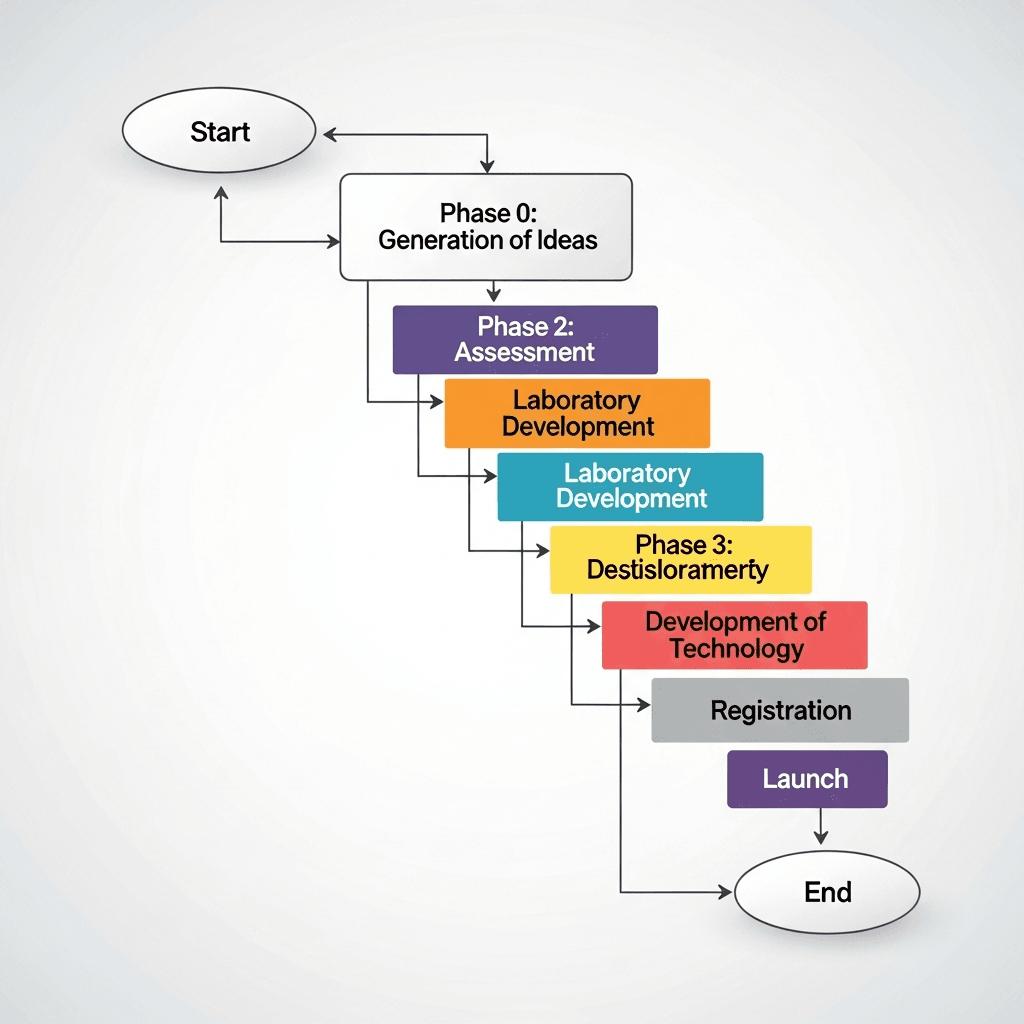
Phase – 0: Encompasses the extensive generation of ideas or potential drug candidates. A specialized team of experts determines which ideas or candidates should advance to the preliminary assessment phase.
Phase 1 involves the initial evaluation of the drug candidates. This phase consists solely of desk research or an assessment conducted “on paper,” typically addressing the marketing potential, production capabilities, research and development strategies, registration strategies, and purchasing strategies.
Phase 2 pertains to laboratory development. This phase commences with experimental and accelerated stability studies, development on a laboratory scale, including pilot bio-equivalence studies, and the creation of primary packaging. The transition from laboratory scale to semi-industrial scale is executed.
Phase 3 focuses on technology development. This phase encompasses the first test, the transfer to industrial measures, and the preparation of registration documentation. It includes clinical studies, toxicological studies, bio-equivalence studies, and completed stability studies. This phase concludes with the production of three registration batches.
Phase 4 is the registration process itself. This involves the submission of registration dossiers to regulatory authorities. It concludes when the product is officially registered, and the registration documentation along with marketing authorization is secured.
Phase 5 comprises all final pre-launch activities (such as the production of launch stock, ordering of raw materials, packaging materials, etc.) culminating in the product’s launch in the selected market (product available on shelves).