
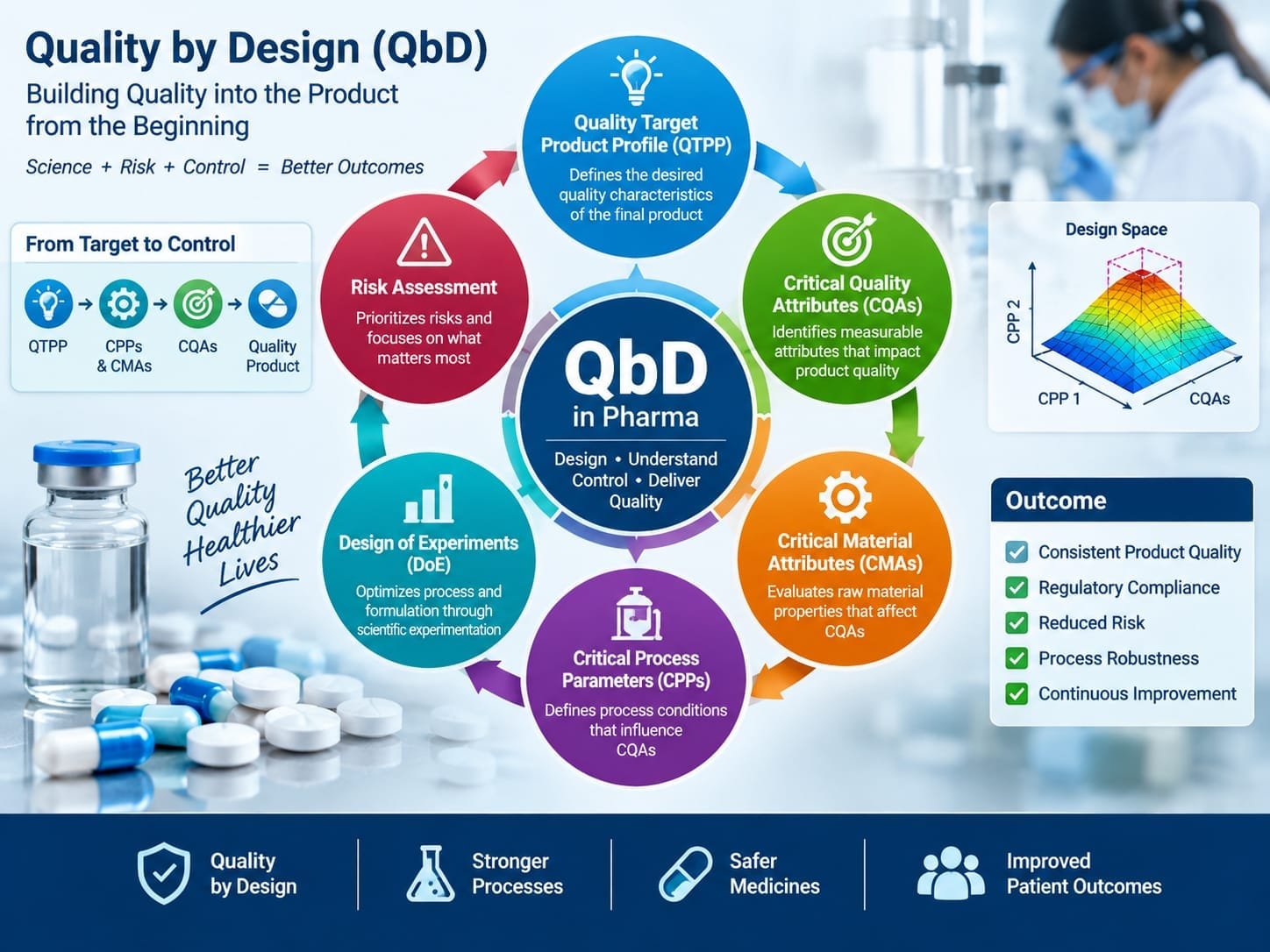
QbD Elements in Pharma: QTPP, CQA, CMA, CPP, and Control Strategy Explained Practically
- Quality Target Product Profile (QTPP)
- Critical Quality Attributes (CQA)
- Critical Material Attributes (CMA) – API & Excipients
- Critical Process Parameters (CPP) – Classification
- Risk Assessment – Linking CMA/CPP to CQA using FMEA
- Control Strategy & Scale Dependent Factors
What Are QbD Elements? – Overall Approach
As per ICH Q8(R2), QbD is a systematic, enhanced understanding of product and process. Possible approaches are:
- Identify critical process parameters and input (raw) material attributes that must be controlled to achieve critical material attributes of final product
- Use risk assessment to prioritize process parameters and material attributes for experimental verification
- Combine prior knowledge with experiments to establish Design Space
- Establish control strategy for entire process – including input material controls, process controls and monitors, design spaces around unit operations, and/or final product tests
- Control strategy should encompass expected changes in scale and be guided by risk assessment
- Continually monitor and update process to assure consistent quality
Fig: Key Steps for Implementing QbD
QTPP → CQA → Risk Assessment → CMA/CPP → DOE → Design Space → Control Strategy → Lifecycle Management
1. Quality Target Product Profile (QTPP) – The Foundation
Definition: QTPP is a prospective summary of quality characteristics of a drug product that ideally will be achieved to ensure desired quality, taking into account safety and efficacy.
QTPP forms basis of design for development. It is patient and labeling centered concept – it can be thought of as the “user interface” of drug product. QTPP links development activities to concepts intended for inclusion in drug labeling.
Considerations for QTPP include:
- Intended use in clinical setting, route of administration, dosage form, delivery system
- Dosage strength
- Container closure system
- Therapeutic moiety release or delivery and attributes affecting PK (e.g., dissolution, aerodynamic performance)
- Drug product quality criteria (e.g., purity, stability, drug release) appropriate for intended marketed product
2. Critical Quality Attributes (CQA)
Definition: A CQA is a physical, chemical, biological, or microbiological property or characteristic that should be within appropriate limit, range, or distribution to ensure desired product quality.
CQAs are generally associated with drug substance, excipients, intermediates (in-process materials) and drug product. For solid oral dosage forms, CQAs are typically purity, strength, drug release and stability. For drug substance, raw materials and intermediates, CQAs can additionally include particle size distribution, bulk density that affect drug product CQAs.
Potential drug product CQAs derived from QTPP and/or prior knowledge are used to guide product and process development. List of potential CQAs can be modified when formulation and manufacturing process are selected and as knowledge increases. Quality risk management is used to prioritize CQAs for evaluation via iterative process of risk assessment and experimentation.
– Assay
– Content Uniformity
– Dissolution
– Degradation Products
– Residual Solvents
– Microbiological Limits
– Appearance
– Impurity Profile (Formation, Fate, Purge)
– Particle Size Distribution
– Bulk Density
– Polymorphic Form
– Moisture Content
– Flowability
3. Critical Material Attributes (CMA) – API & Excipients
Definition: A physical, chemical, biological or microbiological property of a material that should be within appropriate limit, range, or distribution to ensure desired product quality.
Manufacturing process development should identify which material attributes (raw materials, starting materials, reagents, solvents, process aids, intermediates) should be controlled. Risk assessment helps identify material attributes with potential effect on drug substance CQAs.
For chemical entity development, major focus is knowledge and control of impurities. It is important to understand formation, fate (whether impurity reacts and changes structure), and purge (whether impurity is removed by crystallization, extraction), and their relationship to resulting impurities that end up as CQAs.
Example CMAs: API particle size, bulk density, moisture, excipient type/grade/level, lot-to-lot variation, viscosity, PSD, solid state form.
Risk Approach: When assessing link between impurity in raw material and drug substance CQA, consider ability of drug substance manufacturing process to remove that impurity. Risk can be controlled by specifications for raw material/intermediates and/or robust purification in downstream steps. For CQAs with limitations in detectability (e.g., viral safety), control at upstream point.
4. Risk Assessment: Linking CMA & CPP to CQA
Risk assessment is valuable science-based process used in quality risk management to identify which material attributes and process parameters potentially have effect on product CQAs. It is performed early and repeated as more information becomes available.
Initial list of potential parameters can be quite extensive, but can be modified and prioritized by further studies (DOE, mechanistic models). Once significant parameters are identified, they can be further studied to achieve higher level of process understanding.
1. Identify potential sources of process variability
2. Identify material attributes and process parameters likely to have greatest impact on quality – Based on prior knowledge and risk assessment
3. Design and conduct studies (mechanistic, kinetic evaluations, multivariate DOE, modeling) to identify and confirm links
4. Analyze data to establish appropriate ranges, including Design Space if desired
5. Small-scale models can be developed representative of commercial process – Account for scale effects
5. Critical Process Parameters (CPP)
Definition: CPPs are input operating parameters (mixing speed, flow rate) and process state variables (temperature, pressure) of a process or unit operation.
For a given unit operation, there are 4 categories:
- Input material attributes
- Output material attributes
- Input operating parameters
- Output process state conditions
State of process depends on its CPPs and CMAs of input materials. Monitoring and controlling output material attributes can be better control strategy than monitoring operating parameters especially for scale up. A material attribute, such as moisture content, should have same target value in pilot and commercial processes. An operating parameter, such as air flow rate, would be expected to change as scale changes.
Classification of CPP – Why Same Process Has Different CPPs?
- Definition depends on engineering system: e.g., one fluid bed dryer may define product temperature as operating parameter (thermostat), while another may have inlet air flow rate & inlet air temperature as operating parameters. First has fixed temp in batch record, second has design space showing combination of inlet air flow and temp that ensures appropriate product temp.
- Balance between control of operating parameters and material attributes
- Set of CPP and CMA (referred as process critical control points – PCCP) can affect scale-up
CPPs: Inlet air volume, inlet air temperature, product temperature, spray rate per nozzle, nozzle diameter & number, atomization air pressure, partition diameter & height, capacity utilized, inlet air dew point, filter, coating dispersion solid content, viscosity
CQAs Affected: Assay, Coating/Content Uniformity, LOD, Dissolution, Dose Dumping, Particle Size Distribution
6. Control Strategy – Heart of QbD
Control strategy is designed to ensure product of required quality will be produced consistently. Elements should be described and justified how in-process controls and controls of input materials (drug substance and excipients), intermediates, container closure, and drug products contribute to final product quality. These controls should be based on product, formulation and process understanding and should include, at minimum, control of CPPs and CMAs.
Comprehensive pharmaceutical development will generate process and product understanding and identify sources of variability. Sources of variability that can impact quality should be identified, understood, and controlled. Understanding sources can provide opportunity to shift controls upstream and minimize need for end-product testing.
A control strategy can include:
- Control of input material attributes based on impact on processability or quality
- Product specification(s)
- Controls for unit operations that impact downstream processing or quality (e.g., impact of drying on degradation, particle size on dissolution)
- In-process or real-time release testing in lieu of end-product testing (e.g., NIR for blend uniformity)
- Monitoring program (e.g., full product testing at regular intervals) for verifying multivariate prediction models
Heavy reliance on end-product testing, fixed operating parameters, narrow ranges, extensive release testing due to many unclassified parameters (UPP)
Adaptive process, controls upstream, design spaces, real-time release testing (e.g., weight variation + NIR assay for content uniformity), parametric release, less end testing, more flexibility. Example: Disintegration as surrogate for dissolution for highly soluble drugs.
Concept of UPP, CPP, Non-CPP: Classification of process parameters as critical or non-critical is essential. Full classification leads to reduced end-product testing. Without development studies, UPP (Unclassified Process Parameter – criticality unknown) may need to be constrained at fixed values because they might be critical. Goal of development studies is to move parameter from unclassified to either non-critical or critical. Non-critical parameters may be monitored via NOR (Normal Operating Range) up to PAR (Proven Acceptable Range). Ranges of critical parameters must be constrained to multidimensional Design Space. Univariate PAR can be used for CPP only when no significant interactions exist.
7. Risk Assessment Using FMEA Tool
Risk is defined as combination of probability of occurrence of harm and severity of that harm. Risk Assessment is systematic process of organizing information to support risk decision.
Simple techniques: Flowcharts, Check Sheets, Process Mapping, Cause and Effect Diagram (Ishikawa / Fishbone Diagram).
Failure Mode Effects Analysis (FMEA) / FMECA: FMEA might be extended to incorporate severity, probability of occurrence, and detectability, becoming FMECA (per IEC 60812). Product or process specifications should be established before analysis. FMECA can identify places where preventive actions might minimize risks.
Potential Areas of Use: Prioritize risks and monitor effectiveness of risk control activities. Applied to equipment and facilities, analyze manufacturing operation and its effect on product or process. Identifies vulnerable elements. Output can be used as basis for design or further analysis.
Management role in QbD is to ensure teams utilize risk assessment tools that provide risk- and science-based reviews at critical milestones – prior to finalization of process technology, synthetic route, or qualitative formulation. Include appropriate SMEs.
8. Scale Dependent vs Scale Independent Factors & Manufacturing Process Mapping
Past/Present Paradigm: Exhibit (Biobatch) production record with no data to classify CPP vs non-CPP → 10x Scale-up with same equipment/operating principle → Increased risk of failure.
QbD Paradigm: Systematic understanding of scale dependent and independent parameters → Design Space applicable across scales → Increased likelihood of successful commercial-scale process.
Drug Layering: Material Attributes – Particle size, density, moisture, excipient type/grade, viscosity | Process Params – Inlet air volume, temp, product temp, spray rate, nozzle diameter, atomization pressure | QA – Appearance, Dissolution, Assay, Content Uniformity
Sieving I & II: Screen size, type | QA – PSD, fines/agglomerates, usable yield
ER Coating: Same fluid bed params + dispersion solid content, viscosity, sedimentation | QA – Dissolution, dose dumping, LOD
Blending: IR granules + extragranular excipients, holding time, transfer method | Blender type/geometry, no. of revolutions, capacity, intensifier bar | QA – Blend uniformity, PSD, density, flowability
Compression: Pre-compression force, main compression force, press speed, feeder speed, ejection force, hopper design | QA – Assay, CU (whole & split), weight variation, hardness, friability, disintegration
Scale Independent: Product temperature, moisture content, LOD, blend uniformity target – Same in pilot and commercial.
Scale Dependent: Air flow rate, spray rate per nozzle, blender speed, press speed – Changes with scale/equipment size.
Conclusion – How to Implement QbD Elements
QbD elements are connected. Start with QTPP (patient need), derive CQA, use risk assessment (FMEA, Fishbone) to find high-risk CMA/CPP, do DOE to confirm links and establish Design Space, then define Control Strategy that includes upstream controls, in-process controls, and real-time release where possible. Don’t forget scale effects.
Goal is not more documentation, but better understanding so that process can adapt to variability and still give consistent quality. This is what FDA wants.
The information provided on this page is for educational and informational purposes only. It is not intended to provide regulatory, legal, or compliance advice.
Pharmaceutical regulations including FDA 21 CFR, EU GMP Annexes, ICH Guidelines, EDQM, WHO, and CDSCO requirements are subject to frequent updates and interpretation by regulatory authorities.
Readers are responsible for ensuring compliance with current applicable laws and regulations in their jurisdiction. PharmaShare does not guarantee the accuracy, completeness, or currentness of this content.
This content does not create a consultant-client relationship. For product-specific regulatory strategy, dossier preparation, or inspection readiness, please consult qualified regulatory professionals or contact us directly.

About the Author
Mahummed Asif is a experienced pharmaceutical Quality Assurance professional and publisher of Pharmashare. He has worked with leading Pharmaceutical organizations and has developed extensive expertise in Quality Assurance, deviation management, investigations, CAPA, QMS, Product Life Cycle Management, change control, risk management, validation, product complaints, product recalls, and regulatory compliance. He is passionate about sharing practical pharmaceutical knowledge with professionals, students, and quality practitioners across the industry.