SUPAC Guidance: A Complete Guide to Scale-Up and Post-Approval Changes in the Pharmaceutical Industry
The pharmaceutical industry operates under one of the most stringent regulatory frameworks in the world. After receiving FDA approval, manufacturers often need to make changes to formulations, manufacturing processes, equipment, manufacturing sites, analytical methods, packaging components, or batch sizes. These changes are inevitable as companies strive to improve efficiency, reduce costs, enhance product quality, and expand manufacturing capacity.
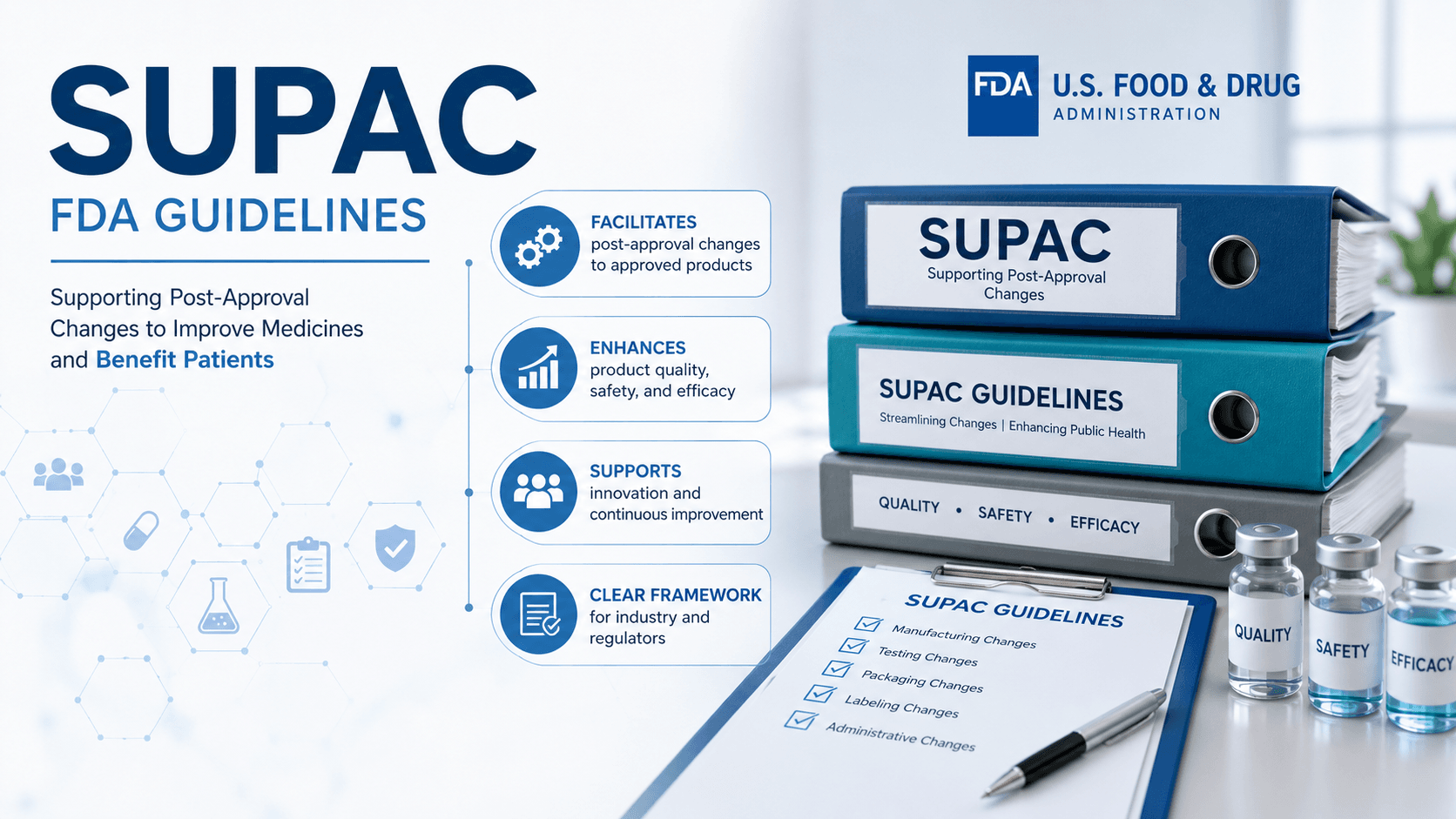
However, post-approval changes can potentially affect a drug product’s identity, strength, quality, purity, potency, safety, or efficacy. To address these concerns, the U.S. Food and Drug Administration (FDA) issued the Scale-Up and Post-Approval Changes (SUPAC) Guidance documents, which provide scientific and regulatory recommendations for implementing manufacturing changes while maintaining product quality.
SUPAC guidance serves as one of the most important regulatory frameworks for pharmaceutical manufacturers, regulatory affairs professionals, formulation scientists, process engineers, quality assurance teams, and compliance specialists. Understanding these guidelines is essential for ensuring regulatory compliance and avoiding unnecessary delays in product commercialization.
What is SUPAC?
SUPAC stands for Scale-Up and Post-Approval Changes. It refers to a series of FDA guidance documents that describe the recommended tests, documentation, filing categories, and regulatory expectations when manufacturers make changes after approval of a drug application.
The primary objective of SUPAC is to ensure that manufacturing changes do not adversely affect:
- Drug quality
- Safety
- Efficacy
- Identity
- Strength
- Purity
- Performance characteristics
- Bioavailability
Rather than requiring every manufacturing change to undergo a complete regulatory review, SUPAC introduces a risk-based approach. Depending on the type and level of change, manufacturers may only need supporting documentation, dissolution testing, stability studies, bioequivalence studies, or prior FDA approval.
Objectives of SUPAC Guidance
The FDA developed SUPAC guidance with several important objectives:
- Facilitate continuous process improvement.
- Allow manufacturers to optimize production.
- Reduce unnecessary regulatory burden.
- Ensure consistent product quality.
- Protect patient safety.
- Encourage scientific decision-making.
- Support Quality by Design (QbD) principles.
- Maintain therapeutic equivalence.
History of SUPAC Guidance
Before SUPAC was introduced, manufacturers had limited guidance regarding acceptable post-approval manufacturing changes. Even relatively minor process improvements often required extensive regulatory review, resulting in delays and increased costs.
Recognizing this challenge, the FDA published several guidance documents during the 1990s that established standardized approaches for evaluating manufacturing changes.
These guidance documents classified manufacturing changes according to risk and specified the studies necessary to demonstrate that product quality remained unchanged.
Today, SUPAC remains one of the most widely referenced FDA guidance documents in pharmaceutical manufacturing.
Major SUPAC Guidance Documents
| Guidance | Dosage Form |
|---|---|
| SUPAC-IR | Immediate Release Solid Oral Dosage Forms |
| SUPAC-MR | Modified Release Solid Oral Dosage Forms |
| SUPAC-SS | Nonsterile Semisolid Dosage Forms |
SUPAC-IR Guidance
SUPAC-IR applies to immediate-release oral solid dosage forms such as tablets and capsules. This guidance is commonly referenced during ANDA lifecycle management and commercial manufacturing.
The document covers changes involving:
- Components and composition
- Manufacturing site
- Manufacturing process
- Equipment
- Batch size
- Analytical testing
SUPAC-MR Guidance
Modified-release dosage forms are significantly more sensitive to manufacturing variables because release characteristics directly influence therapeutic performance.
SUPAC-MR provides detailed recommendations for:
- Extended-release tablets
- Controlled-release capsules
- Sustained-release products
- Delayed-release formulations
- Multiparticulate systems
Due to the complexity of modified-release products, FDA often requires more extensive dissolution profiling and, in some cases, in vivo bioequivalence studies.
SUPAC-SS Guidance
SUPAC-SS applies to nonsterile semisolid dosage forms including:
- Creams
- Ointments
- Lotions
- Topical gels
- Pastes
These dosage forms present unique challenges because factors such as rheology, viscosity, particle size, mixing efficiency, and equipment design significantly influence product performance.
Types of Changes Covered Under SUPAC
SUPAC guidance classifies post-approval changes into several major categories:
- Component and composition changes
- Manufacturing site changes
- Manufacturing process changes
- Equipment changes
- Batch size changes
- Specification changes
- Analytical method updates
- Container closure system modifications
Each category includes different levels of regulatory risk and corresponding filing requirements.
Why SUPAC is Important
Without a structured regulatory pathway, manufacturers would struggle to implement process improvements efficiently. SUPAC provides a science- and risk-based framework that enables innovation while ensuring continued product quality and patient safety.
It also supports lifecycle management by allowing companies to introduce improvements throughout the commercial life of a pharmaceutical product without compromising regulatory compliance.
Classification of Changes Under SUPAC Guidance
One of the key principles of SUPAC guidance is the classification of post-approval changes based on the potential risk they pose to product quality, safety, and efficacy. The FDA categorizes these changes into different levels, each requiring specific supporting data and regulatory reporting.
The greater the potential impact of a change on the finished pharmaceutical product, the more extensive the documentation and regulatory review required.
Level 1 Changes (Minor Changes)
Level 1 changes are considered to have minimal potential to affect the identity, strength, quality, purity, or potency of the drug product. These changes generally require limited supporting documentation and are often reported in the Annual Report.
Examples of Level 1 Changes
- Minor increase in batch size using the same equipment design.
- Replacement of equipment with another of equivalent design and operating principle.
- Minor adjustment in processing parameters within validated ranges.
- Editorial changes to manufacturing documentation.
- Minor analytical method improvements without affecting method performance.
Although Level 1 changes are considered low risk, manufacturers should still evaluate the impact through their Pharmaceutical Quality System (PQS), perform change control, and document scientific justification.
Level 2 Changes (Moderate Changes)
Level 2 changes have a greater potential to impact product quality and generally require additional supporting studies, such as comparative dissolution testing, process validation, stability studies, and updated documentation.
Examples of Level 2 Changes
- Moderate changes in formulation composition.
- Relocation to a different manufacturing facility with comparable equipment.
- Significant increase in batch size.
- Replacement of major processing equipment with different design characteristics.
- Modification of manufacturing process steps.
Depending on the type of change, these may be submitted as a Changes Being Effected (CBE) supplement or another appropriate reporting category.
Level 3 Changes (Major Changes)
Level 3 changes are those with a high potential to affect product performance and therefore require extensive scientific evaluation before implementation.
These changes typically require a Prior Approval Supplement (PAS) because FDA review is necessary before commercial distribution of product manufactured using the proposed change.
Examples of Level 3 Changes
- Major formulation redesign.
- Addition of new excipients affecting drug release.
- Change in release mechanism.
- Transfer to a manufacturing site with substantially different facilities or technology.
- Major process redesign affecting critical quality attributes.
Component and Composition Changes
Changes to formulation components require careful evaluation because excipients influence manufacturability, stability, dissolution, bioavailability, and patient acceptability.
Common Component Changes
- Change in excipient supplier.
- Replacement of an excipient.
- Increase or decrease in excipient concentration.
- Modification of lubricant levels.
- Changes in coating formulation.
- Color or flavor changes.
The FDA expects manufacturers to assess the impact of these changes through comparative testing, including dissolution, assay, impurity profile, stability studies, and where necessary, bioequivalence evaluation.
Manufacturing Site Changes
Pharmaceutical companies frequently transfer manufacturing between facilities due to capacity expansion, mergers, acquisitions, or business continuity planning. Site changes are covered extensively in SUPAC guidance.
Examples of Site Changes
- Transfer within the same campus.
- Transfer to another building.
- Transfer to another manufacturing site.
- Transfer to another country.
- Addition of an alternate manufacturing facility.
The level of regulatory reporting depends on whether the new facility has equivalent equipment, validated processes, and a satisfactory inspection history.
Equipment Changes
Equipment selection significantly influences product quality. Even when the manufacturing process remains unchanged, replacing equipment may affect blending efficiency, granulation characteristics, drying performance, compression force, or coating uniformity.
Examples
- Replacing a V-blender with another V-blender of similar design.
- Changing from a planetary mixer to a high-shear granulator.
- Replacing tablet presses.
- Installing a new coating system.
- Changing fluid bed dryer design.
Manufacturers should demonstrate equipment equivalence through engineering studies, process validation, and comparative product testing.
Manufacturing Process Changes
Process changes represent one of the most common post-approval modifications. These changes may improve efficiency, reduce variability, or enhance product quality but must be evaluated for potential impact on critical quality attributes (CQAs).
Typical Process Changes
- Mixing time adjustments.
- Granulation endpoint modification.
- Drying temperature changes.
- Compression force optimization.
- Coating process improvements.
- Packaging process modifications.
Scientific justification should be supported by process validation, continued process verification, and risk assessment.
Batch Size Changes
Scale-up is one of the primary subjects addressed by SUPAC. Increasing batch size can affect mixing efficiency, heat transfer, drying behavior, granule characteristics, and tablet compression performance.
Manufacturers should evaluate scale-up using process validation, blend uniformity, dissolution comparison, assay, impurity testing, and stability studies.
Challenges During Scale-Up
- Non-uniform blending.
- Segregation of powder blends.
- Variation in granule size distribution.
- Compression variability.
- Coating inconsistency.
- Extended drying time.
Documentation Requirements Under SUPAC
Proper documentation is essential to demonstrate that post-approval changes do not adversely affect product quality.
Typical Documentation Includes
- Formal change control documentation.
- Quality risk assessment.
- Updated batch manufacturing records.
- Process validation reports.
- Equipment qualification documents.
- Comparative dissolution studies.
- Analytical method verification.
- Stability study reports.
- Updated specifications, if applicable.
FDA Reporting Categories
1. Annual Report (AR)
Changes with minimal potential to affect product quality are generally documented in the Annual Report. These changes can usually be implemented without prior FDA approval.
2. Changes Being Effected in 30 Days (CBE-30)
Moderate-risk changes may be submitted as a CBE-30 supplement. Unless FDA objects within 30 days, the manufacturer may distribute product incorporating the change.
3. Changes Being Effected (CBE-0)
Certain moderate changes may be implemented immediately upon FDA receipt of the supplement, provided they meet applicable regulatory criteria.
4. Prior Approval Supplement (PAS)
Major changes with significant potential to affect product quality require FDA review and approval before implementation. Supporting data often include process validation, stability studies, dissolution profiles, and, where necessary, bioequivalence studies.
Practical Industry Example
A manufacturer increases the batch size of an immediate-release tablet from 100 kg to 500 kg while using geometrically similar equipment and maintaining validated process parameters. Comparative dissolution testing, process validation, and stability studies demonstrate equivalent product quality. Depending on the nature and extent of the change, the appropriate reporting category is determined based on SUPAC guidance and applicable FDA regulations.
Dissolution Testing Requirements Under SUPAC
Comparative dissolution testing is one of the most important tools used to evaluate the impact of post-approval changes on drug product performance. Dissolution profiles help demonstrate that changes in formulation, manufacturing process, equipment, or batch size have not altered the release characteristics of the drug product.
Manufacturers should perform dissolution testing using FDA-recommended methods and compare pre-change and post-change batches. Similar dissolution profiles provide evidence that the manufacturing change has not adversely affected product performance.
Factors Affecting Dissolution
- Particle size distribution
- Granulation process
- Compression force
- Binder concentration
- Lubricant level
- Coating thickness
- Manufacturing equipment
- Excipient composition
Bioequivalence Considerations
Certain post-approval changes may require an in vivo bioequivalence (BE) study to demonstrate that the modified product remains therapeutically equivalent to the approved formulation. The need for a BE study depends on the nature of the change and the associated risk to product performance.
For immediate-release products with low-risk changes, comparative dissolution testing may be sufficient. However, significant formulation or process changes—particularly for modified-release dosage forms—may necessitate additional in vivo studies.
Stability Study Requirements
Stability studies are an essential component of evaluating post-approval changes. They provide evidence that the modified product continues to meet established quality specifications throughout its shelf life.
Typical Stability Parameters
- Assay
- Related substances/impurities
- Dissolution
- Water content
- Hardness
- Friability
- Appearance
- Microbiological quality (where applicable)
The stability protocol should align with the approved specifications and applicable ICH stability guidelines.
Quality Risk Management (QRM)
SUPAC implementation should be supported by a robust Quality Risk Management (QRM) approach. A documented risk assessment helps identify potential impacts of manufacturing changes on Critical Quality Attributes (CQAs) and ensures appropriate mitigation measures are in place.
Typical Risk Assessment Tools
- Failure Mode and Effects Analysis (FMEA)
- Risk Ranking and Filtering
- Fishbone (Ishikawa) Diagram
- Hazard Analysis
- Risk Matrix
Integrating QRM into the pharmaceutical quality system supports scientifically justified decision-making and facilitates regulatory compliance.
Process Validation Following SUPAC Changes
Whenever a significant manufacturing change is implemented, manufacturers should evaluate whether revalidation or additional process qualification activities are required. The extent of validation depends on the nature of the change and its potential impact on product quality.
Validation Activities May Include
- Process Performance Qualification (PPQ)
- Cleaning validation
- Equipment qualification
- Analytical method verification
- Continued Process Verification (CPV)
Common FDA Inspection Observations Related to Post-Approval Changes
FDA inspections frequently identify deficiencies in the management of post-approval changes. Inadequate planning, insufficient scientific justification, and incomplete documentation can lead to regulatory observations.
Common Findings
- Inadequate change control procedures.
- Insufficient risk assessments.
- Lack of process validation after significant changes.
- Incomplete stability data.
- Failure to evaluate dissolution profile changes.
- Poor documentation supporting manufacturing changes.
- Inadequate impact assessment on product quality.
- Failure to submit the appropriate regulatory filing.
Best Practices for Implementing SUPAC Changes
- Maintain a robust pharmaceutical quality system.
- Perform documented quality risk assessments before implementing changes.
- Involve cross-functional teams, including Regulatory Affairs, Quality Assurance, Manufacturing, Validation, and R&D.
- Complete validation activities before commercial implementation when required.
- Generate sufficient comparative analytical and stability data.
- Maintain complete change control documentation.
- Ensure personnel are trained on revised procedures.
- Determine the correct FDA reporting category before implementation.
- Monitor product performance through ongoing process verification.
Frequently Asked Questions (FAQs)
1. What does SUPAC stand for?
SUPAC stands for Scale-Up and Post-Approval Changes, a series of FDA guidance documents that provide recommendations for evaluating manufacturing changes after product approval.
2. Does every manufacturing change require FDA approval?
No. The reporting category depends on the risk associated with the change. Some changes are reported in the Annual Report, while others require a CBE supplement or Prior Approval Supplement (PAS).
3. What is the purpose of SUPAC guidance?
SUPAC helps manufacturers implement scientifically justified improvements while ensuring continued product quality, safety, efficacy, and regulatory compliance.
4. When is a bioequivalence study required?
Bioequivalence studies may be required for significant formulation or manufacturing changes, particularly when product performance could be affected.
5. Which dosage forms are covered under SUPAC guidance?
SUPAC guidance covers immediate-release solid oral dosage forms (SUPAC-IR), modified-release solid oral dosage forms (SUPAC-MR), and nonsterile semisolid dosage forms (SUPAC-SS).
Conclusion
SUPAC guidance provides a science- and risk-based framework for managing post-approval changes in pharmaceutical manufacturing. By classifying changes according to their potential impact on product quality and specifying the supporting data and regulatory reporting requirements, the guidance enables manufacturers to improve processes while maintaining compliance with FDA expectations.
Successful implementation of SUPAC principles requires effective change control, quality risk management, process validation, comparative analytical testing, and appropriate regulatory submissions. Organizations that establish robust lifecycle management practices can implement manufacturing improvements efficiently while ensuring consistent product quality and uninterrupted patient supply.
Regulatory Disclaimer
Disclaimer: This article is intended solely for educational and informational purposes. It summarizes key concepts related to FDA Scale-Up and Post-Approval Changes (SUPAC) guidance and should not be interpreted as legal or regulatory advice. Manufacturers should refer to the latest FDA guidance documents, applicable regulations (including 21 CFR Parts 210, 211, and 314), ICH guidelines, and product-specific requirements before implementing post-approval changes. Regulatory expectations may evolve over time, and consultation with qualified regulatory professionals is recommended for product-specific decisions.

About the Author
Mahummed Asif is a pharmaceutical QA professional having sound knowledge in GMP Guidelines, QMS, Product Life Cycle Management, Operational Excelence, Regulatory filing, Product Complaint Management, Change control, risk management, and USFDA audit preparation.
1 thought on “SUPAC Guidance: Complete FDA Guide to Post-Approval Changes”