
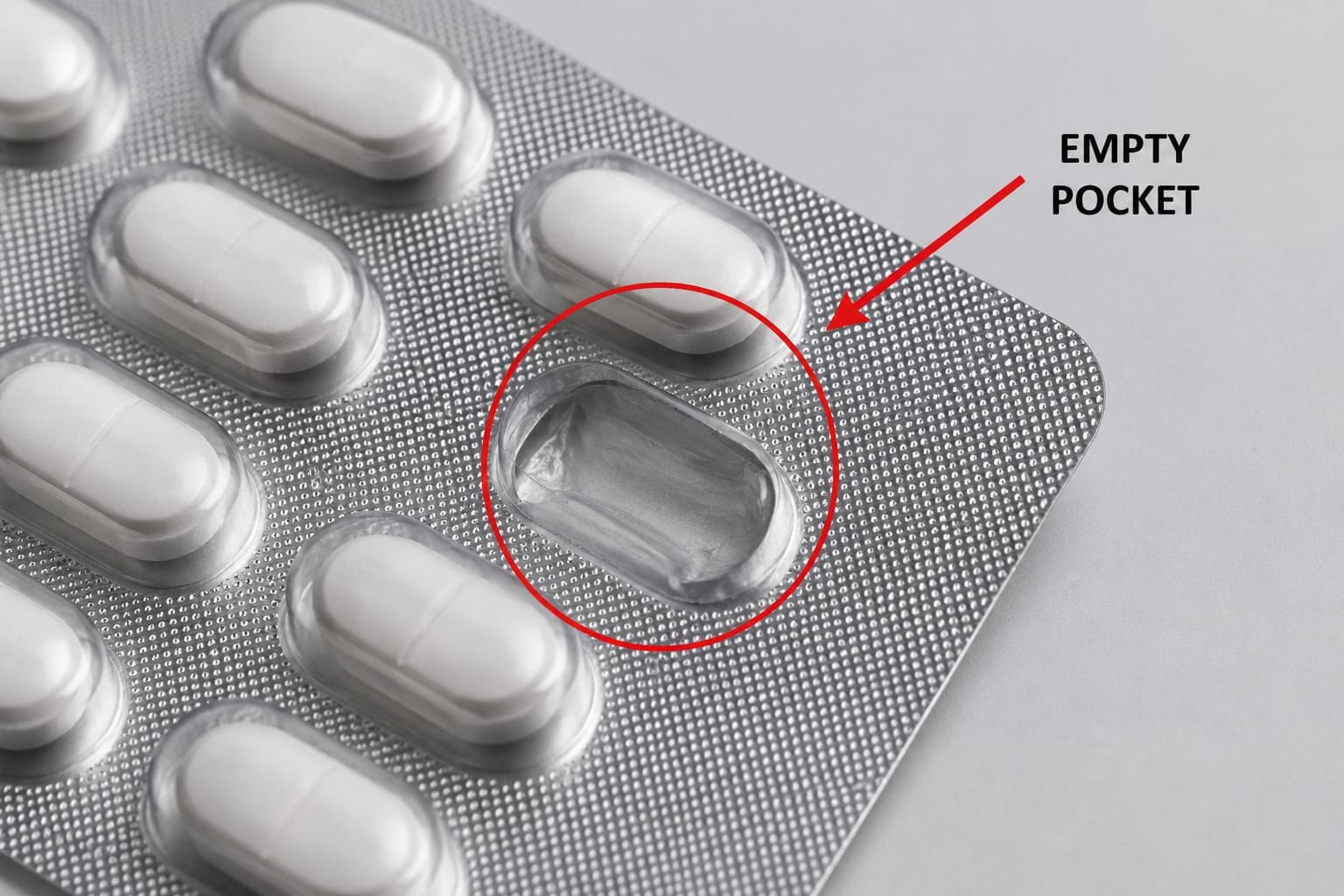
Empty Pockets in Pharmaceutical Blister Packaging: Causes, Impact, and Troubleshooting
Blister packaging is one of the most widely used packaging formats in the pharmaceutical industry due to its ability to provide product protection, tamper evidence, and patient convenience. However, one of the common challenges encountered during blister packaging operations is the occurrence of empty pockets, where a formed blister cavity remains unfilled before sealing.
Although it may appear to be a simple packaging defect, empty pockets can have significant implications for product quality, regulatory compliance, and customer satisfaction.
This article explores the causes of empty pockets in blister packaging and provides practical troubleshooting approaches to minimize their occurrence.
What Are Empty Pockets?
An empty pocket is a blister cavity that passes through the packaging process without receiving the intended tablet, capsule, or dosage form. The defect may occur intermittently or continuously and can affect single or multiple pockets within a blister pack.
If not detected and rejected by in-process controls or vision inspection systems, empty pockets may reach the market, potentially leading to patient complaints, dosage errors, and regulatory observations.
Impact of Empty Pockets
- Product quality defects
- Customer complaints
- Product recalls
- Regulatory non-compliance
- Increased rejection rates and wastage
- Production downtime
- Reduced operational efficiency
- Negative impact on company reputation
Due to these risks, pharmaceutical manufacturers must implement robust controls to detect and prevent empty pocket defects.
Common Causes of Empty Pockets
1. Improper Product Feeding
One of the most common causes of empty pockets is inadequate product feeding from the hopper into the blister cavities.
- Low hopper product level
- Product bridging or sticking
- Improper feeder adjustment
- Excessive dust generation
- Poor product flow characteristics
2. Vibratory Feeder Malfunction
Vibratory feeders guide tablets and capsules into blister pockets. Incorrect settings or equipment malfunction may reduce filling efficiency.
- Loose mounting hardware
- Damaged vibration units
- Incorrect frequency settings
- Electrical issues
3. Product Jamming in Feed Tracks
Products may become lodged in feed channels due to size variation, dust accumulation, worn guide rails, or mechanical obstructions.
This interruption can prevent proper filling of blister cavities.
4. Incorrect Machine Synchronization
Blister packaging machines rely on precise synchronization between the forming, feeding, indexing, and sealing stations. Any timing mismatch may result in pockets passing through the filling area without receiving product.
5. Product Characteristics
Certain dosage forms are inherently difficult to feed consistently.
- Sticky coated tablets
- Lightweight capsules
- Irregular tablet shapes
- Highly friable products
6. Worn or Damaged Tooling
Feed plates, brushes, tracks, and guides may wear over time, negatively impacting filling performance and increasing defect rates.
7. Vision System or Sensor Failure
Automatic inspection systems are designed to detect empty pockets before release. Sensor malfunction, poor calibration, or inadequate inspection settings may allow defective blisters to pass undetected.
Troubleshooting Empty Pockets
Step 1: Analyze the Defect Pattern
- Random occurrence
- Repeated occurrence
- Specific lane involvement
- Product-specific issues
Pattern analysis often helps narrow down the root cause quickly.
Step 2: Verify Product Feed Level
Ensure adequate product is available in the hopper and that free-flow conditions are maintained throughout production.
Step 3: Inspect Feeding Components
- Vibratory feeders
- Feed tracks
- Brush assemblies
- Product guides
Remove accumulated dust and eliminate mechanical obstructions.
Step 4: Check Machine Timing
Verify synchronization between indexing movement and product filling operations according to approved machine settings.
Step 5: Evaluate Product Quality
Inspect tablets or capsules for:
- Weight variation
- Dimension variation
- Broken units
- Excessive powder generation
Step 6: Examine Tooling Condition
Inspect all contact parts for wear, damage, and alignment issues. Replace worn components according to preventive maintenance schedules.
Step 7: Validate Vision Inspection Systems
- Verify camera functionality
- Confirm sensor calibration
- Test rejection mechanisms
- Perform challenge testing
Preventive Measures
- Implement routine preventive maintenance
- Maintain cleaning schedules
- Monitor feeder performance regularly
- Conduct startup verification checks
- Train operators on defect identification
- Calibrate vision systems periodically
- Trend rejection data for continuous improvement
Conclusion
Empty pockets in blister packaging represent a critical packaging defect that can affect patient safety, product quality, and regulatory compliance. Effective troubleshooting requires systematic evaluation of feeding systems, machine synchronization, product characteristics, tooling condition, and inspection systems.
By implementing strong preventive maintenance programs and robust in-process controls, pharmaceutical manufacturers can significantly reduce empty pocket defects and improve packaging reliability.
Disclaimer
The information provided in this article is intended for educational and informational purposes only. While every effort has been made to ensure the accuracy of the content, the author and publisher make no guarantees regarding completeness, reliability, or suitability for any specific application.
Pharmaceutical manufacturing processes, equipment configurations, and regulatory requirements may vary between organizations and regions. Readers should consult their internal procedures, equipment manufacturers, quality systems, and applicable regulatory guidelines before implementing any recommendations described in this article.
The content does not constitute regulatory, legal, engineering, validation, or quality assurance advice. The author and publisher shall not be held responsible for any loss, damage, compliance issues, or operational consequences arising from the use of the information presented herein.

About the Author
Mahummed Asif is a pharmaceutical QA professional with 16 years experience in GMP, QMS, Product Complaint Management, Change control, risk management, and USFDA audit preparation.