
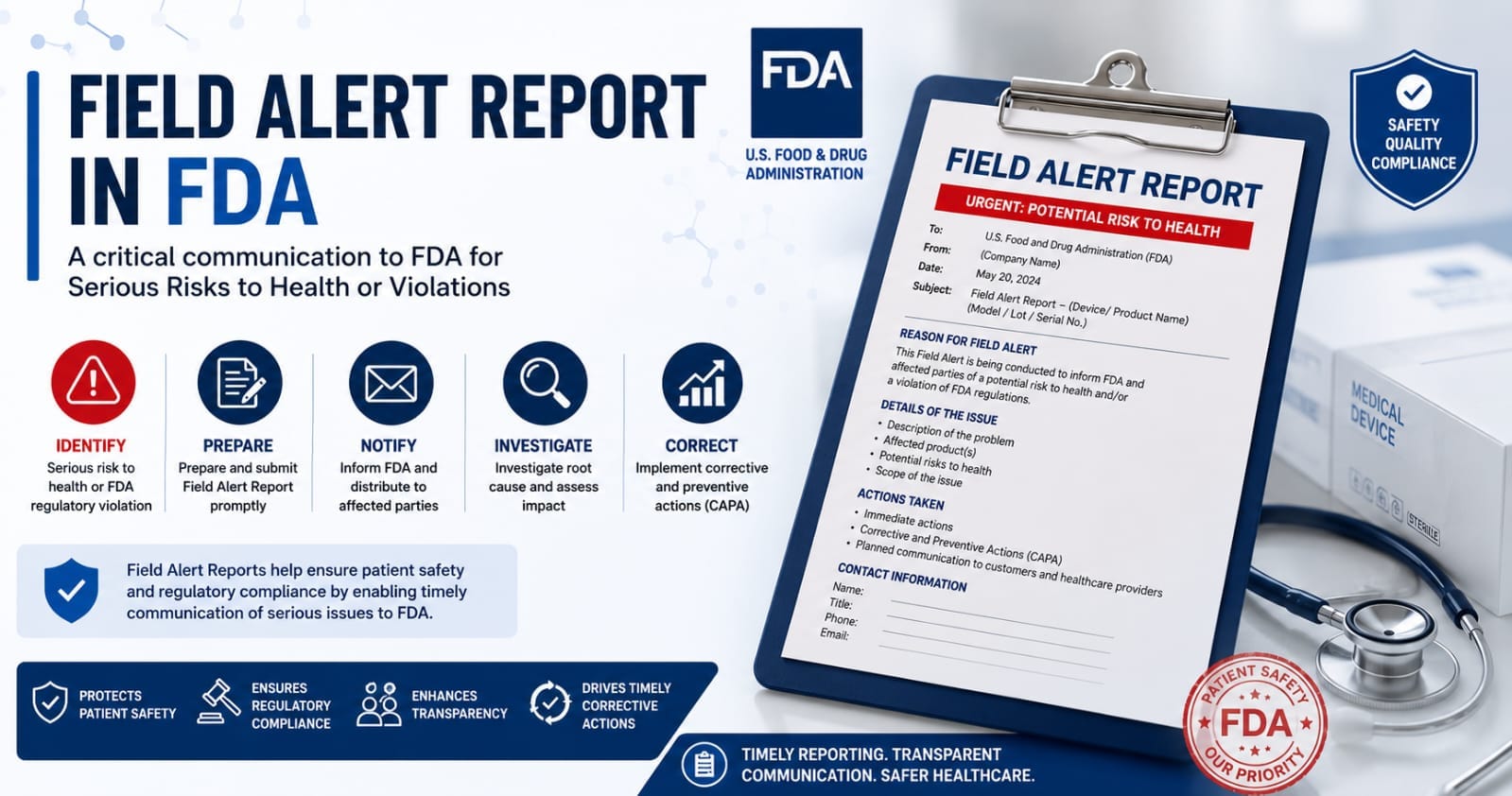
Field Alert Reports (FAR) in the Pharmaceutical Industry: Complete FDA Compliance Guide
In the pharmaceutical industry, maintaining product quality after commercial distribution is one of the most critical responsibilities of drug manufacturers. Despite robust quality systems and validated manufacturing processes, unexpected quality defects may still occur after a product enters the market.
When such defects have the potential to affect product identity, strength, quality, purity, or safety, manufacturers are legally required to notify the U.S. Food and Drug Administration (FDA) through a Field Alert Report (FAR).
A Field Alert Report is not merely a regulatory formality—it serves as an early warning system that enables FDA to assess potential risks to patients and determine whether additional regulatory actions such as recalls, market withdrawals, inspections, or safety communications are warranted.
This comprehensive guide explains everything pharmaceutical professionals need to know about Field Alert Reports, including regulatory requirements, reportable events, submission timelines, investigation expectations, FDA inspection observations, and industry best practices.
Table of Contents
- What is a Field Alert Report?
- Why FDA Requires Field Alert Reports
- Legal Basis (21 CFR 314.81)
- Who Must Submit FAR?
- Products Covered Under FAR Requirements
- Reportable Events
- Submission Timeline
- FDA Expectations
- Examples of FAR Situations
- Frequently Asked Questions
What is a Field Alert Report (FAR)?
A Field Alert Report (FAR) is a mandatory notification submitted to the FDA whenever a distributed drug product experiences certain quality defects that may affect its identity, strength, quality, purity, or potency.
Unlike routine product complaints, a FAR is specifically intended for serious quality issues identified after distribution that could potentially impact patients or indicate a significant manufacturing problem.
The report enables FDA to:
- Evaluate patient safety risks.
- Monitor emerging quality trends.
- Determine whether additional regulatory actions are necessary.
- Assess whether recalls or market withdrawals are warranted.
- Plan targeted inspections.
A FAR does not automatically mean that a recall is required. Instead, it provides FDA with early notification so the Agency can evaluate the situation alongside the manufacturer’s investigation.
Why Are Field Alert Reports Important?
Commercial manufacturing involves millions of dosage units distributed worldwide. Even with advanced Quality Management Systems (QMS), isolated failures can occur due to raw materials, manufacturing deviations, packaging issues, storage conditions, transportation damage, or stability failures.
When these issues remain unidentified or unreported, patients may receive products that fail to meet approved quality standards.
The FDA therefore requires manufacturers to rapidly communicate significant quality defects through Field Alert Reports.
Timely reporting allows:
- Early risk assessment.
- Rapid investigation.
- Protection of public health.
- Evaluation of manufacturing controls.
- Prevention of repeated quality failures.
Regulatory Basis for Field Alert Reports
The legal requirement for submitting a Field Alert Report is established under:
21 CFR 314.81(b)(1)
This regulation requires applicants holding approved New Drug Applications (NDAs) and Abbreviated New Drug Applications (ANDAs) to notify FDA of specific quality problems associated with distributed drug products.
According to the regulation, the applicant must submit a Field Alert Report within 3 working days after receiving information concerning certain reportable events.
The requirement emphasizes the importance of immediate communication rather than waiting for the completion of the full investigation.
Manufacturers should remember that the three-day reporting requirement begins when the company first becomes aware of information suggesting a reportable event—not after root cause determination or CAPA implementation.
Who Must Submit a Field Alert Report?
Field Alert Reports must generally be submitted by the application holder responsible for the approved drug product.
This typically includes:
- New Drug Application (NDA) holders
- Abbreviated New Drug Application (ANDA) holders
- U.S. Marketing Authorization Holders
- Applicants responsible for commercial distribution
Although Contract Manufacturing Organizations (CMOs) frequently discover quality defects during investigations, the legal responsibility for FAR submission remains with the application holder unless contractual arrangements specify regulatory support activities.
Therefore, effective communication between manufacturing sites, quality units, and regulatory affairs departments is essential to ensure timely reporting.
Which Products Are Covered?
Field Alert Report requirements generally apply to prescription drug products approved under an NDA or ANDA that have already entered commercial distribution within the United States.
Examples include:
- Tablets
- Capsules
- Injectables
- Oral liquids
- Topical products
- Ophthalmic products
- Respiratory products
- Biotechnology-derived drug products (where applicable)
Manufacturers should verify product-specific reporting obligations based on the applicable FDA regulations and current guidance, as reporting requirements may vary depending on product category and approval pathway.
Objectives of a Field Alert Report
The primary objectives of submitting a FAR include:
- Protect patient safety.
- Notify FDA of emerging quality defects.
- Support timely regulatory oversight.
- Initiate prompt investigations.
- Determine whether recalls are necessary.
- Identify systemic manufacturing issues.
- Reduce the likelihood of recurring quality failures.
- Maintain compliance with FDA regulations.
A well-managed FAR process demonstrates the effectiveness of a pharmaceutical company’s Quality Management System (QMS) and its commitment to transparency and regulatory compliance.
Key Takeaways (Part 1)
- Field Alert Reports are mandatory FDA notifications for certain quality defects identified after product distribution.
- The reporting requirement is established under 21 CFR 314.81(b)(1).
- Reports must generally be submitted within 3 working days of becoming aware of a reportable event.
- A FAR does not necessarily mean a product recall is required.
- The responsibility for FAR submission generally rests with the NDA or ANDA application holder.
- Prompt reporting demonstrates a mature pharmaceutical quality system and supports patient safety.
Reportable Events That Require a Field Alert Report
One of the most important aspects of FDA compliance is understanding which quality issues trigger the requirement to submit a Field Alert Report (FAR). Not every product complaint or manufacturing deviation is reportable. FARs are intended for significant quality defects that may affect a drug product’s identity, strength, quality, purity, or potency after commercial distribution.
The FDA expects manufacturers to evaluate each quality event promptly and determine whether it meets the regulatory reporting criteria. Delays while awaiting completion of the investigation are generally not acceptable if sufficient information already indicates a reportable event.
Common Reportable Events Include:
- Chemical contamination
- Microbiological contamination
- Unexpected sterility failures
- Out-of-specification (OOS) stability results
- Significant degradation before expiry
- Incorrect product labeling
- Packaging defects affecting product quality
- Incorrect strength or potency
- Presence of visible foreign particles
- Container-closure integrity failures
- Product mix-ups
- Market complaints indicating potential quality defects
Examples of Reportable Quality Defects
| Quality Issue | Potential FAR Requirement |
|---|---|
| Glass particles in injectable product | Yes |
| Tablet dissolution failure on stability | Yes |
| Incorrect package insert | Possibly (based on risk) |
| Container leakage | Yes |
| Microbial contamination | Yes |
| Color variation with no quality impact | Usually No |
| Minor cosmetic carton damage | Generally No |
| Label mix-up between strengths | Yes |
Events That Typically Do Not Require a FAR
Although every quality event should undergo documented assessment, certain issues generally do not require Field Alert Report submission when they do not affect product quality or patient safety.
- Minor cosmetic packaging defects
- Transportation damage without product impact
- Administrative documentation errors
- Minor printing defects on shipping cartons
- Customer complaints unrelated to product quality
- Events confined entirely to manufacturing before batch release
Manufacturers should always perform a documented risk assessment before deciding that a FAR is not required. The rationale should be scientifically justified and retained as part of the quality records.
Field Alert Report Submission Timeline
The FDA requires applicants to submit a Field Alert Report within three (3) working days after first receiving information indicating that a reportable event has occurred.
A common misunderstanding is that companies may wait until the laboratory investigation is complete before notifying the FDA. This approach is inconsistent with regulatory expectations. The reporting clock begins when sufficient information suggests that a reportable event may exist—not when the root cause has been confirmed.
Typical Timeline
| Day | Activity |
|---|---|
| Day 0 | Quality event identified |
| Day 1 | Initial quality assessment and risk evaluation |
| Day 2 | Regulatory review and FAR preparation |
| Day 3 | Submission of FAR to FDA |
| After Submission | Complete investigation and provide follow-up information if needed |
Information Included in a Field Alert Report
A complete FAR should provide enough information for the FDA to understand the nature of the quality issue and assess the potential risk to patients.
Typical Information Includes:
- Drug product name
- NDA or ANDA number
- Dosage form and strength
- Batch/Lot number
- Date the issue was identified
- Description of the quality defect
- Initial health hazard assessment
- Distribution information
- Investigation status
- Immediate corrective actions taken
- Company contact information
If all information is not available within the required reporting period, the company should submit the FAR with available facts and provide follow-up information once the investigation is completed.
Quality Investigation Expectations
Submitting a Field Alert Report does not conclude the company’s regulatory responsibilities. The manufacturer is expected to perform a comprehensive investigation to determine the root cause, evaluate product impact, and implement effective corrective and preventive actions (CAPA).
The Investigation Should Address:
- Root cause determination
- Extent of affected batches
- Manufacturing history review
- Equipment performance evaluation
- Analytical data review
- Complaint trend analysis
- Supplier qualification review
- Risk assessment for distributed lots
- Need for recall or market action
- Effectiveness of CAPA implementation
FDA investigators frequently assess whether investigations are scientifically sound, timely, well-documented, and supported by objective evidence.
Relationship Between FAR, Product Complaints, and Recalls
These three quality system elements are closely related but serve different regulatory purposes.
| Activity | Purpose |
|---|---|
| Product Complaint | Receives and evaluates customer-reported quality issues. |
| Field Alert Report | Notifies FDA of significant reportable quality defects. |
| Recall | Removes defective products from the marketplace when necessary. |
A product complaint may trigger a FAR, and a FAR investigation may ultimately result in a voluntary recall if patient safety or product quality is compromised.
Common FDA Inspection Observations Related to FAR
FDA inspections frequently identify deficiencies in how companies evaluate and report Field Alert events. Common observations include:
- Failure to recognize reportable events
- Late submission of Field Alert Reports
- Incomplete investigations
- Poor documentation of risk assessments
- Failure to trend recurring quality defects
- Inadequate CAPA implementation
- Lack of communication between Quality and Regulatory Affairs
- Failure to evaluate distributed batches
These deficiencies may lead to FDA Form 483 observations, Warning Letters, or additional regulatory scrutiny during future inspections.
Best Practices for Managing Field Alert Reports
An effective Field Alert Report (FAR) process requires close coordination between Quality Assurance (QA), Quality Control (QC), Regulatory Affairs (RA), Manufacturing, Pharmacovigilance (where applicable), and Supply Chain. Organizations with a well-defined FAR procedure are better positioned to meet regulatory timelines and minimize compliance risks.
Industry Best Practices
- Maintain a written SOP for identifying and reporting FAR events.
- Train QA, QC, Manufacturing, and Regulatory Affairs personnel on FAR requirements.
- Establish a cross-functional quality review team for rapid decision-making.
- Perform documented health hazard and patient risk assessments.
- Do not delay reporting while waiting for the final investigation report.
- Maintain complete investigation records and supporting evidence.
- Trend complaints and recurring quality defects to identify systemic issues.
- Implement effective Corrective and Preventive Actions (CAPA).
- Verify CAPA effectiveness through periodic reviews.
- Conduct periodic internal audits of the FAR process.
FDA Expectations During Inspections
FDA investigators routinely review a firm’s complaint handling system, investigation records, CAPA program, and Field Alert Report process during inspections. Companies should be able to demonstrate that reportable events are identified promptly and evaluated consistently.
Inspectors Commonly Review:
- Complaint files and investigation reports.
- Stability program data.
- Out-of-Specification (OOS) investigations.
- Deviation and non-conformance records.
- Recall files.
- CAPA documentation.
- Risk assessments.
- Communication between QA and Regulatory Affairs.
- Evidence supporting FAR submission or justification for not submitting one.
A mature pharmaceutical quality system demonstrates that all quality events are evaluated objectively, documented thoroughly, and escalated appropriately when regulatory reporting is required.
Common Mistakes to Avoid
Many FDA inspection observations related to FARs result from weaknesses in decision-making rather than intentional non-compliance. Avoiding the following common mistakes can significantly improve compliance.
- Waiting for the investigation to be completed before reporting.
- Misinterpreting the three-working-day reporting requirement.
- Poor communication between manufacturing, QA, and Regulatory Affairs.
- Failure to document scientific justification for non-reportable events.
- Incomplete health hazard assessments.
- Ignoring complaint trends that may indicate broader quality issues.
- Submitting incomplete information without appropriate follow-up.
- Ineffective CAPA implementation.
Frequently Asked Questions (FAQs)
1. What is the purpose of a Field Alert Report?
A Field Alert Report informs the FDA of significant quality issues affecting distributed drug products so that potential risks to patients can be evaluated promptly.
2. Is every product complaint reportable as a FAR?
No. Only complaints or quality events that meet the regulatory reporting criteria under applicable FDA regulations require submission of a FAR.
3. How quickly must a FAR be submitted?
Generally, within three working days after the applicant first receives information indicating a reportable quality event.
4. Does submitting a FAR automatically require a product recall?
No. A FAR is an early regulatory notification. Whether a recall is necessary depends on the outcome of the health hazard evaluation and the quality investigation.
5. Who is responsible for submitting the FAR?
The NDA or ANDA application holder is generally responsible for ensuring timely submission, even if the quality issue is identified by a contract manufacturing organization.
6. Can follow-up information be submitted after the initial FAR?
Yes. If the investigation is ongoing, additional information and final conclusions should be provided to the FDA as they become available.
Conclusion
Field Alert Reports are a critical component of the U.S. pharmaceutical regulatory framework and play an essential role in protecting public health. They enable the FDA to receive timely information about significant quality defects that may affect distributed drug products and allow appropriate regulatory actions to be taken when necessary.
A successful FAR program extends beyond simply meeting submission timelines. It requires robust quality systems, effective communication, thorough investigations, scientifically justified risk assessments, and a culture of regulatory compliance. Organizations that proactively manage Field Alert Reports strengthen their Quality Management System (QMS), reduce inspection risks, and reinforce confidence among regulators, healthcare professionals, and patients.
By implementing clear procedures, training employees, and integrating FAR evaluations into complaint handling, deviation management, stability programs, and CAPA systems, pharmaceutical manufacturers can demonstrate a strong commitment to product quality and patient safety.
Suggested Internal Links
References
- 21 CFR 314.81 – Other Postmarketing Reports.
- FDA Guidance for Industry – Field Alert Report Submission Questions and Answers.
- FDA Compliance Program Guidance Manual.
- FDA Investigations Operations Manual.
- ICH Q10 – Pharmaceutical Quality System.
- ICH Q9 – Quality Risk Management.
Regulatory Disclaimer
Disclaimer: This article is intended solely for educational and informational purposes. It summarizes general regulatory concepts related to Field Alert Reports (FAR) and should not be interpreted as legal, regulatory, or compliance advice. Regulatory requirements may change over time and may vary depending on product type, approval pathway, and jurisdiction. Readers should always consult the latest FDA regulations, official guidance documents, and applicable laws before making regulatory decisions. The author and publisher accept no liability for actions taken based on the information presented in this article.

About the Author
Mahummed Asif is a pharmaceutical QA professional with sound knowledge on GMP, GxP, Product Life Cycle Management, Regularory filing, QMS, Product Complaint Management, Change control, risk management, and USFDA audit preparation.