Pharmaceutical Product Recall Process in Europe and the UK – Complete Guide
Patient safety remains the highest priority for pharmaceutical manufacturers,
marketing authorization holders (MAHs), distributors, and regulatory authorities.
Whenever a medicinal product presents a potential risk to patients due to quality,
safety, efficacy, labeling, packaging, contamination, or manufacturing defects,
a product recall may become necessary.
Although the overall objective of recalls is the same worldwide, Europe and the
United Kingdom follow slightly different regulatory pathways. The European Union
operates through national competent authorities coordinated by the European
Medicines Agency (EMA), whereas the United Kingdom follows independent regulatory
requirements governed by the Medicines and Healthcare products Regulatory Agency
(MHRA).
This guide explains the complete pharmaceutical product recall process in both
Europe and the UK, making it useful for QA professionals, Regulatory Affairs,
Manufacturing, Pharmacovigilance, and Supply Chain teams.
What is a Pharmaceutical Product Recall?
A pharmaceutical product recall is the process of removing medicinal products
from the supply chain because they may present a risk to patients or fail to
comply with regulatory or quality requirements.
Recalls may involve products at wholesalers, hospitals, pharmacies, healthcare
providers, or even patients depending upon the severity of the issue.
maintaining product quality throughout the distribution network.
Regulatory Framework in Europe
- EU Good Distribution Practice (GDP) Guidelines
- EudraLex Volume 4 – EU GMP
- European Medicines Agency (EMA)
- National Competent Authorities (NCAs)
- Marketing Authorization Holder Responsibilities
- Qualified Person (QP) Oversight
Regulatory Framework in the United Kingdom
- MHRA Good Distribution Practice
- Human Medicines Regulations
- MHRA Defective Medicines Report Centre (DMRC)
- Marketing Authorization Holder Obligations
- Wholesale Distribution Authorisation (WDA)
Common Reasons for Product Recall
| Category | Examples |
|---|---|
| Manufacturing Defects | Incorrect strength, tablet defects, poor dissolution |
| Contamination | Microbial contamination, particulate matter, cross contamination |
| Packaging Errors | Wrong leaflet, wrong carton, missing blister |
| Labeling Errors | Incorrect expiry date, batch number, storage condition |
| Stability Failure | Out-of-specification during shelf life |
| Counterfeit Detection | Falsified medicines entering the supply chain |
| Regulatory Non-compliance | Critical GMP observations or inspection findings |
Types of Product Recall
Class 1 Recall
Products likely to cause serious injury or death. Immediate action is required,
including communication to healthcare professionals and, if necessary, patients.
Class 2 Recall
Products that may cause temporary or medically reversible adverse health effects
or where the probability of serious consequences is low.
Class 3 Recall
Products with minor defects unlikely to cause patient harm but requiring removal
for regulatory or quality reasons.
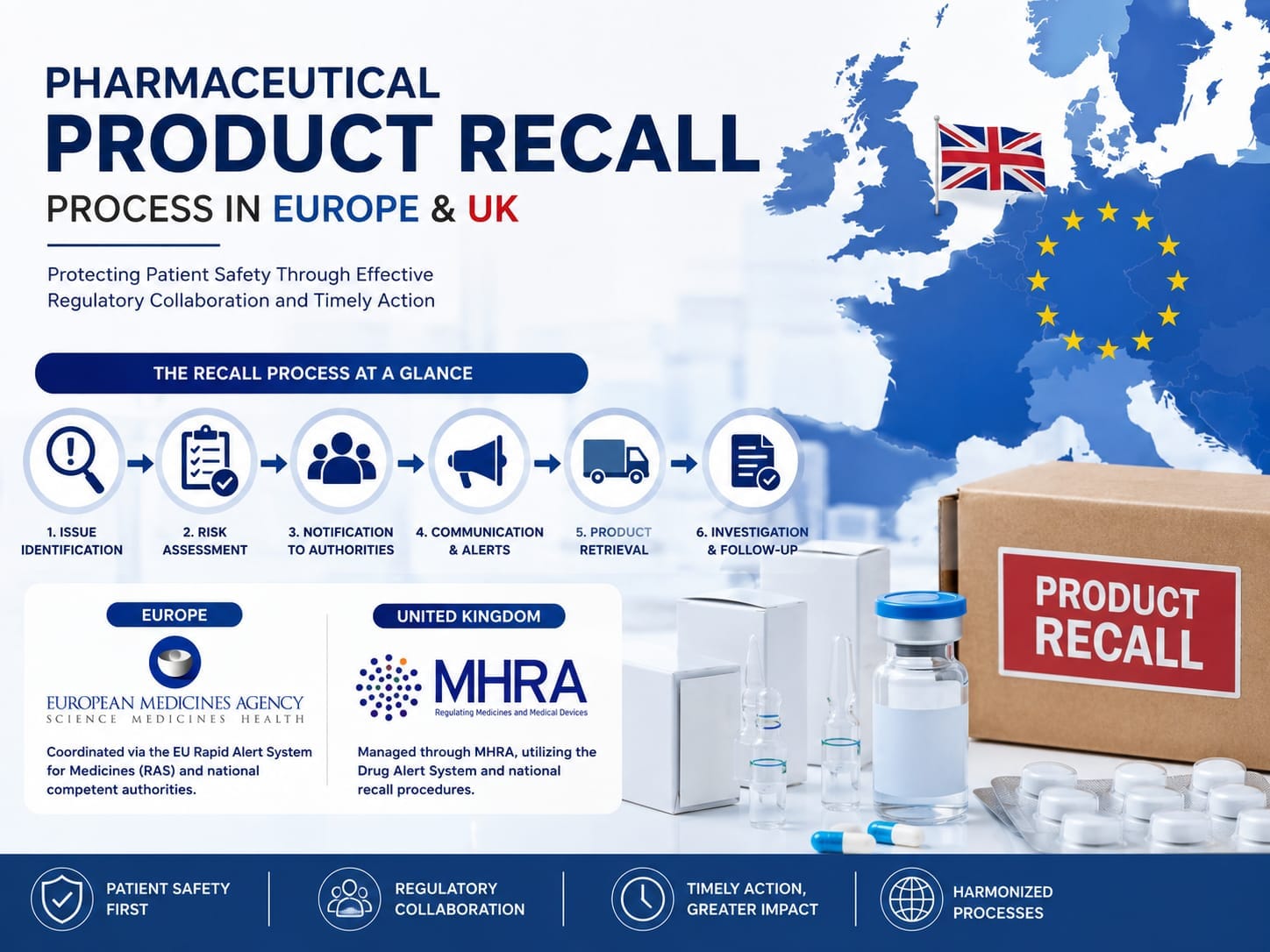
Step-by-Step Pharmaceutical Product Recall Process
Step 1 – Detection of the Quality Defect
A potential quality issue may be identified through customer complaints,
stability failures, deviations, laboratory investigations, pharmacovigilance
signals, GMP inspections, or distributor feedback.
Step 2 – Initial Risk Assessment
A multidisciplinary team evaluates:
- Severity of patient risk
- Extent of batch distribution
- Countries affected
- Availability of alternative medicines
- Urgency of recall
Step 3 – Internal Recall Committee Meeting
The recall committee typically includes:
- Quality Assurance
- Regulatory Affairs
- Manufacturing
- Supply Chain
- Medical Affairs
- Pharmacovigilance
- Legal
- Senior Management
Step 4 – Notify Regulatory Authorities
The MAH informs the appropriate authority:
- National Competent Authorities within the EU
- EMA where applicable
- MHRA Defective Medicines Report Centre (UK)
Information generally includes:
- Product name
- Strength
- Dosage form
- Batch numbers
- Manufacturing site
- Reason for recall
- Health hazard assessment
- Distribution details
Step 5 – Recall Classification
Regulators determine the urgency and recall classification based on the
identified risk.
Step 6 – Issue Recall Communication
Recall letters are sent to:
- Wholesalers
- Hospitals
- Retail pharmacies
- Healthcare providers
- Distributors
- Patients (if required)
The communication includes clear instructions for identifying, quarantining,
returning, or destroying affected batches.
Step 7 – Product Retrieval
Distributors and customers quarantine affected stock immediately. Returned
products are tracked to ensure complete accountability and reconciliation.
Step 8 – Effectiveness Check
The company verifies that all recall notifications were received and appropriate
actions were taken. This may involve follow-up calls, audits, or reconciliation
of distributed versus returned quantities.
Step 9 – Investigation and CAPA
A comprehensive root cause investigation identifies why the issue occurred.
Corrective and Preventive Actions (CAPA) are implemented to prevent recurrence.
Step 10 – Recall Closure
Once the regulatory authority is satisfied that the recall has been completed
effectively and all required actions are documented, the recall is formally
closed.
Roles and Responsibilities
| Department | Responsibility |
|---|---|
| Quality Assurance | Lead recall activities and investigation |
| Regulatory Affairs | Authority notifications |
| Supply Chain | Product traceability and reconciliation |
| Manufacturing | Technical investigation |
| Pharmacovigilance | Evaluate patient safety impact |
| Senior Management | Decision making and oversight |
Documentation Required
- Recall SOP
- Health Hazard Assessment
- Recall decision records
- Authority notifications
- Recall letters
- Distribution records
- Returned goods reconciliation
- Investigation report
- CAPA report
- Recall effectiveness report
- Recall closure report
Inspection Expectations
European inspectors and MHRA inspectors generally expect organizations to
demonstrate:
- Well-defined recall procedures
- Rapid decision-making processes
- Complete batch traceability
- Accurate distribution records
- Periodic mock recall exercises
- Effective CAPA implementation
- Timely authority communication
- Recall effectiveness verification
Best Practices
- Conduct annual mock recalls.
- Maintain accurate serialization and traceability records.
- Train employees regularly.
- Keep distributor contact lists updated.
- Review recall SOPs periodically.
- Use electronic recall management systems where possible.
- Perform health hazard assessments promptly.
- Document every recall activity in real time.
Common Challenges
- Incomplete distribution data
- Delayed communication
- Cross-border coordination within Europe
- Supplier-related investigations
- Multiple language requirements
- Product reconciliation difficulties
- Maintaining business continuity during recalls
Conclusion
A robust pharmaceutical product recall system is a critical element of an
effective Pharmaceutical Quality System (PQS). While Europe and the UK share the
same objective of protecting patient safety, organizations must understand the
specific regulatory expectations of EU competent authorities and the MHRA.
Preparedness through strong procedures, trained personnel, mock recalls, and
comprehensive documentation enables companies to respond quickly, minimize risk,
and maintain regulatory compliance.