FDA Inspection Expectations During Product Recall
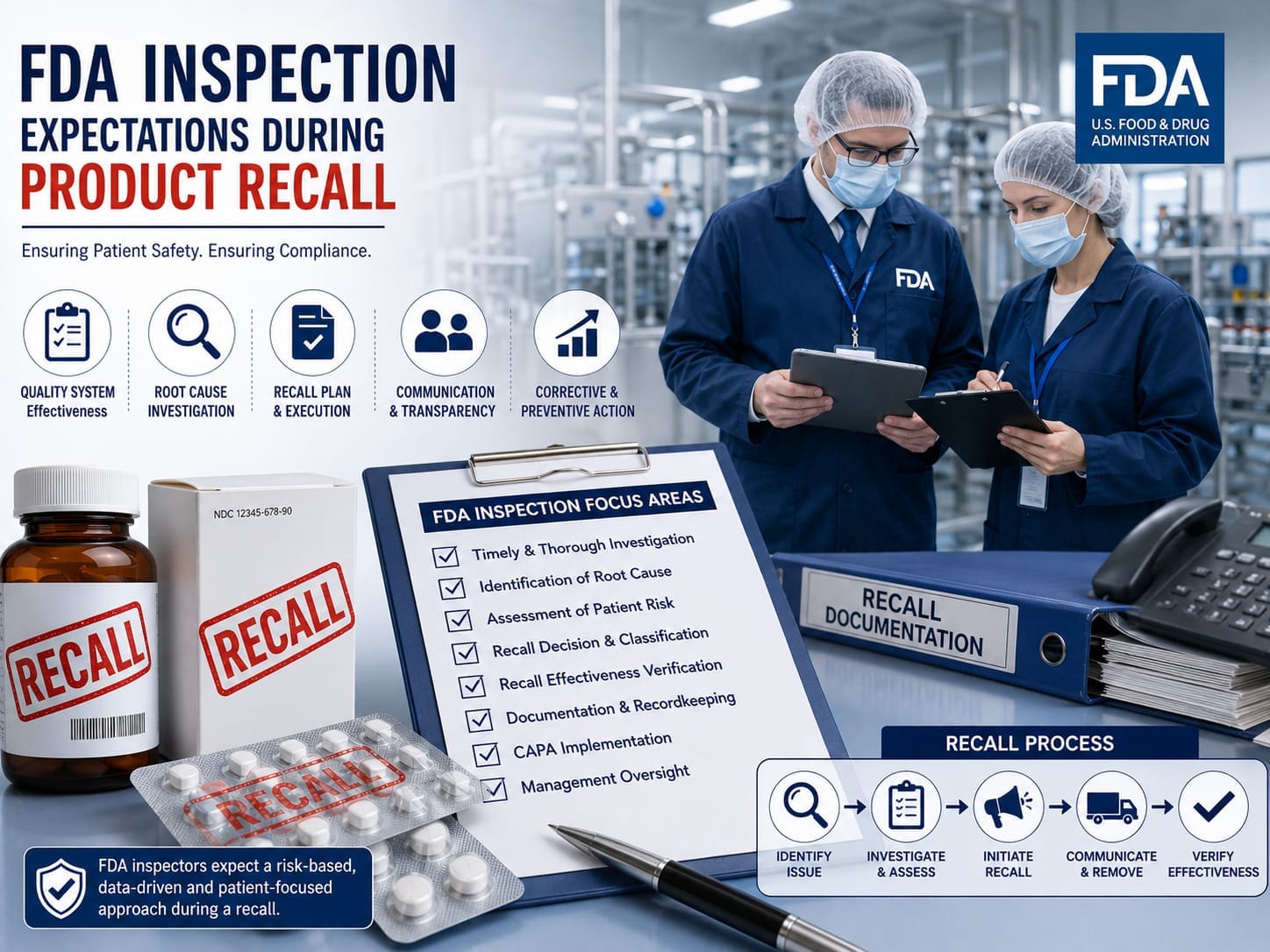
The US FDA expects every pharmaceutical manufacturer to maintain a well-defined, documented, and effective recall system that can be executed promptly whenever a marketed product presents a potential risk to patients or violates applicable regulatory requirements. During inspections, investigators assess not only whether a recall procedure exists, but also whether the firm’s quality system can detect quality issues early, evaluate risks objectively, and execute recalls efficiently.
FDA Investigators Commonly Review
- Product recall Standard Operating Procedures (SOPs)
- Recall committee structure and responsibilities
- Health Hazard Evaluation (HHE) reports
- Risk assessment documentation
- Complaint investigation records
- Deviation and OOS investigation reports
- Batch manufacturing records
- Distribution records and traceability
- Customer notification letters
- Recall effectiveness checks
- Returned product reconciliation
- CAPA implementation records
- Management review meeting minutes
- Recall training records
- Mock recall reports
Common FDA 483 Observations Related to Product Recalls
Failure to maintain an effective recall system is frequently cited during FDA inspections. The following deficiencies are commonly observed:
| Observation | Potential Impact |
|---|---|
| Delayed initiation of recall | Increased patient exposure |
| Incomplete distribution records | Unable to identify affected customers |
| Poor Health Hazard Evaluation | Incorrect recall classification |
| Ineffective recall communication | Customers fail to quarantine product |
| Lack of effectiveness checks | Recall success cannot be demonstrated |
| Inadequate CAPA | Repeat quality failures |
| Poor complaint investigations | Root causes remain unidentified |
| Failure to reconcile returned product | Risk of recalled product remaining in the market |
Best Practices for an Effective Pharmaceutical Recall Program
A mature Pharmaceutical Quality System (PQS) integrates recall management into routine quality operations. The following best practices help organizations respond effectively while minimizing regulatory and business risks.
- Establish a cross-functional recall committee.
- Maintain current customer and distributor contact information.
- Perform routine mock recalls at least annually.
- Maintain complete product traceability.
- Integrate recalls with complaint handling and CAPA systems.
- Conduct timely Health Hazard Evaluations.
- Use Quality Risk Management (ICH Q9) during decision-making.
- Ensure rapid communication with regulatory authorities.
- Train employees on recall procedures regularly.
- Monitor recall effectiveness through periodic reviews.
- Maintain electronic distribution records whenever possible.
- Review recall metrics during Management Review meetings.
Role of Quality Risk Management (ICH Q9)
Quality Risk Management (QRM) plays a critical role throughout the recall lifecycle. Risk assessment tools help manufacturers determine the severity of defects, evaluate patient impact, prioritize recall actions, and identify appropriate corrective measures.
Common Risk Assessment Tools
- Failure Mode and Effects Analysis (FMEA)
- Risk Ranking and Filtering
- Hazard Analysis
- Fault Tree Analysis (FTA)
- Fishbone Diagram
- 5 Why Analysis
Importance of Mock Recalls
Mock recalls simulate actual recall events without involving defective products. They verify whether the organization can identify, locate, and account for distributed batches within predefined timelines.
Benefits of Mock Recall Exercises
- Verifies traceability systems
- Tests recall team readiness
- Identifies process gaps
- Improves documentation practices
- Demonstrates regulatory compliance
- Enhances employee confidence during actual recalls
Real-World Examples of Pharmaceutical Product Recalls
| Recall Reason | Example |
|---|---|
| Nitrosamine impurities | Several ARB products recalled due to NDMA contamination. |
| Microbial contamination | Sterile ophthalmic products recalled because of contamination risks. |
| Glass particles | Injectable products recalled after visible particulate findings. |
| Label mix-up | Incorrect strength printed on product labels. |
| Sub-potent drug product | Stability failures leading to reduced potency. |
Frequently Asked Questions (FAQs)
1. Are pharmaceutical recalls always mandatory?
No. Most pharmaceutical recalls in the United States are voluntarily initiated by manufacturers, although the FDA oversees and monitors the process.
2. Who assigns the recall classification?
The FDA assigns the official Class I, II, or III recall classification after reviewing the Health Hazard Evaluation.
3. What is the difference between a recall and a market withdrawal?
A recall addresses products that violate FDA regulations or pose potential health risks, whereas a market withdrawal generally involves minor quality issues with little or no regulatory significance.
4. How long does a recall remain active?
A recall remains active until the FDA determines that all reasonable efforts have been made to remove or correct the affected product and officially terminates the recall.
5. Why are mock recalls important?
Mock recalls validate an organization’s ability to trace products, retrieve affected batches, and execute recalls efficiently before an actual emergency occurs.
Conclusion
An effective pharmaceutical product recall program is a fundamental component of a robust Pharmaceutical Quality System. Although recalls can significantly affect a company’s reputation and finances, timely identification of quality defects, objective risk assessment, transparent communication, and effective CAPA implementation help protect patients and maintain regulatory compliance.
Organizations that invest in strong quality systems, routine mock recalls, comprehensive employee training, and continuous improvement are better prepared to manage recall events successfully while meeting FDA expectations.
Regulatory Disclaimer
The information provided in this article is intended solely for educational and informational purposes. It should not be interpreted as legal, regulatory, or professional advice. Pharmaceutical manufacturers should always consult the latest US FDA regulations, applicable guidance documents, current Good Manufacturing Practices (cGMP), and their internal quality management procedures before making product recall decisions. Regulatory requirements may change over time, and organizations remain responsible for ensuring compliance with all applicable laws and regulations.