
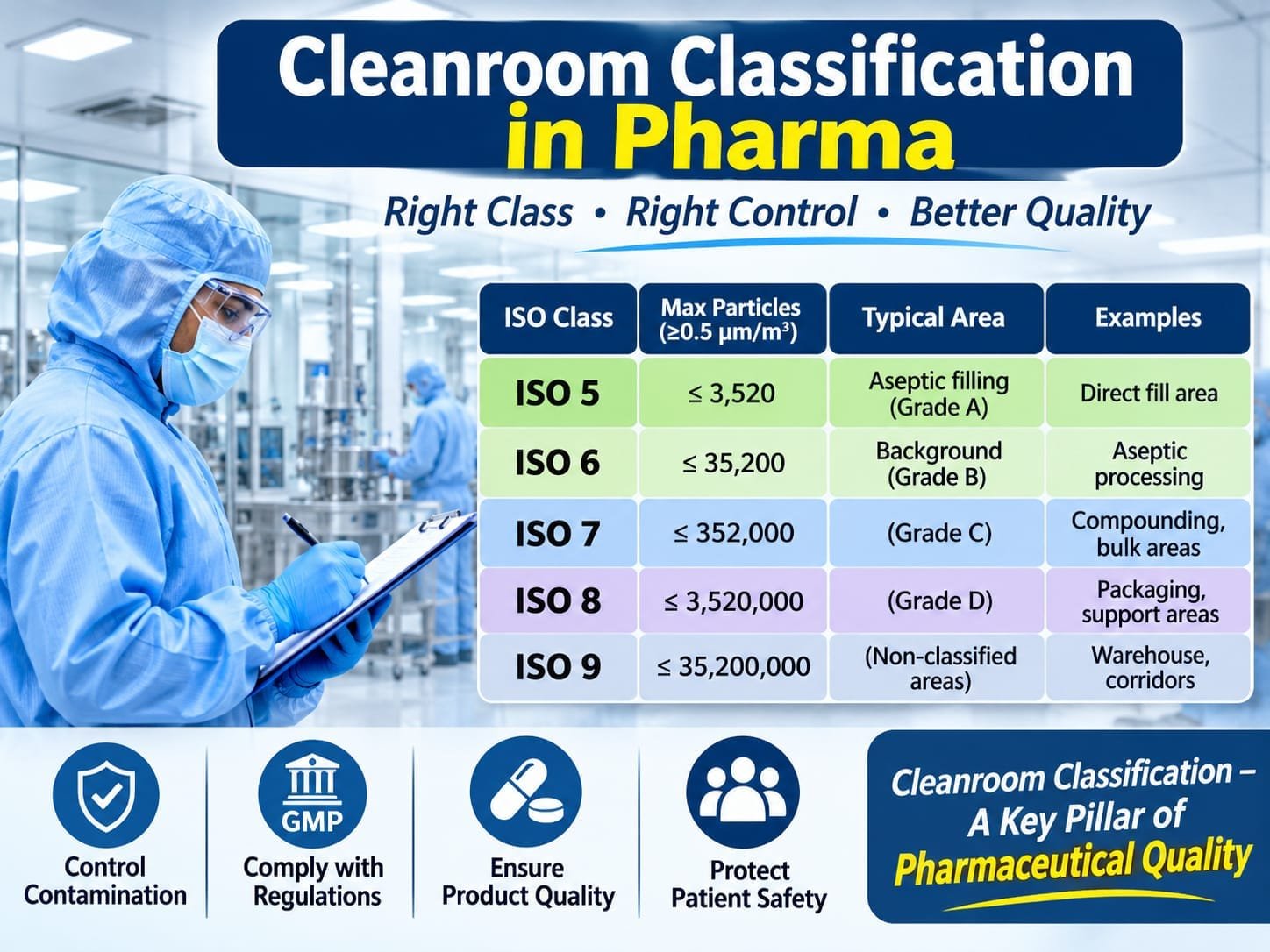
Cleanroom Classifications in Pharmaceutical Industry: Complete Guide to ISO Classes, GMP Grades A, B, C & D
Cleanroom classification in pharmaceutical manufacturing is essential for maintaining environmental cleanliness, preventing contamination and ensuring product quality and patient safety. Pharmaceutical cleanrooms are classified according to airborne particle concentration, manufacturing activities and applicable Good Manufacturing Practices (GMP).
Two important classification systems used in pharmaceutical manufacturing are ISO 14644-1 and EU GMP Annex 1. ISO 14644-1 defines cleanroom classes based on airborne particulate concentration, whereas EU GMP Annex 1 establishes four cleanroom grades: A, B, C and D.
This comprehensive guide explains pharmaceutical cleanroom classifications, ISO classes, GMP grades, particle limits, microbiological monitoring, HVAC requirements, pressure differentials and cleanroom qualification.
Table of Contents
- What is a Pharmaceutical Cleanroom?
- Cleanroom Classification Standards
- Difference Between ISO Classes and GMP Grades
- Classification of Pharmaceutical Cleanrooms
- Airborne Particle Concentration Limits
- EU GMP Annex 1 Particle Limits
- Microbiological Limits
- Cleanroom HVAC System Requirements
- Environmental Monitoring Programme
- Cleanroom Qualification and Validation
- Personnel Gowning Requirements
- Contamination Control Strategy
- Classification vs Environmental Monitoring
- Common Classification Mistakes
- Regulatory References
- Frequently Asked Questions
- Conclusion
1. What Is a Pharmaceutical Cleanroom?
A pharmaceutical cleanroom is a specially designed and controlled environment in which airborne particles, microorganisms, temperature, humidity and other environmental conditions are maintained within predefined limits.
The primary objective is to minimise contamination from personnel, equipment, materials and the surrounding environment during pharmaceutical manufacturing.
A pharmaceutical cleanroom generally consists of:
- HVAC system with appropriate air filtration.
- HEPA filters for high-efficiency particle removal.
- Controlled air changes per hour (ACH).
- Defined room pressure differentials.
- Temperature and relative humidity control.
- Controlled personnel and material movement.
- Appropriate gowning and change rooms.
- Cleaning and disinfection programmes.
- Environmental monitoring systems.
- Qualified equipment and utilities.
Why Are Cleanrooms Important in Pharmaceutical Manufacturing?
- Prevent microbial and particulate contamination.
- Protect sterile products from environmental contamination.
- Maintain product quality and consistency.
- Reduce the risk of cross-contamination.
- Maintain compliance with GMP requirements.
- Protect patients from contamination-related product defects.
2. Pharmaceutical Cleanroom Classification Standards
2.1 ISO 14644-1
ISO 14644-1:2015 specifies the classification of air cleanliness in cleanrooms and associated controlled environments based on airborne particle concentration.
It defines ISO Classes 1 to 9, with ISO Class 1 representing the highest level of air cleanliness and ISO Class 9 representing the lowest.
The classification is based on the concentration of airborne particles of specified sizes, measured using a calibrated airborne particle counter.
Important: ISO 14644-1 does not classify microbiological contamination. Microbiological monitoring and GMP requirements must therefore be addressed separately.
2.2 EU GMP Annex 1
EU GMP Annex 1, Manufacture of Sterile Medicinal Products, defines four cleanroom grades:
- Grade A
- Grade B
- Grade C
- Grade D
The revised EU GMP Annex 1 was published in August 2022 and became effective for most provisions on 25 August 2023. It emphasises Contamination Control Strategy (CCS), quality risk management, environmental monitoring, barrier technologies and contamination prevention.
2.3 WHO GMP Guidelines
WHO GMP guidelines for sterile pharmaceutical products also recognise Grades A, B, C and D and provide recommendations for cleanroom design, environmental monitoring, personnel practices and contamination control.
2.4 Indian Revised Schedule M
The revised Schedule M, notified through G.S.R. 922(E) dated 28 December 2023, includes requirements for pharmaceutical premises, equipment and GMP. Its sterile manufacturing provisions address cleanroom grades, ISO-based classification, airborne particle limits, environmental monitoring and contamination control.
3. Difference Between ISO Cleanroom Classes and GMP Grades
ISO classification and GMP grading are related, but they are not interchangeable.
ISO classification primarily evaluates airborne non-viable particle concentration, whereas pharmaceutical GMP grading also considers manufacturing activities, microbiological contamination and process-related contamination risks.
| EU GMP Grade | ISO Class at Rest | ISO Class in Operation |
|---|---|---|
| Grade A | ISO 5 | ISO 5 |
| Grade B | ISO 5 | ISO 7 |
| Grade C | ISO 7 | ISO 8 |
| Grade D | ISO 8 | Risk-based / not predetermined |
Note: These are commonly used ISO correlations under the EU GMP Annex 1 framework. The exact classification must be verified against the applicable regulatory standard, particle sizes, operating state and qualification protocol.
4. Classification of Pharmaceutical Cleanrooms: Grades A, B, C and D
4.1 Grade A Cleanroom
Grade A represents the critical zone where high-risk aseptic operations are performed. It provides the highest level of environmental cleanliness and is generally maintained using unidirectional airflow (UDAF), also commonly known as laminar airflow.
Typical applications:
- Aseptic filling of sterile products.
- Aseptic connections.
- Open vial and ampoule filling.
- Filling of sterile ophthalmic preparations.
- Exposure of sterile product or components.
- Aseptic loading and unloading activities where the product is exposed.
- Critical operations inside RABS and isolators.
Key characteristics:
- ISO Class 5 under both at-rest and in-operation conditions.
- Unidirectional airflow in the critical zone, unless an appropriately justified alternative design applies.
- HEPA-filtered air supply.
- Continuous viable and non-viable environmental monitoring as appropriate.
- Strict personnel and intervention controls.
- Qualified airflow visualisation studies.
- Highly controlled gowning and aseptic practices.
Under EU GMP Annex 1, the guidance airflow velocity for unidirectional airflow systems is generally 0.36–0.54 m/s at the defined test position, unless otherwise scientifically justified.
4.2 Grade B Cleanroom
Grade B is the background environment for Grade A aseptic processing where conventional open aseptic processing arrangements are used. It supports critical aseptic activities and helps maintain the required environmental conditions around the Grade A zone.
Typical applications:
- Background for aseptic filling lines.
- Aseptic preparation and filling support.
- Preparation and transfer of sterile equipment.
- Activities supporting exposed sterile product handling.
Key characteristics:
- ISO Class 5 at rest.
- ISO Class 7 in operation.
- HEPA-filtered air supply.
- Controlled pressure differential with adjacent lower-grade areas.
- Qualified HVAC system.
- Environmental and personnel monitoring.
- Strict gowning and access controls.
4.3 Grade C Cleanroom
Grade C is used for less critical manufacturing operations in sterile pharmaceutical production. It generally supports preparation activities in which the product or components may subsequently undergo sterilisation or sterile filtration.
Typical applications:
- Preparation of solutions for subsequent sterile filtration.
- Preparation of equipment and components.
- Handling of materials before sterilisation.
- Certain filling operations for terminally sterilised products.
- Preparation of products where contamination risk is controlled by subsequent processing.
Key characteristics:
- ISO Class 7 at rest.
- ISO Class 8 in operation.
- HEPA-filtered air where required by the facility design and applicable GMP.
- Controlled personnel movement.
- Defined gowning requirements.
- Routine particle and microbiological monitoring.
- Qualified HVAC and environmental controls.
4.4 Grade D Cleanroom
Grade D is generally used for less critical manufacturing activities and supporting operations in sterile pharmaceutical manufacturing. It provides a controlled environment for activities where the product is not directly exposed to the highest contamination risks.
Typical applications:
- Handling of cleaned components.
- Initial preparation of equipment and materials.
- Washing and drying activities, where justified by the process.
- Preparation of materials for subsequent sterilisation.
- Supporting operations in sterile manufacturing facilities.
Key characteristics:
- ISO Class 8 at rest under the commonly used EU GMP correlation.
- In-operation particle limits are not predetermined under revised EU GMP Annex 1.
- HVAC performance established according to risk and process requirements.
- Appropriate personnel gowning.
- Routine environmental monitoring based on risk.
- Controlled material and personnel movement.
5. Maximum Permitted Airborne Particle Concentration
Airborne particulate concentration is one of the most important parameters used to classify pharmaceutical cleanrooms. Particles are measured using a calibrated airborne particle counter.
The commonly evaluated particle sizes are ≥0.5 µm and ≥5.0 µm.
Airborne Particle Limits According to Indian Revised Schedule M
Maximum permitted particles per cubic metre:
| Grade | At Rest ≥0.5 µm | At Rest ≥5.0 µm | In Operation ≥0.5 µm | In Operation ≥5.0 µm |
|---|---|---|---|---|
| A | 3,520 | 20 | 3,520 | 20 |
| B | 3,520 | 29 | 352,000 | 2,900 |
| C | 352,000 | 2,900 | 3,520,000 | 29,000 |
| D | 3,520,000 | 29,000 | Not defined | Not defined |
Note: These values are reproduced from the Indian revised Schedule M notification. They should not be substituted for EU GMP Annex 1 limits, which have some differences, particularly in the treatment of particles ≥5.0 µm in Grade A and the Grade D in-operation state.
At Rest Condition
At-rest condition means that:
- The cleanroom installation is complete.
- HVAC and other relevant systems are operating.
- Equipment is installed and operating as agreed.
- No operating personnel are present.
In Operation Condition
In-operation condition means that:
- The cleanroom is functioning in its defined operating mode.
- Equipment is operating.
- The specified number of personnel is present.
- Normal or simulated manufacturing activities are being performed.
6. EU GMP Annex 1 Particle Limits: 2022 Revision
For facilities manufacturing sterile medicinal products for EU markets, the revised EU GMP Annex 1 particle classification limits are as follows.
Maximum permitted particles per cubic metre:
| Grade | At Rest ≥0.5 µm | At Rest ≥5.0 µm | In Operation ≥0.5 µm | In Operation ≥5.0 µm |
|---|---|---|---|---|
| A | 3,520 | Not specified* | 3,520 | Not specified* |
| B | 3,520 | Not specified* | 352,000 | 2,930 |
| C | 352,000 | 2,930 | 3,520,000 | 29,300 |
| D | 3,520,000 | 29,300 | Not predetermined | Not predetermined |
*The inclusion of ≥5.0 µm particles for Grade A and B classification may be considered where indicated by the Contamination Control Strategy or historical trends.
For Grade D, in-operation limits should be established by the manufacturer based on risk assessment and routine data, where applicable.
Important: The Indian Schedule M and EU GMP Annex 1 tables should be treated as separate regulatory references. Always use the applicable current version for the intended market.
7. Microbiological Limits for Pharmaceutical Cleanrooms
In addition to airborne particle concentration, microbiological contamination must be controlled in pharmaceutical cleanrooms.
Microbiological monitoring helps evaluate the presence of viable microorganisms in the manufacturing environment.
Common environmental monitoring techniques include:
- Active air sampling.
- Passive air sampling using settle plates.
- Surface monitoring using contact plates.
- Surface monitoring using swabs.
- Personnel monitoring using glove and gown contact plates.
Recommended Microbiological Limits According to EU GMP Annex 1
| Grade | Active Air Sampling (CFU/m³) | Settle Plate 90 mm (CFU/4 hours) | Contact Plate 55 mm (CFU/plate) |
|---|---|---|---|
| A | No growth | No growth | No growth |
| B | 10 | 5 | 5 |
| C | 100 | 50 | 25 |
| D | 200 | 100 | 50 |
These are recommended maximum limits for microbiological monitoring under EU GMP Annex 1.
Important points:
- Grade A should show no microbial growth.
- Grade B, C and D limits are established according to the applicable grade.
- Alert and action limits must be established as part of the environmental monitoring programme.
- Any excursion must be assessed and investigated.
- Microorganism identification and trending should be performed where appropriate.
- The microbiological monitoring programme must be risk-based.
Microbiological limits should not be confused with airborne particle classification limits. Both are essential but evaluate different types of contamination.
8. Cleanroom HVAC System Requirements
The HVAC system is one of the most critical engineering systems supporting pharmaceutical cleanroom classification.
It maintains the required air cleanliness, temperature, humidity, pressure differential and airflow pattern.
8.1 Pre-Filters
Pre-filters remove larger airborne particles from incoming air and protect downstream filtration stages.
8.2 Fine Filters
Fine filters provide additional particulate removal before air reaches the final filtration stage.
8.3 HEPA Filters
High-Efficiency Particulate Air (HEPA) filters remove very small airborne particles from supplied air. HEPA filtration is particularly important in sterile manufacturing environments.
Filter integrity testing is performed to verify that the filter media, frame and sealing arrangements do not allow unacceptable leakage.
8.4 Air Handling Unit (AHU)
The Air Handling Unit is responsible for conditioning and supplying air to the cleanroom.
It may include:
- Air mixing section.
- Pre-filtration section.
- Cooling coil.
- Heating coil, where applicable.
- Humidity control system.
- Fine filtration.
- Supply and return air fans.
- Control instrumentation.
8.5 Air Changes Per Hour (ACH)
Air changes per hour indicate how many times the equivalent volume of air in a room is supplied or exchanged in one hour.
The ACH requirement depends on:
- Cleanroom classification.
- Room size and design.
- Number of personnel.
- Equipment and process activities.
- Particle generation.
- Heat load.
- Required recovery performance.
There is no single universal ACH value that automatically qualifies a room as Grade A, B, C or D. The airflow system must be scientifically designed, qualified and demonstrated to achieve the required environmental conditions.
8.6 Pressure Differential
Pressure differential helps control the direction of airflow between adjacent rooms.
In a conventional positive-pressure cleanroom arrangement, air generally moves from the cleaner area towards the less clean adjacent area.
A pressure cascade helps minimise contamination ingress. Pressure differentials should be defined through risk-based facility design, appropriately monitored and supported by alarm and investigation procedures.
8.7 Temperature and Relative Humidity
Temperature and relative humidity should be controlled within established operating ranges.
The limits should consider product requirements, personnel comfort, equipment performance, material characteristics, microbial contamination risks and process requirements.
9. Cleanroom Environmental Monitoring Programme
Environmental monitoring (EM) is a systematic programme used to assess the microbiological and particulate cleanliness of pharmaceutical cleanrooms.
The programme should demonstrate that the cleanroom remains under a state of control during manufacturing activities.
9.1 Non-Viable Particle Monitoring
Non-viable particle monitoring measures airborne particulate contamination using calibrated particle counters.
Particle monitoring is used during:
- Initial cleanroom classification.
- Routine environmental monitoring.
- HVAC performance evaluation.
- Investigations of environmental excursions.
- Requalification activities.
9.2 Active Air Sampling
Active air sampling measures viable microorganisms in a defined volume of air. A microbiological air sampler draws air onto an appropriate culture medium for subsequent incubation and evaluation. Results are generally expressed as CFU/m³.
9.3 Passive Air Sampling
Settle plates are exposed for a defined period to detect microorganisms settling from the surrounding environment. Results are generally expressed as CFU per plate over the exposure period.
9.4 Surface Monitoring
Surface monitoring evaluates microbial contamination on equipment surfaces, workbenches, walls, floors and transfer areas. Contact plates and swabs are commonly used.
9.5 Personnel Monitoring
Personnel are a major potential source of contamination in cleanrooms.
Personnel monitoring may include:
- Glove monitoring.
- Sleeve monitoring.
- Gown monitoring.
- Other relevant gown-contact locations.
Personnel monitoring results should be evaluated together with the activity performed and the contamination risk.
10. Cleanroom Qualification and Validation
Cleanroom qualification is essential to demonstrate that the facility and its environmental control systems are suitable for their intended use.
Qualification should be performed using an approved protocol and documented acceptance criteria.
10.1 Design Qualification (DQ)
Verification that the cleanroom design meets the intended GMP and user requirements.
10.2 Installation Qualification (IQ)
Verification that the HVAC system, HEPA filters, instrumentation, ducting and associated equipment have been installed as per approved design specifications.
10.3 Operational Qualification (OQ)
Demonstration that the HVAC and environmental control systems operate within predefined acceptance criteria.
10.4 Performance Qualification (PQ)
Demonstration that the cleanroom consistently performs under representative operating conditions.
Important Cleanroom Qualification Tests
- Airborne particle classification.
- HEPA filter integrity testing.
- Airflow velocity measurement.
- Airflow volume measurement.
- Airflow visualisation or smoke studies.
- Room pressure differential verification.
- Temperature and relative humidity mapping.
- Airflow recovery testing.
- Air change rate determination.
- Microbiological assessment, as applicable.
Requalification frequency should follow applicable regulatory requirements and risk assessment.
Under EU GMP Annex 1, the maximum interval for requalification is generally six months for Grade A and B areas and twelve months for Grade C and D areas.
Requalification should also be considered following significant changes, maintenance interventions or adverse trends that could affect environmental control.
11. Personnel Gowning Requirements in Pharmaceutical Cleanrooms
Personnel are one of the most significant potential sources of microbial and particulate contamination. Therefore, appropriate gowning procedures are essential for maintaining cleanroom classification.
| Cleanroom Grade | Typical Gowning Requirements |
|---|---|
| Grade A/B | Sterile, non-shedding cleanroom garments, sterile gloves, face mask, appropriate head and footwear coverage. |
| Grade C | Appropriate cleanroom suit, head covering, footwear and gloves as required. |
| Grade D | Dedicated cleanroom clothing, head covering and appropriate footwear. |
Gowning requirements should be defined in approved SOPs based on applicable regulatory requirements and contamination risks.
Personnel entering critical areas should undergo:
- Initial gowning training.
- Practical gowning qualification.
- Periodic requalification.
- Aseptic behaviour training.
- Personal hygiene training.
- Cleanroom entry and exit procedure training.
12. Contamination Control Strategy (CCS)
The revised EU GMP Annex 1 places strong emphasis on establishing a comprehensive Contamination Control Strategy.
A CCS is a documented strategy that identifies, evaluates and controls potential contamination risks throughout the manufacturing facility.
It should cover:
- Facility and cleanroom design.
- Personnel and material movement.
- HVAC and HEPA filtration.
- Equipment design.
- Cleaning and disinfection.
- Environmental monitoring.
- Personnel training and gowning.
- Process and equipment interventions.
- Sterilisation and filtration processes.
- Utilities and water systems.
- Supplier and material controls.
- Continuous improvement and periodic review.
The CCS should integrate the various contamination control measures into one coherent system rather than treating each control independently.
13. Difference Between Cleanroom Classification and Environmental Monitoring
This is an important concept for pharmaceutical QA and microbiology professionals.
Although cleanroom classification and environmental monitoring are related, they are not the same activity.
| Parameter | Cleanroom Classification | Environmental Monitoring |
|---|---|---|
| Objective | Establish air cleanliness class | Monitor environmental state of control |
| Particle monitoring | Yes | Yes |
| Microbiological monitoring | Not part of ISO particle classification itself | Yes |
| Test conditions | As-built, at rest or in operation, as applicable | Routine operating conditions and risk-based sampling |
| Frequency | Initial and periodic requalification | Routine frequency based on risk |
| Main reference | ISO 14644-1 | Applicable GMP requirements and approved EM programme |
A cleanroom may successfully meet its ISO particle classification but still have microbiological contamination.
Therefore, ISO classification alone cannot establish GMP compliance for sterile pharmaceutical manufacturing.
14. Common Cleanroom Classification Mistakes
The following mistakes should be avoided in pharmaceutical facilities:
- Treating ISO classification and GMP grading as identical.
- Considering only non-viable particle results.
- Ignoring microbiological contamination trends.
- Performing classification only at rest without considering in-operation requirements.
- Using inappropriate particle counter sampling locations.
- Ignoring pressure differential alarms.
- Not performing adequate airflow visualisation studies.
- Allowing uncontrolled personnel movement.
- Not qualifying personnel gowning practices.
- Failing to investigate environmental monitoring excursions.
- Not performing timely HEPA filter integrity testing.
- Failing to review cleanroom performance after major HVAC modifications.
15. Regulatory References for Pharmaceutical Cleanroom Classification
The following documents are important references for cleanroom design, classification and environmental control:
- EU GMP Annex 1 – Manufacture of Sterile Medicinal Products, 2022 revision.
- ISO 14644-1:2015 – Classification of Air Cleanliness by Particle Concentration.
- ISO 14644-2 – Monitoring to Provide Evidence of Cleanroom Performance.
- Indian Revised Schedule M – G.S.R. 922(E), 28 December 2023.
- US FDA Guidance – Sterile Drug Products Produced by Aseptic Processing, Current Good Manufacturing Practice.
- WHO GMP Guidelines for Sterile Pharmaceutical Products, WHO Technical Report Series No. 1044, 2022.
Manufacturers should always refer to the latest applicable regulatory versions and their approved site procedures.
16. Frequently Asked Questions (FAQs)
Q1. What are the four cleanroom grades in pharmaceutical manufacturing?
The four cleanroom grades used for sterile pharmaceutical manufacturing are Grade A, Grade B, Grade C and Grade D.
Q2. Which is the highest cleanroom classification in pharma?
Grade A is the highest GMP cleanroom grade used for critical aseptic processing operations.
Q3. What is the ISO class equivalent of Grade A?
Grade A generally corresponds to ISO Class 5 in both at-rest and in-operation conditions under the EU GMP Annex 1 framework.
Q4. What is the ISO class equivalent of Grade B?
Grade B generally corresponds to ISO Class 5 at rest and ISO Class 7 in operation.
Q5. What is the ISO class equivalent of Grade C?
Grade C generally corresponds to ISO Class 7 at rest and ISO Class 8 in operation.
Q6. What is the ISO class equivalent of Grade D?
Grade D generally corresponds to ISO Class 8 at rest. Its in-operation classification is not predetermined under revised EU GMP Annex 1.
Q7. What is the purpose of HEPA filters in pharmaceutical cleanrooms?
HEPA filters remove airborne particulate contamination from the supplied air and help maintain the required cleanroom air quality.
Q8. What is the difference between at-rest and in-operation conditions?
At-rest conditions are assessed with equipment installed and operating but without personnel present. In-operation conditions are assessed with the room operating under defined conditions with the specified number of personnel present.
Q9. Is ISO Class 5 equivalent to Grade A?
They are commonly correlated for airborne particle cleanliness, but ISO Class 5 alone does not establish full GMP Grade A compliance. GMP requirements also address microbiological control, airflow protection, process conditions and contamination control.
Q10. Why is environmental monitoring important in pharmaceutical cleanrooms?
Environmental monitoring helps detect particulate and microbial contamination, identify adverse trends, evaluate the effectiveness of contamination controls and demonstrate that the cleanroom remains in a state of control.
17. Conclusion
Cleanroom classification is a fundamental requirement for maintaining contamination control in pharmaceutical manufacturing facilities.
Understanding ISO 14644-1 and GMP Grades A, B, C and D helps pharmaceutical professionals establish appropriate environmental conditions for different manufacturing activities.
However, cleanroom classification alone is not sufficient to ensure product quality. Effective contamination control requires a combination of properly designed HVAC systems, HEPA filtration, airflow visualisation, pressure differentials, qualified personnel, gowning practices, cleaning and disinfection programmes, environmental monitoring and periodic requalification.
The introduction of the revised EU GMP Annex 1 and Indian Schedule M has further strengthened the importance of risk-based contamination control and a comprehensive Contamination Control Strategy.
Ultimately, a well-designed and properly qualified pharmaceutical cleanroom is not just a regulatory requirement; it is an essential component of product quality assurance and patient safety.
About the Author
Mahummed Asif is a pharmaceutical Quality Assurance professional with extensive experience in pharmaceutical manufacturing, GMP compliance, Quality Management Systems, contamination control and regulatory requirements. He shares practical pharmaceutical quality and regulatory knowledge through PharmaShare.in.
Disclaimer: This article is intended for pharmaceutical industry education and professional reference. It does not replace applicable GMP regulations, official standards, approved facility procedures or product-specific regulatory requirements. Always consult the latest applicable regulatory documents before implementing cleanroom classification and monitoring programmes.
The information provided on this page is for educational and informational purposes only. It is not intended to provide regulatory, legal, or compliance advice.
Pharmaceutical regulations including FDA 21 CFR, EU GMP Annexes, ICH Guidelines, EDQM, WHO, and CDSCO requirements are subject to frequent updates and interpretation by regulatory authorities.
Readers are responsible for ensuring compliance with current applicable laws and regulations in their jurisdiction. PharmaShare does not guarantee the accuracy, completeness, or currentness of this content.
This content does not create a consultant-client relationship. For product-specific regulatory strategy, dossier preparation, or inspection readiness, please consult qualified regulatory professionals or contact us directly.

About the Author
Mahummed Asif is a experienced pharmaceutical Quality Assurance professional and publisher of Pharmashare. He has worked with leading Pharmaceutical organizations and has developed extensive expertise in Quality Assurance, deviation management, investigations, CAPA, QMS, Product Life Cycle Management, change control, risk management, validation, product complaints, product recalls, and regulatory compliance. He is passionate about sharing practical pharmaceutical knowledge with professionals, students, and quality practitioners across the industry.