
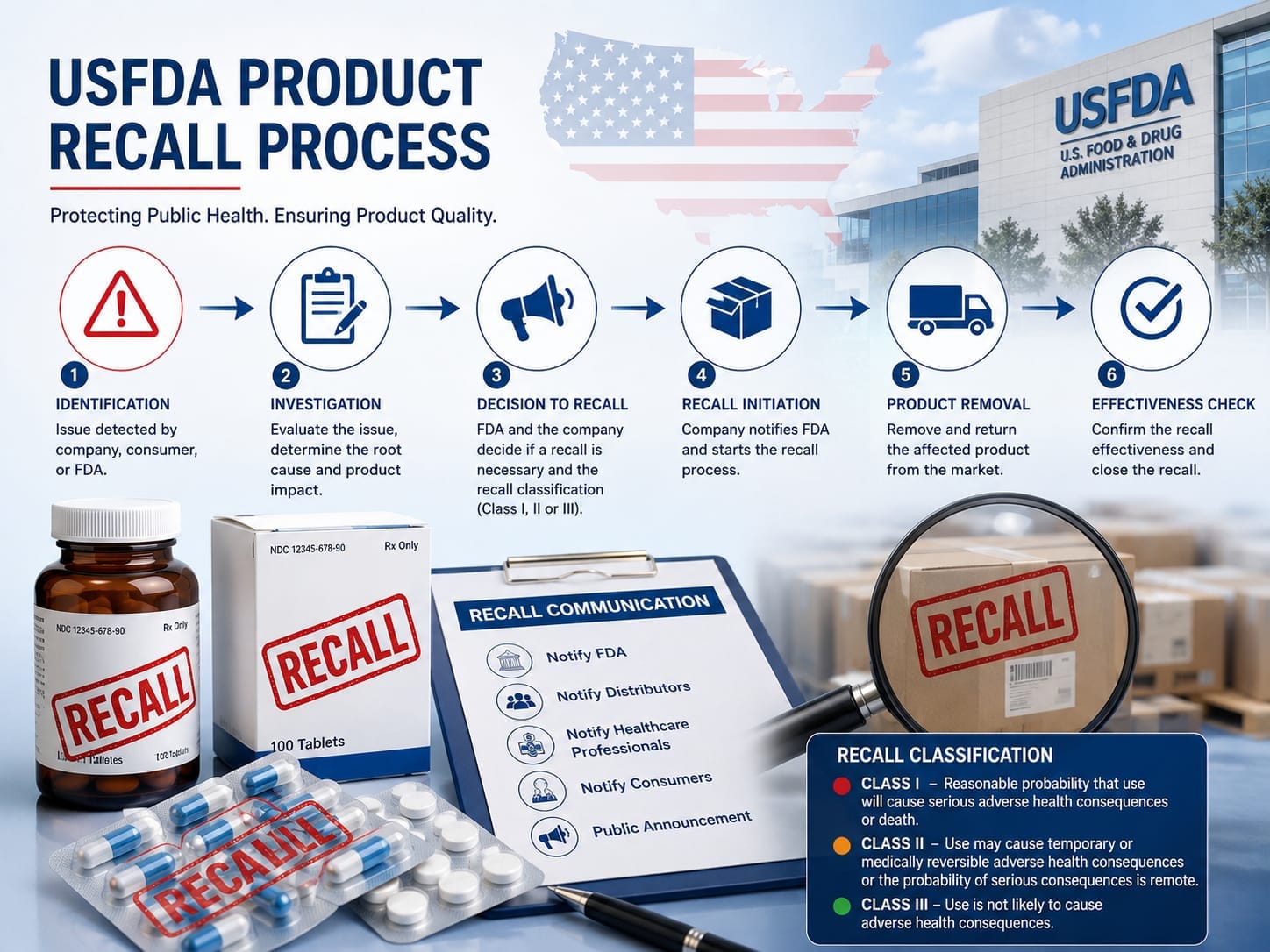
Health Hazard Evaluation (HHE)
A Health Hazard Evaluation (HHE) is the scientific assessment used to determine the potential risk
posed by a defective pharmaceutical product. The outcome of the HHE forms the basis for the recall
decision and helps the FDA determine the appropriate recall classification.
Key Factors Evaluated
- Nature of the defect
- Route of administration
- Patient population (pediatric, geriatric, immunocompromised)
- Dose and duration of therapy
- Potential for serious injury or death
- Likelihood of occurrence
- Detectability of the defect by healthcare professionals or patients
Examples
| Defect | Potential Hazard |
|---|---|
| Microbial contamination in sterile injection | Sepsis and death |
| Superpotent tablets | Toxicity or overdose |
| Subpotent antibiotic | Treatment failure |
| Missing warning statement | Medication error |
| Glass particles in injectable product | Embolism or tissue injury |
Quality Assurance, Regulatory Affairs, Medical Affairs, Pharmacovigilance, and Manufacturing.
Recall Decision-Making Process
Once the HHE is completed, senior quality management determines whether a recall is required.
The decision should be documented with scientific justification and approved according to the
company’s recall procedure.
Typical Decision Tree
- Is the product adulterated or misbranded?
- Has any affected batch been distributed?
- Can the defect impact patient safety?
- Is the defect limited to a specific batch or multiple batches?
- Is field action necessary?
If the answer indicates a potential patient risk and the product has entered distribution,
a recall is generally initiated.
FDA Notification Requirements
The FDA should be informed promptly after the company decides to initiate a recall.
Notification is typically made to the appropriate FDA District Office or Center.
Information Submitted to FDA
- Product name and dosage form
- NDC number
- Lot numbers
- Expiration dates
- Reason for recall
- Quantity manufactured and distributed
- Distribution pattern
- Proposed recall strategy
- Copy of recall communication
- Health Hazard Evaluation summary
be considered a significant compliance deficiency.
Development of Recall Strategy
A written recall strategy is required to ensure that the recall is executed effectively and consistently.
The strategy is reviewed by FDA and should be tailored to the level of risk.
Elements of Recall Strategy
| Element | Description |
|---|---|
| Recall depth | Consumer, retail, wholesale, or distributor level |
| Public warning | Press release, website notice, or healthcare communication |
| Effectiveness checks | Verification that customers received the recall notice |
| Product disposition | Return, destruction, or correction of product |
| Reporting frequency | Periodic status reports to FDA |
Recall Communication
Recall communications must be clear, accurate, and free from promotional language.
The purpose is to enable customers to identify and quarantine affected product immediately.
Essential Contents of Recall Letter
- Urgent recall heading
- Product identification details
- Lot numbers and expiry dates
- Description of the defect
- Potential health risk
- Instructions for quarantine and return
- Contact information
- Response form for acknowledgment
Example Heading
URGENT: DRUG RECALL – IMMEDIATE ACTION REQUIRED
evidence of delivery, such as courier tracking, certified mail, or electronic acknowledgment.
Public Warning and Press Release
For Class I recalls and certain serious Class II recalls, FDA may request or the company may voluntarily
issue a public warning.
When Public Warning is Appropriate
- Life-threatening contamination
- Incorrect strength with serious overdose potential
- Undeclared allergen or contraindicated ingredient
- Products dispensed directly to patients
- Wide nationwide distribution
The press release should include product photographs whenever possible to help patients identify
the affected product.
Effectiveness Checks
Effectiveness checks verify that all consignees have received and acted upon the recall notice.
The level of checking depends on the recall classification.
| Level | Method |
|---|---|
| Level A | 100% verification of all consignees |
| Level B | High percentage verification |
| Level C | Random sample verification |
| Level D | Minimal verification |
| Level E | No effectiveness checks |
Methods Used
- Telephone confirmation
- Email acknowledgment
- Online response portals
- On-site visits
- Review of returned response forms
Product Retrieval and Reconciliation
All returned product must be physically segregated and reconciled against distribution records.
Discrepancies should be investigated promptly.
Reconciliation Formula
Quantity Manufactured = Quantity Distributed + Quantity in Stock + Quantity Returned + Quantity Destroyed
Information to Record
- Batch number
- Quantity returned
- Date received
- Condition of returned product
- Storage location
- Final disposition
“RECALLED PRODUCT – NOT FOR DISTRIBUTION” and stored in a secure, access-controlled area.
Recall Status Reports
The company must submit periodic status reports to FDA until the recall is terminated.
The reporting frequency is usually specified in the recall strategy.
Status Report Contents
- Total number of consignees notified
- Number responding
- Quantity returned
- Quantity corrected or destroyed
- Results of effectiveness checks
- Investigation progress
- Corrective actions implemented
- Any adverse events reported
Documentation Requirements
Complete documentation is essential for demonstrating recall effectiveness and regulatory compliance.
Required Records
- Recall procedure
- HHE report
- Recall committee meeting minutes
- FDA correspondence
- Recall letters and press releases
- Distribution records
- Effectiveness check records
- Reconciliation records
- Destruction certificates
- Investigation report
- CAPA records
These records should be retained according to the company’s record retention policy and be readily
available during FDA inspections.
Integration with CAPA
A recall is not complete until the root cause has been identified and effective corrective and
preventive actions have been implemented.
Typical CAPA Actions
- Equipment modification
- Process validation or revalidation
- Supplier qualification improvements
- Enhanced environmental monitoring
- Additional in-process controls
- Personnel retraining
- Revision of SOPs
- Implementation of automated inspection systems
CAPA effectiveness should be verified through trend analysis, internal audits, and ongoing process
monitoring.
Common FDA Inspection Observations Related to Recalls
| Observation | Risk |
|---|---|
| No written recall procedure | Inadequate recall preparedness |
| Delayed recall initiation | Continued patient exposure |
| Incomplete distribution records | Inability to trace affected product |
| Ineffective effectiveness checks | Customers may not quarantine product |
| Poor investigation of root cause | Repeat recalls |
| Inadequate CAPA implementation | Systemic quality failure |
to evaluate traceability and the company’s ability to account for distributed product within a short timeframe.
Mock Recall Program
Pharmaceutical companies should conduct periodic mock recalls to verify the effectiveness of their
recall system.
Objectives of Mock Recall
- Test traceability of batches
- Verify accuracy of distribution records
- Evaluate response time
- Assess cross-functional coordination
- Identify gaps in procedures or systems
Recommended Frequency
At least once every 12 months or more frequently for high-risk products such as sterile injectables and biologics.
best practices for preventing recalls, recall termination, FAQs, and a strong conclusion for publication.
Regulatory Disclaimer
This article is intended for educational purposes only and should not be interpreted as legal or regulatory advice. Pharmaceutical companies should consult the latest US FDA regulations, applicable guidance documents, and company-specific quality procedures before making recall decisions.