
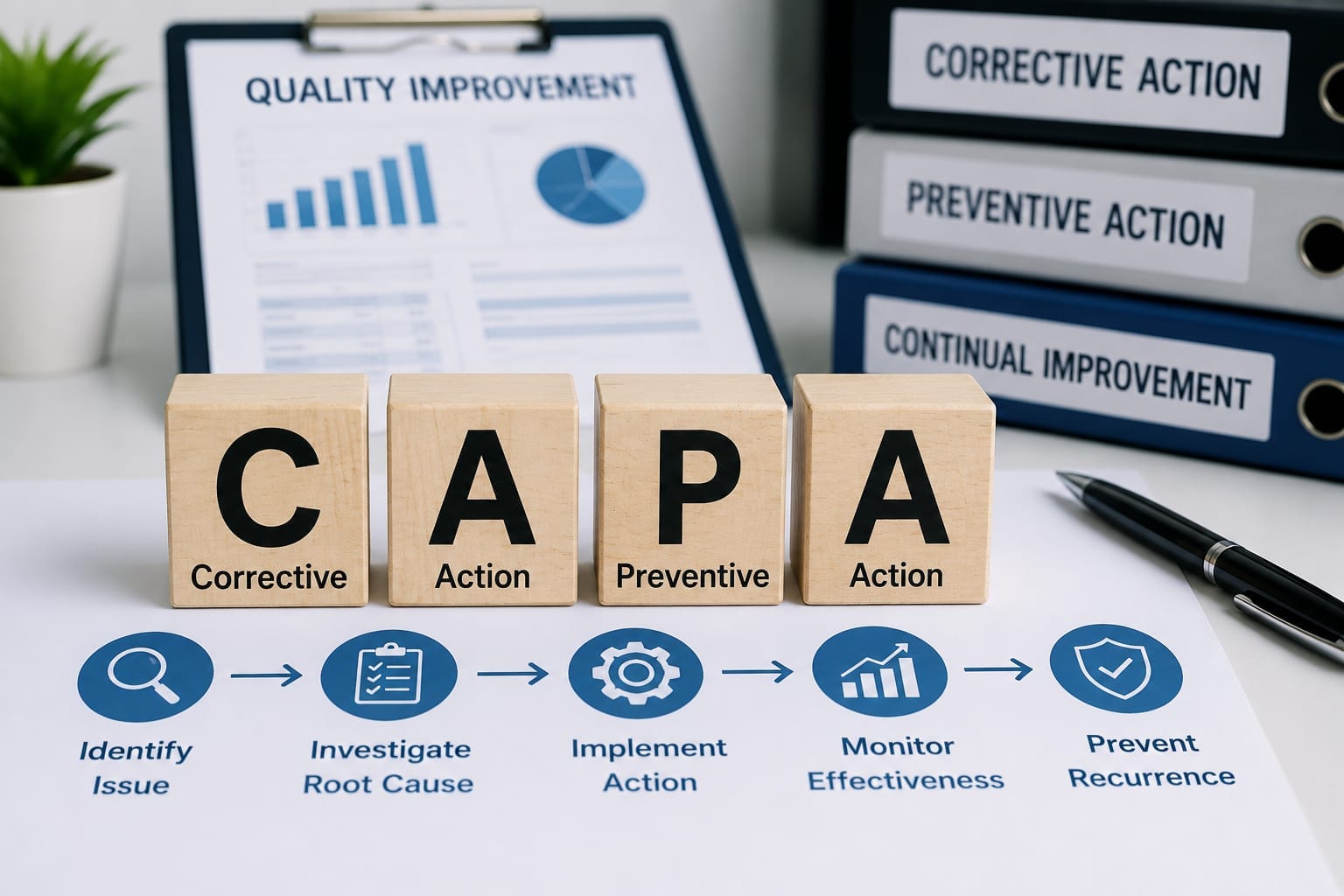
FDA 483 Observations on CAPA & CAPA Effectiveness: Why 42% of Warning Letters Quote This
Updated: April 21, 2026 | Category: QA & Compliance | Reading Time: 9 min
“Corrective and Preventive Action procedures are not adequate.”
If you’ve seen a USFDA 483, you’ve probably seen this line. From FY 2022-2025, “Inadequate CAPA” was the #2 most cited observation across pharma 483s, right after data integrity.
Here’s the problem: Most plants close CAPAs. Few plants prove CAPAs are effective. FDA doesn’t want closure. FDA wants proof that the problem won’t repeat.
This guide covers real 483 examples, root cause failures, and a 5-step formula to make your CAPAs audit-proof per 21 CFR 820.100 + ICH Q10.
1. What FDA Actually Wants from CAPA per 21 CFR 820.100
FDA’s CAPA requirement has 6 elements. Miss 1 = 483.
- Analyze processes + quality data to identify existing/potential causes
- Investigate nonconformities + root cause determination
- Identify + implement action to eliminate cause and prevent recurrence
- Verify/validate CAPA to ensure it’s effective and doesn’t cause new issues
- Implement + record changes in procedures, SOPs, specs
- Disseminate information for preventive action
FDA Logic: “Closing a CAPA is not the same as verifying effectiveness. Verification = objective evidence that recurrence rate dropped.” – FDA Investigator Manual
2. Top 5 FDA 483 Observations on CAPA 2024-2025
| 483 Wording | Real Meaning | How to Fix |
|---|---|---|
| “CAPA not effective” | Same deviation recurred after CAPA closure. No trend data shown. | Link CAPA to quality metrics. Show 6-month trend: deviation rate ↓ after CAPA. |
| “Root cause not determined” | Cause listed as “human error” or “procedural lapse” without 5-Why/FMEA. | Use 5-Why, Fishbone, or Fault Tree. “Human error” is never an acceptable root cause. |
| “CAPA lacked justification” | Action taken was retraining only, with no system change. | If system design caused error, change the system: poka-yoke, checklist, automation. |
| “No CAPA effectiveness check” | CAPA closed after implementation, no follow-up data collected. | Define metric + time: “Monitor OOS rate for 6 months post-CAPA. Target: <1%” |
| “CAPA overdue + not escalated” | CAPA open 180+ days. Management review never discussed it. | Set aging limit: 90 days. Escalate red CAPAs to monthly QMR. |
3. Why Most CAPAs Fail: 4 Silent Killers
- Symptom = Root Cause: Writing “operator forgot to sign” as root cause. FDA will ask “Why did operator forget?” Keep asking “why” 5 times.
- CAPA = Band-Aid: Retraining, memo, warning letter. If equipment design allows error, training won’t help. Fix the process, not the person.
- No Baseline Data: You can’t prove effectiveness without “before” data. Capture deviation rate, OOS%, complaint rate before CAPA starts.
- Effectiveness = Hope: “We believe it won’t happen again” is not evidence. FDA wants numbers: charts, trends, audit results for 6-12 months.
4. 5-Step Formula for Audit-Proof CAPA Effectiveness
Step 1: Define Measurable Problem
Bad: “Label mix-up occurred”
Good: “2 label mix-up events in 3 months. Target: 0 events for 6 months post-CAPA”
Step 2: Find True Root Cause
Use 5-Why + data. Example: Label mix-up → Similar labels stored together → No barcode scan → No physical segregation → SOP allowed it. Root cause = “SOP lacked segregation + no barcode verification”.
Step 3: Action That Fixes System
Not: “Retrain operator”
Yes: “Implement barcode scan at line clearance + physical segregation of look-alike labels + update SOP v4.0”
Step 4: Verify Implementation
Objective evidence: training records, new SOP copy, barcode scanner validation, photos of new rack layout.
Step 5: Prove Effectiveness
Monitor metric for defined period. Example: “Track label errors monthly for 6 months. CAPA effective if 0 errors AND trend chart shows drop from 2/month to 0.”
5. FDA Expectations for CAPA Effectiveness Check
- Time period: Minimum 3-6 months data after CAPA implementation
- Metric: Must tie to original problem. If problem = OOS, metric = OOS rate. If problem = deviation, metric = deviation recurrence rate.
- Data source: Quality metrics dashboard, APR, complaint log, audit findings
- Decision rule: Pre-define “effective” vs “not effective”. Example: “Effective if recurrence rate <0.5% for 6 months”
- Documentation: Trend chart + conclusion + QA approval. Put this in CAPA closure section.
6. Key Takeaways Before Your Next FDA Inspection
- “Human error” is not a root cause. If you write it, FDA will write a 483.
- Retraining ≠ CAPA. If only action is training, FDA assumes you didn’t fix the system.
- Effectiveness needs data, not opinions. Show trend chart. “No recurrence in 6 months” beats “problem resolved”.
- Link CAPA to Quality Metrics. FDA now asks for metrics in first 2 hours of inspection per ICH Q10.
- Aging CAPAs = Red flag. >90 days open CAPA triggers FDA suspicion about management oversight.
Conclusion
CAPA is not paperwork. CAPA is your proof that GMP works. FDA’s 483 on CAPA effectiveness simply means: “You said you fixed it, but your data says you didn’t.”
Shift mindset from “close CAPA fast” to “prove CAPA works”. When FDA asks “How do you know it’s effective?”, hand them the trend chart, not the SOP.
Next read: How CAPA fits into FDA’s 6 Quality Systems → USFDA Inspection Systems Guide
Disclaimer
Content on Pharmashare.in is for educational purposes only. FDA regulations, 483 interpretations, and warning letter trends change frequently. This article does not replace official FDA guidance, 21 CFR regulations, or legal/regulatory advice. Companies must consult their QA and regulatory affairs teams and refer to current FDA.gov publications before inspection. Pharmashare.in is not liable for regulatory actions or inspection outcomes.

About the Author
Mahummed Asif is a pharmaceutical QA professional with 16 years experience in GMP, QMS, Product Complaint Management, Process validation, Change control, risk management, Deviation Management, CAPA & CAPA Effectiveness, and USFDA audit preparation.
1 thought on “483 Observations on CAPA and CAPA Effectiveness”