
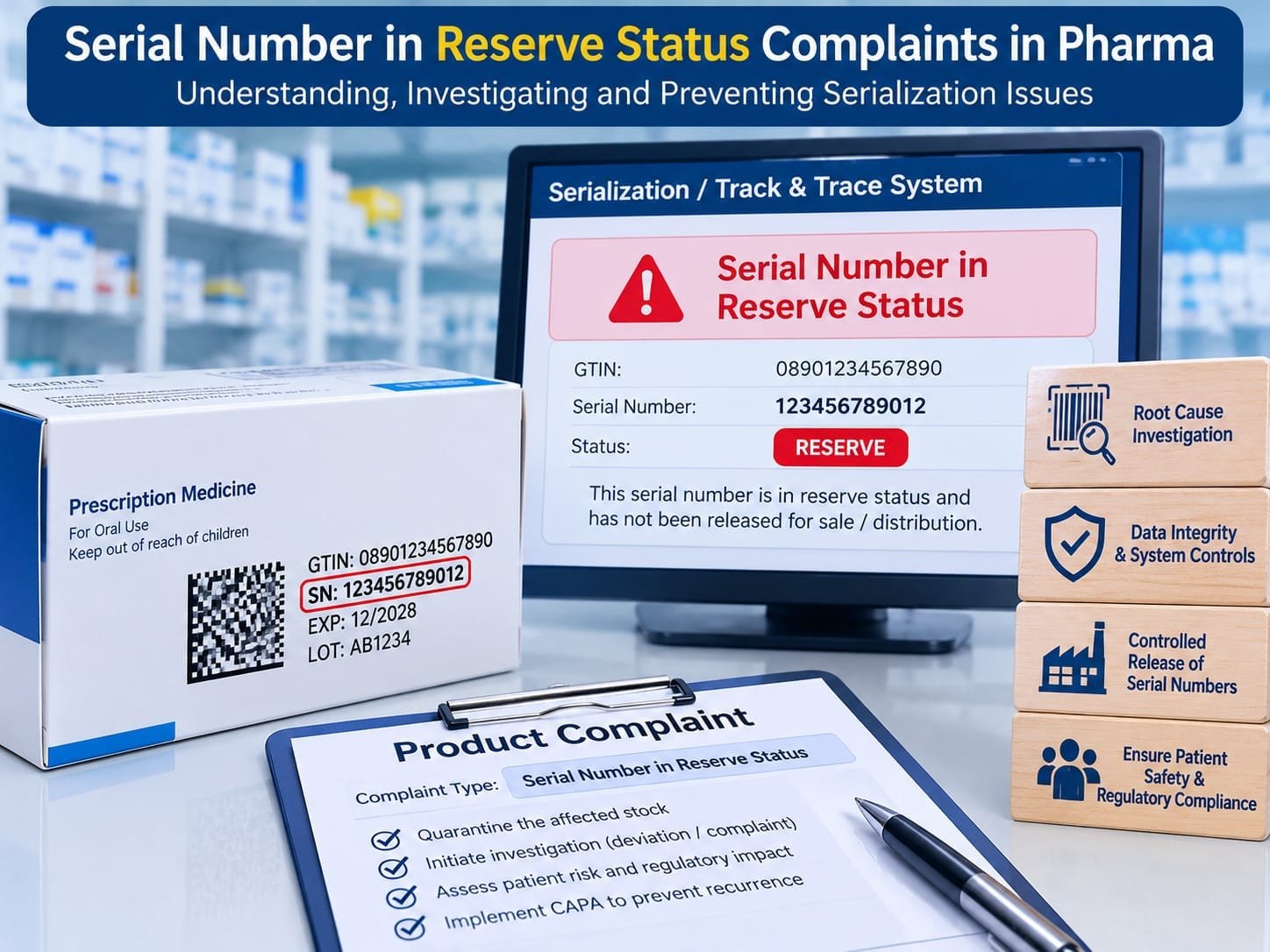
Serial Number in “Reserve” Status Complaints in Pharma: Complete Guide 2026
One of the most common customer complaints and regulatory observations in serialization today is: “Serial Number is in Reserve Status”.
For US DSCSA, EU FMD, India DAVA, and GCC markets, a pack cannot be dispensed if its serial number is not in “Active/Commissioned” state. If it’s stuck in “Reserve”, the pharmacy system will reject it. Result: Product recall, customer complaint, lost sales.
This blog explains what “Reserve” status means, why it happens, business impact, and GMP-compliant CAPA.
Assigning a unique identifier (GTIN + Serial No + Batch + Expiry) to each primary/secondary pack and uploading it to a central repository for traceability.
Serialization Levels in Pharma
- L1 – Device Level: Printer, Camera, Verifier
- L2 – Line Level: PLC, HMI integration
- L3 – Site Level: L4 Software, database
- L4 – Enterprise Level: ERP, SAP AII, TraceLink
- L5 – Network Level: Govt repository like US FDA, EMVO, DAVA
90% of issues happen at L2-L3 interface. Focus your validation there.
1. How Serialization Status Flow Works
Every serial number moves through states in the repository like FDA DSCSA, EMVO, or DAVA:
- Generated: SNo created in L4
- Reserve: SNo sent to L5 repository and reserved for a GTIN + Batch
- Commissioned/Active: Pack printed and confirmed. Ready for sale
- Decommissioned: Dispensed or destroyed
- Expired/Recalled: End of life
Complaint happens at Step 2: Pack reached market but SNo never moved from Reserve → Commissioned.
2. Top 8 Reasons Why Serial Numbers Stay in “Reserve” Status
Issue 1: Communication Failure Between L4 and L5
Root Cause: After printing, L4 did not get “ACK” from TraceLink/SAP AII/DAVA portal due to network timeout.
Result: L4 thinks it failed and keeps SNo in Reserve. Pack is shipped anyway.
Issue 2: Line Stop Before Commissioning Event
Root Cause: Operator stopped line after printing but before “commission” signal was sent. Power failure, E-stop.
Result: Physical pack exists, but system never commissioned it.
Issue 3: Wrong Job Setup / GTIN Mismatch
Root Cause: Wrong product recipe loaded. Serials reserved for GTIN-A but printed on GTIN-B.
Result: Repository rejects commissioning due to GTIN mismatch. SNo stays in Reserve.
Issue 4: Aggregation Breakage
Root Cause: Case/Pallet aggregation done, but child packs were never commissioned individually.
Result: When pharmacy scans pack, parent is Active but child is Reserve.
Issue 5: Manual Override / Rework
Root Cause: QA released reworked packs without re-commissioning. Or operator printed from “reprint” without L4 transaction.
Issue 6: Repository Delay or Reconciliation Error
Root Cause: Batch uploaded to L5 but stuck in “pending”. End-of-batch reconciliation not done.
Issue 7: Duplicate SNo Attempt
Root Cause: Same SNo tried to be commissioned twice. First time failed, second time blocked. First remains in Reserve.
Issue 8: Sample / Promo Packs Shipped
Root Cause: Packs taken from line for samples but never commissioned or properly decommissioned as “sample”.
3. Business & Regulatory Impact
| Impact Area | Consequence |
|---|---|
| Customer Complaint | Pharmacy cannot dispense. Product returned. Brand damage. |
| Regulatory | DSCSA violation: “Suspect Product”. FDA 483 observation. |
| Financial | Recall cost, rework, investigation cost |
| Supply Chain | Wholesaler blocks entire batch |
4. Investigation Steps for “Reserve Status” Complaint
Use this 5-step approach as per GMP:
- Verify Complaint: Check SNo in L5 repository. Confirm status = Reserve. Take screenshot.
- Batch Traceback: Find batch, line, date, shift from L4 reports. Check commissioning logs.
- Review L4-L5 Communication Log: Look for “Timeout”, “No ACK”, “Upload Failed” errors on that timestamp.
- Physical Reconciliation: Qty Printed vs Qty Commissioned vs Qty Shipped. Identify gap.
- Check for Similar Incidents: Is this isolated or line-wide issue?
5. CAPA and Preventive Actions
Immediate CAPA
- Quarantine remaining stock of that batch.
- Raise complaint to L5 vendor to force “Commission” the SNo if product is genuine.
- If not possible, initiate product recall for affected SNs.
Corrective Actions
- Network Redundancy: Add backup internet + local buffer in L4 for 72 hours.
- Force Line Stop: Configure PLC: “No Commission ACK = Line Stop”. No pack leaves without status = Active.
- End-of-Batch Report: Mandatory reconciliation: Printed = Commissioned = Shipped before batch release by QA.
Preventive Actions
- Daily Health Check: QA to review “Reserve SNo report” from L4 every shift.
- Operator Training: Do not override. Do not ship if HMI shows “Upload Pending”.
- CSV & Validation: Include network failure scenario in PQ. Test store-and-forward.
- Alert System: Auto-email to QA/IT if >10 SNs in Reserve for >1 hour.
Have SOP + trend report ready.
6. Role of QA, IT and Production
- Production: Ensure no shipment without “Green” commissioning status on HMI.
- QA: Review serialization data as part of batch release. Sign reconciliation.
- IT/Engineering: Monitor L4-L5 connectivity. Maintain DR plan.
- Regulatory: Define process for “exception handling” with L5 provider.
7. FAQs
Q1: Can we sell a product with Reserve SNo?
No. As per DSCSA/FMD, it will fail verification at pharmacy. It is considered “illegitimate product”.
Q2: How long can SNo stay in Reserve?
Depends on L5 provider. Usually 24-48 hours. After that it may auto-expire and need new SNo.
Q3: What is difference between Reserve and Commissioned?
Reserve = Reserved but not yet printed/activated. Commissioned = Printed on pack and active for sale.
Conclusion
“Serial Number in Reserve Status” is a preventable but high-risk complaint. It’s 90% a process and communication issue, not a technology issue.
Key to zero complaints: Right-first-time commissioning + real-time reconciliation + no shipment without Active status.
Treat serialization data with the same GMP rigor as batch manufacturing data.

About the Author
Mahummed Asif is a experienced pharmaceutical QA professional and publisher of Pharmashare. He has sound knowledge in GMP, Product Life Cycle Management, Regulatory filing, QMS, Product Complaint Management, Change control, risk management, and global audit preparation.