Serialization Issues in Pharma: Common Challenges, Root Causes & Solutions 2026
Serialization is no longer optional. From US DSCSA to EU FMD, India’s Pharma Traceability, and Brazil ANVISA — regulators worldwide now mandate unique serial numbers on every saleable pack.
But implementing serialization is where most pharma companies struggle. Line stoppages, rejected packs, rework, and regulatory observations are common.
This guide covers the top serialization issues in pharma, why they happen, and how to fix them with GMP-compliant solutions.
Assigning a unique identifier (GTIN + Serial No + Batch + Expiry) to each primary/secondary pack and uploading it to a central repository for traceability.
1. Why Serialization is Critical in 2026
- Regulatory Compliance: US DSCSA, EU FMD, India DAVA, GCC, Turkey, China
- Anti-Counterfeiting: Prevent fake medicines in supply chain
- Recall Efficiency: Trace 1 bad batch in hours instead of weeks
- Business Continuity: No serialization = No market access
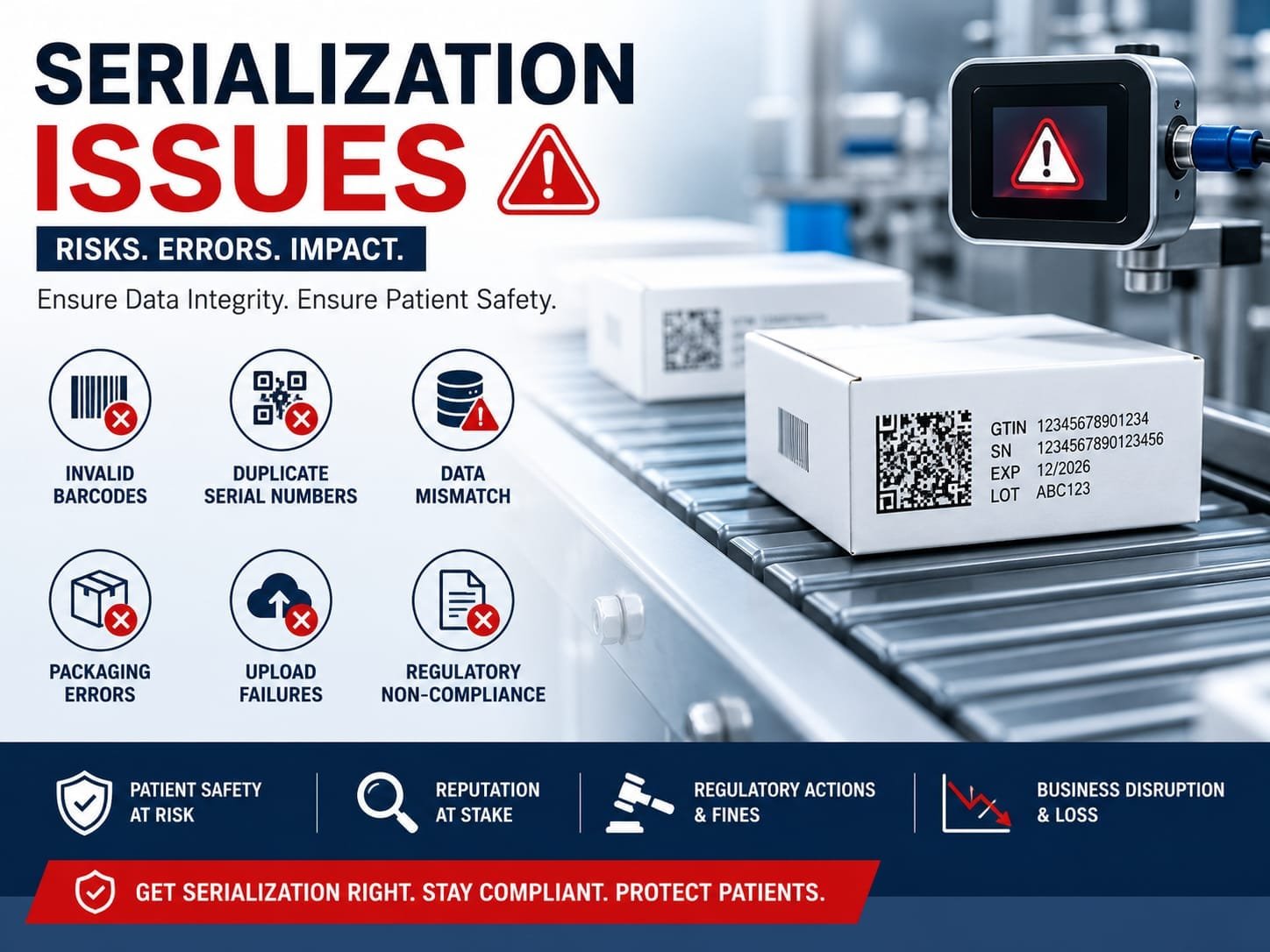
2. Top 12 Serialization Issues in Pharma & How to Solve Them
Issue 1: Line Integration & Equipment Compatibility
Problem: Old cartoning lines cannot handle cameras, inkjet printers, and conveyors. Leads to frequent jams.
Root Cause: No gap assessment before project kickoff.
Solution: Conduct L4-L5 integration study. Use modular printers. Validate line speed vs read rate.
Issue 2: Poor Print Quality / Code Read Failures
Problem: 2D datamatrix fails verification. Rejection rate >5%.
Root Cause: Wrong ink, glossy cartons, vibration, printhead misalignment.
Solution: Do print trials on actual material. Use ISO 15416 verification. Daily printhead cleaning SOP. Environmental control: 25°C ±5°C, RH <60%.
Issue 3: Aggregation Failures – Parent-Child Relationship
Problem: Bundle to case, case to pallet aggregation fails. “Orphan” packs.
Root Cause: Operator error, conveyor gap, wrong scanner placement.
Solution: Install tunnel scanners + presence sensors. Force “No Read = Line Stop”. Train operators on exception handling.
Issue 4: Duplicate Serial Numbers
Problem: Same SNo printed twice. Regulatory violation.
Root Cause: L4 system didn’t get ACK from repository. Operator reprinted job.
Solution: Use “reserve and commit” model. Lock job after first print. Audit trail in L4 software.
Issue 5: Network/Repository Downtime
Problem: Cannot connect to TraceLink, SAP AII, or Govt portal. Production stops.
Root Cause: Internet dependency, firewall issues.
Solution: Implement local buffer in L4. Store and forward. 24hr business continuity plan as per DSCSA.
Issue 6: Data Upload Failures & Reconciliation Mismatch
Problem: Physical packs = 10,000 but uploaded = 9,985. Variance.
Root Cause: Rejects not accounted, communication loss.
Solution: End-of-batch reconciliation SOP. Use “pack → reject → destroy” workflow in software.
Issue 7: Changeover & Job Setup Errors
Problem: Wrong GTIN printed for next SKU. Whole batch rejected.
Root Cause: Manual job selection, no barcode on job card.
Solution: Recipe management in L4. Barcode scanning of job card to load recipe. Second person check.
Issue 8: Validation & CSV Challenges
Problem: 21 CFR Part 11, Annex 11 audit observations on audit trail, user access.
Root Cause: Treating serialization software as “plug and play”.
Solution: Full CSV: URS, DQ, IQ, OQ, PQ. Role-based access. Electronic signature. Regular audit trail review.
Issue 9: Training & Human Errors
Problem: Operator overrides reject, disables camera to meet targets.
Root Cause: KPI pressure + lack of understanding.
Solution: Competency-based training. Make serialization KPI separate from line efficiency. Management commitment.
Issue 10: Multi-Market / Multi-Format Complexity
Problem: Same product for EU, US, India needs 3 different code formats.
Root Cause: No centralized L4 design.
Solution: Use “market module” in L4. One golden batch record, different print templates.
Issue 11: Returns & Decommissioning Issues
Problem: Hospital returns pack but cannot decommission because already sold.
Root Cause: No process for reverse logistics.
Solution: Define SOP for returns, samples, destruction. Use “commissioning at pack” not “at shipment”.
Issue 12: Cost & OEE Impact
Problem: Line OEE dropped from 75% to 55% after serialization.
Root Cause: Treating serialization as compliance, not process improvement.
Solution: SMED for changeover, predictive maintenance, continuous improvement. Track “serialization OEE” separately.
3. Regulatory Expectations During Inspection
| Inspector Will Ask | What You Must Show |
|---|---|
| How do you prevent duplicate SNo? | L4 software logic + audit trail |
| What if network fails? | Business continuity SOP + buffer data |
| How are rejects handled? | Physical + system reconciliation |
| Show CSV documents | URS to PQ + Validation Summary |
4. Best Practices to Avoid Serialization Issues
- Start Early: 12-18 months before regulatory deadline
- Cross-Functional Team: QA, Engineering, IT, Supply Chain, Regulatory
- Material Qualification: Test carton, label, ink before finalizing
- Golden Samples: Keep verified good code samples at line
- Daily Line Checks: Vision system calibration, verifier check, printer nozzle check
- Data Integrity: ALCOA+ principles for all serialization data
- Mock Recalls: Test traceability every 6 months
5. Serialization Levels in Pharma
- L1 – Device Level: Printer, Camera, Verifier
- L2 – Line Level: PLC, HMI integration
- L3 – Site Level: L4 Software, database
- L4 – Enterprise Level: ERP, SAP AII, TraceLink
- L5 – Network Level: Govt repository like US FDA, EMVO, DAVA
90% of issues happen at L2-L3 interface. Focus your validation there.
Conclusion
Serialization is not just about printing a code. It’s about process control, data integrity, and supply chain transparency.
The companies that succeed treat serialization as a manufacturing science problem, not just an IT project.
Identify issues early, validate properly, train people well, and you can run serialization at >95% OEE with zero compliance risk.

About the Author
Mahummed Asif is a experienced pharmaceutical QA professional and publisher of Pharmashare. He has sound knowledge in GMP, Product Life Cycle Management, Regulatory filing, QMS, Product Complaint Management, Change control, risk management, and global audit preparation.